SUBSCRIBE TO OUR FREE NEWSLETTER
Daily news & progressive opinion—funded by the people, not the corporations—delivered straight to your inbox.
5
#000000
#FFFFFF
To donate by check, phone, or other method, see our More Ways to Give page.
Daily news & progressive opinion—funded by the people, not the corporations—delivered straight to your inbox.
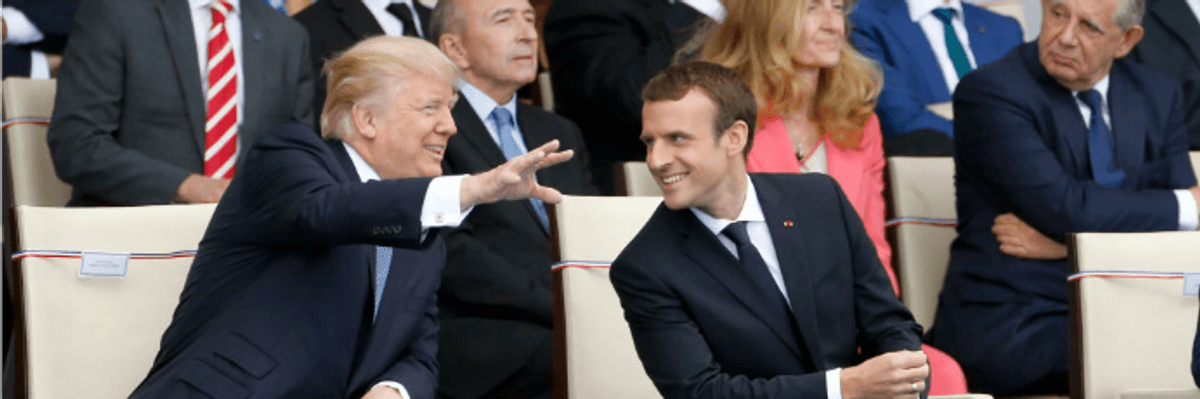
U.S. President Donald Trump and French President Emmanuel Macron attend the traditional Bastille Day military parade on the Champs-Elysees on July 14, 2017 in Paris, France. (Photo: Thierry Chesnot/Getty Images)
Citing France's Bastille Day celebration in July--a "dramatic show of pageantry" featuring thousands of French troops and dozens of military jets--U.S. President Donald Trump on Monday suggested that he would like the United States to put on a massive display of "military might" on Independence Day, a proposal commentators immediately portrayed as evidence of Trump's affinity for authoritarian displays of force.
"Strong countries don't do that. Only weak, insecure leaders feel the need to... oh crap. That's us now, isn't it?"
--Nicholas Grossman"What's next, giant portraits and murals of the Dear Leader everywhere?" asked Garry Kasparov, chairman of the Human Rights Foundation.
French President Emmanuel Macron laughed when Trump expressed his desire to "top" France's military festivities during a meeting at the United Nations General Assembly in New York, but the U.S. president appeared to be quite serious about wanting to put on "a really great parade to show [the U.S.'s] military strength." The parade, Trump suggested, would march down Pennsylvania Avenue.
"I think we're looking forward to doing that," Trump said. "I'm speaking with [retired general and Chief of Staff John Kelly] and with all of the people involved."
Watch Trump's remarks:
Trump has long expressed his love for military spectacles--and his desire to put on such a show with his name attached to it.
As the New York Times notes, Trump's inaugural committee considered "the idea of highlighting military equipment in his inaugural parade."
"That military may come marching down Pennsylvania Avenue," Trump said ahead of his inauguration.
Many mocked Trump's proposal on Monday, which came just ahead of his speech at the U.N. General Assembly, where the president threatened to "totally destroy" North Korea if the nation's leader Kim Jong-un--who Trump has taken to calling "rocket man"--continues to threaten the United States.
Dear Common Dreams reader, It’s been nearly 30 years since I co-founded Common Dreams with my late wife, Lina Newhouser. We had the radical notion that journalism should serve the public good, not corporate profits. It was clear to us from the outset what it would take to build such a project. No paid advertisements. No corporate sponsors. No millionaire publisher telling us what to think or do. Many people said we wouldn't last a year, but we proved those doubters wrong. Together with a tremendous team of journalists and dedicated staff, we built an independent media outlet free from the constraints of profits and corporate control. Our mission has always been simple: To inform. To inspire. To ignite change for the common good. Building Common Dreams was not easy. Our survival was never guaranteed. When you take on the most powerful forces—Wall Street greed, fossil fuel industry destruction, Big Tech lobbyists, and uber-rich oligarchs who have spent billions upon billions rigging the economy and democracy in their favor—the only bulwark you have is supporters who believe in your work. But here’s the urgent message from me today. It's never been this bad out there. And it's never been this hard to keep us going. At the very moment Common Dreams is most needed, the threats we face are intensifying. We need your support now more than ever. We don't accept corporate advertising and never will. We don't have a paywall because we don't think people should be blocked from critical news based on their ability to pay. Everything we do is funded by the donations of readers like you. When everyone does the little they can afford, we are strong. But if that support retreats or dries up, so do we. Will you donate now to make sure Common Dreams not only survives but thrives? —Craig Brown, Co-founder |
Citing France's Bastille Day celebration in July--a "dramatic show of pageantry" featuring thousands of French troops and dozens of military jets--U.S. President Donald Trump on Monday suggested that he would like the United States to put on a massive display of "military might" on Independence Day, a proposal commentators immediately portrayed as evidence of Trump's affinity for authoritarian displays of force.
"Strong countries don't do that. Only weak, insecure leaders feel the need to... oh crap. That's us now, isn't it?"
--Nicholas Grossman"What's next, giant portraits and murals of the Dear Leader everywhere?" asked Garry Kasparov, chairman of the Human Rights Foundation.
French President Emmanuel Macron laughed when Trump expressed his desire to "top" France's military festivities during a meeting at the United Nations General Assembly in New York, but the U.S. president appeared to be quite serious about wanting to put on "a really great parade to show [the U.S.'s] military strength." The parade, Trump suggested, would march down Pennsylvania Avenue.
"I think we're looking forward to doing that," Trump said. "I'm speaking with [retired general and Chief of Staff John Kelly] and with all of the people involved."
Watch Trump's remarks:
Trump has long expressed his love for military spectacles--and his desire to put on such a show with his name attached to it.
As the New York Times notes, Trump's inaugural committee considered "the idea of highlighting military equipment in his inaugural parade."
"That military may come marching down Pennsylvania Avenue," Trump said ahead of his inauguration.
Many mocked Trump's proposal on Monday, which came just ahead of his speech at the U.N. General Assembly, where the president threatened to "totally destroy" North Korea if the nation's leader Kim Jong-un--who Trump has taken to calling "rocket man"--continues to threaten the United States.
Citing France's Bastille Day celebration in July--a "dramatic show of pageantry" featuring thousands of French troops and dozens of military jets--U.S. President Donald Trump on Monday suggested that he would like the United States to put on a massive display of "military might" on Independence Day, a proposal commentators immediately portrayed as evidence of Trump's affinity for authoritarian displays of force.
"Strong countries don't do that. Only weak, insecure leaders feel the need to... oh crap. That's us now, isn't it?"
--Nicholas Grossman"What's next, giant portraits and murals of the Dear Leader everywhere?" asked Garry Kasparov, chairman of the Human Rights Foundation.
French President Emmanuel Macron laughed when Trump expressed his desire to "top" France's military festivities during a meeting at the United Nations General Assembly in New York, but the U.S. president appeared to be quite serious about wanting to put on "a really great parade to show [the U.S.'s] military strength." The parade, Trump suggested, would march down Pennsylvania Avenue.
"I think we're looking forward to doing that," Trump said. "I'm speaking with [retired general and Chief of Staff John Kelly] and with all of the people involved."
Watch Trump's remarks:
Trump has long expressed his love for military spectacles--and his desire to put on such a show with his name attached to it.
As the New York Times notes, Trump's inaugural committee considered "the idea of highlighting military equipment in his inaugural parade."
"That military may come marching down Pennsylvania Avenue," Trump said ahead of his inauguration.
Many mocked Trump's proposal on Monday, which came just ahead of his speech at the U.N. General Assembly, where the president threatened to "totally destroy" North Korea if the nation's leader Kim Jong-un--who Trump has taken to calling "rocket man"--continues to threaten the United States.