SUBSCRIBE TO OUR FREE NEWSLETTER
Daily news & progressive opinion—funded by the people, not the corporations—delivered straight to your inbox.
5
#000000
#FFFFFF
To donate by check, phone, or other method, see our More Ways to Give page.
Daily news & progressive opinion—funded by the people, not the corporations—delivered straight to your inbox.
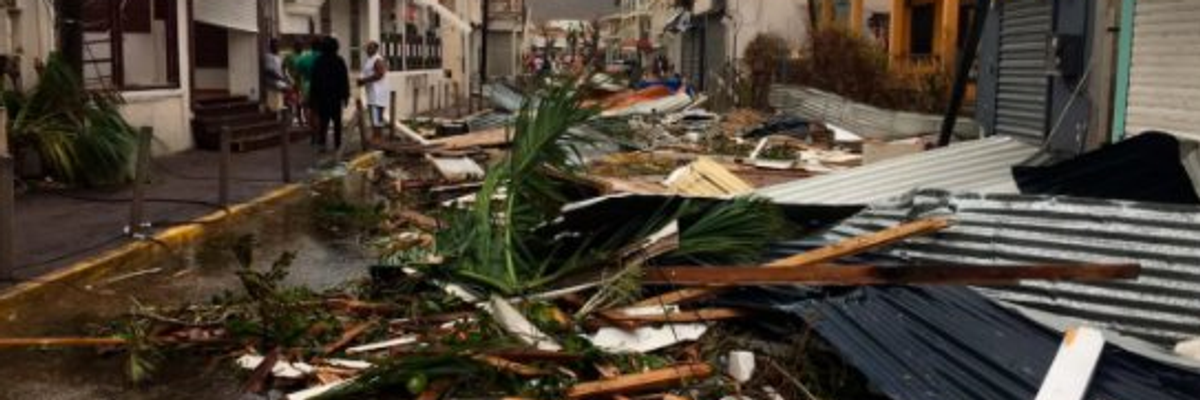
As the Dutch announced it would send more troops to St. Martin this week following Hurricane Irma, the response seemed focused on "restoring order" amid reports of "looting," which emerged as the island experienced a food shortage. (Photo: @Telegraph/Twitter)
As much of the media's attention shifted to Hurricane Irma's impact on Florida, the affected Caribbean islands were left cut off from aid in recent days as officials assessed the storm's damage. The region's isolation gave way to desperation as residents scavenged for food and drinking water--leading to media reports of "looting." But critics questioned the characterization of the chaos that's broken out on the islands, highlighting the difference between looting and survival.
St. Martin experienced some of the worst damage last week, with Irma reportedly leveling 95 percent of the island's structures. The island, a territory of the Dutch and the French, experienced a severe food and water shortage after the storm, with businesses reportedly gouging prices on necessities; the Wall Street Journal interviewed two American vacationers who paid $150 for Gatorade and water in the wake of the hurricane.
For most St. Martin residents, such prices are out of the question. The New York Times reported that people searched for necessities at grocery stores over the weekend, with fights eventually breaking out amid the food shortage. A 63-year-old resident told the Times, "All the food is gone now. People are fighting in the streets for what is left."
"Some people steal luxury things and booze, but a lot of people are stealing water and biscuits," said Paul De Windt, a newspaper publisher in St. Martin, to the Times.
The Dutch and French said they would send more troops to join the 265 military personnel that were already stationed in St. Martin, but the response seemed aimed largely at stopping the so-called "looting."
"We need to restore public order to Saint-Martin," said Annick Girardin, minister of France's overseas territories, in a BBC report. "I was out this morning and this afternoon and there was looting right there in front of my eyes. There is a strange mood at the moment in Saint-Martin, so we need to think about public order."
But many rejected the characterization of post-disaster survival as "looting."
In an interview with the Washington Post last week, retired Army Lieutenant General Russel Honore questioned reports of looting in Houston after Hurricane Harvey, speaking from his experience of overseeing military relief efforts in Houston and after Hurricane Katrina in New Orleans in 2005.
"There's no doubt that on any given day, there are people who are going to steal other people's stuff," said Honore. "But what we see after these storms is a greatly over-exaggerated concern...That's not looting, that's survival mode."
Critics on social media agreed:
Also, when there is a hurricane/disaster, that is not looting! Stores are corporate entities that can write off the loss. Survival first. pic.twitter.com/1qTuK8mcug
-- Tia Oso (@Tia_Oso) September 8, 2017
Setting an example of neighborliness and compassion, one owner of a diving supply business located on Virgin Gorda (VG) in the British Virgin Islands--where the UK government faced criticism for its slow response to the storm and its failure to set up contingency plans before Irma hit--asked those trapped on the island to help those in need and urged anyone who might be in need to help themselves to items that might be found at the shop.
"If you DO get a call from anyone in VG - our shop there might have clothes and shelter in Leverick Bay," said the owner of Dive BVI on Facebook. "I know some looting has started as people are desperate to find resources. Take anything we have left if it helps you get through this time."
Dear Common Dreams reader, It’s been nearly 30 years since I co-founded Common Dreams with my late wife, Lina Newhouser. We had the radical notion that journalism should serve the public good, not corporate profits. It was clear to us from the outset what it would take to build such a project. No paid advertisements. No corporate sponsors. No millionaire publisher telling us what to think or do. Many people said we wouldn't last a year, but we proved those doubters wrong. Together with a tremendous team of journalists and dedicated staff, we built an independent media outlet free from the constraints of profits and corporate control. Our mission has always been simple: To inform. To inspire. To ignite change for the common good. Building Common Dreams was not easy. Our survival was never guaranteed. When you take on the most powerful forces—Wall Street greed, fossil fuel industry destruction, Big Tech lobbyists, and uber-rich oligarchs who have spent billions upon billions rigging the economy and democracy in their favor—the only bulwark you have is supporters who believe in your work. But here’s the urgent message from me today. It's never been this bad out there. And it's never been this hard to keep us going. At the very moment Common Dreams is most needed, the threats we face are intensifying. We need your support now more than ever. We don't accept corporate advertising and never will. We don't have a paywall because we don't think people should be blocked from critical news based on their ability to pay. Everything we do is funded by the donations of readers like you. When everyone does the little they can afford, we are strong. But if that support retreats or dries up, so do we. Will you donate now to make sure Common Dreams not only survives but thrives? —Craig Brown, Co-founder |
As much of the media's attention shifted to Hurricane Irma's impact on Florida, the affected Caribbean islands were left cut off from aid in recent days as officials assessed the storm's damage. The region's isolation gave way to desperation as residents scavenged for food and drinking water--leading to media reports of "looting." But critics questioned the characterization of the chaos that's broken out on the islands, highlighting the difference between looting and survival.
St. Martin experienced some of the worst damage last week, with Irma reportedly leveling 95 percent of the island's structures. The island, a territory of the Dutch and the French, experienced a severe food and water shortage after the storm, with businesses reportedly gouging prices on necessities; the Wall Street Journal interviewed two American vacationers who paid $150 for Gatorade and water in the wake of the hurricane.
For most St. Martin residents, such prices are out of the question. The New York Times reported that people searched for necessities at grocery stores over the weekend, with fights eventually breaking out amid the food shortage. A 63-year-old resident told the Times, "All the food is gone now. People are fighting in the streets for what is left."
"Some people steal luxury things and booze, but a lot of people are stealing water and biscuits," said Paul De Windt, a newspaper publisher in St. Martin, to the Times.
The Dutch and French said they would send more troops to join the 265 military personnel that were already stationed in St. Martin, but the response seemed aimed largely at stopping the so-called "looting."
"We need to restore public order to Saint-Martin," said Annick Girardin, minister of France's overseas territories, in a BBC report. "I was out this morning and this afternoon and there was looting right there in front of my eyes. There is a strange mood at the moment in Saint-Martin, so we need to think about public order."
But many rejected the characterization of post-disaster survival as "looting."
In an interview with the Washington Post last week, retired Army Lieutenant General Russel Honore questioned reports of looting in Houston after Hurricane Harvey, speaking from his experience of overseeing military relief efforts in Houston and after Hurricane Katrina in New Orleans in 2005.
"There's no doubt that on any given day, there are people who are going to steal other people's stuff," said Honore. "But what we see after these storms is a greatly over-exaggerated concern...That's not looting, that's survival mode."
Critics on social media agreed:
Also, when there is a hurricane/disaster, that is not looting! Stores are corporate entities that can write off the loss. Survival first. pic.twitter.com/1qTuK8mcug
-- Tia Oso (@Tia_Oso) September 8, 2017
Setting an example of neighborliness and compassion, one owner of a diving supply business located on Virgin Gorda (VG) in the British Virgin Islands--where the UK government faced criticism for its slow response to the storm and its failure to set up contingency plans before Irma hit--asked those trapped on the island to help those in need and urged anyone who might be in need to help themselves to items that might be found at the shop.
"If you DO get a call from anyone in VG - our shop there might have clothes and shelter in Leverick Bay," said the owner of Dive BVI on Facebook. "I know some looting has started as people are desperate to find resources. Take anything we have left if it helps you get through this time."
As much of the media's attention shifted to Hurricane Irma's impact on Florida, the affected Caribbean islands were left cut off from aid in recent days as officials assessed the storm's damage. The region's isolation gave way to desperation as residents scavenged for food and drinking water--leading to media reports of "looting." But critics questioned the characterization of the chaos that's broken out on the islands, highlighting the difference between looting and survival.
St. Martin experienced some of the worst damage last week, with Irma reportedly leveling 95 percent of the island's structures. The island, a territory of the Dutch and the French, experienced a severe food and water shortage after the storm, with businesses reportedly gouging prices on necessities; the Wall Street Journal interviewed two American vacationers who paid $150 for Gatorade and water in the wake of the hurricane.
For most St. Martin residents, such prices are out of the question. The New York Times reported that people searched for necessities at grocery stores over the weekend, with fights eventually breaking out amid the food shortage. A 63-year-old resident told the Times, "All the food is gone now. People are fighting in the streets for what is left."
"Some people steal luxury things and booze, but a lot of people are stealing water and biscuits," said Paul De Windt, a newspaper publisher in St. Martin, to the Times.
The Dutch and French said they would send more troops to join the 265 military personnel that were already stationed in St. Martin, but the response seemed aimed largely at stopping the so-called "looting."
"We need to restore public order to Saint-Martin," said Annick Girardin, minister of France's overseas territories, in a BBC report. "I was out this morning and this afternoon and there was looting right there in front of my eyes. There is a strange mood at the moment in Saint-Martin, so we need to think about public order."
But many rejected the characterization of post-disaster survival as "looting."
In an interview with the Washington Post last week, retired Army Lieutenant General Russel Honore questioned reports of looting in Houston after Hurricane Harvey, speaking from his experience of overseeing military relief efforts in Houston and after Hurricane Katrina in New Orleans in 2005.
"There's no doubt that on any given day, there are people who are going to steal other people's stuff," said Honore. "But what we see after these storms is a greatly over-exaggerated concern...That's not looting, that's survival mode."
Critics on social media agreed:
Also, when there is a hurricane/disaster, that is not looting! Stores are corporate entities that can write off the loss. Survival first. pic.twitter.com/1qTuK8mcug
-- Tia Oso (@Tia_Oso) September 8, 2017
Setting an example of neighborliness and compassion, one owner of a diving supply business located on Virgin Gorda (VG) in the British Virgin Islands--where the UK government faced criticism for its slow response to the storm and its failure to set up contingency plans before Irma hit--asked those trapped on the island to help those in need and urged anyone who might be in need to help themselves to items that might be found at the shop.
"If you DO get a call from anyone in VG - our shop there might have clothes and shelter in Leverick Bay," said the owner of Dive BVI on Facebook. "I know some looting has started as people are desperate to find resources. Take anything we have left if it helps you get through this time."