

SUBSCRIBE TO OUR FREE NEWSLETTER
Daily news & progressive opinion—funded by the people, not the corporations—delivered straight to your inbox.
5
#000000
#FFFFFF
To donate by check, phone, or other method, see our More Ways to Give page.
Daily news & progressive opinion—funded by the people, not the corporations—delivered straight to your inbox.
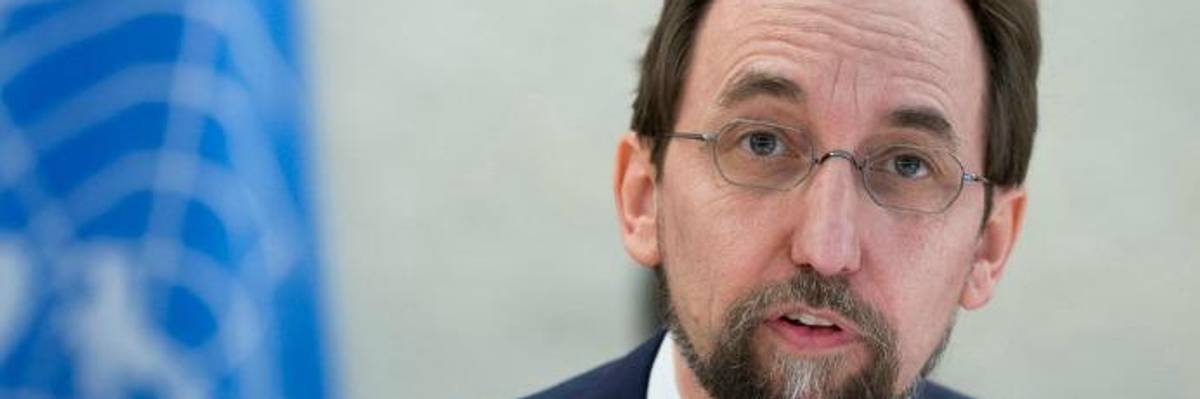
U.N. High Commissioner for Human Rights Zeid Ra'ad Al Hussein condemned Donald Trump's treatment of the news media, saying in Geneva on Wednesday that U.S. press freedom is "under attack from the president." (Photo: Jean-Marc Ferre/United Nations)
The United Nations human rights chief said on Wednesday that U.S. President Donald Trump's frequent disparagement of reporters and news outlets threatens press freedom in the United States, and could incite violence against journalists.
"To call these news organizations 'fake' does tremendous damage, and to refer to individual journalists...is this not an incitement for others to attack journalists?"
--Zeid Ra'ad Al Hussein, U.N. High Commissioner for Human Rights
"It's really quite amazing when you think that freedom of the press, not only sort of a cornerstone of the U.S. Constitution but very much something that the United States defended over the years is now itself under attack from the president," said Zeid Ra'ad Al Hussein, the U.N. High Commissioner for Human Rights, at a news conference in Geneva.
Pointing to Trump's denouncements of CNN, the New York Times, and the Washington Post, Zeid said: "To call these news organizations 'fake' does tremendous damage, and to refer to individual journalists in this way, I have to ask the question is this not an incitement for others to attack journalists?"
Zeid also criticized Trump's running commentary on women, Mexicans, and Muslims, as well as his decisions late last week to reinstate a ban on transgender individuals enlisting in the military, and to pardon former sheriff Joe Arpaio, who was convicted of racially profiling Latinos in Arizona.
"I almost feel that the president is driving the bus of humanity, and we're careening down a mountain path," Zeid concluded, comparing the role of the U.S. president to that of a bus driver, "and in taking these measures, at least from a human rights perspective, it seems to be reckless driving."
Even before Trump took office, he had a contentious relationship with much of the news media, and began deploying the term "fake news" to refer to publications and networks that report any criticism or negative reactions to his policies and actions. In public addresses and online, the president often attacks the media outlets Zeid mentioned, as well as the three major broadcast news networks:
In response to the growing animosity toward journalists, bolstered by Trump's never-ending "fake news" charges, the Committee to Protect Journalists (CPJ), the Freedom of the Press Foundation, and several other groups partnered to develop a new website to track threats to press freedom in the United States, as Common Dreams previously reported.
The U.S. Press Freedom Tracker--which tracks physical attacks and arrests of reporters, equipment searches and seizures, prosecutions for legally sharing information (denounced as "leaks" by the Trump administration), and other threats to the free press--has documented at least 20 arrests and 16 assaults of U.S.-based journalists so far this year.
One such assault occurred in May, when U.S. Rep. Greg Gianforte--then a Republican nominee in a special congressional race in Montana--body-slammed Guardian reporter Ben Jacobs, who was trying to interview him on the eve of the election. Gianforte's campaign initially tried to blame Jacobs, but after Gianforte won, he publicly apologized and donated $50,000 to the CPJ, which invested the money into the press freedom tracker project.
And as the press freedom tracker shows, the attacks--physical and otherwise--continue. Shortly after the tracker launched, Attorney General Jeff Sessions announced a crackdown on government officials who disclose sensitive and classified information to the press, as well as news organizations that publish such disclosures. As Common Dreams reported, among reporters, press freedom groups, and civil libertarians, Sessions' declared "war on leaks" was seen as "a direct attack on the First Amendment."
Dear Common Dreams reader, It’s been nearly 30 years since I co-founded Common Dreams with my late wife, Lina Newhouser. We had the radical notion that journalism should serve the public good, not corporate profits. It was clear to us from the outset what it would take to build such a project. No paid advertisements. No corporate sponsors. No millionaire publisher telling us what to think or do. Many people said we wouldn't last a year, but we proved those doubters wrong. Together with a tremendous team of journalists and dedicated staff, we built an independent media outlet free from the constraints of profits and corporate control. Our mission has always been simple: To inform. To inspire. To ignite change for the common good. Building Common Dreams was not easy. Our survival was never guaranteed. When you take on the most powerful forces—Wall Street greed, fossil fuel industry destruction, Big Tech lobbyists, and uber-rich oligarchs who have spent billions upon billions rigging the economy and democracy in their favor—the only bulwark you have is supporters who believe in your work. But here’s the urgent message from me today. It's never been this bad out there. And it's never been this hard to keep us going. At the very moment Common Dreams is most needed, the threats we face are intensifying. We need your support now more than ever. We don't accept corporate advertising and never will. We don't have a paywall because we don't think people should be blocked from critical news based on their ability to pay. Everything we do is funded by the donations of readers like you. When everyone does the little they can afford, we are strong. But if that support retreats or dries up, so do we. Will you donate now to make sure Common Dreams not only survives but thrives? —Craig Brown, Co-founder |
The United Nations human rights chief said on Wednesday that U.S. President Donald Trump's frequent disparagement of reporters and news outlets threatens press freedom in the United States, and could incite violence against journalists.
"To call these news organizations 'fake' does tremendous damage, and to refer to individual journalists...is this not an incitement for others to attack journalists?"
--Zeid Ra'ad Al Hussein, U.N. High Commissioner for Human Rights
"It's really quite amazing when you think that freedom of the press, not only sort of a cornerstone of the U.S. Constitution but very much something that the United States defended over the years is now itself under attack from the president," said Zeid Ra'ad Al Hussein, the U.N. High Commissioner for Human Rights, at a news conference in Geneva.
Pointing to Trump's denouncements of CNN, the New York Times, and the Washington Post, Zeid said: "To call these news organizations 'fake' does tremendous damage, and to refer to individual journalists in this way, I have to ask the question is this not an incitement for others to attack journalists?"
Zeid also criticized Trump's running commentary on women, Mexicans, and Muslims, as well as his decisions late last week to reinstate a ban on transgender individuals enlisting in the military, and to pardon former sheriff Joe Arpaio, who was convicted of racially profiling Latinos in Arizona.
"I almost feel that the president is driving the bus of humanity, and we're careening down a mountain path," Zeid concluded, comparing the role of the U.S. president to that of a bus driver, "and in taking these measures, at least from a human rights perspective, it seems to be reckless driving."
Even before Trump took office, he had a contentious relationship with much of the news media, and began deploying the term "fake news" to refer to publications and networks that report any criticism or negative reactions to his policies and actions. In public addresses and online, the president often attacks the media outlets Zeid mentioned, as well as the three major broadcast news networks:
In response to the growing animosity toward journalists, bolstered by Trump's never-ending "fake news" charges, the Committee to Protect Journalists (CPJ), the Freedom of the Press Foundation, and several other groups partnered to develop a new website to track threats to press freedom in the United States, as Common Dreams previously reported.
The U.S. Press Freedom Tracker--which tracks physical attacks and arrests of reporters, equipment searches and seizures, prosecutions for legally sharing information (denounced as "leaks" by the Trump administration), and other threats to the free press--has documented at least 20 arrests and 16 assaults of U.S.-based journalists so far this year.
One such assault occurred in May, when U.S. Rep. Greg Gianforte--then a Republican nominee in a special congressional race in Montana--body-slammed Guardian reporter Ben Jacobs, who was trying to interview him on the eve of the election. Gianforte's campaign initially tried to blame Jacobs, but after Gianforte won, he publicly apologized and donated $50,000 to the CPJ, which invested the money into the press freedom tracker project.
And as the press freedom tracker shows, the attacks--physical and otherwise--continue. Shortly after the tracker launched, Attorney General Jeff Sessions announced a crackdown on government officials who disclose sensitive and classified information to the press, as well as news organizations that publish such disclosures. As Common Dreams reported, among reporters, press freedom groups, and civil libertarians, Sessions' declared "war on leaks" was seen as "a direct attack on the First Amendment."
The United Nations human rights chief said on Wednesday that U.S. President Donald Trump's frequent disparagement of reporters and news outlets threatens press freedom in the United States, and could incite violence against journalists.
"To call these news organizations 'fake' does tremendous damage, and to refer to individual journalists...is this not an incitement for others to attack journalists?"
--Zeid Ra'ad Al Hussein, U.N. High Commissioner for Human Rights
"It's really quite amazing when you think that freedom of the press, not only sort of a cornerstone of the U.S. Constitution but very much something that the United States defended over the years is now itself under attack from the president," said Zeid Ra'ad Al Hussein, the U.N. High Commissioner for Human Rights, at a news conference in Geneva.
Pointing to Trump's denouncements of CNN, the New York Times, and the Washington Post, Zeid said: "To call these news organizations 'fake' does tremendous damage, and to refer to individual journalists in this way, I have to ask the question is this not an incitement for others to attack journalists?"
Zeid also criticized Trump's running commentary on women, Mexicans, and Muslims, as well as his decisions late last week to reinstate a ban on transgender individuals enlisting in the military, and to pardon former sheriff Joe Arpaio, who was convicted of racially profiling Latinos in Arizona.
"I almost feel that the president is driving the bus of humanity, and we're careening down a mountain path," Zeid concluded, comparing the role of the U.S. president to that of a bus driver, "and in taking these measures, at least from a human rights perspective, it seems to be reckless driving."
Even before Trump took office, he had a contentious relationship with much of the news media, and began deploying the term "fake news" to refer to publications and networks that report any criticism or negative reactions to his policies and actions. In public addresses and online, the president often attacks the media outlets Zeid mentioned, as well as the three major broadcast news networks:
In response to the growing animosity toward journalists, bolstered by Trump's never-ending "fake news" charges, the Committee to Protect Journalists (CPJ), the Freedom of the Press Foundation, and several other groups partnered to develop a new website to track threats to press freedom in the United States, as Common Dreams previously reported.
The U.S. Press Freedom Tracker--which tracks physical attacks and arrests of reporters, equipment searches and seizures, prosecutions for legally sharing information (denounced as "leaks" by the Trump administration), and other threats to the free press--has documented at least 20 arrests and 16 assaults of U.S.-based journalists so far this year.
One such assault occurred in May, when U.S. Rep. Greg Gianforte--then a Republican nominee in a special congressional race in Montana--body-slammed Guardian reporter Ben Jacobs, who was trying to interview him on the eve of the election. Gianforte's campaign initially tried to blame Jacobs, but after Gianforte won, he publicly apologized and donated $50,000 to the CPJ, which invested the money into the press freedom tracker project.
And as the press freedom tracker shows, the attacks--physical and otherwise--continue. Shortly after the tracker launched, Attorney General Jeff Sessions announced a crackdown on government officials who disclose sensitive and classified information to the press, as well as news organizations that publish such disclosures. As Common Dreams reported, among reporters, press freedom groups, and civil libertarians, Sessions' declared "war on leaks" was seen as "a direct attack on the First Amendment."

