SUBSCRIBE TO OUR FREE NEWSLETTER
Daily news & progressive opinion—funded by the people, not the corporations—delivered straight to your inbox.
5
#000000
#FFFFFF
To donate by check, phone, or other method, see our More Ways to Give page.
Daily news & progressive opinion—funded by the people, not the corporations—delivered straight to your inbox.
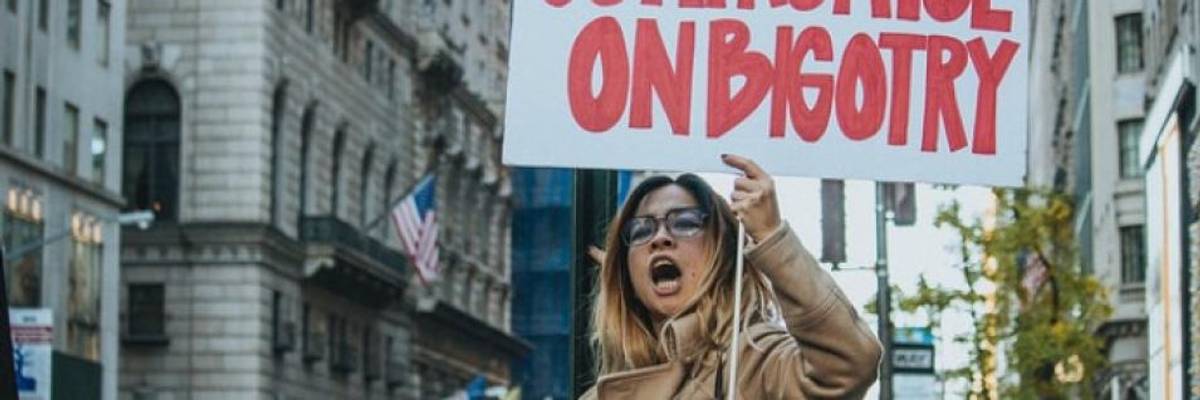
"While today's delayed words are welcome, they should have been spoken on Saturday. This unconscionable delay has undermined his moral credibility as our nation's leader," said Vanita Gupta, president and CEO of The Leadership Conference on Civil and Human Rights. (Photo: mathiaswasik/Flickr/cc)
"Not good enough." "Insufficient." "Too little, too late."
"It is a sad state of affairs when it's a news story that the president of the United States condemns racism and white supremacy."
--Vanita Gupta, The Leadership Conference on Civil and Human Rights
These were just some of the words used to describe President Donald Trump's speech on Monday, in which he "finally did the absolute bare minimum" by denouncing white supremacists for the deadly violence they perpetrated over the weekend in Charlottesville, Virginia--and even then, he did so in a speech that started with a boast about the state of the economy.
It took Trump two days and "overwhelming pressure" to denounce white supremacists explicitly. In his first comments regarding the neo-Nazi rally in Virginia--an event also known as "Unite the Right"--the president suggested the violence came from "many sides." These remarks were met with applause by neo-Nazis on the Internet, who celebrated Trump's refusal to condemn them by name. Lawmakers from both sides of the aisle were quick to label the comments as evasive and unacceptable.
Vanita Gupta, president and CEO of The Leadership Conference on Civil and Human Rights, expressed a sentiment many echoed following the president's televised speech on Monday, saying: "It is a sad state of affairs when it's a news story that the president of the United States condemns racism and white supremacy."
Gupta continued:
Two days after the fact, President Trump has at long last, directly and personally, condemned the white supremacist rallies and violent extremism that occurred in Charlottesville. While today's delayed words are welcome, they should have been spoken on Saturday. This unconscionable delay has undermined his moral credibility as our nation's leader.
Today's words must be followed by action. He must stop advancing policies that seek to divide this nation. Supporters of white supremacists, violent extremism, racial bigotry, and neo-Nazis should not serve in the White House or at any level of government. The president should fire Stephen Bannon and Sebastian Gorka or any staffers who stoke hate and division.
Others heaped on the criticism, arguing that it should not have taken days of external pressure and shoves from his own cabinet to convince Trump to speak out against white supremacy.
Following the president's remarks on Monday, reports emerged that Trump is "seriously considering a pardon" for former Arizona Sheriff Joe Arpaio, who was found guilty of criminal contempt of court last month after failing to adhere to a court order demanding that he stop racially profiling Latinos.
Dear Common Dreams reader, It’s been nearly 30 years since I co-founded Common Dreams with my late wife, Lina Newhouser. We had the radical notion that journalism should serve the public good, not corporate profits. It was clear to us from the outset what it would take to build such a project. No paid advertisements. No corporate sponsors. No millionaire publisher telling us what to think or do. Many people said we wouldn't last a year, but we proved those doubters wrong. Together with a tremendous team of journalists and dedicated staff, we built an independent media outlet free from the constraints of profits and corporate control. Our mission has always been simple: To inform. To inspire. To ignite change for the common good. Building Common Dreams was not easy. Our survival was never guaranteed. When you take on the most powerful forces—Wall Street greed, fossil fuel industry destruction, Big Tech lobbyists, and uber-rich oligarchs who have spent billions upon billions rigging the economy and democracy in their favor—the only bulwark you have is supporters who believe in your work. But here’s the urgent message from me today. It's never been this bad out there. And it's never been this hard to keep us going. At the very moment Common Dreams is most needed, the threats we face are intensifying. We need your support now more than ever. We don't accept corporate advertising and never will. We don't have a paywall because we don't think people should be blocked from critical news based on their ability to pay. Everything we do is funded by the donations of readers like you. When everyone does the little they can afford, we are strong. But if that support retreats or dries up, so do we. Will you donate now to make sure Common Dreams not only survives but thrives? —Craig Brown, Co-founder |
"Not good enough." "Insufficient." "Too little, too late."
"It is a sad state of affairs when it's a news story that the president of the United States condemns racism and white supremacy."
--Vanita Gupta, The Leadership Conference on Civil and Human Rights
These were just some of the words used to describe President Donald Trump's speech on Monday, in which he "finally did the absolute bare minimum" by denouncing white supremacists for the deadly violence they perpetrated over the weekend in Charlottesville, Virginia--and even then, he did so in a speech that started with a boast about the state of the economy.
It took Trump two days and "overwhelming pressure" to denounce white supremacists explicitly. In his first comments regarding the neo-Nazi rally in Virginia--an event also known as "Unite the Right"--the president suggested the violence came from "many sides." These remarks were met with applause by neo-Nazis on the Internet, who celebrated Trump's refusal to condemn them by name. Lawmakers from both sides of the aisle were quick to label the comments as evasive and unacceptable.
Vanita Gupta, president and CEO of The Leadership Conference on Civil and Human Rights, expressed a sentiment many echoed following the president's televised speech on Monday, saying: "It is a sad state of affairs when it's a news story that the president of the United States condemns racism and white supremacy."
Gupta continued:
Two days after the fact, President Trump has at long last, directly and personally, condemned the white supremacist rallies and violent extremism that occurred in Charlottesville. While today's delayed words are welcome, they should have been spoken on Saturday. This unconscionable delay has undermined his moral credibility as our nation's leader.
Today's words must be followed by action. He must stop advancing policies that seek to divide this nation. Supporters of white supremacists, violent extremism, racial bigotry, and neo-Nazis should not serve in the White House or at any level of government. The president should fire Stephen Bannon and Sebastian Gorka or any staffers who stoke hate and division.
Others heaped on the criticism, arguing that it should not have taken days of external pressure and shoves from his own cabinet to convince Trump to speak out against white supremacy.
Following the president's remarks on Monday, reports emerged that Trump is "seriously considering a pardon" for former Arizona Sheriff Joe Arpaio, who was found guilty of criminal contempt of court last month after failing to adhere to a court order demanding that he stop racially profiling Latinos.
"Not good enough." "Insufficient." "Too little, too late."
"It is a sad state of affairs when it's a news story that the president of the United States condemns racism and white supremacy."
--Vanita Gupta, The Leadership Conference on Civil and Human Rights
These were just some of the words used to describe President Donald Trump's speech on Monday, in which he "finally did the absolute bare minimum" by denouncing white supremacists for the deadly violence they perpetrated over the weekend in Charlottesville, Virginia--and even then, he did so in a speech that started with a boast about the state of the economy.
It took Trump two days and "overwhelming pressure" to denounce white supremacists explicitly. In his first comments regarding the neo-Nazi rally in Virginia--an event also known as "Unite the Right"--the president suggested the violence came from "many sides." These remarks were met with applause by neo-Nazis on the Internet, who celebrated Trump's refusal to condemn them by name. Lawmakers from both sides of the aisle were quick to label the comments as evasive and unacceptable.
Vanita Gupta, president and CEO of The Leadership Conference on Civil and Human Rights, expressed a sentiment many echoed following the president's televised speech on Monday, saying: "It is a sad state of affairs when it's a news story that the president of the United States condemns racism and white supremacy."
Gupta continued:
Two days after the fact, President Trump has at long last, directly and personally, condemned the white supremacist rallies and violent extremism that occurred in Charlottesville. While today's delayed words are welcome, they should have been spoken on Saturday. This unconscionable delay has undermined his moral credibility as our nation's leader.
Today's words must be followed by action. He must stop advancing policies that seek to divide this nation. Supporters of white supremacists, violent extremism, racial bigotry, and neo-Nazis should not serve in the White House or at any level of government. The president should fire Stephen Bannon and Sebastian Gorka or any staffers who stoke hate and division.
Others heaped on the criticism, arguing that it should not have taken days of external pressure and shoves from his own cabinet to convince Trump to speak out against white supremacy.
Following the president's remarks on Monday, reports emerged that Trump is "seriously considering a pardon" for former Arizona Sheriff Joe Arpaio, who was found guilty of criminal contempt of court last month after failing to adhere to a court order demanding that he stop racially profiling Latinos.