SUBSCRIBE TO OUR FREE NEWSLETTER
Daily news & progressive opinion—funded by the people, not the corporations—delivered straight to your inbox.
5
#000000
#FFFFFF
To donate by check, phone, or other method, see our More Ways to Give page.
Daily news & progressive opinion—funded by the people, not the corporations—delivered straight to your inbox.
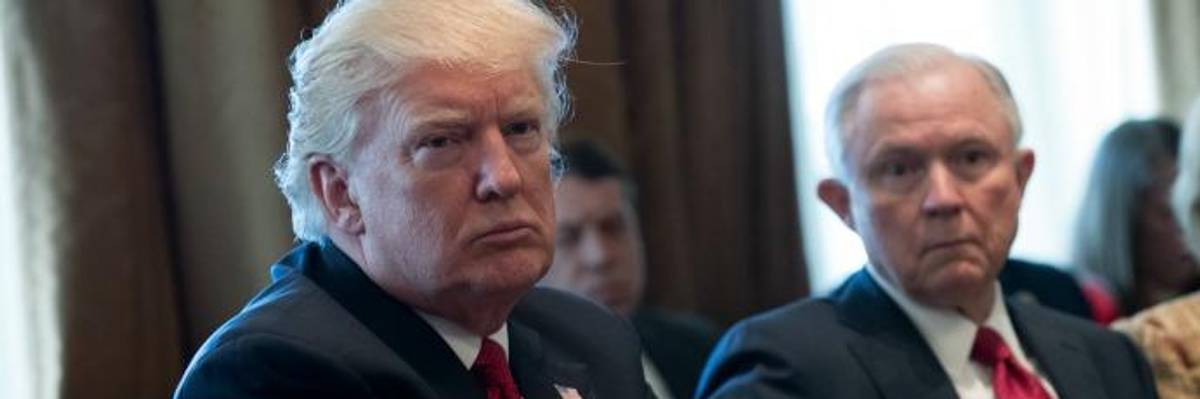
U.S. President Donald Trump and Attorney General Jeff Sessions attend a panel discussion on an opioid and drug abuse in the Roosevelt Room of the White House March 29, 2017 in Washington, DC. (Photo: Shawn Thew-Pool/Getty Images)
In an interview with the New York Times released Wednesday evening--with remarks described as "insane" and "unbelievable"--President Donald Trump openly admits he would not have appointed Jeff Sessions, a loyal campaign surrogate, to be his attorney general if he'd known Sessions would ultimately recuse himself on matters related to Russia and alleged election interference. The embattled U.S. president also had a message for the special prosecutor now conducting the probe, warning Robert Mueller III to steer clear of Trump family financial dealings.
"Sessions should have never recused himself," Trump told the Times, "and if he was going to recuse himself he should have told me before he took the job and I would have picked somebody else."
Such a recusal, continued Trump, "Frankly I think is very unfair to the president. How do you take a job and then recuse yourself? If he would have recused himself before the job, I would have said, 'Thanks, Jeff, but I'm not going to take you.' It's extremely unfair -- and that's a mild word -- to the president."
Listen:
Also in the interview, Trump took what many construed as a direct threat against the work of Special Prosecutor Mueller, now conducting an independent probe into last year's election, including possible collusion between meddling foreign agents and members of Trump's campaign staff. As the Associated Press notes, Trump "appeared to threaten Mueller, suggesting he had damaging information on the former FBI director."
According to the Times' reporting,
Mr. Trump said Mr. Mueller was running an office rife with conflicts of interest and warned investigators against delving into matters too far afield from Russia. Mr. Trump never said he would order the Justice Department to fire Mr. Mueller, nor would he outline circumstances under which he might do so. But he left open the possibility as he expressed deep grievance over an investigation that has taken a political toll in the six months since he took office.
Asked if Mr. Mueller's investigation would cross a red line if it expanded to look at his family's finances beyond any relationship to Russia, Mr. Trump said, "I would say yes." He would not say what he would do about it. "I think that's a violation. Look, this is about Russia."
In a tweet subsequent to their publication, Dan Pfeiffer, a former senior advisor to President Obama, characterized Trump's remarks as an "insane rant masquerading as an interview." Many legal analysts, former DOJ employees, and political observers said the comments about Sessions put the Attorney General in a tremendously difficult spot.
Dear Common Dreams reader, It’s been nearly 30 years since I co-founded Common Dreams with my late wife, Lina Newhouser. We had the radical notion that journalism should serve the public good, not corporate profits. It was clear to us from the outset what it would take to build such a project. No paid advertisements. No corporate sponsors. No millionaire publisher telling us what to think or do. Many people said we wouldn't last a year, but we proved those doubters wrong. Together with a tremendous team of journalists and dedicated staff, we built an independent media outlet free from the constraints of profits and corporate control. Our mission has always been simple: To inform. To inspire. To ignite change for the common good. Building Common Dreams was not easy. Our survival was never guaranteed. When you take on the most powerful forces—Wall Street greed, fossil fuel industry destruction, Big Tech lobbyists, and uber-rich oligarchs who have spent billions upon billions rigging the economy and democracy in their favor—the only bulwark you have is supporters who believe in your work. But here’s the urgent message from me today. It's never been this bad out there. And it's never been this hard to keep us going. At the very moment Common Dreams is most needed, the threats we face are intensifying. We need your support now more than ever. We don't accept corporate advertising and never will. We don't have a paywall because we don't think people should be blocked from critical news based on their ability to pay. Everything we do is funded by the donations of readers like you. When everyone does the little they can afford, we are strong. But if that support retreats or dries up, so do we. Will you donate now to make sure Common Dreams not only survives but thrives? —Craig Brown, Co-founder |
In an interview with the New York Times released Wednesday evening--with remarks described as "insane" and "unbelievable"--President Donald Trump openly admits he would not have appointed Jeff Sessions, a loyal campaign surrogate, to be his attorney general if he'd known Sessions would ultimately recuse himself on matters related to Russia and alleged election interference. The embattled U.S. president also had a message for the special prosecutor now conducting the probe, warning Robert Mueller III to steer clear of Trump family financial dealings.
"Sessions should have never recused himself," Trump told the Times, "and if he was going to recuse himself he should have told me before he took the job and I would have picked somebody else."
Such a recusal, continued Trump, "Frankly I think is very unfair to the president. How do you take a job and then recuse yourself? If he would have recused himself before the job, I would have said, 'Thanks, Jeff, but I'm not going to take you.' It's extremely unfair -- and that's a mild word -- to the president."
Listen:
Also in the interview, Trump took what many construed as a direct threat against the work of Special Prosecutor Mueller, now conducting an independent probe into last year's election, including possible collusion between meddling foreign agents and members of Trump's campaign staff. As the Associated Press notes, Trump "appeared to threaten Mueller, suggesting he had damaging information on the former FBI director."
According to the Times' reporting,
Mr. Trump said Mr. Mueller was running an office rife with conflicts of interest and warned investigators against delving into matters too far afield from Russia. Mr. Trump never said he would order the Justice Department to fire Mr. Mueller, nor would he outline circumstances under which he might do so. But he left open the possibility as he expressed deep grievance over an investigation that has taken a political toll in the six months since he took office.
Asked if Mr. Mueller's investigation would cross a red line if it expanded to look at his family's finances beyond any relationship to Russia, Mr. Trump said, "I would say yes." He would not say what he would do about it. "I think that's a violation. Look, this is about Russia."
In a tweet subsequent to their publication, Dan Pfeiffer, a former senior advisor to President Obama, characterized Trump's remarks as an "insane rant masquerading as an interview." Many legal analysts, former DOJ employees, and political observers said the comments about Sessions put the Attorney General in a tremendously difficult spot.
In an interview with the New York Times released Wednesday evening--with remarks described as "insane" and "unbelievable"--President Donald Trump openly admits he would not have appointed Jeff Sessions, a loyal campaign surrogate, to be his attorney general if he'd known Sessions would ultimately recuse himself on matters related to Russia and alleged election interference. The embattled U.S. president also had a message for the special prosecutor now conducting the probe, warning Robert Mueller III to steer clear of Trump family financial dealings.
"Sessions should have never recused himself," Trump told the Times, "and if he was going to recuse himself he should have told me before he took the job and I would have picked somebody else."
Such a recusal, continued Trump, "Frankly I think is very unfair to the president. How do you take a job and then recuse yourself? If he would have recused himself before the job, I would have said, 'Thanks, Jeff, but I'm not going to take you.' It's extremely unfair -- and that's a mild word -- to the president."
Listen:
Also in the interview, Trump took what many construed as a direct threat against the work of Special Prosecutor Mueller, now conducting an independent probe into last year's election, including possible collusion between meddling foreign agents and members of Trump's campaign staff. As the Associated Press notes, Trump "appeared to threaten Mueller, suggesting he had damaging information on the former FBI director."
According to the Times' reporting,
Mr. Trump said Mr. Mueller was running an office rife with conflicts of interest and warned investigators against delving into matters too far afield from Russia. Mr. Trump never said he would order the Justice Department to fire Mr. Mueller, nor would he outline circumstances under which he might do so. But he left open the possibility as he expressed deep grievance over an investigation that has taken a political toll in the six months since he took office.
Asked if Mr. Mueller's investigation would cross a red line if it expanded to look at his family's finances beyond any relationship to Russia, Mr. Trump said, "I would say yes." He would not say what he would do about it. "I think that's a violation. Look, this is about Russia."
In a tweet subsequent to their publication, Dan Pfeiffer, a former senior advisor to President Obama, characterized Trump's remarks as an "insane rant masquerading as an interview." Many legal analysts, former DOJ employees, and political observers said the comments about Sessions put the Attorney General in a tremendously difficult spot.