SUBSCRIBE TO OUR FREE NEWSLETTER
Daily news & progressive opinion—funded by the people, not the corporations—delivered straight to your inbox.
5
#000000
#FFFFFF
To donate by check, phone, or other method, see our More Ways to Give page.
Daily news & progressive opinion—funded by the people, not the corporations—delivered straight to your inbox.
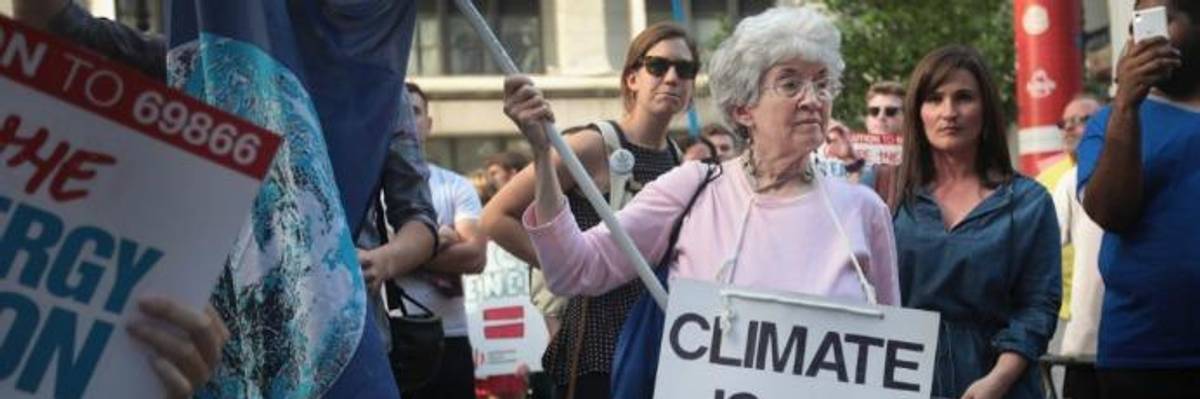
Demonstrators protest U.S. President Donald Trump's decision to exit the Paris climate change accord. (Photo: Scott Olson/Getty Images)
The United Church of Christ on Monday passed a resolution that calls on clergy to lead educational and legislative efforts to combat climate change, urging its members to be "bold and courageous as we address the greatest moral challenge that the world has ever faced."
The resolution, titled "The Earth is the Lord's--Not Ours to Wreck: Imperatives for a New Moral Era," was supported by 97 percent of the delegates of the church's General Synod, which meets every two years to discuss church structure and policies.
"This sets the stage for engagement and hope. This is a proclamation of truth and the love of God's gift," said Rev. Jim Antal, head of the UCC's Massachusetts conference and author of the resolution. "The climate crisis is an opportunity for which the church was born."
Framing climate change prevention as a moral obligation--similar to the message of Pope Francis's 2015 encyclical--the resolution reads: "As people of faith, recognizing that the earth is the Lord's, it falls upon our generation to embrace the imperatives set forth in this resolution."
It details a strategy for "the whole of the church to prayerfully engage" with the issue of climate change through three key imperatives:
In addition to preaching the clergy's obligation to protect the planet and educate the public about the climate crisis, the resolution encourages church members to advocate for wide-scale transitions to accessible, sustainable energy sources. "Let us commit to resist all expansion of fossil fuel infrastructure and demand new sources of renewable energy that are accessible to all communities," the resolution states.
It also takes a swipe at U.S. President Donald Trump and his administration's recent actions on climate policy: "While the leaders of every country in the world recognize this reality, our current Administration ignores science, defunds the Environmental Protection Agency, and withdraws from the Paris Climate Accord."
Along with ditching the Paris Agreement and the administration's controversial choices regarding the EPA, Trump and his apointees have attempted to halt an Obama-era rule targeting methane leaks, frustrating U.S. citizens and world leaders alike. The administration's disregard for climate science and environmental protection is pushing cities, states, and groups such as the UCC to take action.
This is not the UCC's first move to address climate change. In 2013, the church's General Synod approved--also with major support from Rev. Antal--a five-year path toward divesting from fossil fuel companies, and became the first major U.S. religious body to act on divestment. They also adopted a resolution to make UCC buildings more carbon-neutral.
Dear Common Dreams reader, It’s been nearly 30 years since I co-founded Common Dreams with my late wife, Lina Newhouser. We had the radical notion that journalism should serve the public good, not corporate profits. It was clear to us from the outset what it would take to build such a project. No paid advertisements. No corporate sponsors. No millionaire publisher telling us what to think or do. Many people said we wouldn't last a year, but we proved those doubters wrong. Together with a tremendous team of journalists and dedicated staff, we built an independent media outlet free from the constraints of profits and corporate control. Our mission has always been simple: To inform. To inspire. To ignite change for the common good. Building Common Dreams was not easy. Our survival was never guaranteed. When you take on the most powerful forces—Wall Street greed, fossil fuel industry destruction, Big Tech lobbyists, and uber-rich oligarchs who have spent billions upon billions rigging the economy and democracy in their favor—the only bulwark you have is supporters who believe in your work. But here’s the urgent message from me today. It's never been this bad out there. And it's never been this hard to keep us going. At the very moment Common Dreams is most needed, the threats we face are intensifying. We need your support now more than ever. We don't accept corporate advertising and never will. We don't have a paywall because we don't think people should be blocked from critical news based on their ability to pay. Everything we do is funded by the donations of readers like you. When everyone does the little they can afford, we are strong. But if that support retreats or dries up, so do we. Will you donate now to make sure Common Dreams not only survives but thrives? —Craig Brown, Co-founder |
The United Church of Christ on Monday passed a resolution that calls on clergy to lead educational and legislative efforts to combat climate change, urging its members to be "bold and courageous as we address the greatest moral challenge that the world has ever faced."
The resolution, titled "The Earth is the Lord's--Not Ours to Wreck: Imperatives for a New Moral Era," was supported by 97 percent of the delegates of the church's General Synod, which meets every two years to discuss church structure and policies.
"This sets the stage for engagement and hope. This is a proclamation of truth and the love of God's gift," said Rev. Jim Antal, head of the UCC's Massachusetts conference and author of the resolution. "The climate crisis is an opportunity for which the church was born."
Framing climate change prevention as a moral obligation--similar to the message of Pope Francis's 2015 encyclical--the resolution reads: "As people of faith, recognizing that the earth is the Lord's, it falls upon our generation to embrace the imperatives set forth in this resolution."
It details a strategy for "the whole of the church to prayerfully engage" with the issue of climate change through three key imperatives:
In addition to preaching the clergy's obligation to protect the planet and educate the public about the climate crisis, the resolution encourages church members to advocate for wide-scale transitions to accessible, sustainable energy sources. "Let us commit to resist all expansion of fossil fuel infrastructure and demand new sources of renewable energy that are accessible to all communities," the resolution states.
It also takes a swipe at U.S. President Donald Trump and his administration's recent actions on climate policy: "While the leaders of every country in the world recognize this reality, our current Administration ignores science, defunds the Environmental Protection Agency, and withdraws from the Paris Climate Accord."
Along with ditching the Paris Agreement and the administration's controversial choices regarding the EPA, Trump and his apointees have attempted to halt an Obama-era rule targeting methane leaks, frustrating U.S. citizens and world leaders alike. The administration's disregard for climate science and environmental protection is pushing cities, states, and groups such as the UCC to take action.
This is not the UCC's first move to address climate change. In 2013, the church's General Synod approved--also with major support from Rev. Antal--a five-year path toward divesting from fossil fuel companies, and became the first major U.S. religious body to act on divestment. They also adopted a resolution to make UCC buildings more carbon-neutral.
The United Church of Christ on Monday passed a resolution that calls on clergy to lead educational and legislative efforts to combat climate change, urging its members to be "bold and courageous as we address the greatest moral challenge that the world has ever faced."
The resolution, titled "The Earth is the Lord's--Not Ours to Wreck: Imperatives for a New Moral Era," was supported by 97 percent of the delegates of the church's General Synod, which meets every two years to discuss church structure and policies.
"This sets the stage for engagement and hope. This is a proclamation of truth and the love of God's gift," said Rev. Jim Antal, head of the UCC's Massachusetts conference and author of the resolution. "The climate crisis is an opportunity for which the church was born."
Framing climate change prevention as a moral obligation--similar to the message of Pope Francis's 2015 encyclical--the resolution reads: "As people of faith, recognizing that the earth is the Lord's, it falls upon our generation to embrace the imperatives set forth in this resolution."
It details a strategy for "the whole of the church to prayerfully engage" with the issue of climate change through three key imperatives:
In addition to preaching the clergy's obligation to protect the planet and educate the public about the climate crisis, the resolution encourages church members to advocate for wide-scale transitions to accessible, sustainable energy sources. "Let us commit to resist all expansion of fossil fuel infrastructure and demand new sources of renewable energy that are accessible to all communities," the resolution states.
It also takes a swipe at U.S. President Donald Trump and his administration's recent actions on climate policy: "While the leaders of every country in the world recognize this reality, our current Administration ignores science, defunds the Environmental Protection Agency, and withdraws from the Paris Climate Accord."
Along with ditching the Paris Agreement and the administration's controversial choices regarding the EPA, Trump and his apointees have attempted to halt an Obama-era rule targeting methane leaks, frustrating U.S. citizens and world leaders alike. The administration's disregard for climate science and environmental protection is pushing cities, states, and groups such as the UCC to take action.
This is not the UCC's first move to address climate change. In 2013, the church's General Synod approved--also with major support from Rev. Antal--a five-year path toward divesting from fossil fuel companies, and became the first major U.S. religious body to act on divestment. They also adopted a resolution to make UCC buildings more carbon-neutral.