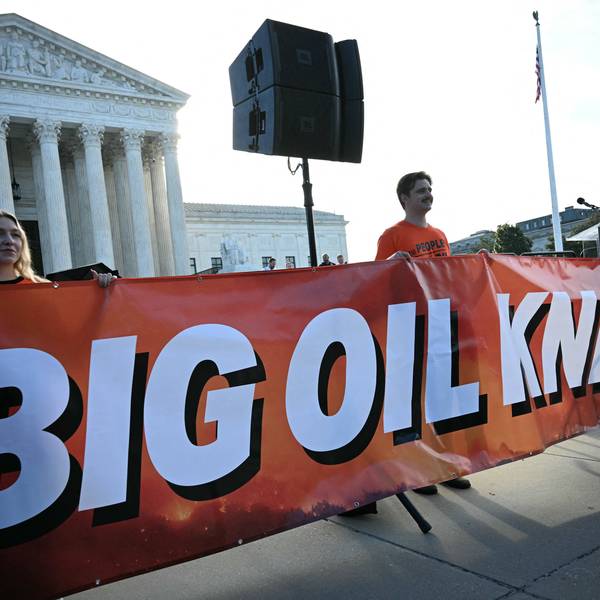

Exxon and Tillerson Accused of Defrauding Investors Over Climate Risks
New York attorney general claims the oil giant used "secret, internal figures" to account for impacts of climate change
ExxonMobil is being accused of using "sham" accounting to "mislead" investors about the likely financial risks posed by climate change, which New York Attorney General Eric Schneiderman said was evidence of potentially "wide-ranging fraud" executed under the direction of former CEO and current U.S. Secretary of State Rex Tillerson.
In a court filing with the New York state Supreme Court on Friday, Schneiderman's office said that the oil giant had used "secret, internal figures [that] understated the degree to which Exxon was taking into account the risks of climate change regulations." These figures "were not as conservative" as the so-called "proxy costs" that the company provided to investors.
According to the filing,
Exxon has repeatedly represented to investors that the company applies a "proxy cost" to greenhouse gas emissions ("GHGs") when it makes investment decisions and performs asset valuations, and that because it does so, it can assure investors that none of Exxon's projects or assets will be materially impacted by future climate change-related regulations.
However,
Internal documents produced by Exxon reveal that from at least 2010 through approximately June 2014, Exxon told its investors it used one set of proxy-cost figures, when in fact the company's internal policies set forth a second set of lower proxy costs (and therefore a less risk-sensitive version) for use in its internal business planning.
Further, documents provided to the Office of the Attorney General (OAG) "show that former chairman and CEO Rex Tillerson was specifically informed of, and approved of, this inconsistency," according to the filing, which is the latest development in an ongoing investigation into the company's decades-long suppression of climate science.
"These allegations reveal what many of us already claimed: Exxon has been deceiving the public and its own investors on climate change for years," said Naomi Ages, who heads Greenpeace's Climate Liability Project. "If Exxon was saying one thing to the public and its shareholders about climate risk while basing its internal decisions on entirely different information, it could certainly amount to fraud."
The OAG's accusation also follows the recent discovery that while serving as CEO, Tillerson used an alternate email and alias "Wayne Tracker"to discuss climate-related matters. On May 22, a New York state appeals court ordered Exxon to hand over those emails, which Exxon continues to claim are lost.
Friday's filing includes a request for witness testimony, which the OAG said is "critical to understanding and potential remedying Exxon's still-unaccounted-for destruction of documents from key custodians," referring to the Wayne Tracker emails.
Ages said the charges were "Exxon's second embarrassment this week," referring to the passage of a shareholder resolution on Wednesday ordering the company to publish an annual report detailing the risks of climate policies and technological advances to its oil and gas holdings.
Ages described the surprise vote as "public rebuke...for willfully ignoring technological advances and the risk of climate change."
The resolution specifically states that the assessment must "analyze the impacts on ExxonMobil's oil and gas reserves and resources under a scenario in which reduction in demand results from carbon restrictions and related rules or commitments adopted by governments consistent with the globally agreed upon 2 degree target," giving the company less individual discretion over how to account for the risks.
As Greenpeace's Kelly Mitchell noted, the fact that "large institutional investors" also backed the activist resolution shows that the issue of climate risk is now widely seen as having "deep financial implications."
We are at a crossroads
This country and this world are at a monumental crossroads. In a few short weeks, US voters will have an opportunity to beat back the forces of fascism and confront the billionaires who are rigging the economy, our media system, and our democracy, making it increasingly impossible for ordinary people to get by. We’re not just talking about the election. We’re talking about what must be done once these fascist elements are vanquished from power. We need a bolder set of solutions than what either major party has so far been willing to offer and a working-class movement ready to fight like hell for it. Trump didn't emerge from nowhere. The conditions that fueled MAGA authoritarianism were created by decades of radical neoliberal economic policies and a corrupt political system dominated by corporate interests. They slashed taxes on the super-rich, promising that the benefits would trickle down. They said giveaways to the corporate titans would make life more affordable for the rest of us. It was all bullshit. And when a bitter, betrayed populace searches for someone to blame, right-wing demagogues have little trouble finding scapegoats. People know when they're being lied to, but you won't hear any of this from the corporate media. Only independent journalism—powered and funded by people who believe in building a better world—can deliver truly trustworthy daily news. Our Fall Campaign is underway, and we need your help. To power our newsroom through the rest of the year, we need to raise $125,000 by midnight on October 31. So if you share our vision, please contribute whatever you can to sustain our work. |
ExxonMobil is being accused of using "sham" accounting to "mislead" investors about the likely financial risks posed by climate change, which New York Attorney General Eric Schneiderman said was evidence of potentially "wide-ranging fraud" executed under the direction of former CEO and current U.S. Secretary of State Rex Tillerson.
In a court filing with the New York state Supreme Court on Friday, Schneiderman's office said that the oil giant had used "secret, internal figures [that] understated the degree to which Exxon was taking into account the risks of climate change regulations." These figures "were not as conservative" as the so-called "proxy costs" that the company provided to investors.
According to the filing,
Exxon has repeatedly represented to investors that the company applies a "proxy cost" to greenhouse gas emissions ("GHGs") when it makes investment decisions and performs asset valuations, and that because it does so, it can assure investors that none of Exxon's projects or assets will be materially impacted by future climate change-related regulations.
However,
Internal documents produced by Exxon reveal that from at least 2010 through approximately June 2014, Exxon told its investors it used one set of proxy-cost figures, when in fact the company's internal policies set forth a second set of lower proxy costs (and therefore a less risk-sensitive version) for use in its internal business planning.
Further, documents provided to the Office of the Attorney General (OAG) "show that former chairman and CEO Rex Tillerson was specifically informed of, and approved of, this inconsistency," according to the filing, which is the latest development in an ongoing investigation into the company's decades-long suppression of climate science.
"These allegations reveal what many of us already claimed: Exxon has been deceiving the public and its own investors on climate change for years," said Naomi Ages, who heads Greenpeace's Climate Liability Project. "If Exxon was saying one thing to the public and its shareholders about climate risk while basing its internal decisions on entirely different information, it could certainly amount to fraud."
The OAG's accusation also follows the recent discovery that while serving as CEO, Tillerson used an alternate email and alias "Wayne Tracker"to discuss climate-related matters. On May 22, a New York state appeals court ordered Exxon to hand over those emails, which Exxon continues to claim are lost.
Friday's filing includes a request for witness testimony, which the OAG said is "critical to understanding and potential remedying Exxon's still-unaccounted-for destruction of documents from key custodians," referring to the Wayne Tracker emails.
Ages said the charges were "Exxon's second embarrassment this week," referring to the passage of a shareholder resolution on Wednesday ordering the company to publish an annual report detailing the risks of climate policies and technological advances to its oil and gas holdings.
Ages described the surprise vote as "public rebuke...for willfully ignoring technological advances and the risk of climate change."
The resolution specifically states that the assessment must "analyze the impacts on ExxonMobil's oil and gas reserves and resources under a scenario in which reduction in demand results from carbon restrictions and related rules or commitments adopted by governments consistent with the globally agreed upon 2 degree target," giving the company less individual discretion over how to account for the risks.
As Greenpeace's Kelly Mitchell noted, the fact that "large institutional investors" also backed the activist resolution shows that the issue of climate risk is now widely seen as having "deep financial implications."
ExxonMobil is being accused of using "sham" accounting to "mislead" investors about the likely financial risks posed by climate change, which New York Attorney General Eric Schneiderman said was evidence of potentially "wide-ranging fraud" executed under the direction of former CEO and current U.S. Secretary of State Rex Tillerson.
In a court filing with the New York state Supreme Court on Friday, Schneiderman's office said that the oil giant had used "secret, internal figures [that] understated the degree to which Exxon was taking into account the risks of climate change regulations." These figures "were not as conservative" as the so-called "proxy costs" that the company provided to investors.
According to the filing,
Exxon has repeatedly represented to investors that the company applies a "proxy cost" to greenhouse gas emissions ("GHGs") when it makes investment decisions and performs asset valuations, and that because it does so, it can assure investors that none of Exxon's projects or assets will be materially impacted by future climate change-related regulations.
However,
Internal documents produced by Exxon reveal that from at least 2010 through approximately June 2014, Exxon told its investors it used one set of proxy-cost figures, when in fact the company's internal policies set forth a second set of lower proxy costs (and therefore a less risk-sensitive version) for use in its internal business planning.
Further, documents provided to the Office of the Attorney General (OAG) "show that former chairman and CEO Rex Tillerson was specifically informed of, and approved of, this inconsistency," according to the filing, which is the latest development in an ongoing investigation into the company's decades-long suppression of climate science.
"These allegations reveal what many of us already claimed: Exxon has been deceiving the public and its own investors on climate change for years," said Naomi Ages, who heads Greenpeace's Climate Liability Project. "If Exxon was saying one thing to the public and its shareholders about climate risk while basing its internal decisions on entirely different information, it could certainly amount to fraud."
The OAG's accusation also follows the recent discovery that while serving as CEO, Tillerson used an alternate email and alias "Wayne Tracker"to discuss climate-related matters. On May 22, a New York state appeals court ordered Exxon to hand over those emails, which Exxon continues to claim are lost.
Friday's filing includes a request for witness testimony, which the OAG said is "critical to understanding and potential remedying Exxon's still-unaccounted-for destruction of documents from key custodians," referring to the Wayne Tracker emails.
Ages said the charges were "Exxon's second embarrassment this week," referring to the passage of a shareholder resolution on Wednesday ordering the company to publish an annual report detailing the risks of climate policies and technological advances to its oil and gas holdings.
Ages described the surprise vote as "public rebuke...for willfully ignoring technological advances and the risk of climate change."
The resolution specifically states that the assessment must "analyze the impacts on ExxonMobil's oil and gas reserves and resources under a scenario in which reduction in demand results from carbon restrictions and related rules or commitments adopted by governments consistent with the globally agreed upon 2 degree target," giving the company less individual discretion over how to account for the risks.
As Greenpeace's Kelly Mitchell noted, the fact that "large institutional investors" also backed the activist resolution shows that the issue of climate risk is now widely seen as having "deep financial implications."