

SUBSCRIBE TO OUR FREE NEWSLETTER
Daily news & progressive opinion—funded by the people, not the corporations—delivered straight to your inbox.
5
#000000
#FFFFFF
To donate by check, phone, or other method, see our More Ways to Give page.
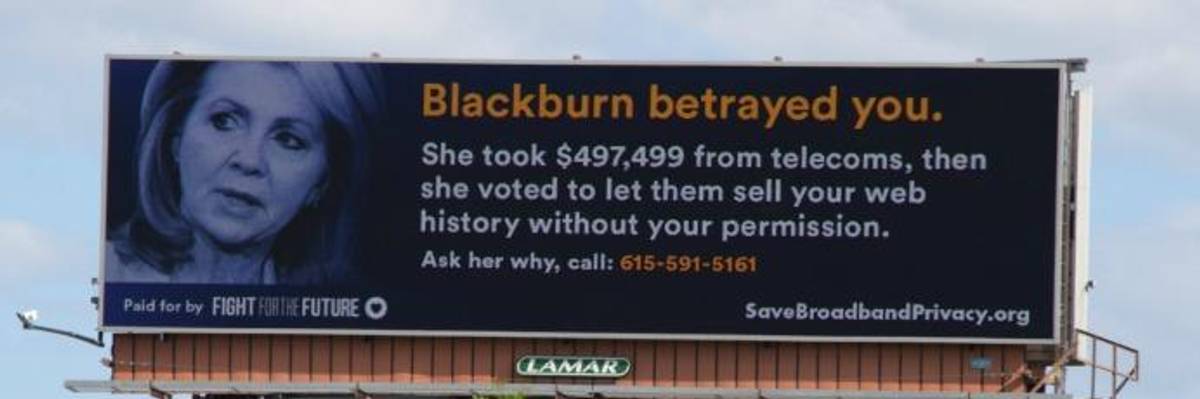
Billboards targeting legislators who voted to end online privacy measures earlier this year have gone up in key districts, as promised by activists.
Digital rights group Fight for the Future vowed to put up the ads against Reps. Marsha Blackburn (R-Tenn.) and John Rutherford (R-Fla.), Sens. Jeff Flake (R-Ariz.) and Dean Heller (R-Nev.), as well as other lawmakers after they voted in favor of a resolution, introduced by Flake, that overturned federal rules preventing broadband providers from selling user data to third parties without consent.
Blackburn, Rutherford, Flake, and Heller took large contributions from the telecommunications industry before supporting the resolution, Fight for the Future said. The billboards--paid for through a crowdfunded campaign--encourage viewers to contact the lawmakers' offices and ask why they voted against their constituents' privacy rights.
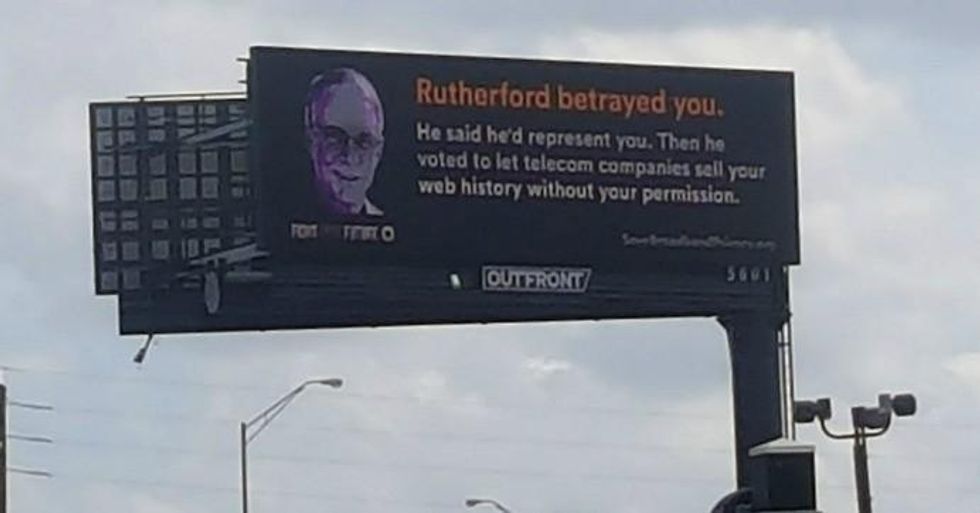
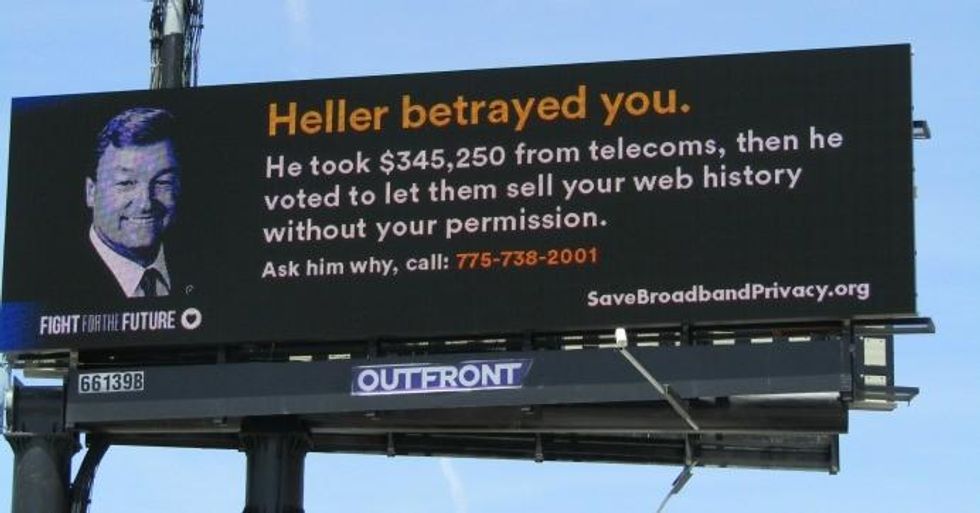
"Members of Congress who help monopolies get richer while undermining our online privacy and attacking net neutrality will soon see that they can't hide from the public on these issues," said the group's co-founder Tiffiniy Cheng. "Everyone who drives by one of these billboards will know exactly how much money these lawmakers took in exchange for selling off their basic right to use the web safely, and handing their most personal information to advertisers."
Flake's resolution was introduced under the Congressional Review Act (CRA), which gives lawmakers the authority to overturn recently-introduced agency rules with a simple majority. The Federal Communications Commission (FCC) implemented the data-sharing ban in October.
Once a rule is repealed under the CRA, an agency cannot reintroduce it without specific authorization by a new law.
"Congress voting to gut internet privacy was one of the most blatant displays of corruption in recent history," Cheng said. "They might think that they've gotten away with it, but they're wrong. These billboards are just the latest example of the growing public backlash to these attacks on our internet freedom and privacy."
Billboards targeting legislators who voted to end online privacy measures earlier this year have gone up in key districts, as promised by activists.
Digital rights group Fight for the Future vowed to put up the ads against Reps. Marsha Blackburn (R-Tenn.) and John Rutherford (R-Fla.), Sens. Jeff Flake (R-Ariz.) and Dean Heller (R-Nev.), as well as other lawmakers after they voted in favor of a resolution, introduced by Flake, that overturned federal rules preventing broadband providers from selling user data to third parties without consent.
Blackburn, Rutherford, Flake, and Heller took large contributions from the telecommunications industry before supporting the resolution, Fight for the Future said. The billboards--paid for through a crowdfunded campaign--encourage viewers to contact the lawmakers' offices and ask why they voted against their constituents' privacy rights.
"Members of Congress who help monopolies get richer while undermining our online privacy and attacking net neutrality will soon see that they can't hide from the public on these issues," said the group's co-founder Tiffiniy Cheng. "Everyone who drives by one of these billboards will know exactly how much money these lawmakers took in exchange for selling off their basic right to use the web safely, and handing their most personal information to advertisers."
Flake's resolution was introduced under the Congressional Review Act (CRA), which gives lawmakers the authority to overturn recently-introduced agency rules with a simple majority. The Federal Communications Commission (FCC) implemented the data-sharing ban in October.
Once a rule is repealed under the CRA, an agency cannot reintroduce it without specific authorization by a new law.
"Congress voting to gut internet privacy was one of the most blatant displays of corruption in recent history," Cheng said. "They might think that they've gotten away with it, but they're wrong. These billboards are just the latest example of the growing public backlash to these attacks on our internet freedom and privacy."
Billboards targeting legislators who voted to end online privacy measures earlier this year have gone up in key districts, as promised by activists.
Digital rights group Fight for the Future vowed to put up the ads against Reps. Marsha Blackburn (R-Tenn.) and John Rutherford (R-Fla.), Sens. Jeff Flake (R-Ariz.) and Dean Heller (R-Nev.), as well as other lawmakers after they voted in favor of a resolution, introduced by Flake, that overturned federal rules preventing broadband providers from selling user data to third parties without consent.
Blackburn, Rutherford, Flake, and Heller took large contributions from the telecommunications industry before supporting the resolution, Fight for the Future said. The billboards--paid for through a crowdfunded campaign--encourage viewers to contact the lawmakers' offices and ask why they voted against their constituents' privacy rights.
"Members of Congress who help monopolies get richer while undermining our online privacy and attacking net neutrality will soon see that they can't hide from the public on these issues," said the group's co-founder Tiffiniy Cheng. "Everyone who drives by one of these billboards will know exactly how much money these lawmakers took in exchange for selling off their basic right to use the web safely, and handing their most personal information to advertisers."
Flake's resolution was introduced under the Congressional Review Act (CRA), which gives lawmakers the authority to overturn recently-introduced agency rules with a simple majority. The Federal Communications Commission (FCC) implemented the data-sharing ban in October.
Once a rule is repealed under the CRA, an agency cannot reintroduce it without specific authorization by a new law.
"Congress voting to gut internet privacy was one of the most blatant displays of corruption in recent history," Cheng said. "They might think that they've gotten away with it, but they're wrong. These billboards are just the latest example of the growing public backlash to these attacks on our internet freedom and privacy."

