




SUBSCRIBE TO OUR FREE NEWSLETTER
Daily news & progressive opinion—funded by the people, not the corporations—delivered straight to your inbox.
5
#000000
#FFFFFF
To donate by check, phone, or other method, see our More Ways to Give page.
Daily news & progressive opinion—funded by the people, not the corporations—delivered straight to your inbox.
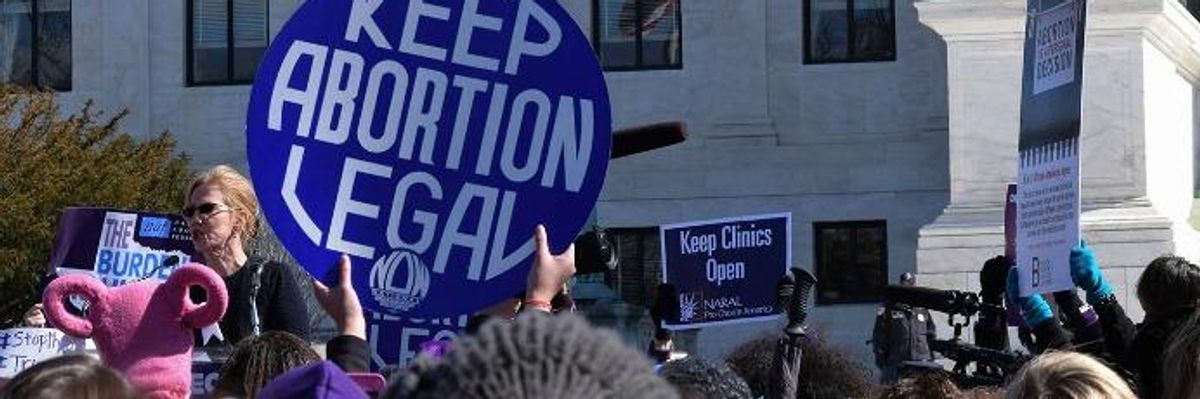
Outside the U.S. Supreme Court earlier this year. (Photo: NARAL Pro-Choice Texas)
Reproductive health advocates have filed a lawsuit against the state of Texas for its latest unconstitutional attack on women's right to access safe and legal abortion.
The suit (pdf), filed Monday in the U.S. District Court for the Western District of Texas on behalf of several Texas healthcare providers, demands that the state halt implementation of a regulation, finalized late last month by the Texas Department of State Health Services (DSHS), requiring the burial or cremation of embryonic and fetal tissue that results from abortions, miscarriages, or ectopic pregnancy surgery.
The Center for Reproductive Rights had warned (pdf) in August that the regulation would "almost certainly trigger costly litigation."
According to the suit, the new rule "burdens women seeking pregnancy-related medical care. It imposes a funeral ritual on women who have a miscarriage management procedure, ectopic pregnancy surgery, or an abortion. Further, it threatens women's health and safety by providing no safe harbor for sending tissue to pathology or crime labs. It also forces healthcare providers to work with an extremely limited number of third-party vendors for burial or scattering ashes, threatening abortion clinics' provision of care and their long-term ability to remain open, as well as cost increases for women seeking pregnancy-related medical care."
What's more, say the plaintiffs, it employs the same tactics as HB2, the controversial law whose challenged provisions were struck down in June. Texas currently faces a $4.5 million legal bill over its defense of HB2. The DSHS regulations were first proposed just four days after the U.S. Supreme Court's historic ruling in Whole Women's Health v. Hellerstedt.
"Also like HB2, the [r]egulation has no public health benefit," the lawsuit reads. "It does nothing to improve public health or safety, as DSHS alleges; rather, it is a pretext for restricting abortion access."
As such, Center for Reproductive Rights executive director and CEO Nancy Northup described the rule as "insidious" and "a new low in Texas' long history of denying women the respect that they deserve."
"These regulations are an insult to Texas women, the rule of law, and the U.S. Supreme Court, which declared less than six months ago that medically unnecessary restrictions on abortion access are unconstitutional," said Northup.
"Texas' profound disrespect of women's health and dignity apparently has no bounds with this new regulation announced just days after our June victory in the Supreme Court," added Amy Hagstrom-Miller, president and CEO of lead plaintiff Whole Woman's Health. "This latest attack is an end-run game to add restrictions on abortion care and it ignores thousands of Texans' testimony and comments."
"We at Whole Woman's Health have a history of fighting restrictions that are deeply rooted in shaming and stigmatizing Texans and today's filing is no different," she said.
Texas is likely to be a battleground state on abortion rights in the coming year, as conservative state lawmakers filed a slew of anti-abortion bills in the wake of Donald Trump's election. Just last week, DSHS released a revised version of the booklet "A Woman's Right to Know," which women seeking abortion in the state are required to read. Women's health advocates and medical professionals alike say the pamphlet is rife with inaccuracies and "coercive language."
Donald Trump’s attacks on democracy, justice, and a free press are escalating — putting everything we stand for at risk. We believe a better world is possible, but we can’t get there without your support. Common Dreams stands apart. We answer only to you — our readers, activists, and changemakers — not to billionaires or corporations. Our independence allows us to cover the vital stories that others won’t, spotlighting movements for peace, equality, and human rights. Right now, our work faces unprecedented challenges. Misinformation is spreading, journalists are under attack, and financial pressures are mounting. As a reader-supported, nonprofit newsroom, your support is crucial to keep this journalism alive. Whatever you can give — $10, $25, or $100 — helps us stay strong and responsive when the world needs us most. Together, we’ll continue to build the independent, courageous journalism our movement relies on. Thank you for being part of this community. |
Reproductive health advocates have filed a lawsuit against the state of Texas for its latest unconstitutional attack on women's right to access safe and legal abortion.
The suit (pdf), filed Monday in the U.S. District Court for the Western District of Texas on behalf of several Texas healthcare providers, demands that the state halt implementation of a regulation, finalized late last month by the Texas Department of State Health Services (DSHS), requiring the burial or cremation of embryonic and fetal tissue that results from abortions, miscarriages, or ectopic pregnancy surgery.
The Center for Reproductive Rights had warned (pdf) in August that the regulation would "almost certainly trigger costly litigation."
According to the suit, the new rule "burdens women seeking pregnancy-related medical care. It imposes a funeral ritual on women who have a miscarriage management procedure, ectopic pregnancy surgery, or an abortion. Further, it threatens women's health and safety by providing no safe harbor for sending tissue to pathology or crime labs. It also forces healthcare providers to work with an extremely limited number of third-party vendors for burial or scattering ashes, threatening abortion clinics' provision of care and their long-term ability to remain open, as well as cost increases for women seeking pregnancy-related medical care."
What's more, say the plaintiffs, it employs the same tactics as HB2, the controversial law whose challenged provisions were struck down in June. Texas currently faces a $4.5 million legal bill over its defense of HB2. The DSHS regulations were first proposed just four days after the U.S. Supreme Court's historic ruling in Whole Women's Health v. Hellerstedt.
"Also like HB2, the [r]egulation has no public health benefit," the lawsuit reads. "It does nothing to improve public health or safety, as DSHS alleges; rather, it is a pretext for restricting abortion access."
As such, Center for Reproductive Rights executive director and CEO Nancy Northup described the rule as "insidious" and "a new low in Texas' long history of denying women the respect that they deserve."
"These regulations are an insult to Texas women, the rule of law, and the U.S. Supreme Court, which declared less than six months ago that medically unnecessary restrictions on abortion access are unconstitutional," said Northup.
"Texas' profound disrespect of women's health and dignity apparently has no bounds with this new regulation announced just days after our June victory in the Supreme Court," added Amy Hagstrom-Miller, president and CEO of lead plaintiff Whole Woman's Health. "This latest attack is an end-run game to add restrictions on abortion care and it ignores thousands of Texans' testimony and comments."
"We at Whole Woman's Health have a history of fighting restrictions that are deeply rooted in shaming and stigmatizing Texans and today's filing is no different," she said.
Texas is likely to be a battleground state on abortion rights in the coming year, as conservative state lawmakers filed a slew of anti-abortion bills in the wake of Donald Trump's election. Just last week, DSHS released a revised version of the booklet "A Woman's Right to Know," which women seeking abortion in the state are required to read. Women's health advocates and medical professionals alike say the pamphlet is rife with inaccuracies and "coercive language."
Reproductive health advocates have filed a lawsuit against the state of Texas for its latest unconstitutional attack on women's right to access safe and legal abortion.
The suit (pdf), filed Monday in the U.S. District Court for the Western District of Texas on behalf of several Texas healthcare providers, demands that the state halt implementation of a regulation, finalized late last month by the Texas Department of State Health Services (DSHS), requiring the burial or cremation of embryonic and fetal tissue that results from abortions, miscarriages, or ectopic pregnancy surgery.
The Center for Reproductive Rights had warned (pdf) in August that the regulation would "almost certainly trigger costly litigation."
According to the suit, the new rule "burdens women seeking pregnancy-related medical care. It imposes a funeral ritual on women who have a miscarriage management procedure, ectopic pregnancy surgery, or an abortion. Further, it threatens women's health and safety by providing no safe harbor for sending tissue to pathology or crime labs. It also forces healthcare providers to work with an extremely limited number of third-party vendors for burial or scattering ashes, threatening abortion clinics' provision of care and their long-term ability to remain open, as well as cost increases for women seeking pregnancy-related medical care."
What's more, say the plaintiffs, it employs the same tactics as HB2, the controversial law whose challenged provisions were struck down in June. Texas currently faces a $4.5 million legal bill over its defense of HB2. The DSHS regulations were first proposed just four days after the U.S. Supreme Court's historic ruling in Whole Women's Health v. Hellerstedt.
"Also like HB2, the [r]egulation has no public health benefit," the lawsuit reads. "It does nothing to improve public health or safety, as DSHS alleges; rather, it is a pretext for restricting abortion access."
As such, Center for Reproductive Rights executive director and CEO Nancy Northup described the rule as "insidious" and "a new low in Texas' long history of denying women the respect that they deserve."
"These regulations are an insult to Texas women, the rule of law, and the U.S. Supreme Court, which declared less than six months ago that medically unnecessary restrictions on abortion access are unconstitutional," said Northup.
"Texas' profound disrespect of women's health and dignity apparently has no bounds with this new regulation announced just days after our June victory in the Supreme Court," added Amy Hagstrom-Miller, president and CEO of lead plaintiff Whole Woman's Health. "This latest attack is an end-run game to add restrictions on abortion care and it ignores thousands of Texans' testimony and comments."
"We at Whole Woman's Health have a history of fighting restrictions that are deeply rooted in shaming and stigmatizing Texans and today's filing is no different," she said.
Texas is likely to be a battleground state on abortion rights in the coming year, as conservative state lawmakers filed a slew of anti-abortion bills in the wake of Donald Trump's election. Just last week, DSHS released a revised version of the booklet "A Woman's Right to Know," which women seeking abortion in the state are required to read. Women's health advocates and medical professionals alike say the pamphlet is rife with inaccuracies and "coercive language."