SUBSCRIBE TO OUR FREE NEWSLETTER
Daily news & progressive opinion—funded by the people, not the corporations—delivered straight to your inbox.
5
#000000
#FFFFFF
To donate by check, phone, or other method, see our More Ways to Give page.
Addressing concerns that the media may preemptively announce his rival Hillary Clinton as the "presumptive Democratic Party nominee" even before she has won the requisite numbers of pledge delegates, Bernie Sanders over the weekend indicated that such reporting would be both wrong and irresponsible and held to his commitment to take his campaign all the way to the national convention when so-called superdelegates will finally--and for the first time, in fact--be able to cast their vote for who they believe will make the best nominee.
Six states are holding Democratic primaries this Tuesday, including California, New Mexico, New Jersey, Montana, South Dakota, and North Dakota.
Amid some speculation, bolstered by overt comments by people like MSNBC's Chris Matthews, that cable outlets or other news agencies would call the election in favor of Clinton before all the results of next Tuesday's results are in, Sander reiterated his argument that even though he has a steep hill to climb, the race is much closer than often reported.
"It is extremely unlikely that Secretary Clinton will have the requisite number of pledged delegates to claim victory on Tuesday night," Sanders said at a press conference in California on Saturday. "Now I have heard reports that Secretary Clinton has said it's all going to be over on Tuesday night. I have reports that the media, after the New Jersey results come in, are going to declare that it is all over. That simply is not accurate."
What that means, he added, is that he will continue to campaign until the last votes are cast in Washington, D.C.'s primary on June 14 and will then bring his message to July's Democratic National Convention in Philadelphia. "[It] will be a contested convention," he said.
On Sunday morning's Face The Nation, Democratic Party operative David Axelrod was the latest to say that Clinton would likely "clinch" the nomination before polls close in California.
While Sanders does not deny the delegate math is not in his favor, he explained to the more 13,500 supporters at the Los Angeles Memorial Coliseum why he continues to believe he is the best choice to defeat Donald Trump in the general election.
Citing the consistent trends of both national and state polls showing him performing better against the billionaire reality tv star than Clinton, Sanders declared: "I hope that the delegates going to the Democratic National Convention understand that in virtually every state poll we do much better against Donald Trump than Secretary Clinton. If the delegates at the Democratic National Convention want to make sure we defeat Trump and defeat him badly we are the candidate to do that."
And on Sunday, Sanders tweeted:
As of Saturday afternoon, according to Associated Press figures, Sanders trailed Clinton in pledged delegates by a tally of 1,769 to 1,501 -- a difference of 268. Meanwhile, among the superdelegates--elected and party officials who automatically attend the convention where they vote for the candidate of their choice--Clinton has the stated support of 547 of them, compared to 46 who at this point say they back Sanders. Importantly, however, none of these superdelegates have actually "voted" and they can change their minds at any point until casting their ballot at the convention.
And so while the real difference between the candidates is less than 300 delegates, the media often continue to report that difference as more than twice that.
As of this writing on Sunday morning, for example, anyone going to MSNBC's "delegate tracker" on their website would see this:
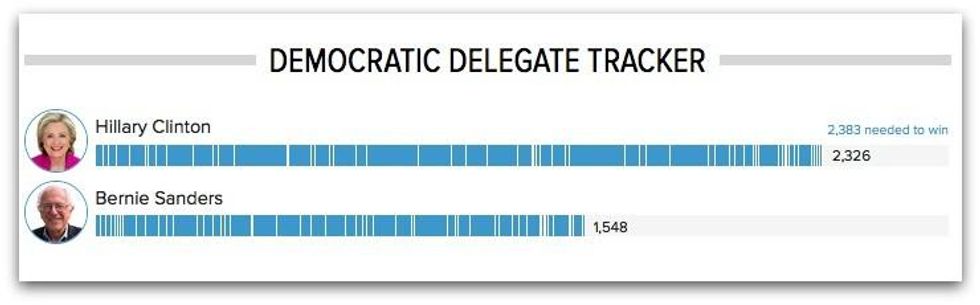
Instead of showing the real difference of 268, this tally shows the difference as 778.
Such sloppy and misleading reporting--which has been ongoing, despite criticism, for months and months--gives the impression to uninformed voters that it's objectively true when outlets declare Clinton needs "about 60 more delegates" to clinch the nomination. The problem? It's not true. In reality, Clinton needs 614 delegates to get to that magic 2,383 number. And as Sanders campaign has been arguing, she is unlikely to get that even if she wins New Jersey or other stats on Tuesday.
Expressing disgust with how the delegate count has been reported throughout the primary season, political observer and columnist Seth Abramson recently wrote:
While not rigged, there is no question that the Democratic Party's primary process -- which uses superdelegates to create an appearance of pre-election electoral inevitability and closed primaries and onerous registration requirements to exclude many new, independent, and party-switching voters -- has dramatically favored Mrs. Clinton, just as the mainstream media, while not engaged in a massive conspiracy, has without question done all it can to aid Mrs. Clinton and hinder Mr. Sanders (as to airtime, coverage, reporting of superdelegate tallies contrary to explicit DNC instructions, and much more); and now, having failed to stop Sanders via either a lack of media coverage or the superdelegate process, a host of arguments against the Senator are now being marshaled by Party and media forces, not a single one of which is novel, and all of which are familiar strategies for decimating grassroots movements before they have an opportunity to threaten entrenched power.
And as New York Daily News columnist Shaun King recently reported, even top staff at the DNC have gone out of their way to explicitly condemn the way many cable outlets and news agencies have reported on the delegate numbers.
"We must ask ourselves this question -- if the Democratic Party asked CNN and other networks not to include these superdelegates, and made it abundantly clear that they are not official until the superdelegates actually vote at the Democratic Convention in late July, why are they including them anyway?"
For the record, and as Sanders also argued on Saturday, King concluded that "Anyone who 'calls the election' on June 7th, be it the Clinton campaign or television networks, is knowingly and deliberately going against the very rules of the party."
During its push in California over the weekend, the Sanders campaign also noted on Sunday that amid a record-setting surge of new voter registrations in the state, the senator in recent weeks has drawn more than 211,000 Californians to hear him at rallies that are far bigger and more boisterous than Clinton's.
Though Clinton and Sanders had agreed to debate in California ahead of Tuesday's pivotal primary, Clinton last month withdrew her promise to participate. Subsequently, an invitation put out to Trump by Sanders for a one-on-debate was at first accepted before the Republican nominee also chickened out.
Addressing concerns that the media may preemptively announce his rival Hillary Clinton as the "presumptive Democratic Party nominee" even before she has won the requisite numbers of pledge delegates, Bernie Sanders over the weekend indicated that such reporting would be both wrong and irresponsible and held to his commitment to take his campaign all the way to the national convention when so-called superdelegates will finally--and for the first time, in fact--be able to cast their vote for who they believe will make the best nominee.
Six states are holding Democratic primaries this Tuesday, including California, New Mexico, New Jersey, Montana, South Dakota, and North Dakota.
Amid some speculation, bolstered by overt comments by people like MSNBC's Chris Matthews, that cable outlets or other news agencies would call the election in favor of Clinton before all the results of next Tuesday's results are in, Sander reiterated his argument that even though he has a steep hill to climb, the race is much closer than often reported.
"It is extremely unlikely that Secretary Clinton will have the requisite number of pledged delegates to claim victory on Tuesday night," Sanders said at a press conference in California on Saturday. "Now I have heard reports that Secretary Clinton has said it's all going to be over on Tuesday night. I have reports that the media, after the New Jersey results come in, are going to declare that it is all over. That simply is not accurate."
What that means, he added, is that he will continue to campaign until the last votes are cast in Washington, D.C.'s primary on June 14 and will then bring his message to July's Democratic National Convention in Philadelphia. "[It] will be a contested convention," he said.
On Sunday morning's Face The Nation, Democratic Party operative David Axelrod was the latest to say that Clinton would likely "clinch" the nomination before polls close in California.
While Sanders does not deny the delegate math is not in his favor, he explained to the more 13,500 supporters at the Los Angeles Memorial Coliseum why he continues to believe he is the best choice to defeat Donald Trump in the general election.
Citing the consistent trends of both national and state polls showing him performing better against the billionaire reality tv star than Clinton, Sanders declared: "I hope that the delegates going to the Democratic National Convention understand that in virtually every state poll we do much better against Donald Trump than Secretary Clinton. If the delegates at the Democratic National Convention want to make sure we defeat Trump and defeat him badly we are the candidate to do that."
And on Sunday, Sanders tweeted:
As of Saturday afternoon, according to Associated Press figures, Sanders trailed Clinton in pledged delegates by a tally of 1,769 to 1,501 -- a difference of 268. Meanwhile, among the superdelegates--elected and party officials who automatically attend the convention where they vote for the candidate of their choice--Clinton has the stated support of 547 of them, compared to 46 who at this point say they back Sanders. Importantly, however, none of these superdelegates have actually "voted" and they can change their minds at any point until casting their ballot at the convention.
And so while the real difference between the candidates is less than 300 delegates, the media often continue to report that difference as more than twice that.
As of this writing on Sunday morning, for example, anyone going to MSNBC's "delegate tracker" on their website would see this:
Instead of showing the real difference of 268, this tally shows the difference as 778.
Such sloppy and misleading reporting--which has been ongoing, despite criticism, for months and months--gives the impression to uninformed voters that it's objectively true when outlets declare Clinton needs "about 60 more delegates" to clinch the nomination. The problem? It's not true. In reality, Clinton needs 614 delegates to get to that magic 2,383 number. And as Sanders campaign has been arguing, she is unlikely to get that even if she wins New Jersey or other stats on Tuesday.
Expressing disgust with how the delegate count has been reported throughout the primary season, political observer and columnist Seth Abramson recently wrote:
While not rigged, there is no question that the Democratic Party's primary process -- which uses superdelegates to create an appearance of pre-election electoral inevitability and closed primaries and onerous registration requirements to exclude many new, independent, and party-switching voters -- has dramatically favored Mrs. Clinton, just as the mainstream media, while not engaged in a massive conspiracy, has without question done all it can to aid Mrs. Clinton and hinder Mr. Sanders (as to airtime, coverage, reporting of superdelegate tallies contrary to explicit DNC instructions, and much more); and now, having failed to stop Sanders via either a lack of media coverage or the superdelegate process, a host of arguments against the Senator are now being marshaled by Party and media forces, not a single one of which is novel, and all of which are familiar strategies for decimating grassroots movements before they have an opportunity to threaten entrenched power.
And as New York Daily News columnist Shaun King recently reported, even top staff at the DNC have gone out of their way to explicitly condemn the way many cable outlets and news agencies have reported on the delegate numbers.
"We must ask ourselves this question -- if the Democratic Party asked CNN and other networks not to include these superdelegates, and made it abundantly clear that they are not official until the superdelegates actually vote at the Democratic Convention in late July, why are they including them anyway?"
For the record, and as Sanders also argued on Saturday, King concluded that "Anyone who 'calls the election' on June 7th, be it the Clinton campaign or television networks, is knowingly and deliberately going against the very rules of the party."
During its push in California over the weekend, the Sanders campaign also noted on Sunday that amid a record-setting surge of new voter registrations in the state, the senator in recent weeks has drawn more than 211,000 Californians to hear him at rallies that are far bigger and more boisterous than Clinton's.
Though Clinton and Sanders had agreed to debate in California ahead of Tuesday's pivotal primary, Clinton last month withdrew her promise to participate. Subsequently, an invitation put out to Trump by Sanders for a one-on-debate was at first accepted before the Republican nominee also chickened out.
Addressing concerns that the media may preemptively announce his rival Hillary Clinton as the "presumptive Democratic Party nominee" even before she has won the requisite numbers of pledge delegates, Bernie Sanders over the weekend indicated that such reporting would be both wrong and irresponsible and held to his commitment to take his campaign all the way to the national convention when so-called superdelegates will finally--and for the first time, in fact--be able to cast their vote for who they believe will make the best nominee.
Six states are holding Democratic primaries this Tuesday, including California, New Mexico, New Jersey, Montana, South Dakota, and North Dakota.
Amid some speculation, bolstered by overt comments by people like MSNBC's Chris Matthews, that cable outlets or other news agencies would call the election in favor of Clinton before all the results of next Tuesday's results are in, Sander reiterated his argument that even though he has a steep hill to climb, the race is much closer than often reported.
"It is extremely unlikely that Secretary Clinton will have the requisite number of pledged delegates to claim victory on Tuesday night," Sanders said at a press conference in California on Saturday. "Now I have heard reports that Secretary Clinton has said it's all going to be over on Tuesday night. I have reports that the media, after the New Jersey results come in, are going to declare that it is all over. That simply is not accurate."
What that means, he added, is that he will continue to campaign until the last votes are cast in Washington, D.C.'s primary on June 14 and will then bring his message to July's Democratic National Convention in Philadelphia. "[It] will be a contested convention," he said.
On Sunday morning's Face The Nation, Democratic Party operative David Axelrod was the latest to say that Clinton would likely "clinch" the nomination before polls close in California.
While Sanders does not deny the delegate math is not in his favor, he explained to the more 13,500 supporters at the Los Angeles Memorial Coliseum why he continues to believe he is the best choice to defeat Donald Trump in the general election.
Citing the consistent trends of both national and state polls showing him performing better against the billionaire reality tv star than Clinton, Sanders declared: "I hope that the delegates going to the Democratic National Convention understand that in virtually every state poll we do much better against Donald Trump than Secretary Clinton. If the delegates at the Democratic National Convention want to make sure we defeat Trump and defeat him badly we are the candidate to do that."
And on Sunday, Sanders tweeted:
As of Saturday afternoon, according to Associated Press figures, Sanders trailed Clinton in pledged delegates by a tally of 1,769 to 1,501 -- a difference of 268. Meanwhile, among the superdelegates--elected and party officials who automatically attend the convention where they vote for the candidate of their choice--Clinton has the stated support of 547 of them, compared to 46 who at this point say they back Sanders. Importantly, however, none of these superdelegates have actually "voted" and they can change their minds at any point until casting their ballot at the convention.
And so while the real difference between the candidates is less than 300 delegates, the media often continue to report that difference as more than twice that.
As of this writing on Sunday morning, for example, anyone going to MSNBC's "delegate tracker" on their website would see this:
Instead of showing the real difference of 268, this tally shows the difference as 778.
Such sloppy and misleading reporting--which has been ongoing, despite criticism, for months and months--gives the impression to uninformed voters that it's objectively true when outlets declare Clinton needs "about 60 more delegates" to clinch the nomination. The problem? It's not true. In reality, Clinton needs 614 delegates to get to that magic 2,383 number. And as Sanders campaign has been arguing, she is unlikely to get that even if she wins New Jersey or other stats on Tuesday.
Expressing disgust with how the delegate count has been reported throughout the primary season, political observer and columnist Seth Abramson recently wrote:
While not rigged, there is no question that the Democratic Party's primary process -- which uses superdelegates to create an appearance of pre-election electoral inevitability and closed primaries and onerous registration requirements to exclude many new, independent, and party-switching voters -- has dramatically favored Mrs. Clinton, just as the mainstream media, while not engaged in a massive conspiracy, has without question done all it can to aid Mrs. Clinton and hinder Mr. Sanders (as to airtime, coverage, reporting of superdelegate tallies contrary to explicit DNC instructions, and much more); and now, having failed to stop Sanders via either a lack of media coverage or the superdelegate process, a host of arguments against the Senator are now being marshaled by Party and media forces, not a single one of which is novel, and all of which are familiar strategies for decimating grassroots movements before they have an opportunity to threaten entrenched power.
And as New York Daily News columnist Shaun King recently reported, even top staff at the DNC have gone out of their way to explicitly condemn the way many cable outlets and news agencies have reported on the delegate numbers.
"We must ask ourselves this question -- if the Democratic Party asked CNN and other networks not to include these superdelegates, and made it abundantly clear that they are not official until the superdelegates actually vote at the Democratic Convention in late July, why are they including them anyway?"
For the record, and as Sanders also argued on Saturday, King concluded that "Anyone who 'calls the election' on June 7th, be it the Clinton campaign or television networks, is knowingly and deliberately going against the very rules of the party."
During its push in California over the weekend, the Sanders campaign also noted on Sunday that amid a record-setting surge of new voter registrations in the state, the senator in recent weeks has drawn more than 211,000 Californians to hear him at rallies that are far bigger and more boisterous than Clinton's.
Though Clinton and Sanders had agreed to debate in California ahead of Tuesday's pivotal primary, Clinton last month withdrew her promise to participate. Subsequently, an invitation put out to Trump by Sanders for a one-on-debate was at first accepted before the Republican nominee also chickened out.