SUBSCRIBE TO OUR FREE NEWSLETTER
Daily news & progressive opinion—funded by the people, not the corporations—delivered straight to your inbox.
5
#000000
#FFFFFF
To donate by check, phone, or other method, see our More Ways to Give page.
Daily news & progressive opinion—funded by the people, not the corporations—delivered straight to your inbox.
Intense fighting between Houthi factions and Yemeni forces allied with a Saudi-backed military campaign continued on Sunday, just a day after the killing of approximately 120 civilians by a Saudi airstrike spurred an impromptu call for a five-day ceasefire in the war-torn and poverty-stricken country.
According to the Associated Press:
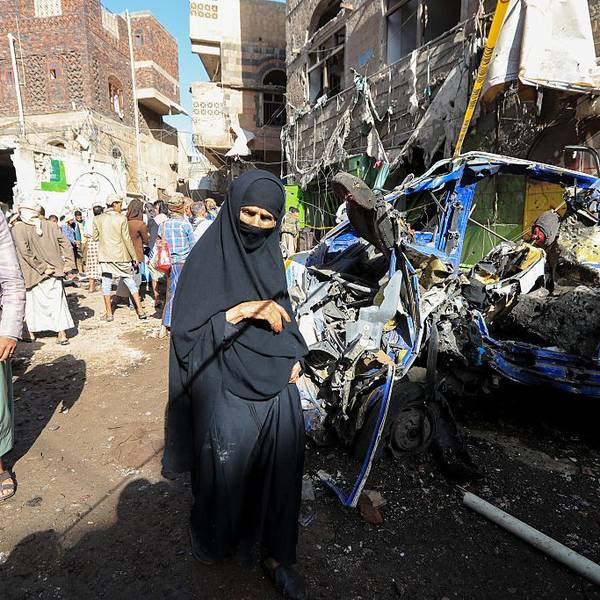
The airstrikes late Friday hit workers' housing for a power plant in Mokha, flattening some of the buildings to the ground [...] A fire erupted in the area, charring many of the corpses, including children, women and elderly people.
Wahib Mohammed, an eyewitness and area resident, said some of the bodies were torn apart by the force of the blast and buried in a mass grave on Saturday. Some of the strikes also hit nearby livestock pens, he said. Human and animal blood pooled on the ground of the surrounding area.
The deadly strike highlights growing concerns that the Saudi-led coalition's airstrikes are increasingly killing civilians as they continue to target Shiite rebels known as Houthis.
Responding to the carnage, Hassan Boucenine of the Geneva-based Doctors Without Borders told AP, "It just shows what is the trend now of the air strikes from the coalition. Now, it's a house, it's a market, it's anything."
In the wake of the deadly airstrike on Saturday, the Saudi-led coalition, which includes the United States and allied Gulf states, called for a five-day ceasefire that would begin at midnight local time on Sunday.
However, even as mixed reporting by Reuters indicated that Houthi military leaders may have rejected the call, a fierce battle raged near the port city Aden over a strategically valuable air base:
The al-Anad base, 50 km (30 miles) from the major southern port city, has been held by the Iranian-allied Houthi movement for much of a fourth-month-old civil war, and is regarded as a strategic asset commanding the approaches to Aden.
The Arab coalition on Saturday announced a ceasefire to take effect at 11.59 p.m. (2059 GMT) on Sunday evening for five days to allow for the delivery of humanitarian aid.
Reuters indicated that a Houthi leader may have taken to Twitter to reject the call for the midnight ceasefire, but other journalists expressed doubt that the message was valid:
Since the Saudi-led bombing began in March of this year, the United Nations last week estimated that in addition to the many more thousands injured and maimed, at least 1,693 civilians have been killed in Yemen, of which 365 were children. Already one of the poorest nations on the planet before the fighting and subsequent bombing campaign began, both the UN and independent aid agencies have warned that so long as the war continues and humanitarian blockade enforced, Yemen's further spiral towards total political chaos and a full-fledged famine will continue.
Dear Common Dreams reader, It’s been nearly 30 years since I co-founded Common Dreams with my late wife, Lina Newhouser. We had the radical notion that journalism should serve the public good, not corporate profits. It was clear to us from the outset what it would take to build such a project. No paid advertisements. No corporate sponsors. No millionaire publisher telling us what to think or do. Many people said we wouldn't last a year, but we proved those doubters wrong. Together with a tremendous team of journalists and dedicated staff, we built an independent media outlet free from the constraints of profits and corporate control. Our mission has always been simple: To inform. To inspire. To ignite change for the common good. Building Common Dreams was not easy. Our survival was never guaranteed. When you take on the most powerful forces—Wall Street greed, fossil fuel industry destruction, Big Tech lobbyists, and uber-rich oligarchs who have spent billions upon billions rigging the economy and democracy in their favor—the only bulwark you have is supporters who believe in your work. But here’s the urgent message from me today. It's never been this bad out there. And it's never been this hard to keep us going. At the very moment Common Dreams is most needed, the threats we face are intensifying. We need your support now more than ever. We don't accept corporate advertising and never will. We don't have a paywall because we don't think people should be blocked from critical news based on their ability to pay. Everything we do is funded by the donations of readers like you. When everyone does the little they can afford, we are strong. But if that support retreats or dries up, so do we. Will you donate now to make sure Common Dreams not only survives but thrives? —Craig Brown, Co-founder |
Intense fighting between Houthi factions and Yemeni forces allied with a Saudi-backed military campaign continued on Sunday, just a day after the killing of approximately 120 civilians by a Saudi airstrike spurred an impromptu call for a five-day ceasefire in the war-torn and poverty-stricken country.
According to the Associated Press:
The airstrikes late Friday hit workers' housing for a power plant in Mokha, flattening some of the buildings to the ground [...] A fire erupted in the area, charring many of the corpses, including children, women and elderly people.
Wahib Mohammed, an eyewitness and area resident, said some of the bodies were torn apart by the force of the blast and buried in a mass grave on Saturday. Some of the strikes also hit nearby livestock pens, he said. Human and animal blood pooled on the ground of the surrounding area.
The deadly strike highlights growing concerns that the Saudi-led coalition's airstrikes are increasingly killing civilians as they continue to target Shiite rebels known as Houthis.
Responding to the carnage, Hassan Boucenine of the Geneva-based Doctors Without Borders told AP, "It just shows what is the trend now of the air strikes from the coalition. Now, it's a house, it's a market, it's anything."
In the wake of the deadly airstrike on Saturday, the Saudi-led coalition, which includes the United States and allied Gulf states, called for a five-day ceasefire that would begin at midnight local time on Sunday.
However, even as mixed reporting by Reuters indicated that Houthi military leaders may have rejected the call, a fierce battle raged near the port city Aden over a strategically valuable air base:
The al-Anad base, 50 km (30 miles) from the major southern port city, has been held by the Iranian-allied Houthi movement for much of a fourth-month-old civil war, and is regarded as a strategic asset commanding the approaches to Aden.
The Arab coalition on Saturday announced a ceasefire to take effect at 11.59 p.m. (2059 GMT) on Sunday evening for five days to allow for the delivery of humanitarian aid.
Reuters indicated that a Houthi leader may have taken to Twitter to reject the call for the midnight ceasefire, but other journalists expressed doubt that the message was valid:
Since the Saudi-led bombing began in March of this year, the United Nations last week estimated that in addition to the many more thousands injured and maimed, at least 1,693 civilians have been killed in Yemen, of which 365 were children. Already one of the poorest nations on the planet before the fighting and subsequent bombing campaign began, both the UN and independent aid agencies have warned that so long as the war continues and humanitarian blockade enforced, Yemen's further spiral towards total political chaos and a full-fledged famine will continue.
Intense fighting between Houthi factions and Yemeni forces allied with a Saudi-backed military campaign continued on Sunday, just a day after the killing of approximately 120 civilians by a Saudi airstrike spurred an impromptu call for a five-day ceasefire in the war-torn and poverty-stricken country.
According to the Associated Press:
The airstrikes late Friday hit workers' housing for a power plant in Mokha, flattening some of the buildings to the ground [...] A fire erupted in the area, charring many of the corpses, including children, women and elderly people.
Wahib Mohammed, an eyewitness and area resident, said some of the bodies were torn apart by the force of the blast and buried in a mass grave on Saturday. Some of the strikes also hit nearby livestock pens, he said. Human and animal blood pooled on the ground of the surrounding area.
The deadly strike highlights growing concerns that the Saudi-led coalition's airstrikes are increasingly killing civilians as they continue to target Shiite rebels known as Houthis.
Responding to the carnage, Hassan Boucenine of the Geneva-based Doctors Without Borders told AP, "It just shows what is the trend now of the air strikes from the coalition. Now, it's a house, it's a market, it's anything."
In the wake of the deadly airstrike on Saturday, the Saudi-led coalition, which includes the United States and allied Gulf states, called for a five-day ceasefire that would begin at midnight local time on Sunday.
However, even as mixed reporting by Reuters indicated that Houthi military leaders may have rejected the call, a fierce battle raged near the port city Aden over a strategically valuable air base:
The al-Anad base, 50 km (30 miles) from the major southern port city, has been held by the Iranian-allied Houthi movement for much of a fourth-month-old civil war, and is regarded as a strategic asset commanding the approaches to Aden.
The Arab coalition on Saturday announced a ceasefire to take effect at 11.59 p.m. (2059 GMT) on Sunday evening for five days to allow for the delivery of humanitarian aid.
Reuters indicated that a Houthi leader may have taken to Twitter to reject the call for the midnight ceasefire, but other journalists expressed doubt that the message was valid:
Since the Saudi-led bombing began in March of this year, the United Nations last week estimated that in addition to the many more thousands injured and maimed, at least 1,693 civilians have been killed in Yemen, of which 365 were children. Already one of the poorest nations on the planet before the fighting and subsequent bombing campaign began, both the UN and independent aid agencies have warned that so long as the war continues and humanitarian blockade enforced, Yemen's further spiral towards total political chaos and a full-fledged famine will continue.