SUBSCRIBE TO OUR FREE NEWSLETTER
Daily news & progressive opinion—funded by the people, not the corporations—delivered straight to your inbox.
5
#000000
#FFFFFF
To donate by check, phone, or other method, see our More Ways to Give page.
Daily news & progressive opinion—funded by the people, not the corporations—delivered straight to your inbox.
The death toll continues to climb in what is being called the worst outbreak of Ebola in history.
Health officials say the epidemic, which has killed more than 670 people in four West African countries, is "out of control," while Liberia's president has closed all but three land border crossings, restricted public gatherings, and quarantined communities heavily affected by the outbreak. Screening centers are being set up at the few major entry points that will remain open, such as the main airport, according to the BBC.
Two American health care workers have been infected with the disease, and one of Liberia's high-profile Ebola doctors, Samuel Brisbane, died Sunday. In Liberia, all hotels, restaurants, and movie theaters have been ordered to play a five-minute film to raise public awareness about the highly contagious virus.
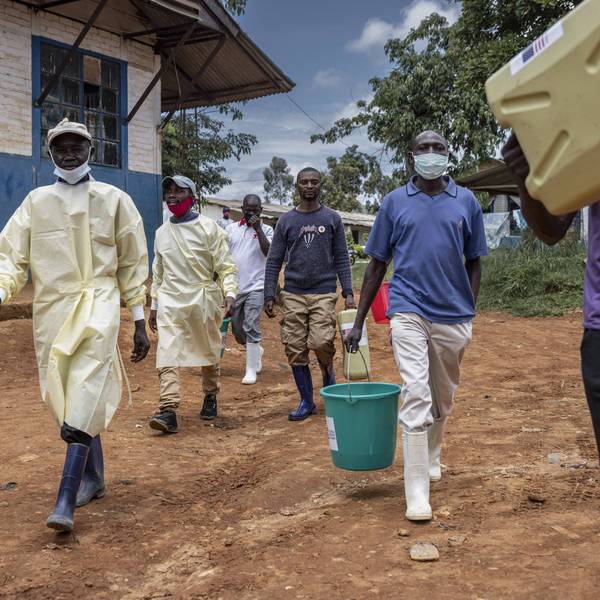
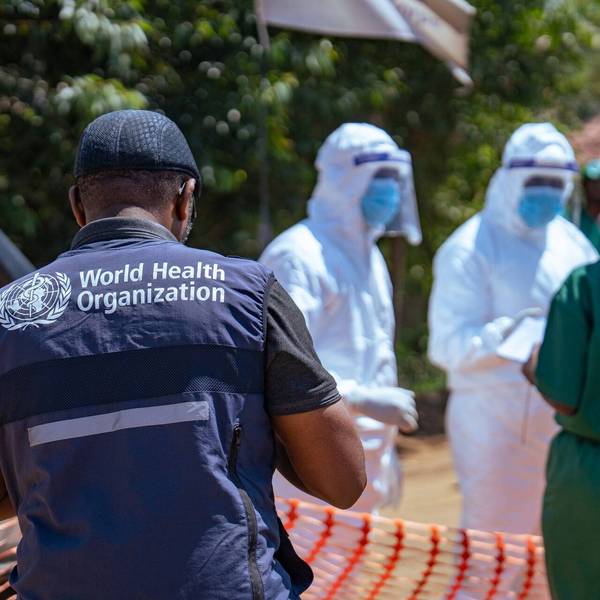
Doctors Without Borders/Medecins Sans Frontieres (MSF) announced Monday it was stepping up its response in the most affected areas, even as medical volunteers face fear and hostility from panicked local populations.
The New York Times reports:
Now the fear of aid workers, principally from Doctors Without Borders and the Red Cross, is helping to spread the disease, health officials say, creating a secondary crisis.
Villagers flee at the sight of a Red Cross truck. When a Westerner passes, villagers cry out, "Ebola, Ebola!" and run away.
This month, Doctors Without Borders classified 12 villages in Guinea as "red," meaning they might harbor Ebola but were inaccessible for safety reasons.
To combat such mistrust in Sierra Leone, which MSF refers to as the "epicenter of the epidemic," the international aid organization has trained more than 200 community health workers "to deliver essential health messages to people in their villages about how to protect themselves against Ebola and what action to take if someone shows any signs or symptoms of the disease."
But humanitarian resources are stretched thin. In a Field News report released Monday, MSF says:
In Liberia, the situation is deteriorating rapidly, with cases of Ebola now confirmed in seven counties, including in the capital, Monrovia. There are critical gaps in all aspects of the response, and urgent efforts are needed to scale up, particularly in terms of contact tracing, organizing safe burials, and establishing a functioning alert system.
Already stretched beyond capacity in Guinea and Sierra Leone, MSF is able to provide only limited technical support to the Liberian Ministry of Health.
According to the World Health Organization (WHO), Ebola symptoms include: sudden onset of fever, intense weakness, muscle pain, headache, and sore throat, followed by vomiting, diarrhea, rash, impaired kidney and liver function, and in some cases, both internal and external bleeding. The virus is thought to be introduced through close contact with the blood, secretions, and bodily fluids of infected animals such as fruit bats, monkeys, and chimpanzees. It is then spread via human-to-human contact, both direct and indirect.
The WHO says: "Burial ceremonies in which mourners have direct contact with the body of the deceased person can also play a role in the transmission of Ebola. Men who have recovered from the disease can still transmit the virus through their semen for up to 7 weeks after recovery from illness."
No vaccines or drug treatments are known. The disease can have a 90 percent fatality rate, though the rate for the current outbreak is around 60 percent.
For Financial Times, journalists Javier Blas and Clive Cookson explain why Ebola is so scary, even when compared to other deadly diseases such as AIDS, malaria, and tuberculosis:
The main risk of Ebola, however, lies in its immediate impact and high fatality rate, giving rise to fears of a Hollywood-like horror scenario in which it travels to an African megacity, such as Lagos with its 21m inhabitants, and spreads without control.
On Monday, Nigeria largest's airline, Arik Air, suspended all flights to Liberia and Sierra Leone after a man with Ebola flew to Nigeria last week and died at the Lagos airport.
Dear Common Dreams reader, It’s been nearly 30 years since I co-founded Common Dreams with my late wife, Lina Newhouser. We had the radical notion that journalism should serve the public good, not corporate profits. It was clear to us from the outset what it would take to build such a project. No paid advertisements. No corporate sponsors. No millionaire publisher telling us what to think or do. Many people said we wouldn't last a year, but we proved those doubters wrong. Together with a tremendous team of journalists and dedicated staff, we built an independent media outlet free from the constraints of profits and corporate control. Our mission has always been simple: To inform. To inspire. To ignite change for the common good. Building Common Dreams was not easy. Our survival was never guaranteed. When you take on the most powerful forces—Wall Street greed, fossil fuel industry destruction, Big Tech lobbyists, and uber-rich oligarchs who have spent billions upon billions rigging the economy and democracy in their favor—the only bulwark you have is supporters who believe in your work. But here’s the urgent message from me today. It's never been this bad out there. And it's never been this hard to keep us going. At the very moment Common Dreams is most needed, the threats we face are intensifying. We need your support now more than ever. We don't accept corporate advertising and never will. We don't have a paywall because we don't think people should be blocked from critical news based on their ability to pay. Everything we do is funded by the donations of readers like you. When everyone does the little they can afford, we are strong. But if that support retreats or dries up, so do we. Will you donate now to make sure Common Dreams not only survives but thrives? —Craig Brown, Co-founder |
The death toll continues to climb in what is being called the worst outbreak of Ebola in history.
Health officials say the epidemic, which has killed more than 670 people in four West African countries, is "out of control," while Liberia's president has closed all but three land border crossings, restricted public gatherings, and quarantined communities heavily affected by the outbreak. Screening centers are being set up at the few major entry points that will remain open, such as the main airport, according to the BBC.
Two American health care workers have been infected with the disease, and one of Liberia's high-profile Ebola doctors, Samuel Brisbane, died Sunday. In Liberia, all hotels, restaurants, and movie theaters have been ordered to play a five-minute film to raise public awareness about the highly contagious virus.
Doctors Without Borders/Medecins Sans Frontieres (MSF) announced Monday it was stepping up its response in the most affected areas, even as medical volunteers face fear and hostility from panicked local populations.
The New York Times reports:
Now the fear of aid workers, principally from Doctors Without Borders and the Red Cross, is helping to spread the disease, health officials say, creating a secondary crisis.
Villagers flee at the sight of a Red Cross truck. When a Westerner passes, villagers cry out, "Ebola, Ebola!" and run away.
This month, Doctors Without Borders classified 12 villages in Guinea as "red," meaning they might harbor Ebola but were inaccessible for safety reasons.
To combat such mistrust in Sierra Leone, which MSF refers to as the "epicenter of the epidemic," the international aid organization has trained more than 200 community health workers "to deliver essential health messages to people in their villages about how to protect themselves against Ebola and what action to take if someone shows any signs or symptoms of the disease."
But humanitarian resources are stretched thin. In a Field News report released Monday, MSF says:
In Liberia, the situation is deteriorating rapidly, with cases of Ebola now confirmed in seven counties, including in the capital, Monrovia. There are critical gaps in all aspects of the response, and urgent efforts are needed to scale up, particularly in terms of contact tracing, organizing safe burials, and establishing a functioning alert system.
Already stretched beyond capacity in Guinea and Sierra Leone, MSF is able to provide only limited technical support to the Liberian Ministry of Health.
According to the World Health Organization (WHO), Ebola symptoms include: sudden onset of fever, intense weakness, muscle pain, headache, and sore throat, followed by vomiting, diarrhea, rash, impaired kidney and liver function, and in some cases, both internal and external bleeding. The virus is thought to be introduced through close contact with the blood, secretions, and bodily fluids of infected animals such as fruit bats, monkeys, and chimpanzees. It is then spread via human-to-human contact, both direct and indirect.
The WHO says: "Burial ceremonies in which mourners have direct contact with the body of the deceased person can also play a role in the transmission of Ebola. Men who have recovered from the disease can still transmit the virus through their semen for up to 7 weeks after recovery from illness."
No vaccines or drug treatments are known. The disease can have a 90 percent fatality rate, though the rate for the current outbreak is around 60 percent.
For Financial Times, journalists Javier Blas and Clive Cookson explain why Ebola is so scary, even when compared to other deadly diseases such as AIDS, malaria, and tuberculosis:
The main risk of Ebola, however, lies in its immediate impact and high fatality rate, giving rise to fears of a Hollywood-like horror scenario in which it travels to an African megacity, such as Lagos with its 21m inhabitants, and spreads without control.
On Monday, Nigeria largest's airline, Arik Air, suspended all flights to Liberia and Sierra Leone after a man with Ebola flew to Nigeria last week and died at the Lagos airport.
The death toll continues to climb in what is being called the worst outbreak of Ebola in history.
Health officials say the epidemic, which has killed more than 670 people in four West African countries, is "out of control," while Liberia's president has closed all but three land border crossings, restricted public gatherings, and quarantined communities heavily affected by the outbreak. Screening centers are being set up at the few major entry points that will remain open, such as the main airport, according to the BBC.
Two American health care workers have been infected with the disease, and one of Liberia's high-profile Ebola doctors, Samuel Brisbane, died Sunday. In Liberia, all hotels, restaurants, and movie theaters have been ordered to play a five-minute film to raise public awareness about the highly contagious virus.
Doctors Without Borders/Medecins Sans Frontieres (MSF) announced Monday it was stepping up its response in the most affected areas, even as medical volunteers face fear and hostility from panicked local populations.
The New York Times reports:
Now the fear of aid workers, principally from Doctors Without Borders and the Red Cross, is helping to spread the disease, health officials say, creating a secondary crisis.
Villagers flee at the sight of a Red Cross truck. When a Westerner passes, villagers cry out, "Ebola, Ebola!" and run away.
This month, Doctors Without Borders classified 12 villages in Guinea as "red," meaning they might harbor Ebola but were inaccessible for safety reasons.
To combat such mistrust in Sierra Leone, which MSF refers to as the "epicenter of the epidemic," the international aid organization has trained more than 200 community health workers "to deliver essential health messages to people in their villages about how to protect themselves against Ebola and what action to take if someone shows any signs or symptoms of the disease."
But humanitarian resources are stretched thin. In a Field News report released Monday, MSF says:
In Liberia, the situation is deteriorating rapidly, with cases of Ebola now confirmed in seven counties, including in the capital, Monrovia. There are critical gaps in all aspects of the response, and urgent efforts are needed to scale up, particularly in terms of contact tracing, organizing safe burials, and establishing a functioning alert system.
Already stretched beyond capacity in Guinea and Sierra Leone, MSF is able to provide only limited technical support to the Liberian Ministry of Health.
According to the World Health Organization (WHO), Ebola symptoms include: sudden onset of fever, intense weakness, muscle pain, headache, and sore throat, followed by vomiting, diarrhea, rash, impaired kidney and liver function, and in some cases, both internal and external bleeding. The virus is thought to be introduced through close contact with the blood, secretions, and bodily fluids of infected animals such as fruit bats, monkeys, and chimpanzees. It is then spread via human-to-human contact, both direct and indirect.
The WHO says: "Burial ceremonies in which mourners have direct contact with the body of the deceased person can also play a role in the transmission of Ebola. Men who have recovered from the disease can still transmit the virus through their semen for up to 7 weeks after recovery from illness."
No vaccines or drug treatments are known. The disease can have a 90 percent fatality rate, though the rate for the current outbreak is around 60 percent.
For Financial Times, journalists Javier Blas and Clive Cookson explain why Ebola is so scary, even when compared to other deadly diseases such as AIDS, malaria, and tuberculosis:
The main risk of Ebola, however, lies in its immediate impact and high fatality rate, giving rise to fears of a Hollywood-like horror scenario in which it travels to an African megacity, such as Lagos with its 21m inhabitants, and spreads without control.
On Monday, Nigeria largest's airline, Arik Air, suspended all flights to Liberia and Sierra Leone after a man with Ebola flew to Nigeria last week and died at the Lagos airport.