SUBSCRIBE TO OUR FREE NEWSLETTER
Daily news & progressive opinion—funded by the people, not the corporations—delivered straight to your inbox.
5
#000000
#FFFFFF
To donate by check, phone, or other method, see our More Ways to Give page.
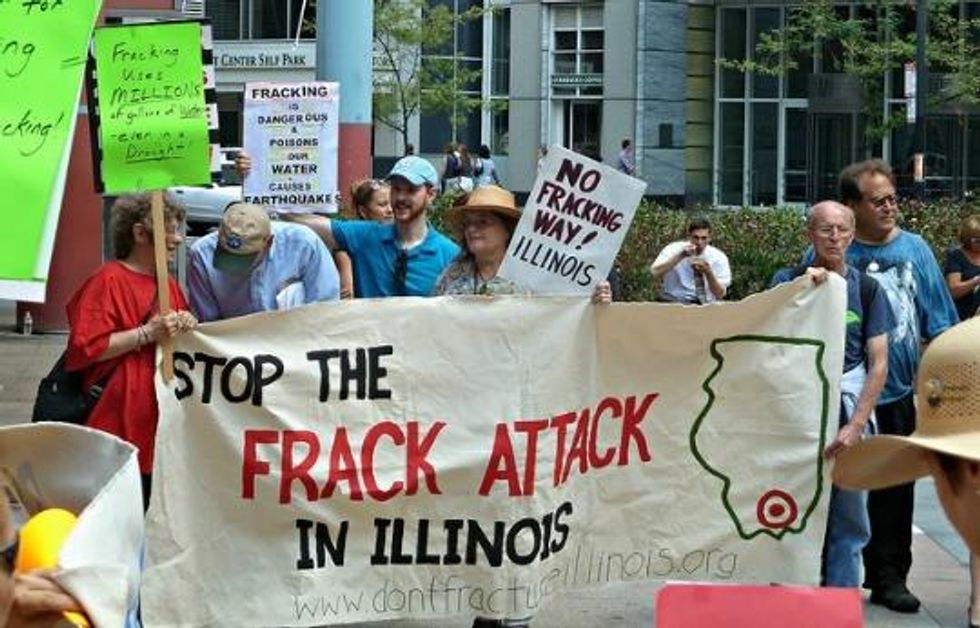
A bid to ban the controversial drilling practice known as fracking from an Illinois county, which drew widespread attention from the fracking industry across the country, failed Tuesday night in a referendum vote.
The ballot measure, which sought to ban fracking "as a violation of their rights to health and safety," was defeated by a 600-vote margin, with 2,220 people voting against the provision and 1,600 supporting it.
In the lead up to the referendum vote, out of state fracking interests as well as instate conservative groups poured money into the campaign against the ban, including The Illinois Chamber of Commerce who spent $23,500 alone to promote fracking in the county "where less than 3,000 people cast ballots in the last primary election," the Huffington Post reported.
Earlier:
Residents in Johnson County, Illinois are voting Tuesday on whether or not to ban the controversial drilling practice known as hydraulic fracturing (fracking) with anti-drilling organizers saying a 'Yes' vote on the proposed moratorium would send a clear anti-fracking message to county officials and the oil and gas industries not only locally but across the country.
"Shall the people's right to local self-government be asserted by Johnson County to ban corporate fracking as a violation of their rights to health and safety?" asks the referendum, which was organized by two groups --the Southern Illinoisans Against Fracking Our Environment (SAFE) and the Community Environment Legal Defense Fund (CELDF).
Predictably, oil and gas interests are spending big money in the county to sway voters against the ban. And even if the non-binding referendum passes, the measure will move to the Johnson County's board of commissioners for approval, where it risks being rejected by the three-person panel.
"You've got a bunch of environmentalists that want a bill of rights that covers a whole lot of stuff that these environmentalists stand for ... and I'm not going to get into it," Phil Stewart, one of the Johnson County commissioners, told Al-Jazeera. "I've leased my land to the oil companies and I see nothing wrong with fracking."
At the heart of the issue lies the "New Albany Shale" of the Illinois Basin, which fossil fuel companies claim may contain up to 300 billion barrels of oil. The oil and gas industry has been exploring this shale area since Illinois passed the Hydraulic Fracturing Regulatory Act last June. Opponents of that law, however, say it fails to protect humans and the environment from air and water contamination, as Al Jazeera reports.
The referendum "has oil and gas interests panicked about a local effort to stop fracking," argues Will Reynolds, an environmental activist and blogger, writing at the Huffington Post. "They're spending tens of thousands in the rural county to defeat a referendum that opposes fracking and defends local rights."
The Illinois Chamber of Commerce alone has spent $23,500 to promote fracking in the county "where less than 3,000 people cast ballots in the last primary election," writes Reynolds.
And an out of state "front group for the oil industry," according to Reynolds, has been sending professional mailings and robo-calls throughout the county in support of the energy companies, such as the Kansas-based Woolsey Petroleum Corporation, looking to move in on Illinois' profitable reserves.
"The industry and their cronies recently realized that voters are siding with local control instead of handing their future over to Kansas-based frackers Woolsey Energy," Reynolds continues. SAFE gathered 1000 signatures in support of the referendum, which is roughly three times more than required. In January 20,000 fracking comments were sent to the Illinois Department of Natural Resources, opposing the "dangerously weak" fracking rules written by the IDNR to implement the Hydraulic Fracturing Regulatory Act.
Annette McMichael, communications director for SAFE and a Johnson County landowner, said that if Tuesday's ban referendum fails, "We'll go back to the education campaign -- one thing the oil and gas industry doesn't realize is that we're never going to quit. And we have the truth on our side."
______________________
A bid to ban the controversial drilling practice known as fracking from an Illinois county, which drew widespread attention from the fracking industry across the country, failed Tuesday night in a referendum vote.
The ballot measure, which sought to ban fracking "as a violation of their rights to health and safety," was defeated by a 600-vote margin, with 2,220 people voting against the provision and 1,600 supporting it.
In the lead up to the referendum vote, out of state fracking interests as well as instate conservative groups poured money into the campaign against the ban, including The Illinois Chamber of Commerce who spent $23,500 alone to promote fracking in the county "where less than 3,000 people cast ballots in the last primary election," the Huffington Post reported.
Earlier:
Residents in Johnson County, Illinois are voting Tuesday on whether or not to ban the controversial drilling practice known as hydraulic fracturing (fracking) with anti-drilling organizers saying a 'Yes' vote on the proposed moratorium would send a clear anti-fracking message to county officials and the oil and gas industries not only locally but across the country.
"Shall the people's right to local self-government be asserted by Johnson County to ban corporate fracking as a violation of their rights to health and safety?" asks the referendum, which was organized by two groups --the Southern Illinoisans Against Fracking Our Environment (SAFE) and the Community Environment Legal Defense Fund (CELDF).
Predictably, oil and gas interests are spending big money in the county to sway voters against the ban. And even if the non-binding referendum passes, the measure will move to the Johnson County's board of commissioners for approval, where it risks being rejected by the three-person panel.
"You've got a bunch of environmentalists that want a bill of rights that covers a whole lot of stuff that these environmentalists stand for ... and I'm not going to get into it," Phil Stewart, one of the Johnson County commissioners, told Al-Jazeera. "I've leased my land to the oil companies and I see nothing wrong with fracking."
At the heart of the issue lies the "New Albany Shale" of the Illinois Basin, which fossil fuel companies claim may contain up to 300 billion barrels of oil. The oil and gas industry has been exploring this shale area since Illinois passed the Hydraulic Fracturing Regulatory Act last June. Opponents of that law, however, say it fails to protect humans and the environment from air and water contamination, as Al Jazeera reports.
The referendum "has oil and gas interests panicked about a local effort to stop fracking," argues Will Reynolds, an environmental activist and blogger, writing at the Huffington Post. "They're spending tens of thousands in the rural county to defeat a referendum that opposes fracking and defends local rights."
The Illinois Chamber of Commerce alone has spent $23,500 to promote fracking in the county "where less than 3,000 people cast ballots in the last primary election," writes Reynolds.
And an out of state "front group for the oil industry," according to Reynolds, has been sending professional mailings and robo-calls throughout the county in support of the energy companies, such as the Kansas-based Woolsey Petroleum Corporation, looking to move in on Illinois' profitable reserves.
"The industry and their cronies recently realized that voters are siding with local control instead of handing their future over to Kansas-based frackers Woolsey Energy," Reynolds continues. SAFE gathered 1000 signatures in support of the referendum, which is roughly three times more than required. In January 20,000 fracking comments were sent to the Illinois Department of Natural Resources, opposing the "dangerously weak" fracking rules written by the IDNR to implement the Hydraulic Fracturing Regulatory Act.
Annette McMichael, communications director for SAFE and a Johnson County landowner, said that if Tuesday's ban referendum fails, "We'll go back to the education campaign -- one thing the oil and gas industry doesn't realize is that we're never going to quit. And we have the truth on our side."
______________________
A bid to ban the controversial drilling practice known as fracking from an Illinois county, which drew widespread attention from the fracking industry across the country, failed Tuesday night in a referendum vote.
The ballot measure, which sought to ban fracking "as a violation of their rights to health and safety," was defeated by a 600-vote margin, with 2,220 people voting against the provision and 1,600 supporting it.
In the lead up to the referendum vote, out of state fracking interests as well as instate conservative groups poured money into the campaign against the ban, including The Illinois Chamber of Commerce who spent $23,500 alone to promote fracking in the county "where less than 3,000 people cast ballots in the last primary election," the Huffington Post reported.
Earlier:
Residents in Johnson County, Illinois are voting Tuesday on whether or not to ban the controversial drilling practice known as hydraulic fracturing (fracking) with anti-drilling organizers saying a 'Yes' vote on the proposed moratorium would send a clear anti-fracking message to county officials and the oil and gas industries not only locally but across the country.
"Shall the people's right to local self-government be asserted by Johnson County to ban corporate fracking as a violation of their rights to health and safety?" asks the referendum, which was organized by two groups --the Southern Illinoisans Against Fracking Our Environment (SAFE) and the Community Environment Legal Defense Fund (CELDF).
Predictably, oil and gas interests are spending big money in the county to sway voters against the ban. And even if the non-binding referendum passes, the measure will move to the Johnson County's board of commissioners for approval, where it risks being rejected by the three-person panel.
"You've got a bunch of environmentalists that want a bill of rights that covers a whole lot of stuff that these environmentalists stand for ... and I'm not going to get into it," Phil Stewart, one of the Johnson County commissioners, told Al-Jazeera. "I've leased my land to the oil companies and I see nothing wrong with fracking."
At the heart of the issue lies the "New Albany Shale" of the Illinois Basin, which fossil fuel companies claim may contain up to 300 billion barrels of oil. The oil and gas industry has been exploring this shale area since Illinois passed the Hydraulic Fracturing Regulatory Act last June. Opponents of that law, however, say it fails to protect humans and the environment from air and water contamination, as Al Jazeera reports.
The referendum "has oil and gas interests panicked about a local effort to stop fracking," argues Will Reynolds, an environmental activist and blogger, writing at the Huffington Post. "They're spending tens of thousands in the rural county to defeat a referendum that opposes fracking and defends local rights."
The Illinois Chamber of Commerce alone has spent $23,500 to promote fracking in the county "where less than 3,000 people cast ballots in the last primary election," writes Reynolds.
And an out of state "front group for the oil industry," according to Reynolds, has been sending professional mailings and robo-calls throughout the county in support of the energy companies, such as the Kansas-based Woolsey Petroleum Corporation, looking to move in on Illinois' profitable reserves.
"The industry and their cronies recently realized that voters are siding with local control instead of handing their future over to Kansas-based frackers Woolsey Energy," Reynolds continues. SAFE gathered 1000 signatures in support of the referendum, which is roughly three times more than required. In January 20,000 fracking comments were sent to the Illinois Department of Natural Resources, opposing the "dangerously weak" fracking rules written by the IDNR to implement the Hydraulic Fracturing Regulatory Act.
Annette McMichael, communications director for SAFE and a Johnson County landowner, said that if Tuesday's ban referendum fails, "We'll go back to the education campaign -- one thing the oil and gas industry doesn't realize is that we're never going to quit. And we have the truth on our side."
______________________