

SUBSCRIBE TO OUR FREE NEWSLETTER
Daily news & progressive opinion—funded by the people, not the corporations—delivered straight to your inbox.
5
#000000
#FFFFFF
To donate by check, phone, or other method, see our More Ways to Give page.
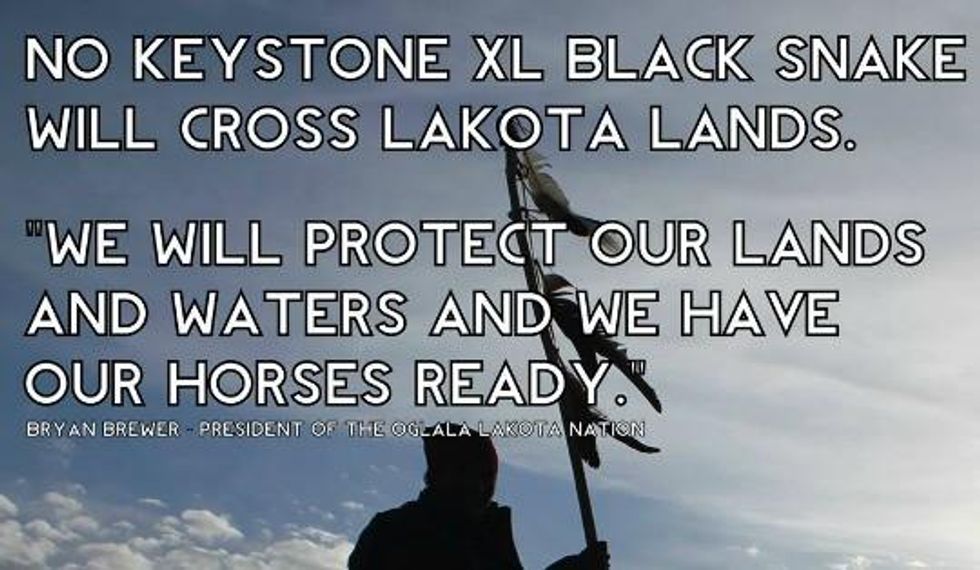
In Montana, North Dakota, South Dakota, and Nebraska, tribal groups and indigenous activists are busy planning the best ways to resist the pipeline--which they have dubbed the Black Snake--if it gains approval. As McClatchy reports Monday:
In South Dakota, home to some of the nation's poorest American Indians, tribes are busy preparing for nonviolent battle with "resistance training" aimed at TransCanada, the company that wants to develop the 1,700-mile pipeline.
While organizers said they want to keep their strategy a secret, they're considering everything from vigils to civil disobedience to blockades to thwart the moving of construction equipment and the delivery of materials.
"We're going to do everything we possibly can," said Greg Grey Cloud of the Rosebud Sioux Tribe, who attended a two-day conference and training session in Rapid City last week sponsored by the Oglala Sioux Tribe called "Help Save Mother Earth from the Keystone Pipeline." He said tribes are considering setting up encampments to follow the construction, but he stressed that any actions would be peaceful. "We're not going to damage anything or riot or anything like that," he said.
As Common Dreams previously reported, the indigenous-led 'Moccasins on the Ground' is one of the key programs laying the groundwork for this resistance by giving nonviolent direct action trainings to front-line communities.
"We go up to wherever we've been invited, usually along pipeline routes," said Kent Lebsock, director of the Owe Aku International Justice Project, in an interview with Common Dreams earlier this month. "We have three-day trainings on nonviolent direct action. This includes blockade tactics, and discipline is a big part of the training as well. We did nine of them last summer and fall, all the way from Montana to South Dakota, as well as teach-ins in Colorado and a training camp in Oklahoma."
65-year-old Faith Spotted Eagle, a Yankton Sioux tribal elder from South Dakota told McClatchy that she feels obligated to try to stop the pipeline, both to protect the land and water but also for her grandchildren and to protect local women from attacks associated with the infusion of outside construction workers.
"This is a form of militarism, bringing in these man camps," said Spotted Eagle, referring to labor camps that some see as a promise of jobs generated by the pipeline project. "For those of us who have the history, it smacks of repetitive economics, when they put us in forts and they wanted our land. . . . All we're willing to do here is sell our soul, just for the economy. That's the dark side."
However, when it comes to feeling assured of their ability to actually block the pipeline, she's not so convinced their effforts will be enough.
"There is no way for Native people to say no - there never has been," she said. "Our history has caused us not to be optimistic. . . . When you have capitalism, you have to have an underclass - and we're the underclass."
______________________________________
In Montana, North Dakota, South Dakota, and Nebraska, tribal groups and indigenous activists are busy planning the best ways to resist the pipeline--which they have dubbed the Black Snake--if it gains approval. As McClatchy reports Monday:
In South Dakota, home to some of the nation's poorest American Indians, tribes are busy preparing for nonviolent battle with "resistance training" aimed at TransCanada, the company that wants to develop the 1,700-mile pipeline.
While organizers said they want to keep their strategy a secret, they're considering everything from vigils to civil disobedience to blockades to thwart the moving of construction equipment and the delivery of materials.
"We're going to do everything we possibly can," said Greg Grey Cloud of the Rosebud Sioux Tribe, who attended a two-day conference and training session in Rapid City last week sponsored by the Oglala Sioux Tribe called "Help Save Mother Earth from the Keystone Pipeline." He said tribes are considering setting up encampments to follow the construction, but he stressed that any actions would be peaceful. "We're not going to damage anything or riot or anything like that," he said.
As Common Dreams previously reported, the indigenous-led 'Moccasins on the Ground' is one of the key programs laying the groundwork for this resistance by giving nonviolent direct action trainings to front-line communities.
"We go up to wherever we've been invited, usually along pipeline routes," said Kent Lebsock, director of the Owe Aku International Justice Project, in an interview with Common Dreams earlier this month. "We have three-day trainings on nonviolent direct action. This includes blockade tactics, and discipline is a big part of the training as well. We did nine of them last summer and fall, all the way from Montana to South Dakota, as well as teach-ins in Colorado and a training camp in Oklahoma."
65-year-old Faith Spotted Eagle, a Yankton Sioux tribal elder from South Dakota told McClatchy that she feels obligated to try to stop the pipeline, both to protect the land and water but also for her grandchildren and to protect local women from attacks associated with the infusion of outside construction workers.
"This is a form of militarism, bringing in these man camps," said Spotted Eagle, referring to labor camps that some see as a promise of jobs generated by the pipeline project. "For those of us who have the history, it smacks of repetitive economics, when they put us in forts and they wanted our land. . . . All we're willing to do here is sell our soul, just for the economy. That's the dark side."
However, when it comes to feeling assured of their ability to actually block the pipeline, she's not so convinced their effforts will be enough.
"There is no way for Native people to say no - there never has been," she said. "Our history has caused us not to be optimistic. . . . When you have capitalism, you have to have an underclass - and we're the underclass."
______________________________________
In Montana, North Dakota, South Dakota, and Nebraska, tribal groups and indigenous activists are busy planning the best ways to resist the pipeline--which they have dubbed the Black Snake--if it gains approval. As McClatchy reports Monday:
In South Dakota, home to some of the nation's poorest American Indians, tribes are busy preparing for nonviolent battle with "resistance training" aimed at TransCanada, the company that wants to develop the 1,700-mile pipeline.
While organizers said they want to keep their strategy a secret, they're considering everything from vigils to civil disobedience to blockades to thwart the moving of construction equipment and the delivery of materials.
"We're going to do everything we possibly can," said Greg Grey Cloud of the Rosebud Sioux Tribe, who attended a two-day conference and training session in Rapid City last week sponsored by the Oglala Sioux Tribe called "Help Save Mother Earth from the Keystone Pipeline." He said tribes are considering setting up encampments to follow the construction, but he stressed that any actions would be peaceful. "We're not going to damage anything or riot or anything like that," he said.
As Common Dreams previously reported, the indigenous-led 'Moccasins on the Ground' is one of the key programs laying the groundwork for this resistance by giving nonviolent direct action trainings to front-line communities.
"We go up to wherever we've been invited, usually along pipeline routes," said Kent Lebsock, director of the Owe Aku International Justice Project, in an interview with Common Dreams earlier this month. "We have three-day trainings on nonviolent direct action. This includes blockade tactics, and discipline is a big part of the training as well. We did nine of them last summer and fall, all the way from Montana to South Dakota, as well as teach-ins in Colorado and a training camp in Oklahoma."
65-year-old Faith Spotted Eagle, a Yankton Sioux tribal elder from South Dakota told McClatchy that she feels obligated to try to stop the pipeline, both to protect the land and water but also for her grandchildren and to protect local women from attacks associated with the infusion of outside construction workers.
"This is a form of militarism, bringing in these man camps," said Spotted Eagle, referring to labor camps that some see as a promise of jobs generated by the pipeline project. "For those of us who have the history, it smacks of repetitive economics, when they put us in forts and they wanted our land. . . . All we're willing to do here is sell our soul, just for the economy. That's the dark side."
However, when it comes to feeling assured of their ability to actually block the pipeline, she's not so convinced their effforts will be enough.
"There is no way for Native people to say no - there never has been," she said. "Our history has caused us not to be optimistic. . . . When you have capitalism, you have to have an underclass - and we're the underclass."
______________________________________

