

SUBSCRIBE TO OUR FREE NEWSLETTER
Daily news & progressive opinion—funded by the people, not the corporations—delivered straight to your inbox.
5
#000000
#FFFFFF
To donate by check, phone, or other method, see our More Ways to Give page.
In their annual End of Year survey, Win/Gallup International found that the United States is considered the number one "greatest threat to peace in the world today" by people across the globe.
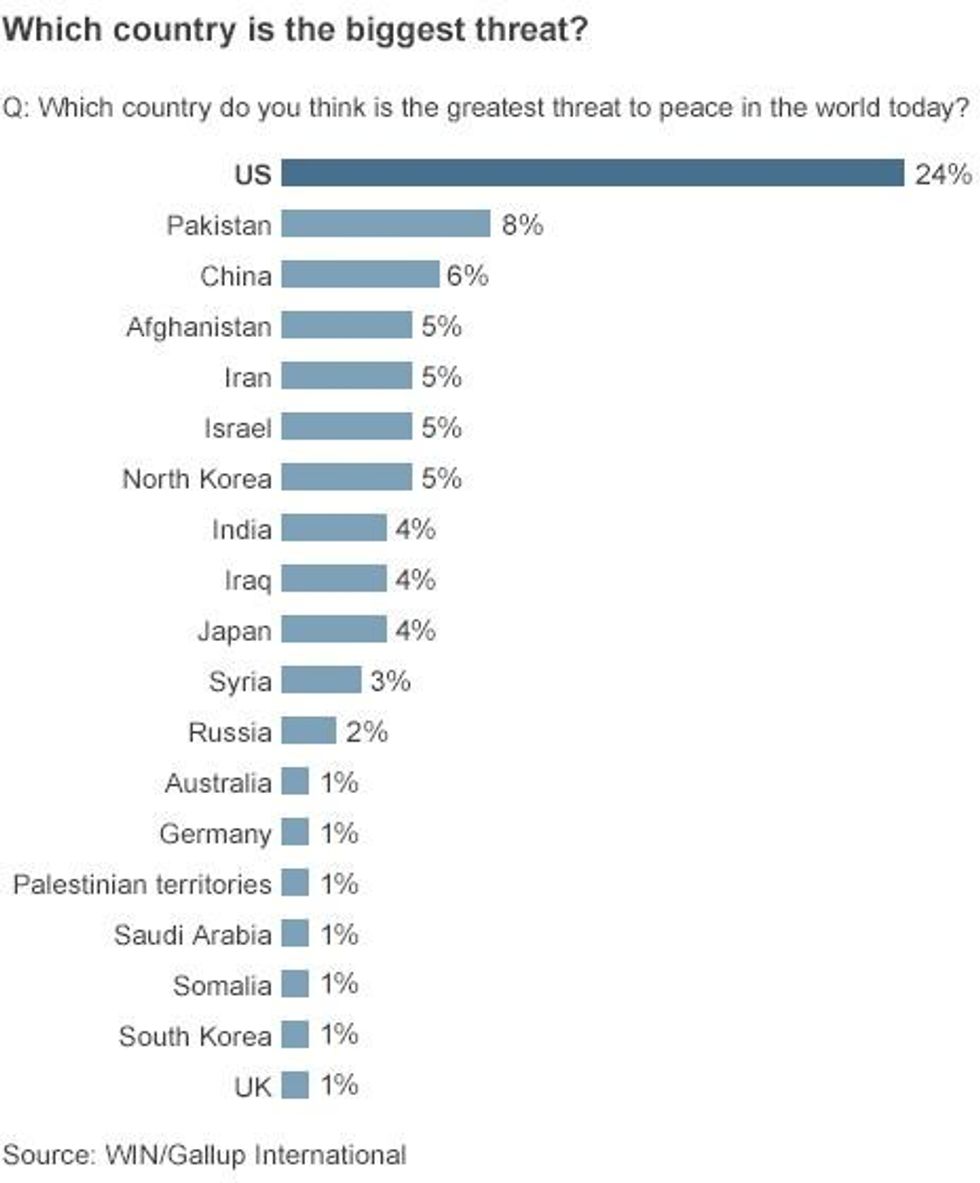
The poll of 67,806 respondents from 65 countries found that the U.S. won this dubious distinction by a landslide, as revealed in the chart below.
The BBC explains that the U.S. was deemed a threat by geopolitical allies as well as foes, including a significant portion of U.S. society.
Predictable in some areas (the Middle East and North Africa) but less so in others. Eastern Europe's 32% figure may be heavily influenced by Russia and Ukraine, but across most of Western Europe there are also lots of figures in the high teens.
In the Americas themselves, decades of US meddling have left an awkward legacy. Its neighbours, Mexico (37%) and Canada (17%), clearly have issues. Even 13% of Americans see their own country as a danger.
_____________________
In their annual End of Year survey, Win/Gallup International found that the United States is considered the number one "greatest threat to peace in the world today" by people across the globe.
The poll of 67,806 respondents from 65 countries found that the U.S. won this dubious distinction by a landslide, as revealed in the chart below.
The BBC explains that the U.S. was deemed a threat by geopolitical allies as well as foes, including a significant portion of U.S. society.
Predictable in some areas (the Middle East and North Africa) but less so in others. Eastern Europe's 32% figure may be heavily influenced by Russia and Ukraine, but across most of Western Europe there are also lots of figures in the high teens.
In the Americas themselves, decades of US meddling have left an awkward legacy. Its neighbours, Mexico (37%) and Canada (17%), clearly have issues. Even 13% of Americans see their own country as a danger.
_____________________

