
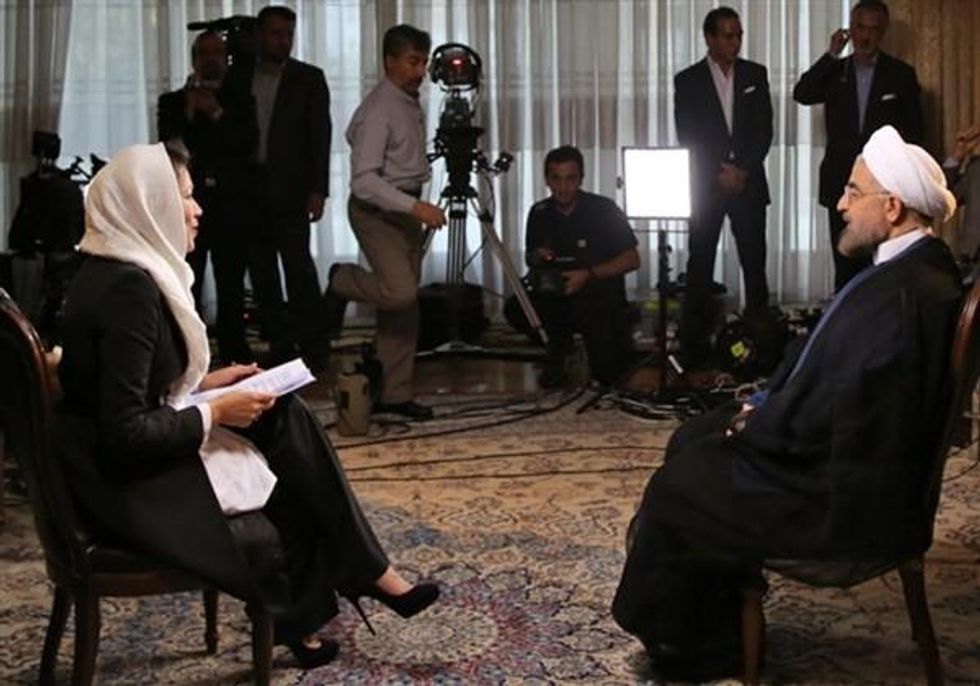
"We have never pursued or sought a nuclear bomb, and we are not going to do so," Rouhani told NBC's Ann Curry in the interview. "We solely are looking for peaceful nuclear technology."
Iran has repeatedly said over the years that its nuclear program is intended for energy and scientific purposes, but the U.S. routinely rejects these assertions.
Rouhani, however, considered more moderate and less bellicose than his predecessor, Mahmoud Ahmadinejad, was precise and unwavering in his statement: "Under no circumstances would we seek any weapons of mass destruction, including nuclear weapons, nor will we ever."
Watch:
The interview with the U.S. news outlet comes amid increased tension in the region, with one of Iran's key allies, Syria, in the midst of a bloody civil war and under threat of possible military attack by western powers. Still, according to many experts on Iran and the politics of the regioin, Rouhani's election has opened a door to new diplomatic opportunities between the U.S. and the Islamic republic.
According to NBC:
Rouhani was questioned about his views on Iran's close ally Syria and its promise to give up chemical weapons under the threat of air strikes from the U.S.
He said he could give no guarantees on behalf of Syrian President Bashar Assad, just days after he was quoted by his country's official news agency as saying he would accept any Syrian president elected by the people.
In his first interview with a U.S. news outlet since becoming president, Hassan Rouhani told NBC News' Ann Curry that he has full authority to strike a nukes deal with the west.
"We are not the government of Syria," he told Curry when asked about the chemical weapons handover. "We are one of the countries of this region which is asking for peace and stability and the elimination of all weapons of mass destruction in the entire region. "
Asked whether he thought Obama looked weak when he backed off the air-strike threat, Rouhani replied, "We consider war a weakness. Any government or administration that decides to wage a war, we consider a weakness. And any government that decides on peace, we look on it with respect to peace."
According to a Wednesday op-ed in the Guardian penned by Hossein Mousavian, a former spokesperson for Iran's nuclear negotiating team, the time for new talks and a path forward between the U.S. and Iran is now. Published just ahead Rouhani's comments to NBC, he writes:
While Iran and the US both consider the use of chemical weapons a crime, Iran has been a victim of these weapons, while the US has deployed them and turned a blind eye to their use. Given this, it would be prudent for Obama, instead of threatening Iran, to apologise for the backing it gave to Saddam Hussein's use of chemical weapons against Iran during the war (1980-88) when 100,000 Iranians were killed or injured by them.
That said, Iran believes broader negotiations can achieve a deal - if the parties come to the table with good intentions. "Rouhani's election and his appointments to the nuclear diplomatic team have created a like-minded group that would facilitate the resolution of the dispute if the other side was willing to do so," Ali Akbar Salehi, a MIT PhD graduate and the Iranian atomic energy chief, said.
There remains a possible dealbreaker. Obama's understanding of how to approach Tehran can be encapsulated as follows: "My view is that if you have both a credible threat of force, combined with a rigorous diplomatic effort, that, in fact, you can strike a deal". Although the use of force and bullying is part of US foreign policy, the grand civilisation and culture of Iran has made the Iranian nation attach great importance to respect and honour, resisting any form of coercion and humiliation.
Though it won't be easy, a report put out last month by the International Crisis Groups urges U.S. policy makers and elected officials to take a more flexible and productive approach to Iran. As foreign policy analyst Jim Lobe reported at the time:
To facilitate such a change, Washington and its Western allies should not maintain their "wait-and-see posture" but instead put "more ambitious proposals on the table," such as offering greater sanctions relief for a period of time in exchange for Iran's suspension of its 20-percent enrichment of its uranium and conversion of its existing to fuel rods and a freeze on the installation of advanced centrifuges in its bunkered enrichment facility at Fordow.
Launching bilateral talks with Tehran - something Obama has repeatedly proposed - would also enhance the chances for progress, according to the report, which noted that Rouhani has several times since his election indicated his support for such a dialogue despite Khamenei's frequently voiced scepticism that it would bear fruit.
________________________________
"We have never pursued or sought a nuclear bomb, and we are not going to do so," Rouhani told NBC's Ann Curry in the interview. "We solely are looking for peaceful nuclear technology."
Iran has repeatedly said over the years that its nuclear program is intended for energy and scientific purposes, but the U.S. routinely rejects these assertions.
Rouhani, however, considered more moderate and less bellicose than his predecessor, Mahmoud Ahmadinejad, was precise and unwavering in his statement: "Under no circumstances would we seek any weapons of mass destruction, including nuclear weapons, nor will we ever."
Watch:
The interview with the U.S. news outlet comes amid increased tension in the region, with one of Iran's key allies, Syria, in the midst of a bloody civil war and under threat of possible military attack by western powers. Still, according to many experts on Iran and the politics of the regioin, Rouhani's election has opened a door to new diplomatic opportunities between the U.S. and the Islamic republic.
According to NBC:
Rouhani was questioned about his views on Iran's close ally Syria and its promise to give up chemical weapons under the threat of air strikes from the U.S.
He said he could give no guarantees on behalf of Syrian President Bashar Assad, just days after he was quoted by his country's official news agency as saying he would accept any Syrian president elected by the people.
In his first interview with a U.S. news outlet since becoming president, Hassan Rouhani told NBC News' Ann Curry that he has full authority to strike a nukes deal with the west.
"We are not the government of Syria," he told Curry when asked about the chemical weapons handover. "We are one of the countries of this region which is asking for peace and stability and the elimination of all weapons of mass destruction in the entire region. "
Asked whether he thought Obama looked weak when he backed off the air-strike threat, Rouhani replied, "We consider war a weakness. Any government or administration that decides to wage a war, we consider a weakness. And any government that decides on peace, we look on it with respect to peace."
According to a Wednesday op-ed in the Guardian penned by Hossein Mousavian, a former spokesperson for Iran's nuclear negotiating team, the time for new talks and a path forward between the U.S. and Iran is now. Published just ahead Rouhani's comments to NBC, he writes:
While Iran and the US both consider the use of chemical weapons a crime, Iran has been a victim of these weapons, while the US has deployed them and turned a blind eye to their use. Given this, it would be prudent for Obama, instead of threatening Iran, to apologise for the backing it gave to Saddam Hussein's use of chemical weapons against Iran during the war (1980-88) when 100,000 Iranians were killed or injured by them.
That said, Iran believes broader negotiations can achieve a deal - if the parties come to the table with good intentions. "Rouhani's election and his appointments to the nuclear diplomatic team have created a like-minded group that would facilitate the resolution of the dispute if the other side was willing to do so," Ali Akbar Salehi, a MIT PhD graduate and the Iranian atomic energy chief, said.
There remains a possible dealbreaker. Obama's understanding of how to approach Tehran can be encapsulated as follows: "My view is that if you have both a credible threat of force, combined with a rigorous diplomatic effort, that, in fact, you can strike a deal". Although the use of force and bullying is part of US foreign policy, the grand civilisation and culture of Iran has made the Iranian nation attach great importance to respect and honour, resisting any form of coercion and humiliation.
Though it won't be easy, a report put out last month by the International Crisis Groups urges U.S. policy makers and elected officials to take a more flexible and productive approach to Iran. As foreign policy analyst Jim Lobe reported at the time:
To facilitate such a change, Washington and its Western allies should not maintain their "wait-and-see posture" but instead put "more ambitious proposals on the table," such as offering greater sanctions relief for a period of time in exchange for Iran's suspension of its 20-percent enrichment of its uranium and conversion of its existing to fuel rods and a freeze on the installation of advanced centrifuges in its bunkered enrichment facility at Fordow.
Launching bilateral talks with Tehran - something Obama has repeatedly proposed - would also enhance the chances for progress, according to the report, which noted that Rouhani has several times since his election indicated his support for such a dialogue despite Khamenei's frequently voiced scepticism that it would bear fruit.
________________________________
"We have never pursued or sought a nuclear bomb, and we are not going to do so," Rouhani told NBC's Ann Curry in the interview. "We solely are looking for peaceful nuclear technology."
Iran has repeatedly said over the years that its nuclear program is intended for energy and scientific purposes, but the U.S. routinely rejects these assertions.
Rouhani, however, considered more moderate and less bellicose than his predecessor, Mahmoud Ahmadinejad, was precise and unwavering in his statement: "Under no circumstances would we seek any weapons of mass destruction, including nuclear weapons, nor will we ever."
Watch:
The interview with the U.S. news outlet comes amid increased tension in the region, with one of Iran's key allies, Syria, in the midst of a bloody civil war and under threat of possible military attack by western powers. Still, according to many experts on Iran and the politics of the regioin, Rouhani's election has opened a door to new diplomatic opportunities between the U.S. and the Islamic republic.
According to NBC:
Rouhani was questioned about his views on Iran's close ally Syria and its promise to give up chemical weapons under the threat of air strikes from the U.S.
He said he could give no guarantees on behalf of Syrian President Bashar Assad, just days after he was quoted by his country's official news agency as saying he would accept any Syrian president elected by the people.
In his first interview with a U.S. news outlet since becoming president, Hassan Rouhani told NBC News' Ann Curry that he has full authority to strike a nukes deal with the west.
"We are not the government of Syria," he told Curry when asked about the chemical weapons handover. "We are one of the countries of this region which is asking for peace and stability and the elimination of all weapons of mass destruction in the entire region. "
Asked whether he thought Obama looked weak when he backed off the air-strike threat, Rouhani replied, "We consider war a weakness. Any government or administration that decides to wage a war, we consider a weakness. And any government that decides on peace, we look on it with respect to peace."
According to a Wednesday op-ed in the Guardian penned by Hossein Mousavian, a former spokesperson for Iran's nuclear negotiating team, the time for new talks and a path forward between the U.S. and Iran is now. Published just ahead Rouhani's comments to NBC, he writes:
While Iran and the US both consider the use of chemical weapons a crime, Iran has been a victim of these weapons, while the US has deployed them and turned a blind eye to their use. Given this, it would be prudent for Obama, instead of threatening Iran, to apologise for the backing it gave to Saddam Hussein's use of chemical weapons against Iran during the war (1980-88) when 100,000 Iranians were killed or injured by them.
That said, Iran believes broader negotiations can achieve a deal - if the parties come to the table with good intentions. "Rouhani's election and his appointments to the nuclear diplomatic team have created a like-minded group that would facilitate the resolution of the dispute if the other side was willing to do so," Ali Akbar Salehi, a MIT PhD graduate and the Iranian atomic energy chief, said.
There remains a possible dealbreaker. Obama's understanding of how to approach Tehran can be encapsulated as follows: "My view is that if you have both a credible threat of force, combined with a rigorous diplomatic effort, that, in fact, you can strike a deal". Although the use of force and bullying is part of US foreign policy, the grand civilisation and culture of Iran has made the Iranian nation attach great importance to respect and honour, resisting any form of coercion and humiliation.
Though it won't be easy, a report put out last month by the International Crisis Groups urges U.S. policy makers and elected officials to take a more flexible and productive approach to Iran. As foreign policy analyst Jim Lobe reported at the time:
To facilitate such a change, Washington and its Western allies should not maintain their "wait-and-see posture" but instead put "more ambitious proposals on the table," such as offering greater sanctions relief for a period of time in exchange for Iran's suspension of its 20-percent enrichment of its uranium and conversion of its existing to fuel rods and a freeze on the installation of advanced centrifuges in its bunkered enrichment facility at Fordow.
Launching bilateral talks with Tehran - something Obama has repeatedly proposed - would also enhance the chances for progress, according to the report, which noted that Rouhani has several times since his election indicated his support for such a dialogue despite Khamenei's frequently voiced scepticism that it would bear fruit.
________________________________