

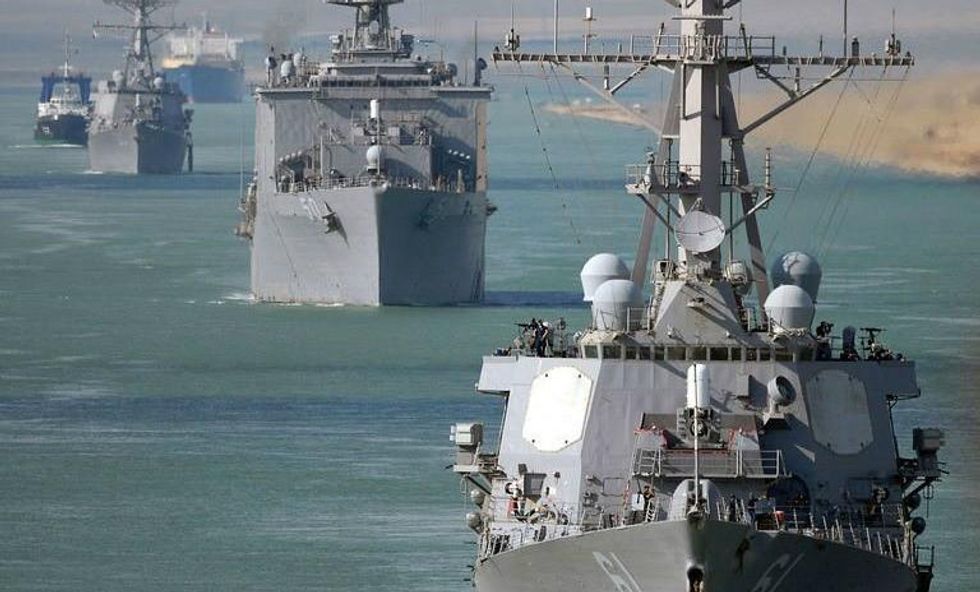
Citing reasons strategic, legal, and moral--critics of a U.S.-led attack on Syria are being drowned out by major news outlets, many citing unnamed government sources, who say U.S. cruise missile attacks (and possibly a multi-day aerial bombing campaign) could begin as earlier as Thursday.
But why? To what end? Who benefits? And who will be left to suffer?
Though asking these questions may not determine definitive answers, there are at least three points of agreement among experts cautioning against war. First, the details of last week's use of a chemical agent outside remain unclear and government claims about intelligence on the matter should be received with high levels of skepticism. Second, even if the Assad government, or someone loyal to it, was responsible for the attack the idea that cruise missiles would be the appropriate response (legally, morally or otherwise) is simply not true. And lastly, there is simply no military solution to the humanitarian crisis in Syria.
So what's the real goal of the attack on Syria?
Asked that question by Democracy Now's Amy Goodman on Wednesday, foreign policy analyst Phyllis Bennis--referencing Obama's August 2012 comment about use of chemical weapons being a "red line" in terms of U.S. military intervention--articulated this answer:
Well, it seems that the goal is a political goal. It's to make a statement: "Oh, my god, I used a red line. I said there was a red line, I have to do something." And the only, quote, "something" that seems to be available is a military action.
But is that analysis--that this is all political cover for Obama in the face of neoconservative pressure or the fear that failure to "respond" with military might will look the U.S. look weak--too simplistic?
Perhaps. But Bennis is not alone in her assessment that what's really at stake in Syria is something overtly fundamental to U.S. power precisely because the calculations being made by the Obama administration to launch strikes are so clearly shrugging off the self-evident complexities and dangerous possibilities predicted to result from military action.
Put another way, the simple political calculation that Obama must "save face" is really an admission that what's most important in terms of U.S. foreign policy is that the potency of U.S. military power should never be questioned by potential rivals or made to look impotent by other nations.
The simple political calculation that Obama must "save face" is really an admission that what's most important in terms of U.S. foreign policy is that the potency of U.S. military power should never be questioned by potential rivals or made to look impotent by other nations.
In that context, as former CIA analyst Ray McGovern writes at Common Dreams, the real target of U.S. military action is not the Assad regime per se--but Iran.
"Obviously, there is concern about the human rights catastrophe in Syria," writes McGovern, "but is the main target Syria's main ally, Iran, as many suspect?"
Parsing why both the U.S. and and neighboring Israel would risk triggering a regional war when both state that neither "regime change" nor protracted involvement in Syria's civil war is the goal, McGovern argues that,
Iran's leaders need not be paranoid to see themselves as a principal target of external meddling in Syria. While there seem to be as many interests being pursued - as there are rag-tag groups pursuing them - Tehran is not likely to see the common interests of Israel and the U.S. as very complicated. Both appear determined to exploit the chaotic duel among the thugs in Syria as an opportunity to deal a blow to Hezbollah and Hamas in Israel's near-frontier and to isolate Iran still further, and perhaps even advance Israel's ultimate aim of "regime change" in Tehran.
What has long been known about the conflict within Syria is the manner in which it has served as a proxy war among both regional and world powers, but none of those players have played such a central and pernicious role in fueling global conflict in the last century than the U.S. military which time and time again has chosen military belligerence and imperial self-interest over the option of more peaceful pathways.
Indeed, as the Guardian's Seumas Milne argues, if the U.S., U.K. and their allies wanted peace in the region, they have a sadistic way of showing it. As he says, it "is the war itself"--the "death and destruction" of ongoing violence--that poses the great threat to Syria's people:
If the US, British and French governments were genuinely interested in bringing it to an end - instead of exploiting it to weaken Iran - they would be using their leverage with the rebels and their sponsors to achieve a ceasefire and a negotiated political settlement.
Instead, they seem intent on escalating the war to save Obama's face and tighten their regional grip. It's a dangerous gamble [...]
Even if the attacks are limited, they will certainly increase the death toll and escalate the war. The risk is that they will invite retaliation by Syria or its allies - including against Israel - draw the US in deeper and spread the conflict. The west can use this crisis to help bring Syria's suffering to an end - or pour yet more petrol on the flames.
As many critics argue and Bennis expressed again Wednesday, the "notion that we are going to somehow escalate these attacks in Syria, rather than saying this is a moment when we desperately need diplomacy" is absurd.
Condemning the U.S. decision to cancel scheduled diplomatic talks with Russia on Wednesday, Bennis said the U.S. is wrong to stave off discussions or any possibility of peace talks.
"This is exactly the time" for such talks, she said, adding:
We need to be talking to Russia, to Iran, to all of the U.S. allies that are supporting the other side, to force the various parties to peace talks. There is no military solution. This is what Congresswoman Barbara Lee said yesterday, and it's absolutely true. There is no military solution. Extra assaults from the United States is going to make the situation worse, is going to put Syrian civilians at greater risk, not provide protection.
So let the record show--if and when the U.S. bombs fall on Syria and the predicted death toll and violence spreads--that there was another choice for President Obama and his allies, but that helping to coordinate peace talks or fostering a negotiated settlement between the warring factions was just "something" that the U.S. simply refused to do.
_____________________________________________
Citing reasons strategic, legal, and moral--critics of a U.S.-led attack on Syria are being drowned out by major news outlets, many citing unnamed government sources, who say U.S. cruise missile attacks (and possibly a multi-day aerial bombing campaign) could begin as earlier as Thursday.
But why? To what end? Who benefits? And who will be left to suffer?
Though asking these questions may not determine definitive answers, there are at least three points of agreement among experts cautioning against war. First, the details of last week's use of a chemical agent outside remain unclear and government claims about intelligence on the matter should be received with high levels of skepticism. Second, even if the Assad government, or someone loyal to it, was responsible for the attack the idea that cruise missiles would be the appropriate response (legally, morally or otherwise) is simply not true. And lastly, there is simply no military solution to the humanitarian crisis in Syria.
So what's the real goal of the attack on Syria?
Asked that question by Democracy Now's Amy Goodman on Wednesday, foreign policy analyst Phyllis Bennis--referencing Obama's August 2012 comment about use of chemical weapons being a "red line" in terms of U.S. military intervention--articulated this answer:
Well, it seems that the goal is a political goal. It's to make a statement: "Oh, my god, I used a red line. I said there was a red line, I have to do something." And the only, quote, "something" that seems to be available is a military action.
But is that analysis--that this is all political cover for Obama in the face of neoconservative pressure or the fear that failure to "respond" with military might will look the U.S. look weak--too simplistic?
Perhaps. But Bennis is not alone in her assessment that what's really at stake in Syria is something overtly fundamental to U.S. power precisely because the calculations being made by the Obama administration to launch strikes are so clearly shrugging off the self-evident complexities and dangerous possibilities predicted to result from military action.
Put another way, the simple political calculation that Obama must "save face" is really an admission that what's most important in terms of U.S. foreign policy is that the potency of U.S. military power should never be questioned by potential rivals or made to look impotent by other nations.
The simple political calculation that Obama must "save face" is really an admission that what's most important in terms of U.S. foreign policy is that the potency of U.S. military power should never be questioned by potential rivals or made to look impotent by other nations.
In that context, as former CIA analyst Ray McGovern writes at Common Dreams, the real target of U.S. military action is not the Assad regime per se--but Iran.
"Obviously, there is concern about the human rights catastrophe in Syria," writes McGovern, "but is the main target Syria's main ally, Iran, as many suspect?"
Parsing why both the U.S. and and neighboring Israel would risk triggering a regional war when both state that neither "regime change" nor protracted involvement in Syria's civil war is the goal, McGovern argues that,
Iran's leaders need not be paranoid to see themselves as a principal target of external meddling in Syria. While there seem to be as many interests being pursued - as there are rag-tag groups pursuing them - Tehran is not likely to see the common interests of Israel and the U.S. as very complicated. Both appear determined to exploit the chaotic duel among the thugs in Syria as an opportunity to deal a blow to Hezbollah and Hamas in Israel's near-frontier and to isolate Iran still further, and perhaps even advance Israel's ultimate aim of "regime change" in Tehran.
What has long been known about the conflict within Syria is the manner in which it has served as a proxy war among both regional and world powers, but none of those players have played such a central and pernicious role in fueling global conflict in the last century than the U.S. military which time and time again has chosen military belligerence and imperial self-interest over the option of more peaceful pathways.
Indeed, as the Guardian's Seumas Milne argues, if the U.S., U.K. and their allies wanted peace in the region, they have a sadistic way of showing it. As he says, it "is the war itself"--the "death and destruction" of ongoing violence--that poses the great threat to Syria's people:
If the US, British and French governments were genuinely interested in bringing it to an end - instead of exploiting it to weaken Iran - they would be using their leverage with the rebels and their sponsors to achieve a ceasefire and a negotiated political settlement.
Instead, they seem intent on escalating the war to save Obama's face and tighten their regional grip. It's a dangerous gamble [...]
Even if the attacks are limited, they will certainly increase the death toll and escalate the war. The risk is that they will invite retaliation by Syria or its allies - including against Israel - draw the US in deeper and spread the conflict. The west can use this crisis to help bring Syria's suffering to an end - or pour yet more petrol on the flames.
As many critics argue and Bennis expressed again Wednesday, the "notion that we are going to somehow escalate these attacks in Syria, rather than saying this is a moment when we desperately need diplomacy" is absurd.
Condemning the U.S. decision to cancel scheduled diplomatic talks with Russia on Wednesday, Bennis said the U.S. is wrong to stave off discussions or any possibility of peace talks.
"This is exactly the time" for such talks, she said, adding:
We need to be talking to Russia, to Iran, to all of the U.S. allies that are supporting the other side, to force the various parties to peace talks. There is no military solution. This is what Congresswoman Barbara Lee said yesterday, and it's absolutely true. There is no military solution. Extra assaults from the United States is going to make the situation worse, is going to put Syrian civilians at greater risk, not provide protection.
So let the record show--if and when the U.S. bombs fall on Syria and the predicted death toll and violence spreads--that there was another choice for President Obama and his allies, but that helping to coordinate peace talks or fostering a negotiated settlement between the warring factions was just "something" that the U.S. simply refused to do.
_____________________________________________
Citing reasons strategic, legal, and moral--critics of a U.S.-led attack on Syria are being drowned out by major news outlets, many citing unnamed government sources, who say U.S. cruise missile attacks (and possibly a multi-day aerial bombing campaign) could begin as earlier as Thursday.
But why? To what end? Who benefits? And who will be left to suffer?
Though asking these questions may not determine definitive answers, there are at least three points of agreement among experts cautioning against war. First, the details of last week's use of a chemical agent outside remain unclear and government claims about intelligence on the matter should be received with high levels of skepticism. Second, even if the Assad government, or someone loyal to it, was responsible for the attack the idea that cruise missiles would be the appropriate response (legally, morally or otherwise) is simply not true. And lastly, there is simply no military solution to the humanitarian crisis in Syria.
So what's the real goal of the attack on Syria?
Asked that question by Democracy Now's Amy Goodman on Wednesday, foreign policy analyst Phyllis Bennis--referencing Obama's August 2012 comment about use of chemical weapons being a "red line" in terms of U.S. military intervention--articulated this answer:
Well, it seems that the goal is a political goal. It's to make a statement: "Oh, my god, I used a red line. I said there was a red line, I have to do something." And the only, quote, "something" that seems to be available is a military action.
But is that analysis--that this is all political cover for Obama in the face of neoconservative pressure or the fear that failure to "respond" with military might will look the U.S. look weak--too simplistic?
Perhaps. But Bennis is not alone in her assessment that what's really at stake in Syria is something overtly fundamental to U.S. power precisely because the calculations being made by the Obama administration to launch strikes are so clearly shrugging off the self-evident complexities and dangerous possibilities predicted to result from military action.
Put another way, the simple political calculation that Obama must "save face" is really an admission that what's most important in terms of U.S. foreign policy is that the potency of U.S. military power should never be questioned by potential rivals or made to look impotent by other nations.
The simple political calculation that Obama must "save face" is really an admission that what's most important in terms of U.S. foreign policy is that the potency of U.S. military power should never be questioned by potential rivals or made to look impotent by other nations.
In that context, as former CIA analyst Ray McGovern writes at Common Dreams, the real target of U.S. military action is not the Assad regime per se--but Iran.
"Obviously, there is concern about the human rights catastrophe in Syria," writes McGovern, "but is the main target Syria's main ally, Iran, as many suspect?"
Parsing why both the U.S. and and neighboring Israel would risk triggering a regional war when both state that neither "regime change" nor protracted involvement in Syria's civil war is the goal, McGovern argues that,
Iran's leaders need not be paranoid to see themselves as a principal target of external meddling in Syria. While there seem to be as many interests being pursued - as there are rag-tag groups pursuing them - Tehran is not likely to see the common interests of Israel and the U.S. as very complicated. Both appear determined to exploit the chaotic duel among the thugs in Syria as an opportunity to deal a blow to Hezbollah and Hamas in Israel's near-frontier and to isolate Iran still further, and perhaps even advance Israel's ultimate aim of "regime change" in Tehran.
What has long been known about the conflict within Syria is the manner in which it has served as a proxy war among both regional and world powers, but none of those players have played such a central and pernicious role in fueling global conflict in the last century than the U.S. military which time and time again has chosen military belligerence and imperial self-interest over the option of more peaceful pathways.
Indeed, as the Guardian's Seumas Milne argues, if the U.S., U.K. and their allies wanted peace in the region, they have a sadistic way of showing it. As he says, it "is the war itself"--the "death and destruction" of ongoing violence--that poses the great threat to Syria's people:
If the US, British and French governments were genuinely interested in bringing it to an end - instead of exploiting it to weaken Iran - they would be using their leverage with the rebels and their sponsors to achieve a ceasefire and a negotiated political settlement.
Instead, they seem intent on escalating the war to save Obama's face and tighten their regional grip. It's a dangerous gamble [...]
Even if the attacks are limited, they will certainly increase the death toll and escalate the war. The risk is that they will invite retaliation by Syria or its allies - including against Israel - draw the US in deeper and spread the conflict. The west can use this crisis to help bring Syria's suffering to an end - or pour yet more petrol on the flames.
As many critics argue and Bennis expressed again Wednesday, the "notion that we are going to somehow escalate these attacks in Syria, rather than saying this is a moment when we desperately need diplomacy" is absurd.
Condemning the U.S. decision to cancel scheduled diplomatic talks with Russia on Wednesday, Bennis said the U.S. is wrong to stave off discussions or any possibility of peace talks.
"This is exactly the time" for such talks, she said, adding:
We need to be talking to Russia, to Iran, to all of the U.S. allies that are supporting the other side, to force the various parties to peace talks. There is no military solution. This is what Congresswoman Barbara Lee said yesterday, and it's absolutely true. There is no military solution. Extra assaults from the United States is going to make the situation worse, is going to put Syrian civilians at greater risk, not provide protection.
So let the record show--if and when the U.S. bombs fall on Syria and the predicted death toll and violence spreads--that there was another choice for President Obama and his allies, but that helping to coordinate peace talks or fostering a negotiated settlement between the warring factions was just "something" that the U.S. simply refused to do.
_____________________________________________