

SUBSCRIBE TO OUR FREE NEWSLETTER
Daily news & progressive opinion—funded by the people, not the corporations—delivered straight to your inbox.
5
#000000
#FFFFFF
To donate by check, phone, or other method, see our More Ways to Give page.
"It's a dramatic showdown between an embattled labor movement and an industry that increasingly not only is prevalent in the United States economy, but really represents where jobs are going in the United States economy," reporter Josh Eidelson told Democracy Now! "This is a mammoth industry, and so it's not one that's going to concede quickly. And so, we're going to see this continue to escalate."
Workers in retail chains across New York City, Chicago, St. Louis, Detroit, Milwaukee, Kansas City and Flint staged actions Monday through Thursday.
"This is not a flash in the pan," a spokesperson from the Service Employees International Union (SEIU) told Common Dreams. "This is definitely something that is ongoing."
The demonstrations were organized by SEIU alongside local labor and fair wage organizations including Fast Food Forward, Fight for 15 and Stand Up Kansas City.
Hundreds of workers walked off their jobs throughout Chicago on Wednesday and Thursday, gathered at a mass rally.
"The excitement is contagious," said Walgreens worker Alex Yekulis. "We have a coworker who wasn't planning on going on strike, but who just decided to walk out with us."
The strikers were from a broad spectrum of retail chains including Macy's, Wendy's, Forever 21, Potbelly, Sally's Beauty Supply, Bed Bath & Beyond, Chik-fil-A, Nordstrom Rack, Caffe Baci, Nike, Protein Bar, Mrs. Fields, Sears, Jason's Deli and Victoria's Secret.
These retail and fast food outlets "are among the country's most profitable, but their workers take home poverty wages to the city's poorest neighborhoods," said Katelyn Johnson, executive director of Action Now. "Every dollar invested in a living wage will raise up the economy for all of the city's neighborhoods."
As Lauren Feeney, Senior Digital Producer for Moyers & Company, wrote this week:
Fast food chains can afford to pay their workers more (despite an ad campaign launched in response to the protests suggesting otherwise). A group of economists in support of a $10.50 minimum wage say that McDonald's could cover half the cost of such an increase by raising the cost of a Big Mac from $4.00 to $4.05. Another study by a student at the University of Kansas found that McDonald's could double all employee salaries -- from workers earning the minimum wage to CEO Donald Thompson, who earned $8.75 million last year -- by increasing the cost of a Big Mac by 68 cents.
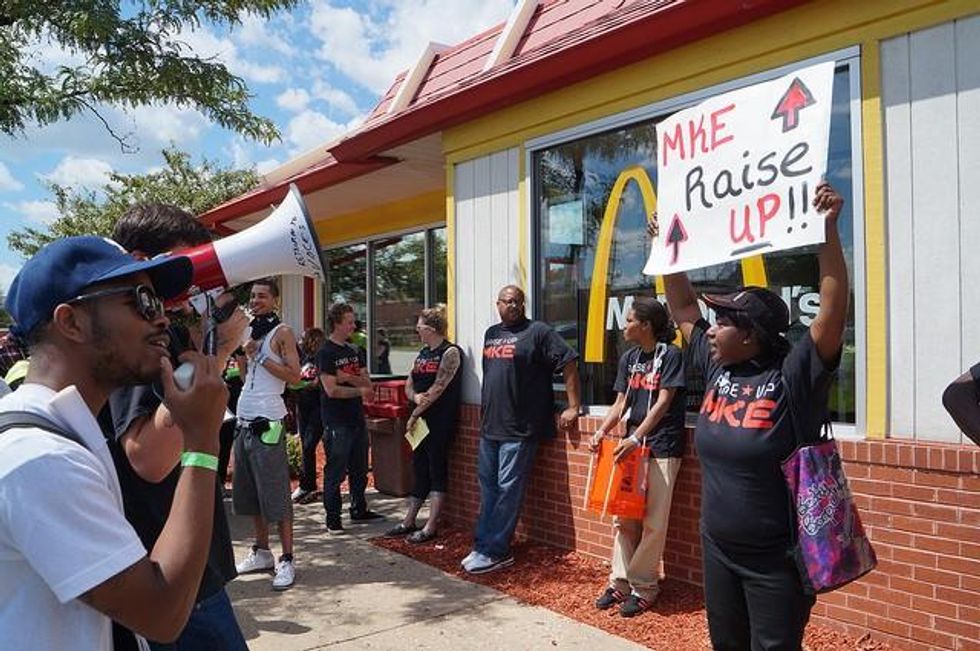
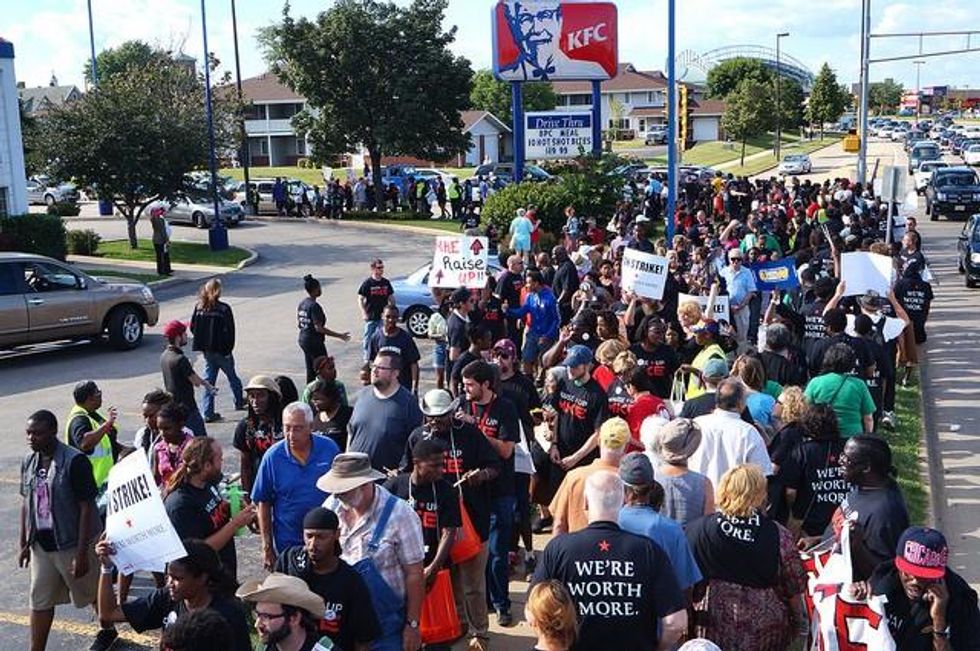
In Milwaukee on Thursday, striking workers with the group Raise Up Milwaukee visited different restaurants around the city to instruct those still working on some of the benefits of union membership.
"Hold the burgers. Hold the fries. Make our wages super sized," they chanted.
When police attempted to disperse an evening rally, the striking workers spread out in a picket line that spread down the street.
According to Eidelson, who has covered these protests extensively for The Nation, these low wage worker strikes have "shifted the national debate."
"The workers are pushing for change in the workplace [and] having these workers out, forcing attention to their struggle by being on strike, has played some role in creating more political attention to poverty in the United States."
Watch Eidelson on Democracy Now! along with Terrance Wise, who works at both Burger King and Pizza Hut and is a member of Stand Up Kansas City:
_______________________
"It's a dramatic showdown between an embattled labor movement and an industry that increasingly not only is prevalent in the United States economy, but really represents where jobs are going in the United States economy," reporter Josh Eidelson told Democracy Now! "This is a mammoth industry, and so it's not one that's going to concede quickly. And so, we're going to see this continue to escalate."
Workers in retail chains across New York City, Chicago, St. Louis, Detroit, Milwaukee, Kansas City and Flint staged actions Monday through Thursday.
"This is not a flash in the pan," a spokesperson from the Service Employees International Union (SEIU) told Common Dreams. "This is definitely something that is ongoing."
The demonstrations were organized by SEIU alongside local labor and fair wage organizations including Fast Food Forward, Fight for 15 and Stand Up Kansas City.
Hundreds of workers walked off their jobs throughout Chicago on Wednesday and Thursday, gathered at a mass rally.
"The excitement is contagious," said Walgreens worker Alex Yekulis. "We have a coworker who wasn't planning on going on strike, but who just decided to walk out with us."
The strikers were from a broad spectrum of retail chains including Macy's, Wendy's, Forever 21, Potbelly, Sally's Beauty Supply, Bed Bath & Beyond, Chik-fil-A, Nordstrom Rack, Caffe Baci, Nike, Protein Bar, Mrs. Fields, Sears, Jason's Deli and Victoria's Secret.
These retail and fast food outlets "are among the country's most profitable, but their workers take home poverty wages to the city's poorest neighborhoods," said Katelyn Johnson, executive director of Action Now. "Every dollar invested in a living wage will raise up the economy for all of the city's neighborhoods."
As Lauren Feeney, Senior Digital Producer for Moyers & Company, wrote this week:
Fast food chains can afford to pay their workers more (despite an ad campaign launched in response to the protests suggesting otherwise). A group of economists in support of a $10.50 minimum wage say that McDonald's could cover half the cost of such an increase by raising the cost of a Big Mac from $4.00 to $4.05. Another study by a student at the University of Kansas found that McDonald's could double all employee salaries -- from workers earning the minimum wage to CEO Donald Thompson, who earned $8.75 million last year -- by increasing the cost of a Big Mac by 68 cents.
In Milwaukee on Thursday, striking workers with the group Raise Up Milwaukee visited different restaurants around the city to instruct those still working on some of the benefits of union membership.
"Hold the burgers. Hold the fries. Make our wages super sized," they chanted.
When police attempted to disperse an evening rally, the striking workers spread out in a picket line that spread down the street.
According to Eidelson, who has covered these protests extensively for The Nation, these low wage worker strikes have "shifted the national debate."
"The workers are pushing for change in the workplace [and] having these workers out, forcing attention to their struggle by being on strike, has played some role in creating more political attention to poverty in the United States."
Watch Eidelson on Democracy Now! along with Terrance Wise, who works at both Burger King and Pizza Hut and is a member of Stand Up Kansas City:
_______________________
"It's a dramatic showdown between an embattled labor movement and an industry that increasingly not only is prevalent in the United States economy, but really represents where jobs are going in the United States economy," reporter Josh Eidelson told Democracy Now! "This is a mammoth industry, and so it's not one that's going to concede quickly. And so, we're going to see this continue to escalate."
Workers in retail chains across New York City, Chicago, St. Louis, Detroit, Milwaukee, Kansas City and Flint staged actions Monday through Thursday.
"This is not a flash in the pan," a spokesperson from the Service Employees International Union (SEIU) told Common Dreams. "This is definitely something that is ongoing."
The demonstrations were organized by SEIU alongside local labor and fair wage organizations including Fast Food Forward, Fight for 15 and Stand Up Kansas City.
Hundreds of workers walked off their jobs throughout Chicago on Wednesday and Thursday, gathered at a mass rally.
"The excitement is contagious," said Walgreens worker Alex Yekulis. "We have a coworker who wasn't planning on going on strike, but who just decided to walk out with us."
The strikers were from a broad spectrum of retail chains including Macy's, Wendy's, Forever 21, Potbelly, Sally's Beauty Supply, Bed Bath & Beyond, Chik-fil-A, Nordstrom Rack, Caffe Baci, Nike, Protein Bar, Mrs. Fields, Sears, Jason's Deli and Victoria's Secret.
These retail and fast food outlets "are among the country's most profitable, but their workers take home poverty wages to the city's poorest neighborhoods," said Katelyn Johnson, executive director of Action Now. "Every dollar invested in a living wage will raise up the economy for all of the city's neighborhoods."
As Lauren Feeney, Senior Digital Producer for Moyers & Company, wrote this week:
Fast food chains can afford to pay their workers more (despite an ad campaign launched in response to the protests suggesting otherwise). A group of economists in support of a $10.50 minimum wage say that McDonald's could cover half the cost of such an increase by raising the cost of a Big Mac from $4.00 to $4.05. Another study by a student at the University of Kansas found that McDonald's could double all employee salaries -- from workers earning the minimum wage to CEO Donald Thompson, who earned $8.75 million last year -- by increasing the cost of a Big Mac by 68 cents.
In Milwaukee on Thursday, striking workers with the group Raise Up Milwaukee visited different restaurants around the city to instruct those still working on some of the benefits of union membership.
"Hold the burgers. Hold the fries. Make our wages super sized," they chanted.
When police attempted to disperse an evening rally, the striking workers spread out in a picket line that spread down the street.
According to Eidelson, who has covered these protests extensively for The Nation, these low wage worker strikes have "shifted the national debate."
"The workers are pushing for change in the workplace [and] having these workers out, forcing attention to their struggle by being on strike, has played some role in creating more political attention to poverty in the United States."
Watch Eidelson on Democracy Now! along with Terrance Wise, who works at both Burger King and Pizza Hut and is a member of Stand Up Kansas City:
_______________________

