




SUBSCRIBE TO OUR FREE NEWSLETTER
Daily news & progressive opinion—funded by the people, not the corporations—delivered straight to your inbox.
5
#000000
#FFFFFF
To donate by check, phone, or other method, see our More Ways to Give page.
Daily news & progressive opinion—funded by the people, not the corporations—delivered straight to your inbox.
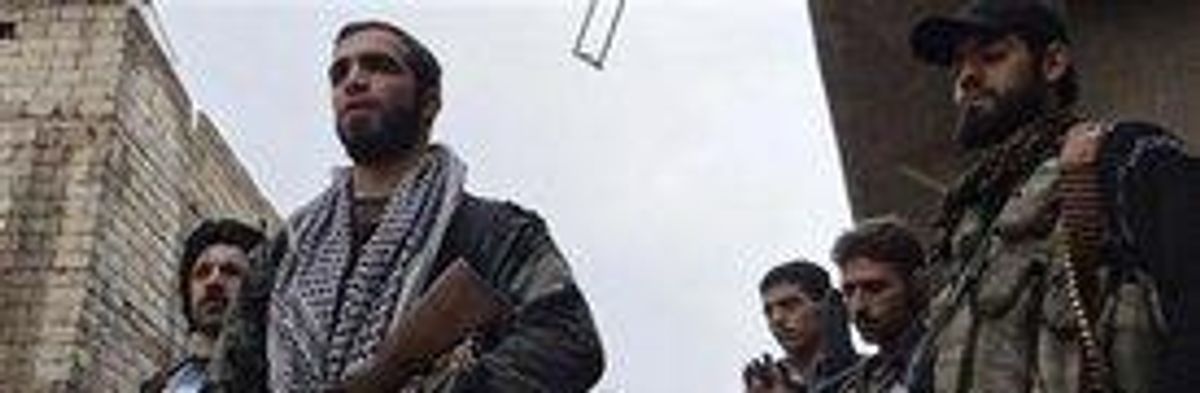
Free Syrian Army fighters carry their weapons as they stand on a street in Aleppo's al-Amereya district December 11, 2012. (Photo: Reuters/Aaref Hretani)
In a move that notches up the potential for a western military intervention in Syria, the US government on Tuesday formally recognized factions of the armed opposition group facing off against President Bashar al-Assad in what has been an escalating and bloody civil war in the Middle East country.
"We've made a decision that the Syrian Opposition Coalition is now inclusive enough, is reflective and representative enough of the Syrian population, that we consider them the legitimate representative of the Syrian people in opposition to the Assad regime," President Obama said announcing the new status of what has also been called the Free Syria Army.
Other Western governments, including the UK and France, have already recognized the coalition. A meeting in Morocco on Wednesday between representatives of the Syrian opposition and Western governments, including the US, is intended to solidify the recognition and determine what kind of support they will receive going forward.
Obama spoke with ABC News on Tuesday night about the decision:
Though the White House endorsement makes clear that its official support of the 'Free Syria Army' does not extend to the radical Islamist militias operating alongside them--such as the al-Qaeda-affiliated Jabhat al-Nusra (or Victory Front) militia--reporting on the ground in Syria shows that these groups are integral to the opposition's campaign against Assad.
Jabhat al-Nusra, in fact, was singled out by the US State Department and labeled a 'terrorist organization' officially just hours before Obama's announcement. That designation, however, only highlights the complexities of developments on the ground and sharpens the case for those cautioning against arming or in other ways actively engaging in what has clearly become a civil war.
As John Glassen at Antiwar.com reports:
[The US] decision was met with ardent backlash from more than 100 rebel groups on the ground inside Syria, who signed a petition expressing solidarity with al-Nusra and promoting the slogan "No to American intervention, for we are all Jabhat al-Nusra."
"It has united a broad spectrum of the opposition -- from Islamist fighters to liberal and nonviolent activists who fervently oppose them -- in anger and exasperation with the United States," reports The New York Times.
So as the US announced its recognition of a detached, pro-Western, unrepresentative exile group as the legitimate leader of the Syrian people, the great bulk of the actual Syrian opposition - both armed and civilian - threw their support behind a notorious jihadist group with ties to the same fighters that battled US troops in Iraq.
And this report by France 24 shows that groups like al-Nursa, though small in numbers, are having an outsized impact by making strong military victories against the Assad regime possible:
All told, the most recent developments on the ground in Syria and in halls of Western powers will be troubling for those, such as Middle East expert Phyllis Bennis, who have long been warning against western intervention.
Arguments Bennis made earlier this year still hold true amid today's news:
A U.S. decision to send fighter-jets or bombers or even ground troops to Syria, won't be because Washington is suddenly worried about Syrian civilians. The Assad regime has brutalized civilians for years, but it has been way too useful for Washington to worry about such things. Damascus accepted U.S. detainees for interrogation and torture in the so-called "global war on terror," it sent warplanes to join the U.S. Gulf War coalition attacking Iraq in 1991, it kept the occupied Golan Heights and the Israeli border largely pacified... and human rights violations were never a problem for the United States. As State Department spokeswoman Victoria Nuland admitted, "we are not always consistent."
Whatever our humanitarian concerns might be, real decisions about direct military intervention will be made with little regard for Syrian civilians, Syrian civil society, or Syria's national survival - all of which will suffer consequences that could last a generation or more. A U.S./NATO air war against Syria would likely not end like Libya's - with no western casualties and a quick exit. Given Syria's military, especially air capacity, it will look far more like Iraq than Libya.
Donald Trump’s attacks on democracy, justice, and a free press are escalating — putting everything we stand for at risk. We believe a better world is possible, but we can’t get there without your support. Common Dreams stands apart. We answer only to you — our readers, activists, and changemakers — not to billionaires or corporations. Our independence allows us to cover the vital stories that others won’t, spotlighting movements for peace, equality, and human rights. Right now, our work faces unprecedented challenges. Misinformation is spreading, journalists are under attack, and financial pressures are mounting. As a reader-supported, nonprofit newsroom, your support is crucial to keep this journalism alive. Whatever you can give — $10, $25, or $100 — helps us stay strong and responsive when the world needs us most. Together, we’ll continue to build the independent, courageous journalism our movement relies on. Thank you for being part of this community. |
In a move that notches up the potential for a western military intervention in Syria, the US government on Tuesday formally recognized factions of the armed opposition group facing off against President Bashar al-Assad in what has been an escalating and bloody civil war in the Middle East country.
"We've made a decision that the Syrian Opposition Coalition is now inclusive enough, is reflective and representative enough of the Syrian population, that we consider them the legitimate representative of the Syrian people in opposition to the Assad regime," President Obama said announcing the new status of what has also been called the Free Syria Army.
Other Western governments, including the UK and France, have already recognized the coalition. A meeting in Morocco on Wednesday between representatives of the Syrian opposition and Western governments, including the US, is intended to solidify the recognition and determine what kind of support they will receive going forward.
Obama spoke with ABC News on Tuesday night about the decision:
Though the White House endorsement makes clear that its official support of the 'Free Syria Army' does not extend to the radical Islamist militias operating alongside them--such as the al-Qaeda-affiliated Jabhat al-Nusra (or Victory Front) militia--reporting on the ground in Syria shows that these groups are integral to the opposition's campaign against Assad.
Jabhat al-Nusra, in fact, was singled out by the US State Department and labeled a 'terrorist organization' officially just hours before Obama's announcement. That designation, however, only highlights the complexities of developments on the ground and sharpens the case for those cautioning against arming or in other ways actively engaging in what has clearly become a civil war.
As John Glassen at Antiwar.com reports:
[The US] decision was met with ardent backlash from more than 100 rebel groups on the ground inside Syria, who signed a petition expressing solidarity with al-Nusra and promoting the slogan "No to American intervention, for we are all Jabhat al-Nusra."
"It has united a broad spectrum of the opposition -- from Islamist fighters to liberal and nonviolent activists who fervently oppose them -- in anger and exasperation with the United States," reports The New York Times.
So as the US announced its recognition of a detached, pro-Western, unrepresentative exile group as the legitimate leader of the Syrian people, the great bulk of the actual Syrian opposition - both armed and civilian - threw their support behind a notorious jihadist group with ties to the same fighters that battled US troops in Iraq.
And this report by France 24 shows that groups like al-Nursa, though small in numbers, are having an outsized impact by making strong military victories against the Assad regime possible:
All told, the most recent developments on the ground in Syria and in halls of Western powers will be troubling for those, such as Middle East expert Phyllis Bennis, who have long been warning against western intervention.
Arguments Bennis made earlier this year still hold true amid today's news:
A U.S. decision to send fighter-jets or bombers or even ground troops to Syria, won't be because Washington is suddenly worried about Syrian civilians. The Assad regime has brutalized civilians for years, but it has been way too useful for Washington to worry about such things. Damascus accepted U.S. detainees for interrogation and torture in the so-called "global war on terror," it sent warplanes to join the U.S. Gulf War coalition attacking Iraq in 1991, it kept the occupied Golan Heights and the Israeli border largely pacified... and human rights violations were never a problem for the United States. As State Department spokeswoman Victoria Nuland admitted, "we are not always consistent."
Whatever our humanitarian concerns might be, real decisions about direct military intervention will be made with little regard for Syrian civilians, Syrian civil society, or Syria's national survival - all of which will suffer consequences that could last a generation or more. A U.S./NATO air war against Syria would likely not end like Libya's - with no western casualties and a quick exit. Given Syria's military, especially air capacity, it will look far more like Iraq than Libya.
In a move that notches up the potential for a western military intervention in Syria, the US government on Tuesday formally recognized factions of the armed opposition group facing off against President Bashar al-Assad in what has been an escalating and bloody civil war in the Middle East country.
"We've made a decision that the Syrian Opposition Coalition is now inclusive enough, is reflective and representative enough of the Syrian population, that we consider them the legitimate representative of the Syrian people in opposition to the Assad regime," President Obama said announcing the new status of what has also been called the Free Syria Army.
Other Western governments, including the UK and France, have already recognized the coalition. A meeting in Morocco on Wednesday between representatives of the Syrian opposition and Western governments, including the US, is intended to solidify the recognition and determine what kind of support they will receive going forward.
Obama spoke with ABC News on Tuesday night about the decision:
Though the White House endorsement makes clear that its official support of the 'Free Syria Army' does not extend to the radical Islamist militias operating alongside them--such as the al-Qaeda-affiliated Jabhat al-Nusra (or Victory Front) militia--reporting on the ground in Syria shows that these groups are integral to the opposition's campaign against Assad.
Jabhat al-Nusra, in fact, was singled out by the US State Department and labeled a 'terrorist organization' officially just hours before Obama's announcement. That designation, however, only highlights the complexities of developments on the ground and sharpens the case for those cautioning against arming or in other ways actively engaging in what has clearly become a civil war.
As John Glassen at Antiwar.com reports:
[The US] decision was met with ardent backlash from more than 100 rebel groups on the ground inside Syria, who signed a petition expressing solidarity with al-Nusra and promoting the slogan "No to American intervention, for we are all Jabhat al-Nusra."
"It has united a broad spectrum of the opposition -- from Islamist fighters to liberal and nonviolent activists who fervently oppose them -- in anger and exasperation with the United States," reports The New York Times.
So as the US announced its recognition of a detached, pro-Western, unrepresentative exile group as the legitimate leader of the Syrian people, the great bulk of the actual Syrian opposition - both armed and civilian - threw their support behind a notorious jihadist group with ties to the same fighters that battled US troops in Iraq.
And this report by France 24 shows that groups like al-Nursa, though small in numbers, are having an outsized impact by making strong military victories against the Assad regime possible:
All told, the most recent developments on the ground in Syria and in halls of Western powers will be troubling for those, such as Middle East expert Phyllis Bennis, who have long been warning against western intervention.
Arguments Bennis made earlier this year still hold true amid today's news:
A U.S. decision to send fighter-jets or bombers or even ground troops to Syria, won't be because Washington is suddenly worried about Syrian civilians. The Assad regime has brutalized civilians for years, but it has been way too useful for Washington to worry about such things. Damascus accepted U.S. detainees for interrogation and torture in the so-called "global war on terror," it sent warplanes to join the U.S. Gulf War coalition attacking Iraq in 1991, it kept the occupied Golan Heights and the Israeli border largely pacified... and human rights violations were never a problem for the United States. As State Department spokeswoman Victoria Nuland admitted, "we are not always consistent."
Whatever our humanitarian concerns might be, real decisions about direct military intervention will be made with little regard for Syrian civilians, Syrian civil society, or Syria's national survival - all of which will suffer consequences that could last a generation or more. A U.S./NATO air war against Syria would likely not end like Libya's - with no western casualties and a quick exit. Given Syria's military, especially air capacity, it will look far more like Iraq than Libya.