

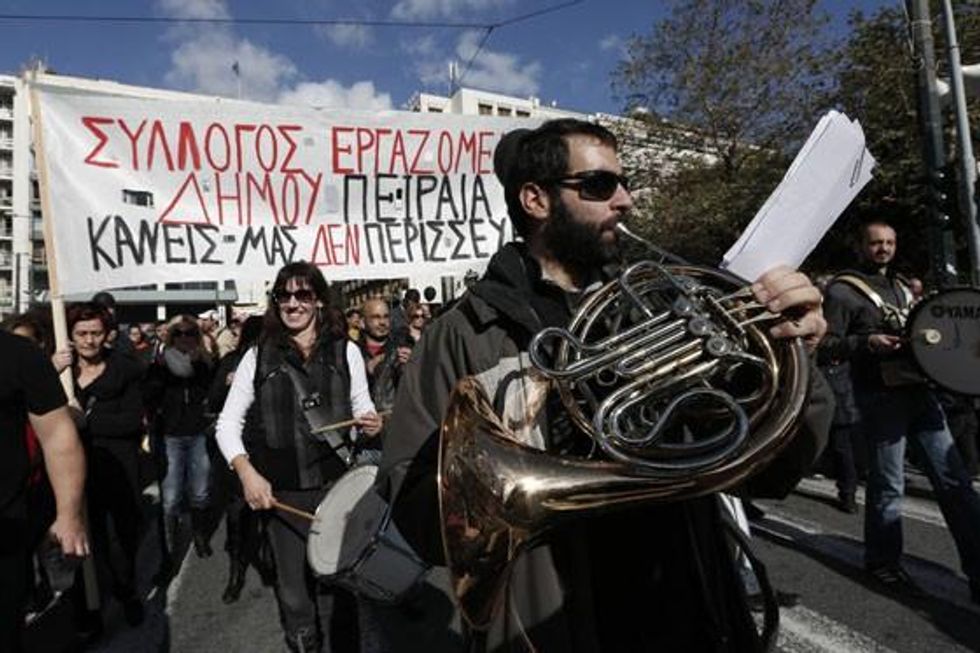
Greek municipal workers occupied hundreds of town halls across the country on Thursday, and thousands of others marched through the streets of Athens to protest layoffs agreed to as part of a financial 'bailout' of the government.
The Greek government plans to lay off up to 27,000 more public sector workers -- with city and local workers likely targeted first -- to meet conditions set by its international creditors, the European Union and the International Monetary Fund, the Greek newspaper Ekathimerini.com reports.
The protests continue a month-long wave of actions that began when the Greek government passed austerity measures such as wage and pension cuts. Workers have staged daily sit-ins at more than two-thirds of the country's 330 city halls and in several ministries, according to Reuters. Ministry employees have blocked the entrance of the agriculture ministry daily since last week, and health ministry employees occupied that ministry on Monday to protest the firing of 68 employees.
The protests have disrupted public services, and reportedly last week some municipal workers threw water and coffee at Germany's consul during a meeting with Greek officials in the city of Thessaloniki.
On Thursday, thousands of municipal workers marched through Athens, some carrying a coffin and wreaths and chanting, "Their measures, our funeral."
Ekathimerini.com reports:
"They think of us as numbers and not as people," Maria Kayvadia, a municipal employee for 12 years, told state TV. "I am afraid I won't be able to support my family and give my five-year old child all I should as a mother."
Although the European commissioner for economic affairs, Olli Rehn, said Thursday that Greece has fulfilled the necessary steps to allow the financial assistance to be finalized on Monday, data released on Thursday shows that Greek citizens are struggling more to survive the government's austerity measures.
Household disposable income decreased by about 14 percent in the second quarter of 2012 from the same period in 2011, according to Reuters, while wages decreased by 15 percent and taxes increased by 37 percent.
* * *
# # #
Greek municipal workers occupied hundreds of town halls across the country on Thursday, and thousands of others marched through the streets of Athens to protest layoffs agreed to as part of a financial 'bailout' of the government.
The Greek government plans to lay off up to 27,000 more public sector workers -- with city and local workers likely targeted first -- to meet conditions set by its international creditors, the European Union and the International Monetary Fund, the Greek newspaper Ekathimerini.com reports.
The protests continue a month-long wave of actions that began when the Greek government passed austerity measures such as wage and pension cuts. Workers have staged daily sit-ins at more than two-thirds of the country's 330 city halls and in several ministries, according to Reuters. Ministry employees have blocked the entrance of the agriculture ministry daily since last week, and health ministry employees occupied that ministry on Monday to protest the firing of 68 employees.
The protests have disrupted public services, and reportedly last week some municipal workers threw water and coffee at Germany's consul during a meeting with Greek officials in the city of Thessaloniki.
On Thursday, thousands of municipal workers marched through Athens, some carrying a coffin and wreaths and chanting, "Their measures, our funeral."
Ekathimerini.com reports:
"They think of us as numbers and not as people," Maria Kayvadia, a municipal employee for 12 years, told state TV. "I am afraid I won't be able to support my family and give my five-year old child all I should as a mother."
Although the European commissioner for economic affairs, Olli Rehn, said Thursday that Greece has fulfilled the necessary steps to allow the financial assistance to be finalized on Monday, data released on Thursday shows that Greek citizens are struggling more to survive the government's austerity measures.
Household disposable income decreased by about 14 percent in the second quarter of 2012 from the same period in 2011, according to Reuters, while wages decreased by 15 percent and taxes increased by 37 percent.
* * *
# # #
Greek municipal workers occupied hundreds of town halls across the country on Thursday, and thousands of others marched through the streets of Athens to protest layoffs agreed to as part of a financial 'bailout' of the government.
The Greek government plans to lay off up to 27,000 more public sector workers -- with city and local workers likely targeted first -- to meet conditions set by its international creditors, the European Union and the International Monetary Fund, the Greek newspaper Ekathimerini.com reports.
The protests continue a month-long wave of actions that began when the Greek government passed austerity measures such as wage and pension cuts. Workers have staged daily sit-ins at more than two-thirds of the country's 330 city halls and in several ministries, according to Reuters. Ministry employees have blocked the entrance of the agriculture ministry daily since last week, and health ministry employees occupied that ministry on Monday to protest the firing of 68 employees.
The protests have disrupted public services, and reportedly last week some municipal workers threw water and coffee at Germany's consul during a meeting with Greek officials in the city of Thessaloniki.
On Thursday, thousands of municipal workers marched through Athens, some carrying a coffin and wreaths and chanting, "Their measures, our funeral."
Ekathimerini.com reports:
"They think of us as numbers and not as people," Maria Kayvadia, a municipal employee for 12 years, told state TV. "I am afraid I won't be able to support my family and give my five-year old child all I should as a mother."
Although the European commissioner for economic affairs, Olli Rehn, said Thursday that Greece has fulfilled the necessary steps to allow the financial assistance to be finalized on Monday, data released on Thursday shows that Greek citizens are struggling more to survive the government's austerity measures.
Household disposable income decreased by about 14 percent in the second quarter of 2012 from the same period in 2011, according to Reuters, while wages decreased by 15 percent and taxes increased by 37 percent.
* * *
# # #