SUBSCRIBE TO OUR FREE NEWSLETTER
Daily news & progressive opinion—funded by the people, not the corporations—delivered straight to your inbox.
5
#000000
#FFFFFF
To donate by check, phone, or other method, see our More Ways to Give page.
Palestinians across the West Bank, Gaza, and those held in Israeli prisons hope to draw attention to abusive nature of solitary confinement, the practice of 'detention without charge,' and renew calls for the release of all political prisoners.
The action comes on the same day that Palestinian activist Khader Adnan is due to be released as part of an agreement struck earlier this year to end his 66-day hunger strike in protest of his prolonged detention without charge.
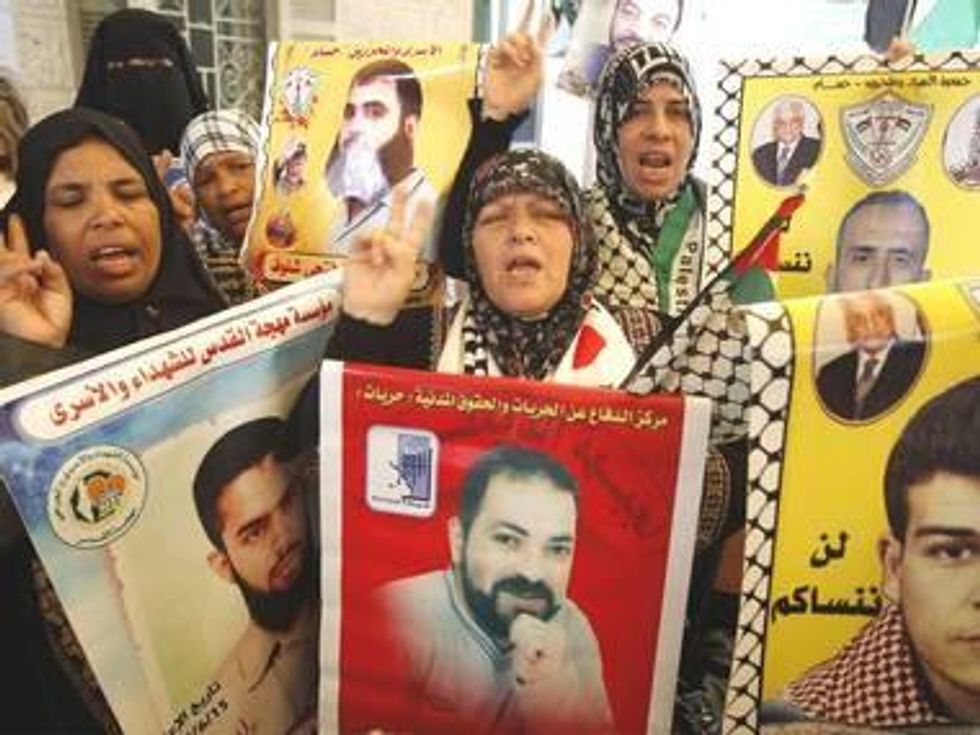
Throughout the morning, thousands of people held marches and rallies across the West Bank, with around 3,000 people gathering in Shuhada Square in central Nablus, waving Palestinian flags and holding up pictures of imprisoned relatives, according to Al-Jazeera.
"The Palestinian detainees who are on hunger strike are protesting Israel's treatment to prisoners inside the Israeli prisons," Amani Sarahna, a spokeswoman for The Palestinian Prisoner's Association Club, an inmate advocacy group, told CNN. "They are protesting Israel's policy of administrative detention and solitary confinement for prisoners for months at a time. They are protesting the arbitrary fines imposed on prisoners by the Israeli authority, the prevention of families especially of those from Gaza."
* * *
CNN: 1,500 Palestinian prisoners start hunger strike
About 1,500 Palestinian prisoners held in Israeli detention began an open-ended hunger strike Tuesday as Palestinians across the West Bank and Gaza gathered in various events to observe the annual Prisoners' Day, marking solidarity for the thousands of Palestinians in Israeli prisons. [...]
Administrative detention is a controversial Israeli practice that allows authorities to detain people indefinitely. There is no requirement to charge detainees held under this practice. Of the roughly 4,700 Palestinian prisoners in Israeli prisons, approximately 300 are in administrative detention.
* * *
The Independent/UK: Prisoners hope to draw attention to solitary confinement and detention without charge
The protest - timed to coincide with the annual Prisoner's Day - comes as two inmates in Israeli jails enter their 48th day on hunger strike. In recent weeks, two other captives came close to death after weeks without food, prompting Israel to agree to individual deals for their release that averted the need for a fundamental shift in policy.
The hunger-strikers have a long list of demands, top of which is to protest against administrative detention, a draconian policy that Israel has used to jail indefinitely those it deems a security threat.
More than 300 of over 4,600 Palestinian prisoners are currently held without charge, in some cases for years without ever knowing why. Israel says that revealing evidence in public courts would endanger its informants and methods, but critics argue that it prevents defendants from challenging the charges. Eleven prisoners are already on hunger strike, including Bilal Diab, 27, and Tha'er Halahi, 34, who have shunned food now for 48 days. Mr Diab, who was arrested in August, has collapsed several times, according to Physicians for Human Rights (PHR), which has been monitoring the two men.
* * *
International Middle East News Center: Palestinian Detainees Initiate An Open-Ended Hunger Strike
The detainees , of all political affiliations, stated that they they formulated their plan for the open-ended hunger strike in order to achieve their legitimate rights, and decided that April 17 is the most suitable date for the launching of this strike.
They said that hunger strike is the only means available to them to achieve their rights and to pressure the Israeli government into negotiating with their representative in order to end all sorts of violations against them.
"Our main demands are; ending all sorts of solitary confinement as numerous detainees spent dozens of years in solitary, in tiny cells that lack the basic living recruitments, we want an end to all physical and emotional abuse", the detainees stated, "We want the families of Gaza Strip detainees to be able to visit their detained sons, they have been denied this right since six consecutive years".
The detainees are also demanding Israel to improve their living conditions, and an end to all illegal "laws" against them, such as the "Shalit Law" that denied the detainees their legitimate rights, including the right to education, in addition to preventing them from receiving newspapers, certain TV channels, books, and the right to education.
They are also demanding Israel to stop the illegal strip search practiced against their families, the night raids against the detainees' rooms, and all sorts of collective punishment.
* * *
Ma'an News Agency in Gaza: Palestinians mark prisoners day in Gaza, West Bank
In Gaza City, Hana Shalabi -- released after 43 days on hunger strike -- lit a torch of freedom and applauded popular support for detainees challenging their imprisonment. Shalabi was sent from her native West Bank to Gaza under the release deal.
Another torch was lit in Arraba to honor Karim Younis, the longest-serving prisoner, and Lina Jarbouni, the longest-serving female prisoner, as well as Adnan, in the presence of prisoners' families.
Officials unveiled a mural painted by four Palestinian artists at the entrance to the village. The "Will and Freedom" mural -- by Muhammad Shalabi from Jenin refugee camp, Areij Urouq from Jenin city, Anas Abiyya from Salfit and Tamir Kamal from Zababda -- shows Palestinian women suffering from imprisonment of Palestinians in Israel.
Speaking at the event, Fatah leader Abbas Zaki said: "There will be no peace and no safety without releasing all prisoners from Israeli jails."
# # #
Palestinians across the West Bank, Gaza, and those held in Israeli prisons hope to draw attention to abusive nature of solitary confinement, the practice of 'detention without charge,' and renew calls for the release of all political prisoners.
The action comes on the same day that Palestinian activist Khader Adnan is due to be released as part of an agreement struck earlier this year to end his 66-day hunger strike in protest of his prolonged detention without charge.
Throughout the morning, thousands of people held marches and rallies across the West Bank, with around 3,000 people gathering in Shuhada Square in central Nablus, waving Palestinian flags and holding up pictures of imprisoned relatives, according to Al-Jazeera.
"The Palestinian detainees who are on hunger strike are protesting Israel's treatment to prisoners inside the Israeli prisons," Amani Sarahna, a spokeswoman for The Palestinian Prisoner's Association Club, an inmate advocacy group, told CNN. "They are protesting Israel's policy of administrative detention and solitary confinement for prisoners for months at a time. They are protesting the arbitrary fines imposed on prisoners by the Israeli authority, the prevention of families especially of those from Gaza."
* * *
CNN: 1,500 Palestinian prisoners start hunger strike
About 1,500 Palestinian prisoners held in Israeli detention began an open-ended hunger strike Tuesday as Palestinians across the West Bank and Gaza gathered in various events to observe the annual Prisoners' Day, marking solidarity for the thousands of Palestinians in Israeli prisons. [...]
Administrative detention is a controversial Israeli practice that allows authorities to detain people indefinitely. There is no requirement to charge detainees held under this practice. Of the roughly 4,700 Palestinian prisoners in Israeli prisons, approximately 300 are in administrative detention.
* * *
The Independent/UK: Prisoners hope to draw attention to solitary confinement and detention without charge
The protest - timed to coincide with the annual Prisoner's Day - comes as two inmates in Israeli jails enter their 48th day on hunger strike. In recent weeks, two other captives came close to death after weeks without food, prompting Israel to agree to individual deals for their release that averted the need for a fundamental shift in policy.
The hunger-strikers have a long list of demands, top of which is to protest against administrative detention, a draconian policy that Israel has used to jail indefinitely those it deems a security threat.
More than 300 of over 4,600 Palestinian prisoners are currently held without charge, in some cases for years without ever knowing why. Israel says that revealing evidence in public courts would endanger its informants and methods, but critics argue that it prevents defendants from challenging the charges. Eleven prisoners are already on hunger strike, including Bilal Diab, 27, and Tha'er Halahi, 34, who have shunned food now for 48 days. Mr Diab, who was arrested in August, has collapsed several times, according to Physicians for Human Rights (PHR), which has been monitoring the two men.
* * *
International Middle East News Center: Palestinian Detainees Initiate An Open-Ended Hunger Strike
The detainees , of all political affiliations, stated that they they formulated their plan for the open-ended hunger strike in order to achieve their legitimate rights, and decided that April 17 is the most suitable date for the launching of this strike.
They said that hunger strike is the only means available to them to achieve their rights and to pressure the Israeli government into negotiating with their representative in order to end all sorts of violations against them.
"Our main demands are; ending all sorts of solitary confinement as numerous detainees spent dozens of years in solitary, in tiny cells that lack the basic living recruitments, we want an end to all physical and emotional abuse", the detainees stated, "We want the families of Gaza Strip detainees to be able to visit their detained sons, they have been denied this right since six consecutive years".
The detainees are also demanding Israel to improve their living conditions, and an end to all illegal "laws" against them, such as the "Shalit Law" that denied the detainees their legitimate rights, including the right to education, in addition to preventing them from receiving newspapers, certain TV channels, books, and the right to education.
They are also demanding Israel to stop the illegal strip search practiced against their families, the night raids against the detainees' rooms, and all sorts of collective punishment.
* * *
Ma'an News Agency in Gaza: Palestinians mark prisoners day in Gaza, West Bank
In Gaza City, Hana Shalabi -- released after 43 days on hunger strike -- lit a torch of freedom and applauded popular support for detainees challenging their imprisonment. Shalabi was sent from her native West Bank to Gaza under the release deal.
Another torch was lit in Arraba to honor Karim Younis, the longest-serving prisoner, and Lina Jarbouni, the longest-serving female prisoner, as well as Adnan, in the presence of prisoners' families.
Officials unveiled a mural painted by four Palestinian artists at the entrance to the village. The "Will and Freedom" mural -- by Muhammad Shalabi from Jenin refugee camp, Areij Urouq from Jenin city, Anas Abiyya from Salfit and Tamir Kamal from Zababda -- shows Palestinian women suffering from imprisonment of Palestinians in Israel.
Speaking at the event, Fatah leader Abbas Zaki said: "There will be no peace and no safety without releasing all prisoners from Israeli jails."
# # #
Palestinians across the West Bank, Gaza, and those held in Israeli prisons hope to draw attention to abusive nature of solitary confinement, the practice of 'detention without charge,' and renew calls for the release of all political prisoners.
The action comes on the same day that Palestinian activist Khader Adnan is due to be released as part of an agreement struck earlier this year to end his 66-day hunger strike in protest of his prolonged detention without charge.
Throughout the morning, thousands of people held marches and rallies across the West Bank, with around 3,000 people gathering in Shuhada Square in central Nablus, waving Palestinian flags and holding up pictures of imprisoned relatives, according to Al-Jazeera.
"The Palestinian detainees who are on hunger strike are protesting Israel's treatment to prisoners inside the Israeli prisons," Amani Sarahna, a spokeswoman for The Palestinian Prisoner's Association Club, an inmate advocacy group, told CNN. "They are protesting Israel's policy of administrative detention and solitary confinement for prisoners for months at a time. They are protesting the arbitrary fines imposed on prisoners by the Israeli authority, the prevention of families especially of those from Gaza."
* * *
CNN: 1,500 Palestinian prisoners start hunger strike
About 1,500 Palestinian prisoners held in Israeli detention began an open-ended hunger strike Tuesday as Palestinians across the West Bank and Gaza gathered in various events to observe the annual Prisoners' Day, marking solidarity for the thousands of Palestinians in Israeli prisons. [...]
Administrative detention is a controversial Israeli practice that allows authorities to detain people indefinitely. There is no requirement to charge detainees held under this practice. Of the roughly 4,700 Palestinian prisoners in Israeli prisons, approximately 300 are in administrative detention.
* * *
The Independent/UK: Prisoners hope to draw attention to solitary confinement and detention without charge
The protest - timed to coincide with the annual Prisoner's Day - comes as two inmates in Israeli jails enter their 48th day on hunger strike. In recent weeks, two other captives came close to death after weeks without food, prompting Israel to agree to individual deals for their release that averted the need for a fundamental shift in policy.
The hunger-strikers have a long list of demands, top of which is to protest against administrative detention, a draconian policy that Israel has used to jail indefinitely those it deems a security threat.
More than 300 of over 4,600 Palestinian prisoners are currently held without charge, in some cases for years without ever knowing why. Israel says that revealing evidence in public courts would endanger its informants and methods, but critics argue that it prevents defendants from challenging the charges. Eleven prisoners are already on hunger strike, including Bilal Diab, 27, and Tha'er Halahi, 34, who have shunned food now for 48 days. Mr Diab, who was arrested in August, has collapsed several times, according to Physicians for Human Rights (PHR), which has been monitoring the two men.
* * *
International Middle East News Center: Palestinian Detainees Initiate An Open-Ended Hunger Strike
The detainees , of all political affiliations, stated that they they formulated their plan for the open-ended hunger strike in order to achieve their legitimate rights, and decided that April 17 is the most suitable date for the launching of this strike.
They said that hunger strike is the only means available to them to achieve their rights and to pressure the Israeli government into negotiating with their representative in order to end all sorts of violations against them.
"Our main demands are; ending all sorts of solitary confinement as numerous detainees spent dozens of years in solitary, in tiny cells that lack the basic living recruitments, we want an end to all physical and emotional abuse", the detainees stated, "We want the families of Gaza Strip detainees to be able to visit their detained sons, they have been denied this right since six consecutive years".
The detainees are also demanding Israel to improve their living conditions, and an end to all illegal "laws" against them, such as the "Shalit Law" that denied the detainees their legitimate rights, including the right to education, in addition to preventing them from receiving newspapers, certain TV channels, books, and the right to education.
They are also demanding Israel to stop the illegal strip search practiced against their families, the night raids against the detainees' rooms, and all sorts of collective punishment.
* * *
Ma'an News Agency in Gaza: Palestinians mark prisoners day in Gaza, West Bank
In Gaza City, Hana Shalabi -- released after 43 days on hunger strike -- lit a torch of freedom and applauded popular support for detainees challenging their imprisonment. Shalabi was sent from her native West Bank to Gaza under the release deal.
Another torch was lit in Arraba to honor Karim Younis, the longest-serving prisoner, and Lina Jarbouni, the longest-serving female prisoner, as well as Adnan, in the presence of prisoners' families.
Officials unveiled a mural painted by four Palestinian artists at the entrance to the village. The "Will and Freedom" mural -- by Muhammad Shalabi from Jenin refugee camp, Areij Urouq from Jenin city, Anas Abiyya from Salfit and Tamir Kamal from Zababda -- shows Palestinian women suffering from imprisonment of Palestinians in Israel.
Speaking at the event, Fatah leader Abbas Zaki said: "There will be no peace and no safety without releasing all prisoners from Israeli jails."
# # #