

SUBSCRIBE TO OUR FREE NEWSLETTER
Daily news & progressive opinion—funded by the people, not the corporations—delivered straight to your inbox.
5
#000000
#FFFFFF
To donate by check, phone, or other method, see our More Ways to Give page.
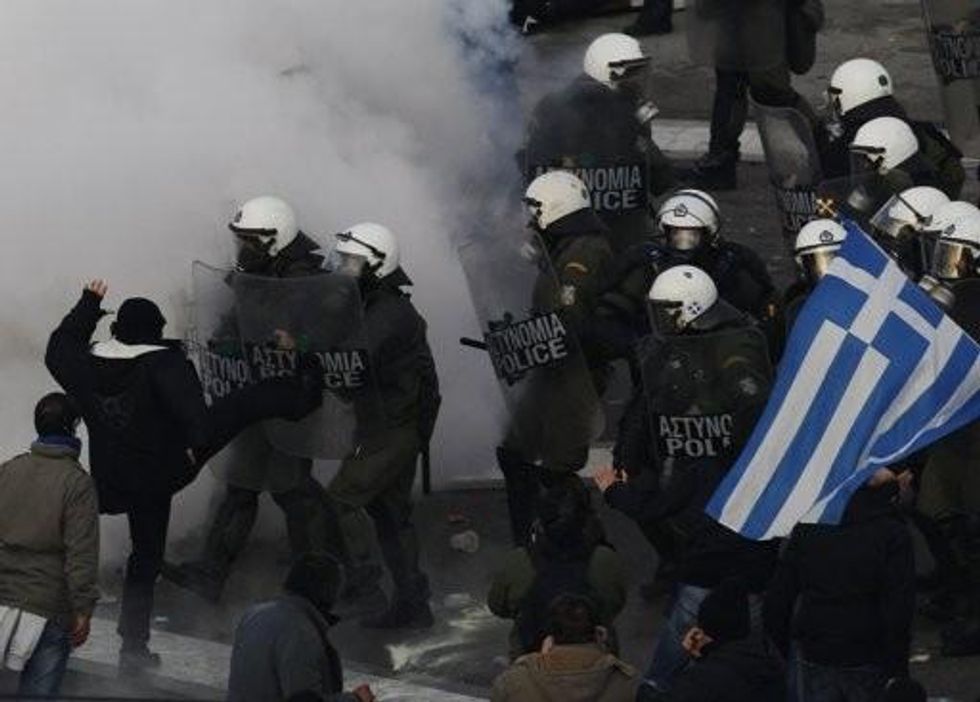
As the Greek parliament debates the final austerity deal required by its creditors, thousands of riot police have been unleashed on protesters demanding an end to the harsh cuts pushing the country toward turmoil.
The scenes both outside and inside the parliament building have turned fiery, with one MP throwing the pages of the austerity bill to the ground and thousands of protesters being tear gassed.
Greek Prime Minister Lucas Papademos pressured the parliament to accept the deal, saying that failure to do so would result in "economic chaos." Channel 4 News reports:
Mr Papademos said parliament had a historic responsibility to back the bill, or face catastrophic consequences if Greece misses a March 20 deadline to service its debt.
"A disorderly default would set the country on a disastrous adventure," he said in a televised address to the nation. "It would create conditions of uncontrolled economic chaos and social explosion."
"The country would be drawn into a vortex of recession, instability, unemployment and protracted misery and this would sooner or later lead the country out of the euro."
Reuters reports on the harsh cuts in the deal:
The austerity measures include EUR300m in pension cuts and a 22% reduction in the minimum wage from about EUR750 a month. The bill aims to cut Greece's state sector workforce by about 150,000 by 2015. It also provides for a bond swap to ease Greece's debt burden by cutting the real value of private investors' bond holdings by some 70%.
Agence France-Presse has details on the protesters:
Tear gas was used on petrol bomb-throwing protesters outside Greece's parliament as it debates an austerity plan.
Police said some 25,000 protesters were massed outside the building and at nearby Omonia Square, with some 3000 police deployed and more protesters arriving.[..]
The overnight protesters included trade unionists, youths with shaven heads waving Greek flags, communist activists and left-wing sympathisers, many of them equipped with gas masks.
They denounced what they describe as blackmail being imposed by the international troika of the EU, the IMF and the European Central Bank in return for the bailout.
"It's not easy to live in these conditions," said 49-year-old engineer Andreas Maragoudakis. "By 2020 we will be the Germans' slaves."
Another protester, Stella Maguina, 33, said: "We are here for our parents and our children, for all those who can't come."
Helena Smith: "The harsh austerity pursued in the name of deficit-reducing goals has pushed Greece towards economic and social collapse."
Helena Smith writes in The Observer today that the austerity push has been a total failure for Greece:
For the truth - as unpalatable as it may be for the IMF, EU and European Central Bank, Greece's "troika" of creditors - is that, far from plugging the country's budget black holes, the harsh austerity pursued in the name of deficit-reducing goals has pushed it towards economic and social collapse. Relentless wage and pension cuts, tax rises and cost-cutting reforms have left the country a shadow of itself. In its fifth successive year of recession, Greece is a hollowed-out version of what it once was, coming apart at the seams a little more with each day. Men and women forage through rubbish bins late at night. More sleep on the streets. Last week as Eurostat, the European statistic agency, announced that poverty had engulfed more than a third of the nation, it was revealed that unemployment had also exceeded one million people, from a record 19% to 20.9% in one month.
Finance Minister Evangelos Venizelos has said the deal must be agreed to on Sunday.
As the Greek parliament debates the final austerity deal required by its creditors, thousands of riot police have been unleashed on protesters demanding an end to the harsh cuts pushing the country toward turmoil.
The scenes both outside and inside the parliament building have turned fiery, with one MP throwing the pages of the austerity bill to the ground and thousands of protesters being tear gassed.
Greek Prime Minister Lucas Papademos pressured the parliament to accept the deal, saying that failure to do so would result in "economic chaos." Channel 4 News reports:
Mr Papademos said parliament had a historic responsibility to back the bill, or face catastrophic consequences if Greece misses a March 20 deadline to service its debt.
"A disorderly default would set the country on a disastrous adventure," he said in a televised address to the nation. "It would create conditions of uncontrolled economic chaos and social explosion."
"The country would be drawn into a vortex of recession, instability, unemployment and protracted misery and this would sooner or later lead the country out of the euro."
Reuters reports on the harsh cuts in the deal:
The austerity measures include EUR300m in pension cuts and a 22% reduction in the minimum wage from about EUR750 a month. The bill aims to cut Greece's state sector workforce by about 150,000 by 2015. It also provides for a bond swap to ease Greece's debt burden by cutting the real value of private investors' bond holdings by some 70%.
Agence France-Presse has details on the protesters:
Tear gas was used on petrol bomb-throwing protesters outside Greece's parliament as it debates an austerity plan.
Police said some 25,000 protesters were massed outside the building and at nearby Omonia Square, with some 3000 police deployed and more protesters arriving.[..]
The overnight protesters included trade unionists, youths with shaven heads waving Greek flags, communist activists and left-wing sympathisers, many of them equipped with gas masks.
They denounced what they describe as blackmail being imposed by the international troika of the EU, the IMF and the European Central Bank in return for the bailout.
"It's not easy to live in these conditions," said 49-year-old engineer Andreas Maragoudakis. "By 2020 we will be the Germans' slaves."
Another protester, Stella Maguina, 33, said: "We are here for our parents and our children, for all those who can't come."
Helena Smith: "The harsh austerity pursued in the name of deficit-reducing goals has pushed Greece towards economic and social collapse."
Helena Smith writes in The Observer today that the austerity push has been a total failure for Greece:
For the truth - as unpalatable as it may be for the IMF, EU and European Central Bank, Greece's "troika" of creditors - is that, far from plugging the country's budget black holes, the harsh austerity pursued in the name of deficit-reducing goals has pushed it towards economic and social collapse. Relentless wage and pension cuts, tax rises and cost-cutting reforms have left the country a shadow of itself. In its fifth successive year of recession, Greece is a hollowed-out version of what it once was, coming apart at the seams a little more with each day. Men and women forage through rubbish bins late at night. More sleep on the streets. Last week as Eurostat, the European statistic agency, announced that poverty had engulfed more than a third of the nation, it was revealed that unemployment had also exceeded one million people, from a record 19% to 20.9% in one month.
Finance Minister Evangelos Venizelos has said the deal must be agreed to on Sunday.
As the Greek parliament debates the final austerity deal required by its creditors, thousands of riot police have been unleashed on protesters demanding an end to the harsh cuts pushing the country toward turmoil.
The scenes both outside and inside the parliament building have turned fiery, with one MP throwing the pages of the austerity bill to the ground and thousands of protesters being tear gassed.
Greek Prime Minister Lucas Papademos pressured the parliament to accept the deal, saying that failure to do so would result in "economic chaos." Channel 4 News reports:
Mr Papademos said parliament had a historic responsibility to back the bill, or face catastrophic consequences if Greece misses a March 20 deadline to service its debt.
"A disorderly default would set the country on a disastrous adventure," he said in a televised address to the nation. "It would create conditions of uncontrolled economic chaos and social explosion."
"The country would be drawn into a vortex of recession, instability, unemployment and protracted misery and this would sooner or later lead the country out of the euro."
Reuters reports on the harsh cuts in the deal:
The austerity measures include EUR300m in pension cuts and a 22% reduction in the minimum wage from about EUR750 a month. The bill aims to cut Greece's state sector workforce by about 150,000 by 2015. It also provides for a bond swap to ease Greece's debt burden by cutting the real value of private investors' bond holdings by some 70%.
Agence France-Presse has details on the protesters:
Tear gas was used on petrol bomb-throwing protesters outside Greece's parliament as it debates an austerity plan.
Police said some 25,000 protesters were massed outside the building and at nearby Omonia Square, with some 3000 police deployed and more protesters arriving.[..]
The overnight protesters included trade unionists, youths with shaven heads waving Greek flags, communist activists and left-wing sympathisers, many of them equipped with gas masks.
They denounced what they describe as blackmail being imposed by the international troika of the EU, the IMF and the European Central Bank in return for the bailout.
"It's not easy to live in these conditions," said 49-year-old engineer Andreas Maragoudakis. "By 2020 we will be the Germans' slaves."
Another protester, Stella Maguina, 33, said: "We are here for our parents and our children, for all those who can't come."
Helena Smith: "The harsh austerity pursued in the name of deficit-reducing goals has pushed Greece towards economic and social collapse."
Helena Smith writes in The Observer today that the austerity push has been a total failure for Greece:
For the truth - as unpalatable as it may be for the IMF, EU and European Central Bank, Greece's "troika" of creditors - is that, far from plugging the country's budget black holes, the harsh austerity pursued in the name of deficit-reducing goals has pushed it towards economic and social collapse. Relentless wage and pension cuts, tax rises and cost-cutting reforms have left the country a shadow of itself. In its fifth successive year of recession, Greece is a hollowed-out version of what it once was, coming apart at the seams a little more with each day. Men and women forage through rubbish bins late at night. More sleep on the streets. Last week as Eurostat, the European statistic agency, announced that poverty had engulfed more than a third of the nation, it was revealed that unemployment had also exceeded one million people, from a record 19% to 20.9% in one month.
Finance Minister Evangelos Venizelos has said the deal must be agreed to on Sunday.

