SUBSCRIBE TO OUR FREE NEWSLETTER
Daily news & progressive opinion—funded by the people, not the corporations—delivered straight to your inbox.
5
#000000
#FFFFFF
To donate by check, phone, or other method, see our More Ways to Give page.
Nuclear-armed Pakistan has been through turmoil for many years with military coups, rampant corruption and US drone attacks. Cricketer-turned-politician Imran Khan, the leader of Pakistan's Movement for Justice party, is emerging as a leading contender to lead Pakistan into the future.
Earlier this week Khan threatened to organize a 'civil disobedience movement' if the current government didn't step down:
(Khan's Movement for Justice party's) central executive committee will discuss various options to mobilize the public against the incumbent government, including a civil disobedience movement, at its next meeting on January 14, Imran said at a press conference on Tuesday.
The government has failed to resolve public issues, and "is backtracking on all accounts -- economy, defence, good governance and its policies," Imran said.
"We are considering large-scale strikes and acts of civil disobedience, including surrounding the President and Prime Minister houses," Khan said.
Huma Yusuf, a journalist for the Pakistani newspaper Dawn, writing in today's New York Times:
An exciting shift is now underway in Pakistan: the young are becoming politically engaged. In coffee shops, beauty salons and workplaces, instead of gossiping or deconstructing the latest televised drama, youngsters are arguing about the merits of various politicians. As a journalist, I can't walk into a social gathering without getting grilled by my peers and their younger siblings about this policy or that. Older Pakistanis who have long bemoaned the apathy of the country's educated, middle-class youth are sighing in relief at this newfound activism. As one elderly family friend put it, "Your lot has finally woken up."
Pakistani youngsters' desire for change and a greater stake in their country's future has fueled the unexpected success of the cricketer-turned-politician Imran Khan. He boasts more than 150,000 followers on Twitter and more than 330,000 Facebook likes. The student wing of his Pakistan Tehrik-e-Insaf (P.T.I.) party counts over 4,000 members in Karachi. A P.T.I. rally in Lahore in October attracted more than 7,000 students and thousands of young voters; with so many fresh faces in the crowd, the line between political gathering and rock concert seemed blurred.
* * *
Al Jazeera wrote of Khan's massive 'Tsunami' rally in Karachi on December 25th:
"I now present you the man who will save Pakistan."
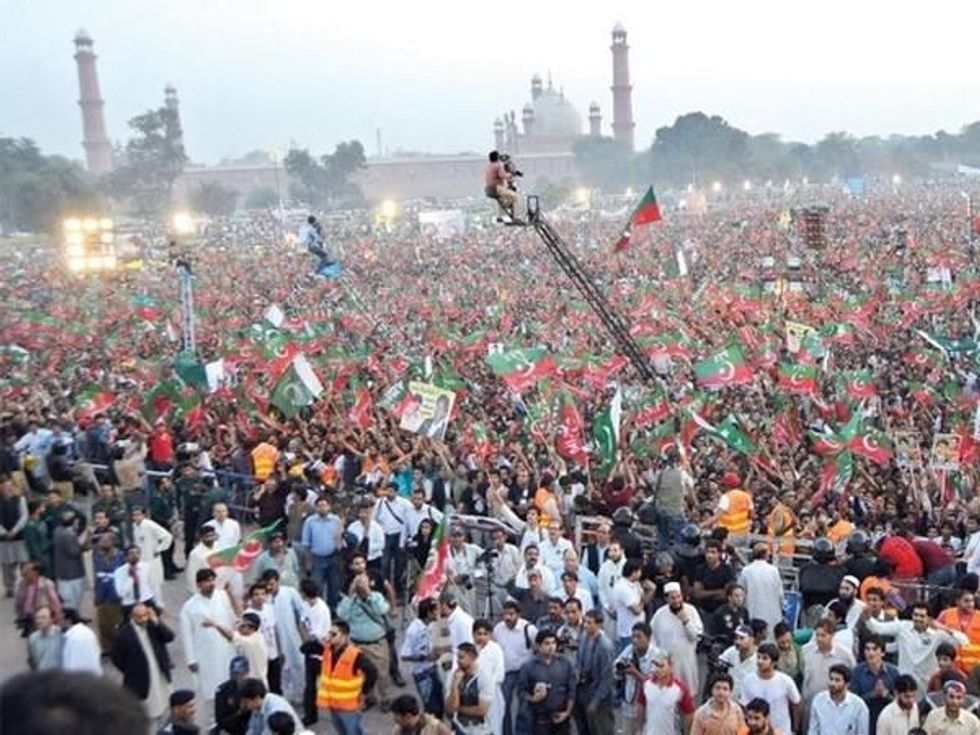
That's how cricket star-turned politician Imran Khan was introduced to a crowd of more than 100,000 of his supporters on Sunday, December 25th.
The rally in Karachi, Pakistan's largest and most diverse city, was a crucial test of the vitality of Khan's recent popular surge.
But the crowds poured in and the energy was infectious.
"Imran Khan is the only hope that we have right now," said 28-year-old Shohaid Siddqui as he proudly waved a flag in support of Khan's party, Tehreek-e-Insaf (or Movement for Justice).
His friend, 23-year-old Mohammed Omar added: "We need revolutionary change, and that change will come in the form of Imran Khan."
India Times reported:
Thousands of people, including women and children, on Sunday converged near the mausoleum of Pakistan's founder Mohammad Ali Jinnah for Imran Khan's massive "tsunami" rally seeking a "change" in the country.
'Peace in Karachi, a stable and progressive Pakistan' read a giant banner on center stage. The rally lit up once Imran Khan entered the venue and went to the main stage to resounding cheers and slogans.
"We are here because of Imran Khan. We believe he can make a better Pakistan and bring changes," shouted Maleeha, a hijab-clad woman who had come with her fiance to the rally.
Zainab, another young woman dressed in jeans and shirt, said many people now know that Imran Khan was the last hope for Pakistan. "We all believe only he can turn around this country and rid it of corruption and extremism. He can bring about better governance."
The interesting aspect of the rally was that the participants included people from all ethnic backgrounds with the women and girls appearing particularly charged up for the rally.
* * *
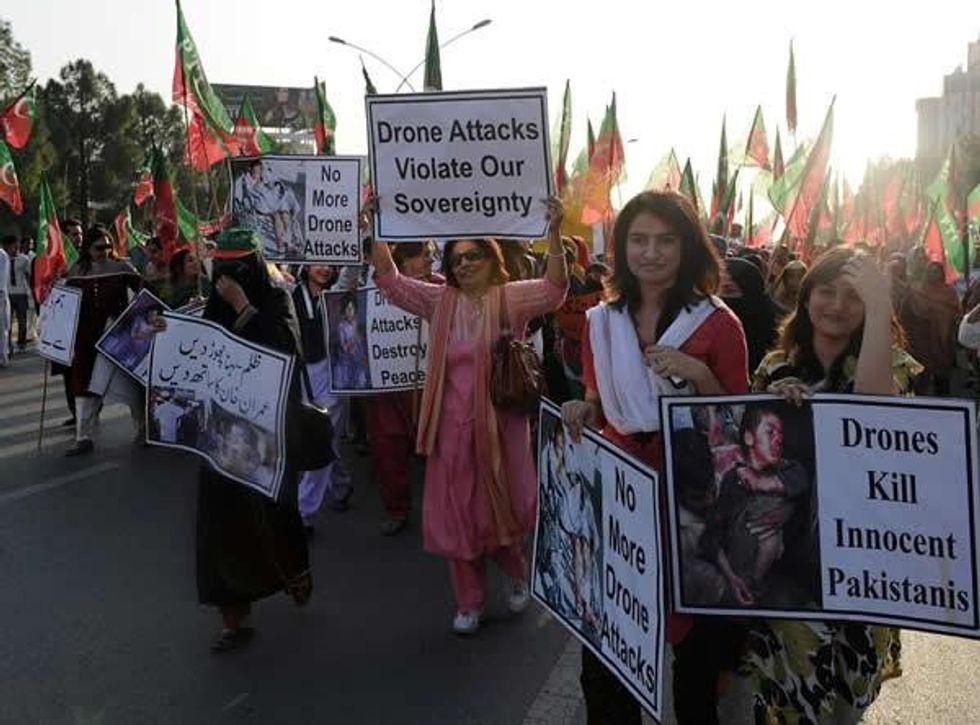
Nuclear-armed Pakistan has been through turmoil for many years with military coups, rampant corruption and US drone attacks. Cricketer-turned-politician Imran Khan, the leader of Pakistan's Movement for Justice party, is emerging as a leading contender to lead Pakistan into the future.
Earlier this week Khan threatened to organize a 'civil disobedience movement' if the current government didn't step down:
(Khan's Movement for Justice party's) central executive committee will discuss various options to mobilize the public against the incumbent government, including a civil disobedience movement, at its next meeting on January 14, Imran said at a press conference on Tuesday.
The government has failed to resolve public issues, and "is backtracking on all accounts -- economy, defence, good governance and its policies," Imran said.
"We are considering large-scale strikes and acts of civil disobedience, including surrounding the President and Prime Minister houses," Khan said.
Huma Yusuf, a journalist for the Pakistani newspaper Dawn, writing in today's New York Times:
An exciting shift is now underway in Pakistan: the young are becoming politically engaged. In coffee shops, beauty salons and workplaces, instead of gossiping or deconstructing the latest televised drama, youngsters are arguing about the merits of various politicians. As a journalist, I can't walk into a social gathering without getting grilled by my peers and their younger siblings about this policy or that. Older Pakistanis who have long bemoaned the apathy of the country's educated, middle-class youth are sighing in relief at this newfound activism. As one elderly family friend put it, "Your lot has finally woken up."
Pakistani youngsters' desire for change and a greater stake in their country's future has fueled the unexpected success of the cricketer-turned-politician Imran Khan. He boasts more than 150,000 followers on Twitter and more than 330,000 Facebook likes. The student wing of his Pakistan Tehrik-e-Insaf (P.T.I.) party counts over 4,000 members in Karachi. A P.T.I. rally in Lahore in October attracted more than 7,000 students and thousands of young voters; with so many fresh faces in the crowd, the line between political gathering and rock concert seemed blurred.
* * *
Al Jazeera wrote of Khan's massive 'Tsunami' rally in Karachi on December 25th:
"I now present you the man who will save Pakistan."
That's how cricket star-turned politician Imran Khan was introduced to a crowd of more than 100,000 of his supporters on Sunday, December 25th.
The rally in Karachi, Pakistan's largest and most diverse city, was a crucial test of the vitality of Khan's recent popular surge.
But the crowds poured in and the energy was infectious.
"Imran Khan is the only hope that we have right now," said 28-year-old Shohaid Siddqui as he proudly waved a flag in support of Khan's party, Tehreek-e-Insaf (or Movement for Justice).
His friend, 23-year-old Mohammed Omar added: "We need revolutionary change, and that change will come in the form of Imran Khan."
India Times reported:
Thousands of people, including women and children, on Sunday converged near the mausoleum of Pakistan's founder Mohammad Ali Jinnah for Imran Khan's massive "tsunami" rally seeking a "change" in the country.
'Peace in Karachi, a stable and progressive Pakistan' read a giant banner on center stage. The rally lit up once Imran Khan entered the venue and went to the main stage to resounding cheers and slogans.
"We are here because of Imran Khan. We believe he can make a better Pakistan and bring changes," shouted Maleeha, a hijab-clad woman who had come with her fiance to the rally.
Zainab, another young woman dressed in jeans and shirt, said many people now know that Imran Khan was the last hope for Pakistan. "We all believe only he can turn around this country and rid it of corruption and extremism. He can bring about better governance."
The interesting aspect of the rally was that the participants included people from all ethnic backgrounds with the women and girls appearing particularly charged up for the rally.
* * *
Nuclear-armed Pakistan has been through turmoil for many years with military coups, rampant corruption and US drone attacks. Cricketer-turned-politician Imran Khan, the leader of Pakistan's Movement for Justice party, is emerging as a leading contender to lead Pakistan into the future.
Earlier this week Khan threatened to organize a 'civil disobedience movement' if the current government didn't step down:
(Khan's Movement for Justice party's) central executive committee will discuss various options to mobilize the public against the incumbent government, including a civil disobedience movement, at its next meeting on January 14, Imran said at a press conference on Tuesday.
The government has failed to resolve public issues, and "is backtracking on all accounts -- economy, defence, good governance and its policies," Imran said.
"We are considering large-scale strikes and acts of civil disobedience, including surrounding the President and Prime Minister houses," Khan said.
Huma Yusuf, a journalist for the Pakistani newspaper Dawn, writing in today's New York Times:
An exciting shift is now underway in Pakistan: the young are becoming politically engaged. In coffee shops, beauty salons and workplaces, instead of gossiping or deconstructing the latest televised drama, youngsters are arguing about the merits of various politicians. As a journalist, I can't walk into a social gathering without getting grilled by my peers and their younger siblings about this policy or that. Older Pakistanis who have long bemoaned the apathy of the country's educated, middle-class youth are sighing in relief at this newfound activism. As one elderly family friend put it, "Your lot has finally woken up."
Pakistani youngsters' desire for change and a greater stake in their country's future has fueled the unexpected success of the cricketer-turned-politician Imran Khan. He boasts more than 150,000 followers on Twitter and more than 330,000 Facebook likes. The student wing of his Pakistan Tehrik-e-Insaf (P.T.I.) party counts over 4,000 members in Karachi. A P.T.I. rally in Lahore in October attracted more than 7,000 students and thousands of young voters; with so many fresh faces in the crowd, the line between political gathering and rock concert seemed blurred.
* * *
Al Jazeera wrote of Khan's massive 'Tsunami' rally in Karachi on December 25th:
"I now present you the man who will save Pakistan."
That's how cricket star-turned politician Imran Khan was introduced to a crowd of more than 100,000 of his supporters on Sunday, December 25th.
The rally in Karachi, Pakistan's largest and most diverse city, was a crucial test of the vitality of Khan's recent popular surge.
But the crowds poured in and the energy was infectious.
"Imran Khan is the only hope that we have right now," said 28-year-old Shohaid Siddqui as he proudly waved a flag in support of Khan's party, Tehreek-e-Insaf (or Movement for Justice).
His friend, 23-year-old Mohammed Omar added: "We need revolutionary change, and that change will come in the form of Imran Khan."
India Times reported:
Thousands of people, including women and children, on Sunday converged near the mausoleum of Pakistan's founder Mohammad Ali Jinnah for Imran Khan's massive "tsunami" rally seeking a "change" in the country.
'Peace in Karachi, a stable and progressive Pakistan' read a giant banner on center stage. The rally lit up once Imran Khan entered the venue and went to the main stage to resounding cheers and slogans.
"We are here because of Imran Khan. We believe he can make a better Pakistan and bring changes," shouted Maleeha, a hijab-clad woman who had come with her fiance to the rally.
Zainab, another young woman dressed in jeans and shirt, said many people now know that Imran Khan was the last hope for Pakistan. "We all believe only he can turn around this country and rid it of corruption and extremism. He can bring about better governance."
The interesting aspect of the rally was that the participants included people from all ethnic backgrounds with the women and girls appearing particularly charged up for the rally.
* * *