
Al-Arian Case: 'When You Have To Leave America To Be Free'
Nearly three years after the U.S. government failed to convict Palestinian activist and former college professor Sami Al-Arian of any charges in one of the most high-profile terrorism trials following the 9/11 terrorist attacks, he continues to be held in federal prison - where, if convicted in an upcoming trial on criminal contempt charges, he faces the prospect of remaining for decades.
Al-Arian has been imprisoned since Feb. 20, 2003, after then-attorney general John Ashcroft declared in a press conference that he and four others were in league with the Palestinian Islamic Jihad, "one of the most violent terrorist organizations in the world."
According to the U.S. government, Al-Arian operated several front groups for the Damascus-based terrorist group during the 1990s, raising money to finance suicide bombings that killed more than 100 Israelis. At his trial, prosecutors played graphic videos of suicide bombings and invited Israeli citizens to testify about their experiences surviving terrorist attacks - attacks the government suggested were the end result of Al-Arian's actions.
Prosecutors also showed jurors a 1991 video of a rally where Al-Arian can be seen shouting, "death to Israel and victory to Islam" in Arabic. Al-Arian, a former professor at the University of South Florida, maintains that he has never condoned violence against civilians, but that he does support the right to resist a "brutal military occupation" of Palestinian lands.
Indeed, even the prosecution conceded that - after more than 10 years of tapping the phone conversations of Al-Arian and his family - there was no evidence directly tying him to a single terrorist attack. As a result, in 2005 a Florida jury acquitted Al-Arian of eight charges and remained deadlocked on another nine, with two-thirds of the jury voting for acquittal on all charges.
Yet despite the lack of a single conviction, Al-Arian remains in prison - where supporters say he has often been held in solitary confinement and denied access to his family and legal counsel - for refusing to testify in a trial against a northern Virginia Islamic think tank.
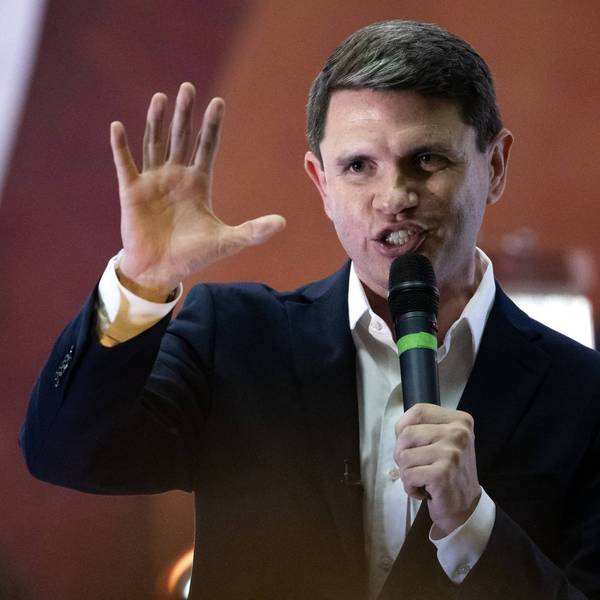
"We don't even know one day where he'll be the next, and we don't know how we'll be able to visit him," said Al-Arian's son, Abdullah, at a recent event here in Washington aimed at raising awareness of the case. "We just want this ordeal to be over."
But if federal prosecutors have their way, Al-Arian's ordeal will not be over anytime soon. After accepting a plea bargain in 2006, where he pled guilty to providing some assistance to friends and family "associated" with the Palestinian Islamic Jihad - such as trying to help his brother-in-law, Mazzen Al-Najjar, obtain a visa - Al-Arian was supposed to be deported to Egypt last year.
However, federal prosecutors - namely, Assistant U.S. Attorney Gordon Kromberg, who critics say has a long record of bigotry toward Arabs and Muslims - have sought to force Al-Arian to testify in a case against the International Institute of Islamic Thought, which is accused of financing terrorist organizations. Al-Arian has refused to testify out of fear that prosecutors are simply seeking to trap him into committing perjury.
"If he does testify, no matter what he says, the prosecutor will charge him with perjury - he's made that pretty clear to us," said Abdullah. "If he does not testify, he can be charged with contempt, and that was the road that my father chose, one that was more principled I think in terms of his taking a stand against the government's abuse of power."
Because of his refusal to testify, Al-Arian is now set for an Aug. 13 trial for criminal contempt. However his lawyer, George Washington University law professor Jonathan Turley, says he has been barred from meeting with his client and is seeking to have the trial delayed and Al-Arian released.
In a motion filed Aug. 1, Turley - who is also seeking to take the case to the Supreme Court - argues that Al-Arian is being illegally detained by authorities in contravention of a Jul. 10 court decision, finding that he posed no flight risk or threat to his community and should be granted bail. "Put simply, Dr. Al-Arian is being held unconstitutionally," Turley states in the motion.
Al-Arian's supporters also maintain that he is a victim of a federal prosecutor - Kromberg. During a 2005 trial, Kromberg told jurors that the defendant in the case - Ali Al-Timimi, a devout Muslim - could not be trusted, as his religion required him to lie to non-believers.
And according to Al-Arian's attorneys, Kromberg told them in a 2006 meeting that he would not grant Al-Arian's request that he not be forced to testify before a grand jury during the Islamic holiday of Ramadan.
"If they can kill each other during Ramadan, they can appear before the grand jury; all they can't do is eat before sunset," Kromberg is quoted as telling Al- Arian's legal counsel. "I am not going to put off Dr. Al-Arian's grand jury appearance to assist in what is becoming the Islamization of America."
Critics say Kromberg's comments - and his unabashed support for the state of Israel - show that his targeting of Al-Arian is based on politics, not terrorism.
"He's been singled out because he's been an effective, courageous man," said Mike Gravel, a former U.S. Senator from Alaska, at the event with Al-Arian's family. Like other supporters, Gravel believes Al-Arian is the victim of a politicized Justice Department eager to silence a controversial and outspoken critic of the Israeli occupation of Palestine.
In an interview with IPS, Gravel said he was "absolutely outraged over the injustice" of the government's treatment of Al-Arian. He also singled out as "gutless" members of Congress - such as Senate Judiciary Committee Chairman Patrick Leahy, a Democrat from Vermont - who have refused to take any action on Al-Arian's behalf.
Since Democrats took over control of Congress, Leahy's committee has held hearings on everything from polygamy to the rights of prisoners at Guantanamo Bay, but none regarding Al-Arian.
An aide to Leahy told IPS that his office continues to receive calls from Al- Arian's supporters, but offered no comment on what - if any - action Leahy would take regarding the case.
"This all stems from AIPAC [the American Israel Public Affairs Committee]," Gravel told IPS. Lawmakers are afraid of offending the powerful lobbying group - which supports a hard-line position on the Israeli-Palestinian conflict in line with Israel's right-wing Likud Party - and thus are unwilling to take up Al-Arian's case, he said. "This guy is just speaking out very effectively for the Palestinian cause, that's what is the root of this, and [the government is] trying to stifle that."
Gravel's comments on the case are echoed by Scott Horton, a former chair of the of the New York City Bar Association's Committee on International Law and a writer for Harper's Magazine.
"I believe that the defence is on firm ground saying that this is a case of political persecution," Horton stated in an interview with IPS. "In fact, I am hard pressed to find another case just like it."
Horton believes Al-Arian has been targeted not because he poses any sort of violent threat, but because he has been a high-profile and articulate critic of Israeli policies. And he believes the case shows that - especially since 9/11 and the advent of the "war on terror" - not even an acquittal is enough to exonerate someone accused of terrorism in the U.S.
"The prosecution's conduct is typical of the Bush Administration... in that it will not accept defeat, whether from a jury or a judge," stated Horton. "When they fail to get the relief they seek, they simply connive another way to secure it."
At the Washington event, Al-Arian's son Abdullah said that, at this point, the best his family could hope for is that the government ultimately decides to deport his father, as they promised to do in the 2006 plea agreement. "It's a sad day when you have to leave America to be free, but that's the America we live in - for some people at least."
An Urgent Message From Our Co-Founder
Dear Common Dreams reader, It’s been nearly 30 years since I co-founded Common Dreams with my late wife, Lina Newhouser. We had the radical notion that journalism should serve the public good, not corporate profits. It was clear to us from the outset what it would take to build such a project. No paid advertisements. No corporate sponsors. No millionaire publisher telling us what to think or do. Many people said we wouldn't last a year, but we proved those doubters wrong. Together with a tremendous team of journalists and dedicated staff, we built an independent media outlet free from the constraints of profits and corporate control. Our mission has always been simple: To inform. To inspire. To ignite change for the common good. Building Common Dreams was not easy. Our survival was never guaranteed. When you take on the most powerful forces—Wall Street greed, fossil fuel industry destruction, Big Tech lobbyists, and uber-rich oligarchs who have spent billions upon billions rigging the economy and democracy in their favor—the only bulwark you have is supporters who believe in your work. But here’s the urgent message from me today. It's never been this bad out there. And it's never been this hard to keep us going. At the very moment Common Dreams is most needed, the threats we face are intensifying. We need your support now more than ever. We don't accept corporate advertising and never will. We don't have a paywall because we don't think people should be blocked from critical news based on their ability to pay. Everything we do is funded by the donations of readers like you. When everyone does the little they can afford, we are strong. But if that support retreats or dries up, so do we. Will you donate now to make sure Common Dreams not only survives but thrives? —Craig Brown, Co-founder |
Nearly three years after the U.S. government failed to convict Palestinian activist and former college professor Sami Al-Arian of any charges in one of the most high-profile terrorism trials following the 9/11 terrorist attacks, he continues to be held in federal prison - where, if convicted in an upcoming trial on criminal contempt charges, he faces the prospect of remaining for decades.
Al-Arian has been imprisoned since Feb. 20, 2003, after then-attorney general John Ashcroft declared in a press conference that he and four others were in league with the Palestinian Islamic Jihad, "one of the most violent terrorist organizations in the world."
According to the U.S. government, Al-Arian operated several front groups for the Damascus-based terrorist group during the 1990s, raising money to finance suicide bombings that killed more than 100 Israelis. At his trial, prosecutors played graphic videos of suicide bombings and invited Israeli citizens to testify about their experiences surviving terrorist attacks - attacks the government suggested were the end result of Al-Arian's actions.
Prosecutors also showed jurors a 1991 video of a rally where Al-Arian can be seen shouting, "death to Israel and victory to Islam" in Arabic. Al-Arian, a former professor at the University of South Florida, maintains that he has never condoned violence against civilians, but that he does support the right to resist a "brutal military occupation" of Palestinian lands.
Indeed, even the prosecution conceded that - after more than 10 years of tapping the phone conversations of Al-Arian and his family - there was no evidence directly tying him to a single terrorist attack. As a result, in 2005 a Florida jury acquitted Al-Arian of eight charges and remained deadlocked on another nine, with two-thirds of the jury voting for acquittal on all charges.
Yet despite the lack of a single conviction, Al-Arian remains in prison - where supporters say he has often been held in solitary confinement and denied access to his family and legal counsel - for refusing to testify in a trial against a northern Virginia Islamic think tank.
"We don't even know one day where he'll be the next, and we don't know how we'll be able to visit him," said Al-Arian's son, Abdullah, at a recent event here in Washington aimed at raising awareness of the case. "We just want this ordeal to be over."
But if federal prosecutors have their way, Al-Arian's ordeal will not be over anytime soon. After accepting a plea bargain in 2006, where he pled guilty to providing some assistance to friends and family "associated" with the Palestinian Islamic Jihad - such as trying to help his brother-in-law, Mazzen Al-Najjar, obtain a visa - Al-Arian was supposed to be deported to Egypt last year.
However, federal prosecutors - namely, Assistant U.S. Attorney Gordon Kromberg, who critics say has a long record of bigotry toward Arabs and Muslims - have sought to force Al-Arian to testify in a case against the International Institute of Islamic Thought, which is accused of financing terrorist organizations. Al-Arian has refused to testify out of fear that prosecutors are simply seeking to trap him into committing perjury.
"If he does testify, no matter what he says, the prosecutor will charge him with perjury - he's made that pretty clear to us," said Abdullah. "If he does not testify, he can be charged with contempt, and that was the road that my father chose, one that was more principled I think in terms of his taking a stand against the government's abuse of power."
Because of his refusal to testify, Al-Arian is now set for an Aug. 13 trial for criminal contempt. However his lawyer, George Washington University law professor Jonathan Turley, says he has been barred from meeting with his client and is seeking to have the trial delayed and Al-Arian released.
In a motion filed Aug. 1, Turley - who is also seeking to take the case to the Supreme Court - argues that Al-Arian is being illegally detained by authorities in contravention of a Jul. 10 court decision, finding that he posed no flight risk or threat to his community and should be granted bail. "Put simply, Dr. Al-Arian is being held unconstitutionally," Turley states in the motion.
Al-Arian's supporters also maintain that he is a victim of a federal prosecutor - Kromberg. During a 2005 trial, Kromberg told jurors that the defendant in the case - Ali Al-Timimi, a devout Muslim - could not be trusted, as his religion required him to lie to non-believers.
And according to Al-Arian's attorneys, Kromberg told them in a 2006 meeting that he would not grant Al-Arian's request that he not be forced to testify before a grand jury during the Islamic holiday of Ramadan.
"If they can kill each other during Ramadan, they can appear before the grand jury; all they can't do is eat before sunset," Kromberg is quoted as telling Al- Arian's legal counsel. "I am not going to put off Dr. Al-Arian's grand jury appearance to assist in what is becoming the Islamization of America."
Critics say Kromberg's comments - and his unabashed support for the state of Israel - show that his targeting of Al-Arian is based on politics, not terrorism.
"He's been singled out because he's been an effective, courageous man," said Mike Gravel, a former U.S. Senator from Alaska, at the event with Al-Arian's family. Like other supporters, Gravel believes Al-Arian is the victim of a politicized Justice Department eager to silence a controversial and outspoken critic of the Israeli occupation of Palestine.
In an interview with IPS, Gravel said he was "absolutely outraged over the injustice" of the government's treatment of Al-Arian. He also singled out as "gutless" members of Congress - such as Senate Judiciary Committee Chairman Patrick Leahy, a Democrat from Vermont - who have refused to take any action on Al-Arian's behalf.
Since Democrats took over control of Congress, Leahy's committee has held hearings on everything from polygamy to the rights of prisoners at Guantanamo Bay, but none regarding Al-Arian.
An aide to Leahy told IPS that his office continues to receive calls from Al- Arian's supporters, but offered no comment on what - if any - action Leahy would take regarding the case.
"This all stems from AIPAC [the American Israel Public Affairs Committee]," Gravel told IPS. Lawmakers are afraid of offending the powerful lobbying group - which supports a hard-line position on the Israeli-Palestinian conflict in line with Israel's right-wing Likud Party - and thus are unwilling to take up Al-Arian's case, he said. "This guy is just speaking out very effectively for the Palestinian cause, that's what is the root of this, and [the government is] trying to stifle that."
Gravel's comments on the case are echoed by Scott Horton, a former chair of the of the New York City Bar Association's Committee on International Law and a writer for Harper's Magazine.
"I believe that the defence is on firm ground saying that this is a case of political persecution," Horton stated in an interview with IPS. "In fact, I am hard pressed to find another case just like it."
Horton believes Al-Arian has been targeted not because he poses any sort of violent threat, but because he has been a high-profile and articulate critic of Israeli policies. And he believes the case shows that - especially since 9/11 and the advent of the "war on terror" - not even an acquittal is enough to exonerate someone accused of terrorism in the U.S.
"The prosecution's conduct is typical of the Bush Administration... in that it will not accept defeat, whether from a jury or a judge," stated Horton. "When they fail to get the relief they seek, they simply connive another way to secure it."
At the Washington event, Al-Arian's son Abdullah said that, at this point, the best his family could hope for is that the government ultimately decides to deport his father, as they promised to do in the 2006 plea agreement. "It's a sad day when you have to leave America to be free, but that's the America we live in - for some people at least."
Nearly three years after the U.S. government failed to convict Palestinian activist and former college professor Sami Al-Arian of any charges in one of the most high-profile terrorism trials following the 9/11 terrorist attacks, he continues to be held in federal prison - where, if convicted in an upcoming trial on criminal contempt charges, he faces the prospect of remaining for decades.
Al-Arian has been imprisoned since Feb. 20, 2003, after then-attorney general John Ashcroft declared in a press conference that he and four others were in league with the Palestinian Islamic Jihad, "one of the most violent terrorist organizations in the world."
According to the U.S. government, Al-Arian operated several front groups for the Damascus-based terrorist group during the 1990s, raising money to finance suicide bombings that killed more than 100 Israelis. At his trial, prosecutors played graphic videos of suicide bombings and invited Israeli citizens to testify about their experiences surviving terrorist attacks - attacks the government suggested were the end result of Al-Arian's actions.
Prosecutors also showed jurors a 1991 video of a rally where Al-Arian can be seen shouting, "death to Israel and victory to Islam" in Arabic. Al-Arian, a former professor at the University of South Florida, maintains that he has never condoned violence against civilians, but that he does support the right to resist a "brutal military occupation" of Palestinian lands.
Indeed, even the prosecution conceded that - after more than 10 years of tapping the phone conversations of Al-Arian and his family - there was no evidence directly tying him to a single terrorist attack. As a result, in 2005 a Florida jury acquitted Al-Arian of eight charges and remained deadlocked on another nine, with two-thirds of the jury voting for acquittal on all charges.
Yet despite the lack of a single conviction, Al-Arian remains in prison - where supporters say he has often been held in solitary confinement and denied access to his family and legal counsel - for refusing to testify in a trial against a northern Virginia Islamic think tank.
"We don't even know one day where he'll be the next, and we don't know how we'll be able to visit him," said Al-Arian's son, Abdullah, at a recent event here in Washington aimed at raising awareness of the case. "We just want this ordeal to be over."
But if federal prosecutors have their way, Al-Arian's ordeal will not be over anytime soon. After accepting a plea bargain in 2006, where he pled guilty to providing some assistance to friends and family "associated" with the Palestinian Islamic Jihad - such as trying to help his brother-in-law, Mazzen Al-Najjar, obtain a visa - Al-Arian was supposed to be deported to Egypt last year.
However, federal prosecutors - namely, Assistant U.S. Attorney Gordon Kromberg, who critics say has a long record of bigotry toward Arabs and Muslims - have sought to force Al-Arian to testify in a case against the International Institute of Islamic Thought, which is accused of financing terrorist organizations. Al-Arian has refused to testify out of fear that prosecutors are simply seeking to trap him into committing perjury.
"If he does testify, no matter what he says, the prosecutor will charge him with perjury - he's made that pretty clear to us," said Abdullah. "If he does not testify, he can be charged with contempt, and that was the road that my father chose, one that was more principled I think in terms of his taking a stand against the government's abuse of power."
Because of his refusal to testify, Al-Arian is now set for an Aug. 13 trial for criminal contempt. However his lawyer, George Washington University law professor Jonathan Turley, says he has been barred from meeting with his client and is seeking to have the trial delayed and Al-Arian released.
In a motion filed Aug. 1, Turley - who is also seeking to take the case to the Supreme Court - argues that Al-Arian is being illegally detained by authorities in contravention of a Jul. 10 court decision, finding that he posed no flight risk or threat to his community and should be granted bail. "Put simply, Dr. Al-Arian is being held unconstitutionally," Turley states in the motion.
Al-Arian's supporters also maintain that he is a victim of a federal prosecutor - Kromberg. During a 2005 trial, Kromberg told jurors that the defendant in the case - Ali Al-Timimi, a devout Muslim - could not be trusted, as his religion required him to lie to non-believers.
And according to Al-Arian's attorneys, Kromberg told them in a 2006 meeting that he would not grant Al-Arian's request that he not be forced to testify before a grand jury during the Islamic holiday of Ramadan.
"If they can kill each other during Ramadan, they can appear before the grand jury; all they can't do is eat before sunset," Kromberg is quoted as telling Al- Arian's legal counsel. "I am not going to put off Dr. Al-Arian's grand jury appearance to assist in what is becoming the Islamization of America."
Critics say Kromberg's comments - and his unabashed support for the state of Israel - show that his targeting of Al-Arian is based on politics, not terrorism.
"He's been singled out because he's been an effective, courageous man," said Mike Gravel, a former U.S. Senator from Alaska, at the event with Al-Arian's family. Like other supporters, Gravel believes Al-Arian is the victim of a politicized Justice Department eager to silence a controversial and outspoken critic of the Israeli occupation of Palestine.
In an interview with IPS, Gravel said he was "absolutely outraged over the injustice" of the government's treatment of Al-Arian. He also singled out as "gutless" members of Congress - such as Senate Judiciary Committee Chairman Patrick Leahy, a Democrat from Vermont - who have refused to take any action on Al-Arian's behalf.
Since Democrats took over control of Congress, Leahy's committee has held hearings on everything from polygamy to the rights of prisoners at Guantanamo Bay, but none regarding Al-Arian.
An aide to Leahy told IPS that his office continues to receive calls from Al- Arian's supporters, but offered no comment on what - if any - action Leahy would take regarding the case.
"This all stems from AIPAC [the American Israel Public Affairs Committee]," Gravel told IPS. Lawmakers are afraid of offending the powerful lobbying group - which supports a hard-line position on the Israeli-Palestinian conflict in line with Israel's right-wing Likud Party - and thus are unwilling to take up Al-Arian's case, he said. "This guy is just speaking out very effectively for the Palestinian cause, that's what is the root of this, and [the government is] trying to stifle that."
Gravel's comments on the case are echoed by Scott Horton, a former chair of the of the New York City Bar Association's Committee on International Law and a writer for Harper's Magazine.
"I believe that the defence is on firm ground saying that this is a case of political persecution," Horton stated in an interview with IPS. "In fact, I am hard pressed to find another case just like it."
Horton believes Al-Arian has been targeted not because he poses any sort of violent threat, but because he has been a high-profile and articulate critic of Israeli policies. And he believes the case shows that - especially since 9/11 and the advent of the "war on terror" - not even an acquittal is enough to exonerate someone accused of terrorism in the U.S.
"The prosecution's conduct is typical of the Bush Administration... in that it will not accept defeat, whether from a jury or a judge," stated Horton. "When they fail to get the relief they seek, they simply connive another way to secure it."
At the Washington event, Al-Arian's son Abdullah said that, at this point, the best his family could hope for is that the government ultimately decides to deport his father, as they promised to do in the 2006 plea agreement. "It's a sad day when you have to leave America to be free, but that's the America we live in - for some people at least."