SUBSCRIBE TO OUR FREE NEWSLETTER
Daily news & progressive opinion—funded by the people, not the corporations—delivered straight to your inbox.
5
#000000
#FFFFFF
To donate by check, phone, or other method, see our More Ways to Give page.
Daily news & progressive opinion—funded by the people, not the corporations—delivered straight to your inbox.

Progressives urged Democratic primary voters not to dismiss concerns about former Vice President Joe Biden's conduct towards women and girls after the 2020 presidential candidate touched a young girl and commented on her appearance at a campaign event Tuesday evening.
At a town hall hosted by the American Federation of Teachers in Houston, Biden responded to a 10-year-old girl's question with the comment, 'I'll bet you're as bright as you are good-looking" before holding her by the shoulders and leading her over the press to introduce her to reporters.
The comment came less than two months after Biden was forced to address numerous past incidents in which he had made touched and kissed women and girls without permission.
"Now, I am sure Biden meant nothing by this," wrote Rebecca Fishbein at Jezebel. "But it is clear Biden has learned nothing. Biden is not listening. It's not that hard not to touch someone! And yet, he can't seem to stop doing it."
Earlier this year, as political observers speculated that Biden would officially begin his presidential campaign, former Nevada lawmaker Lucy Flores published an essay at The Cut, alleging that the former vice president had inappropriately touched her and kissed her on the head at a rally in 2014.
Critics pointed out at the time that Biden had conveyed a dismissive attitude toward sexual harassment during the Anita Hill hearings in 1991 and had been photographed and filmed touching numerous women and girls without their permission over the years.
"The boundaries of protecting personal space have been reset," Biden said on April 3, days after Flores published her story. "I get it. I get it. I hear what they're saying and I understand it. I'll be much more mindful. That's my responsibility and I'll meet it."
Former Democratic Sen. Mike Gravel, who is running an unofficial presidential campaign aimed at steering the party away from nominating a president who would continue the United States' legacy of imperialism, tweeted Wednesday that Biden's continued behavior must be taken seriously as "indicative of how little he cares about sexual assault."
Adam Best, progressive podcast host of "The Left," noted that Biden's public appearances since he announced his candidacy have been relatively rare--and marked by incidents like Biden's comments on Tuesday.
Two days after issuing his public apology, Biden appeared to make light of the accusations against him, placing his hands on at least two people at an event in Pennsylvania and joking to the audience, "I had permission."
"He doesn't learn from mistakes, understand the moment," tweeted Best on Wednesday.
A number of women expressed dismay that a number of young girls at Biden's events have now been exposed to the notion that men in positions of power can be expected to judge their physical appearances.
"It's troubling that Biden can't see why it's inappropriate to comment on a 10-year-old's beauty, or why it's demeaning to juxtapose a girl's looks with her intelligence," wrote Fishbein.
Biden's interaction with the young town hall attendee represented "that fun childhood moment where you realize men will always judge you on your looks in a way that's at best demeaning and at worst sexualized, threatening, and/or predatory, but it's the former vice president and everyone reads about it on Twitter," wrote Splinter writer Libby Watson.
"Stop commenting on little girls' appearances, Joe Biden," wrote women's rights advocate and writer Jessica Shortall. "At best, you're doing them a disservice, reminding them that how they look is open to your subjective judgment. Worse, you're reinforcing the 'normalcy' of your consumption of them."
Meanhwile, journalist Erin Biba expressed dismay at Biden's status as the current frontrunner in the Democratic primary race, despite his well-documented history of inappropriate behavior--and the numerous "qualified women running for president" against him.
For a journalist -- especially one covering government and politics -- the most suspicious, least trustworthy word in the language ought to be: "classified."
For a journalist -- especially one covering government and politics -- the most suspicious, least trustworthy word in the language ought to be: "classified."
As the drama continues to swirl around Russiagate, or whatever the central controversy of the Trump administration winds up being known as, that word keeps popping up, teasingly, seductively: "It appeared that there was a great deal more (former acting Attorney General Sally) Yates wished she could share," the Washington Post informed us the other day, for instance, "but most of the information surrounding everything that happened remains classified."
And the drama continues! And I have yet to hear a mainstream journo challenge or question that word or ask what could be at stake that requires protective secrecy even as the U.S. government seemingly threatens to collapse around Michael Flynn, America's national security advisor for three weeks, and his relationship to Russia. Is there really any there there?
"Government officials left to operate free of public scrutiny -- bereft of public input -- have proven themselves over and over to be shockingly short-sighted and cold-blooded in their decision-making, and indifferent to the impact they have on the future."
I'm not suggesting that there isn't, or that it's all fake news. Trump and pals are undoubtedly entwined financially with Russian oligarchs, which of course is deeply problematic. And maybe there's more. And maybe some of that "more" is arguably classified for a valid reason, but I want, at the very least, to know why it's classified. What I read and hear feels, instead, like collusion: journalists unquestioningly honoring bureaucratic keep-out signs as objective, even sacred, stopping points. Public knowledge must go no further because . . . you know, national security. But the drama continues!
And this is troubling to me because, for starters, nations built on secrecy are far more unstable than those that aren't. Job #1 of a free, independent media is the full-on, continuous challenge to government secrecy. Such a media understands that it answers to the public, or rather, that it's a manifestation of the public will. Stability and freedom are not the result of private tinkering. And peace is something created openly. The best of who we are is contained in the public soul, not bequeathed to us by unfathomably wise leaders.
So I cringe every time I hear the news stop at the word "classified." Indeed, in the Trump era, it seems like a plot device: a way to maintain the drama. ". . . there was a great deal more Yates wished she could share, but most of the information surrounding everything that happened remains classified."
Stay tuned, and keep your imaginations turned to high! This is Russia we're talking about. They messed with our election. They "attacked" us in cyberspace. We'd tell you more about how bad things are, but . . . you know, national security.
If nothing else, this endless retreat behind the word "classified" is a waste of the Trump presidency. This administration's recklessness is opening all sorts of random doors on national secrets that need airing. It's not as though the country was sailing along smoothly and keeping the world safe and peaceful till Donald Trump showed up.
Trump could well be making a bad situation worse, but, as William Hartung pointed out: "After all, he inherited no less than seven conflicts from Barack Obama: Afghanistan, Iraq, Libya, Pakistan, Somalia, Syria and Yemen."
The United States is engaged in endless war, at unbelievable and never-discussed cost, to no end except destruction in all directions. Those who have launched and perpetuated the wars remain the determiners of what's classified and what isn't. And Russia lurks silently in the background as a new Cold War gestates. And the media participate not in reporting the news but promoting the drama.
Occasionally this has not been the case. Remember the Pentagon Papers? Daniel Ellsberg photocopied a multi-thousand-page secret history of the Vietnam War in 1971 and handed it over to the New York Times. It was classified! But papers printed it. And Sen. Mike Gravel later read portions of the text aloud at a Senate subcommittee hearing.
"These portions," notes history.com, "revealed that the presidential administrations of Harry S. Truman, Dwight D. Eisenhower, John F. Kennedy and Lyndon B. Johnson had all misled the public about the degree of U.S. involvement in Vietnam, from Truman's decision to give military aid to France during its struggle against the communist-led Viet Minh to Johnson's development of plans to escalate the war in Vietnam as early as 1964, even as he claimed the opposite during that year's presidential election."
Our own government, in short, is as untrustworthy as the governments of our allies and our enemies. Government officials left to operate free of public scrutiny -- bereft of public input -- have proven themselves over and over to be shockingly short-sighted and cold-blooded in their decision-making, and indifferent to the impact they have on the future.
"It is nearly a truism," writes Jeffrey Sachs, "that U.S. wars of regime change have rarely served America's security needs. Even when the wars succeed in overthrowing a government, as in the case of the Taliban in Afghanistan, Saddam Hussein in Iraq, and Moammar Khadafy in Libya, the result is rarely a stable government, and is more often a civil war. A 'successful' regime change often lights a long fuse leading to a future explosion, such as the 1953 overthrow of Iran's democratically elected government and installation of the autocratic Shah of Iran, which was followed by the Iranian Revolution of 1979."
All of this, and so much more, preceded Trump. He's only the tail end of our troubles.
Democrats, liberals, activist groups, and the media are scrambling to figure out how to respond to the dizzying array of crises triggered by the Trump administration. People concerned about immigrants, refugees, reproductive rights, the environment, mass incarceration and police racism, workers' rights, and other issues are taking to the streets, lobbying, mobilizing new local groups, and other actions. But there is one piece of information that, if revealed, could single-handedly undermine Trump's presidency before he is able to gain momentum: his federal tax returns.
A broad coalition of activists--which so far includes the leaders of the January women's marches that galvanized five million people in cities across the country, MoveOn.org, the American Federation of Teachers, the Indivisible Project (which has inspired more than 7,000 local groups to organize, including protests at local town halls sponsored by members of Congress), Americans For Tax Fairness, the Center for Popular Democracy (a network of local community organizing groups), and Our Revolution (the organization built from Bernie Sanders's presidential campaign)--are planning a massive Tax March on April 15 to demand that Trump release his tax returns. They intend to walk from the U.S. Capitol to the White House, passing both Trump's hotel and the IRS building. They also expect to organize marches in more than 60 cities across the country.
Marches, lawsuits, and demands from members of Congress can keep the issue in the public eye but they may not be enough to actually produce Trump's tax documents. Perhaps the only way we'll ever see his returns is if a courageous IRS employee, or one of Trump's own lawyers or accountants, leaks them to the media, just as Daniel Ellsberg helped to bring down Richard Nixon by releasing the secret Pentagon Papers to The New York Times in 1971.
Trump has adamantly refused to release his returns. He pledged to do so once the IRS had completed its audit. After the election, in early January, Trump repeated that claim: "I'm not releasing the tax returns because, as you know, they're under audit."
With that excuse exposed, Trump changed his tune.
In late January, his spokesperson, Kellyanne Conway, announced that Trump will not release his tax returns under any circumstances, even after the audit is completed.
"The White House response is that he's not going to release his tax returns," Conway said in an interview on ABC's This Week. "We litigated this all through the election. People didn't care," she said. "They voted for him, and let me make this very clear: Most Americans are very focused on what their tax returns will look like while President Trump is in office, not what his look like."
This excuse is also spurious.
In January, an ABC News/Washington Post poll found that 74 percent of all those surveyed, and 49 percent of those who voted for Trump, said that the president should release his tax returns.
By the end of February, more than one million people had signed a petition on the White House website, launched on Inauguration Day, to "Immediately release Donald Trump's full tax returns, with all information needed to verify emoluments clause compliance." It was by far the largest number of names on a White House petition, surpassing a 2012 petition to recognize the Westboro Baptist Church as a hate group, with more than 387,000 signatures.
Trump obviously fears that the release of his tax returns could be an embarrassment and push his already low favorability ratings over a cliff. Even worse, the returns could provide ammunition to those who'd like to see him impeached.
Many Americans want to know: What is he hiding? Tax experts have identified four likely concerns.
First, Trump's tax returns could reveal the extent of his global business dealings and entanglements, including potential conflicts of interest that violate the Constitution's Emoluments Clause, which forbids presidents from accepting payments from foreign governments. Trump was required to file financial disclosure forms that revealed that he has a stake in or owns 564 businesses, corporations, limited partnerships, or limited liability companies around the world. Many of his businesses work in or with foreign countries, including Russia. Some of Trump's business partners might be close to Putin. His tax returns might show that he's making payments on loans from foreign banks and to who have invested in his businesses.
"Until we see his taxes, we don't know how much money he owes Russia, China, and other countries," said Ben Wikler, Washington director of MoveOn, one of the groups sponsoring the Tax Day marches.
Second, Trump's tax returns might reveal that he isn't as wealthy as he has claimed. During the campaign, one of Trump's biggest arguments was that as a successful businessman, he could fix the nation's economy and stem the exodus of jobs. As evidence of his business acumen, Trump claimed to be worth $10 billion. But Forbes magazine put the figure at $4.1 billion.
Trump's tax returns might show that even that number is a wild exaggeration, that he's mired in debt, and that the number of his businesses that have gone bankrupt is even more than the six we already know about. (Despite this, on April 18, 2015, Trump tweeted this falsehood: "For all of the haters and losers out there sorry, I never went Bankrupt").
Third, the tax returns might reveal that Trump has paid little--and in some years, none--in federal income taxes. If there's one thing that most Americans agree on it is that the super-rich should pay their fair share of taxes.
In a debate last September, Hillary Clinton scoffed at Trump's failure to release his tax returns, suggesting that he may be hiding the fact that he paid nothing in federal taxes. "That makes me smart," Trump responded.
In October, The New York Times obtained and released Trump's 1995 tax records, which revealed that he claimed a $916 million loss that could have permitted him to avoid paying federal income taxes for up to 18 years.
The losses stem from major business failures, including his mismanagement of three Atlantic City casinos, the financial crash landing that was Trump Airlines, and his bungled purchase of the Plaza Hotel in Manhattan.
After the Times story was published, Trump again sought to turn the revelations it into an indication of his business acumen.
"Mr. Trump is a highly-skilled businessman who has a fiduciary responsibility to his business, his family and his employees to pay no more tax than legally required," he said in a prepared statement.
In Trump's logic, if a wealthy mogul with a good accountant can exploit tax loopholes created to help the super-rich avoid paying taxes, he has a moral obligation to take advantage of them. The statement didn't mention that while enriching himself, Trump stiffed scores of unpaid contractors and bondholders on his casinos. In his statement, Trump even claimed that his experience manipulating the tax laws was a positive credential for a would-be president: "Mr. Trump knows the tax code far better than anyone who has ever run for President and he is the only one that knows how to fix it."
Fourth, the tax returns might reveal that Trump gives little or no money to charity. Trump has long boasted that he's a generous philanthropist. He often showed up at star-studded charity events to demonstrate his do-gooderism. On the same day that Trump announced he was running for president, he released a 93-page list of his charitable donations. The list included 4,844 individual gifts that totaled $102 million. Washington Post reporter David Fahrenthold spent months trying to confirm Trump's claims. He called more than 420 charities on Trump's list. Only one group, the Police Athletic League of New York City, said that it had received a donation from Trump--and that one was for less than $10,000.
Fahrenthold discovered that even the Trump Foundation, supposedly created as a vehicle for Trump's charitable giving, is mostly a scam. Trump has given only $5.5 million to his own foundation and nothing since 2008. Meanwhile, Trump enticed others to contribute $9.3 million to the foundation. This helps Trump look like a generous donor without spending his own money. Moreover, Trump has illegally used the Trump Foundation for his own business purposes, a clear violation of federal tax laws against self-dealing. For example, his foundation's largest gift--$264,631--was used to renovate a fountain outside the windows of Trump's Plaza Hotel, hardly a charitable cause. In 2007, he used the foundation to buy a six-foot-tall painting of himself, for $20,000, which wound up hanging on a wall in Trump's private golf club in Briarcliff Manor, New York. Trump has also used his foundation's funds to settle legal disputes involving his for-profit companies, another violation of federal tax laws.
All this suggests that Trump is more Grinch than generous. But the full extent of Trump's stinginess can't be known without reviewing his tax returns, because donors are required to itemize their tax-exempt charitable donations on their annual IRS forms.
Many Americans distrust the IRS as inept or corrupt. Some believe that it favors politically connected taxpayers while harassing ordinary Americans. Presidents have been known to use the IRS to intimidate their critics. Given Trump's indifference to the norms of governance, some fear that he will politicize the IRS the way he's already attacked long-time staffers at the intelligence agencies, the Environmental Protection Agency, and other departments.
Joseph Thorndike, a well-respected tax historian at Tax Analysts, a nonprofit research organization, says that IRS staffers are "dedicated employees who have a hard job to do." Many are demoralized by the constant attacks on their agency by politicians and pundits.
To restore the agency's reputation, "Americans have to feel confident that the IRS is treating President Trump like it treats all other taxpayers," Thorndike says.
Thorndike believes that Congress has a responsibility to make sure that the IRS is treating Trump and his tax returns fairly, without any undue pressure from the president, who also happens to be the boss of the IRS commissioner and of the Treasury secretary, who oversees the IRS. "The only solution is to have some independent agency--like a committee of Congress--look at his returns."
It turns out that Congress has the authority to obtain Trump's tax returns and release them to the public. In 1924, Congress adopted Section 6103 of the Internal Revenue Code to investigate possible conflicts of interest within the executive branch of government. It allows three congressional committees--House Ways and Means, Senate Finance, and the Joint Committee on Taxation--to request that the IRS disclose private tax information to the committee. The committee can then review it, and vote on whether to disclose it to the public. It was used in 1974 when Congress reviewed Nixon's returns, and in 2014 when the Ways and Means Committee released confidential tax information as part of its investigation into the IRS's handling of applications for nonprofit status.
In February, Representative Bill Pascrell sent a letter to Ways and Means Committee Chairman Kevin Brady asking that the committee to obtain ten years' worth of Trump's tax returns from the IRS.
"There is not one person on this committee who can say absolutely that there is no economic relationship between the president of the United States and investments in Russia," Pascrell said at a committee meeting. "Not one. Because we don't know. Let's do our job. This is checks and balances, Mr. Chairman."
Not surprisingly, Brady refused. In fact, it is unlikely that a GOP-led Congress will utilize its power to get Trump's tax returns. But when GOP Congress members went home during the February recess, many were met at town hall meetings with large numbers of angry protesters--many of them mobilized through the Indivisible website--demanding that they protect Obamacare, oppose Trump's plan to defund Planned Parenthood, and force Trump to release his tax returns. In rural Arkansas, a combative crowd of close to 2,000 people confronted Senator Tom Cotton at a town hall at Springdale High School, including frequent chants of "tax returns," referring to Cotton's defense of Trump not releasing his documents.
On February 22, Senator Susan Collins of Maine said she was open to using a subpoena to investigate Trump's tax returns for potential connections to Russia--the first Senate Republican to do so.
"This isn't strictly a partisan issue," said George Yin, a University of Virginia law professor who worked on the Senate Finance Committee staff and served as chief of staff of the congressional Joint Committee on Taxation. "A number of Trump's supporters want the kind of information that has been traditionally provided by presidents. This is simply about good government."
IF THE DEMOCRATS WIN A MAJORITY in either the House or Senate next year, they could vote to obtain Trump's returns. But some observers believe that with Trump's poll numbers tanking, some Republicans on these three key committees might soon have a change of heart.
"I think the Senate [Finance Committee] might be more promising. The majority is narrower. Some Republican senators may peel off," said the University of Virginia's Yin. "All you need is two Republicans on the Finance Committee to shift control. I don't rule out a positive vote before the end of the calendar year."
Harvard Law School Professor Lawrence Tribe isn't waiting for Congress to act. In January, he and a team of well-respected Constitutional scholars and former White House ethics experts filed a lawsuit on behalf of Citizens for Responsibility and Ethics in Washington (CREW), a liberal government watchdog group, accusing Trump of being in violation of the Constitution's Emoluments Clause. The legal team--which in addition to Tribe includes Norman Eisen (an ethics lawyer in the Obama administration), Richard Painter (who held the same job in the George W. Bush administration), Zephyr Teachout (a Fordham University law professor), Erwin Chemerinsky (dean of the University of California-Irvine law school), and Deepak Gupta, a prominent Supreme Court litigator--intends to ask for Trump's federal tax returns in order to gauge what income, loans, or other payments he has received from foreign governments.
The suit is asking a federal court in New York to stop Trump from taking payments from foreign government entities. These include loans to Trump's businesses from banks controlled by foreign governments, leases in Trump's office buildings, and spending on Trump's hotels and golf courses. For example, the government of China rents space at Trump Tower in New York and is a major lender to a New York office building that is part of Trump's real-estate holdings. The major obstacle is whether the courts will rule that CREW has standing to file the suit.
In a recent article, Fordham University Law School professor Jed Shugerman argued that attorneys general in states where Trump has business operations, including New York and others, have the authority to sue corporations that may be acting against the public interest, including violations of the Constitution's Emoluments Clause. Such suits could give the state AGs access to Trump's tax returns, which they could then provide to one of the congressional committees under Section 6103 of the tax code.
Congress could, of course, pass a law requiring all presidential candidates, or at least all presidents, to release their federal tax returns. It is unlikely that the current Republican-controlled Congress would do so, or if they did, that Trump would sign it.
If Congress won't act, and the federal courts won't insist that Trump show his tax returns to Tribe's team or others who might sue for their release, there's only one alternative if the public is ever going to get a look at Trump's tax records: a leak to the media from within the IRS or Trump's own lawyers and accountants.
A leak of Trump's tax records could be as big as the Pentagon Papers in terms of shaking things up in Washington, D.C.
The Pentagon Papers was the name given to a secret Department of Defense report about American military and political involvement in Vietnam from 1945 to 1967, prepared at the request of Secretary of Defense Robert McNamara in 1967. Military analyst Daniel Ellsberg--a former Marine Corps officer who had worked on the study and was an early supporter of the war--had a change of heart. He believed that release of the Pentagon Papers could help shift public opinion against the war. He secretly photocopied portions of the 47-volume, 7,000-page report and in March 1971 gave it to The New York Times and then The Washington Post, which published several articles based on its findings.
The Nixon administration tried to block its publication on grounds of national security, but was overruled by a 6-3 decision of the Supreme Court, which ruled that its publication was justified under the First Amendment's protection of freedom of the press. Portions of the Pentagon Papers themselves were made public by Senator Mike Gravel of Alaska, an outspoken critic of the Vietnam War, who read them aloud in a Senate subcommittee hearing.
Publication of the Pentagon Papers was a turning point in the anti-war movement and ultimately led to Nixon's resignation. The leak persuaded Nixon that there was a liberal conspiracy against him within the government and the media. He was determined to plug the leaks and find the culprits. His administration indicted Ellsberg and an alleged accomplice, Anthony Russo, on criminal charges including conspiracy, espionage, and stealing government property.
The trial ended in a dismissal of the charges after prosecutors discovered that Nixon had approved a secret team--the White House Special Investigations Unit, dubbed "the plumbers"--to burglarize Ellsberg's psychiatrist's office in September 1971 in order to find information that would discredit him. The next year, plumbers E. Howard Hunt and G. Gordon Liddy were involved in the break-in at the Watergate building that, once uncovered by The Washington Post, galvanized growing support for Nixon's impeachment. Instead, he resigned in 1974.
Those who want Trump's tax returns exposed to public scrutiny are hoping that there is an Ellsberg-like bureaucrat within the IRS willing to leak the documents to the media. Surely such a caper would trigger enormous controversy, embarrass Trump, and potentially lead to his downfall.
Such derring-do would be much more difficult to pull off than Ellsberg's purloining the Pentagon Papers. Presidential tax returns, which are audited each year, are reviewed by a small number of IRS professionals. Because Trump's returns are by far the most complex of any president in history, the IRS has likely assigned examiners who specialized in auditing very wealthy taxpayers with complicated business activities.
An informed source estimated that a handful of IRS staffers--"more than five, but less than 15"--have access to Trump's returns.
"My judgment is that if there's truly a smoking gun of a serious nature--one that links Trump with Chinese, Russians, Iranians, North Koreans--I wouldn't rule out that there's someone within the IRS who would leak his returns," the source said.
The perpetrator would have to be willing to risk ending his or her career with the federal government and even spending time in prison. But in a recent article on TaxProfBlog, Gregory Klass, a law professor at Georgetown University, argues that a provision of the federal tax code allows "whistleblowers" to share federal returns with Congress if "such person believes such return or return information may relate to possible misconduct, maladministration, or taxpayer abuse." The narrow interpretation of that provision would apply only to misdeeds by the IRS, but a judge with a broader interpretation could apply it to "misconduct by a taxpayer who happens also to be a high-ranking federal official," Klass wrote, thus allowing the IRS whistleblower to avoid prosecution and penalties.
"I think it's incumbent on all lawyers worried about the president's recent actions, as well as broader questions such as violations of the Emoluments Clause, to use the tools at their disposal to ensure that the president is acting within the law," said Klass in an interview. "That includes thinking creatively about new or forgotten legal tools."
A leak could also come from within Trump's own operation--the people who prepare his tax returns. According to The New York Times, whoever leaked Trump's 1995 tax returns to the paper sent them from New York City, according to the postmark on the documents. The return address claimed the envelope had been sent from Trump Tower.
Whomever leaks Trump's tax returns would have to strongly believe that bringing them to public scrutiny serves a higher purpose, including protecting our democracy from a president with little respect for the Constitution, the separation of powers, and the rule of law. The number of people who share that belief is growing every day.
MEMORANDUM FOR: President Barack Obama
FROM: Veteran Intelligence Professionals for Sanity (VIPS)
SUBJECT: A Key Issue That Still Needs to be Resolved
As President-elect Donald Trump prepares to take the oath of office Friday, a pall hangs over his upcoming presidency amid an unprecedentedly concerted campaign to delegitimize it. Unconfirmed accusations continue to swirl alleging that Russian President Vladimir Putin authorized "Russian hacking" that helped put Mr. Trump in the White House.
As President for a few more days, you have the power to demand concrete evidence of a link between the Russians and WikiLeaks, which published the bulk of the information in question. Lacking that evidence, the American people should be told that there is no fire under the smoke and mirrors of recent weeks.
We urge you to authorize public release of any tangible evidence that takes us beyond the unsubstantiated, "we-assess" judgments by the intelligence agencies. Otherwise, we - as well as other skeptical Americans - will be left with the corrosive suspicion that the intense campaign of accusations is part of a wider attempt to discredit the Russians and those - like Mr. Trump - who wish to deal constructively with them.
Remember the Maine?
Alleged Russian interference has been labeled "an act of war" and Mr. Trump a "traitor." But the "intelligence" served up to support those charges does not pass the smell test. Your press conference on Wednesday will give you a chance to respond more persuasively to NBC's Peter Alexander's challenge at the last one (on Dec. 16) "to show the proof [and], as they say, put your money where your mouth is and declassify some of the intelligence. ..."
You told Alexander you were reluctant to "compromise sources and methods." We can understand that concern better than most Americans. We would remind you, though, that at critical junctures in the past, your predecessors made judicious decisions to give higher priority to buttressing the credibility of U.S. intelligence-based policy than to protecting sources and methods. With the Kremlin widely accused by politicians and pundits of "an act of war," this is the kind of textbook case in which you might seriously consider taking special pains to substantiate serious allegations with hard intelligence - if there is any.
During the Cuban missile crisis, for instance, President Kennedy ordered us to show highly classified photos of Soviet nuclear missiles in Cuba and on ships en route, even though this blew sensitive detail regarding the imagery intelligence capabilities of the cameras on our U-2 aircraft.
President Ronald Reagan's reaction to the Libyan terrorist bombing of La Belle Disco in Berlin on April 5, 1986, that killed two and injured 79 other U.S. servicemen is another case in point. We had intercepted a Libyan message that morning: "At 1:30 in the morning one of the acts was carried out with success, without leaving a trace behind." (We should add here that NSA's dragnet SIGINT capability 30 years later renders it virtually impossible to avoid "leaving a trace behind" once a message is put on the network.)
President Reagan ordered the U.S. Air Force to bomb Col. Muammar Qaddafi's palace compound to smithereens, killing several civilians. Amid widespread international consternation and demands for proof that Libya was responsible for the Berlin attack, President Reagan ordered us to make public the encrypted Libyan message, thereby sacrificing a collection/decryption capability unknown to the Libyans - until then.
As senior CIA veteran Milton Bearden has put it, there are occasions when more damage is done by "protecting" sources and methods than by revealing them.
Where's the Beef?
We find the New York Times- and Washington Post-led media Blitz against Trump and Putin truly extraordinary, despite our long experience with intelligence/media related issues. On Jan. 6, the day after your top intelligence officials published what we found to be an embarrassingly shoddy report purporting to prove Russian hacking in support of Trump's candidacy, the Times banner headline across all six columns on page 1 read: "PUTIN LED SCHEME TO AID TRUMP, REPORT SAYS."
The lead article began: "President Vladimir V. Putin of Russia directed a vast cyberattack aimed at denying Hillary Clinton the presidency and installing Donald J. Trump in the Oval Office, the nation's top intelligence agencies said in an extraordinary report they delivered on Friday to Mr. Trump." Eschewing all subtlety, the Times added that the revelations in "this damning report ... undermined the legitimacy" of the President-elect, and "made the case that Mr. Trump was the favored candidate of Mr. Putin."
On page A10, however, Times investigative reporter Scott Shane pointed out: "What is missing from the public report is what many Americans most eagerly anticipated: hard evidence to back up the agencies' claims that the Russian government engineered the election attack. That is a significant omission."
Shane continued, "Instead, the message from the agencies essentially amounts to 'trust us.' There is no discussion of the forensics used to recognize the handiwork of known hacking groups, no mention of intercepted communications between the Kremlin and the hackers, no hint of spies reporting from inside Moscow's propaganda machinery."
Shane added that the intelligence report "offers an obvious reason for leaving out the details, declaring that including 'the precise bases for its assessments' would 'reveal sensitive sources and methods and imperil the ability to collect critical foreign intelligence in the future.'"
Shane added a quote from former National Security Agency lawyer Susan Hennessey: "The unclassified report is underwhelming at best. There is essentially no new information for those who have been paying attention." Ms. Hennessey served as an attorney in NSA's Office of General Counsel and is now a Brookings Fellow in National Security Law.
Everyone Hacks
There is a lot of ambiguity - whether calculated or not - about "Russian hacking." "Everyone knows that everyone hacks," says everyone: Russia hacks; China hacks; every nation that can hacks. So do individuals of various nationalities. This is not the question.
You said at your press conference on Dec. 16 "the intelligence that I have seen gives me great confidence in their [U.S. intelligence agencies'] assessment that the Russians carried out this hack." "Which hack?" you were asked. "The hack of the DNC and the hack of John Podesta," you answered.
Earlier during the press conference you alluded to the fact that "the information was in the hands of WikiLeaks." The key question is how the material from "Russian hacking" got to WikiLeaks, because it was WikiLeaks that published the DNC and Podesta emails.
Our VIPS colleague William Binney, who was Technical Director of NSA and created many of the collection systems still in use, assures us that NSA's "cast-iron" coverage - particularly surrounding Julian Assange and other people associated with WikiLeaks - would almost certainly have yielded a record of any electronic transfer from Russia to WikiLeaks. Binney has used some of the highly classified slides released by Edward Snowden to demonstrate precisely how NSA accomplishes this using trace mechanisms embedded throughout the network.
NSA Must Come Clean
We strongly suggest that you ask NSA for any evidence it may have indicating that the results of Russian hacking were given to WikiLeaks. If NSA can produce such evidence, you may wish to order whatever declassification may be needed and then release the evidence. This would go a long way toward allaying suspicions that no evidence exists. If NSA cannot give you that information - and quickly - this would probably mean it does not have any.
In all candor, the checkered record of Director of National Intelligence James Clapper for trustworthiness makes us much less confident that anyone should take it on faith that he is more "trustworthy than the Russians," as you suggested on Dec. 16. You will probably recall that Clapper lied under oath to the Senate Intelligence Committee on March 12, 2013, about NSA dragnet activities; later apologizing for testimony he admitted had been "clearly erroneous." In our Memorandum for you on Dec. 11, 2013, we cited chapter and verse as to why Clapper should have been fired for saying things he knew to be "clearly erroneous."
In that Memorandum, we endorsed the demand by Rep. Jim Sensenbrenner that Clapper be removed. "Lying to Congress is a federal offense, and Clapper ought to be fired and prosecuted for it," said Sensenbrenner in an interview with The Hill. "The only way laws are effective is if they're enforced."
Actually, we have had trouble understanding why, almost four years after he deliberately misled the Senate, Clapper remains Director of National Intelligence - overseeing the entire intelligence community.
Hacks or Leaks?
Not mentioned until now is our conclusion that leaks are the source of the WikiLeaks disclosures in question - not hacking. Leaks normally leave no electronic trace. William Binney has been emphasizing this for several months and suggesting strongly that the disclosures were from a leaker with physical access to the information - not a hacker with only remote access.
This, of course, makes it even harder to pin the blame on President Putin, or anyone else. And we suspect that this explains why NSA demurred when asked to join the CIA and FBI in expressing "high confidence" in this key judgment of the report put out under Clapper's auspices on Jan. 6, yielding this curious formulation:
"We also assess Putin and the Russian Government aspired to help President-elect Trump's election chances when possible by discrediting Secretary Clinton and publicly contrasting her unfavorably to him. All three agencies agree with this judgment. CIA and FBI have high confidence in this judgment; NSA has moderate confidence." (Emphasis, and lack of emphasis, in original)
In addition, former U.K. Ambassador Craig Murray has said publicly he has first-hand information on the provenance of the leaks, and has expressed surprise that no one from the New York Times or the Washington Post has tried to get in touch with him. We would be interested in knowing whether anyone from your administration, including the intelligence community, has made any effort to contact Ambassador Murray.
What to Do
President-elect Trump said a few days ago that his team will have a "full report on hacking within 90 days." Whatever the findings of the Trump team turn out to be, they will no doubt be greeted with due skepticism, since Mr. Trump is in no way a disinterested party.
You, on the other hand, enjoy far more credibility - AND power - for the next few days. And we assume you would not wish to hobble your successor with charges that cannot withstand close scrutiny. We suggest you order the chiefs of the NSA, FBI and CIA to the White House and ask them to lay all their cards on the table. They need to show you why you should continue to place credence in what, a month ago, you described as "uniform intelligence assessments" about Russian hacking.
At that point, if the intelligence heads have credible evidence, you have the option of ordering it released - even at the risk of damage to sources and methods. For what it may be worth, we will not be shocked if it turns out that they can do no better than the evidence-deprived assessments they have served up in recent weeks. In that case, we would urge you, in all fairness, to let the American people in on the dearth of convincing evidence before you leave office.
As you will have gathered by now, we strongly suspect that the evidence your intelligence chiefs have of a joint Russian-hacking-WikiLeaks-publishing operation is no better than the "intelligence" evidence in 2002-2003 - expressed then with comparable flat-fact "certitude" - of the existence of weapons of mass destruction in Iraq.
Obama's Legacy
Mr. President, there is much talk in your final days in office about your legacy. Will part of that legacy be that you stood by while flames of illegitimacy rose willy-nilly around your successor? Or will you use your power to reveal the information - or the fact that there are merely unsupported allegations - that would enable us to deal with them responsibly?
In the immediate wake of the holiday on which we mark the birthday of Dr. Martin Luther King, Jr., it seems appropriate to make reference to his legacy, calling to mind the graphic words in his "Letter From the Birmingham City Jail," with which he reminds us of our common duty to expose lies and injustice:
"Like a boil that can never be cured as long as it is covered up, but must be opened with all its pus-flowing ugliness to the natural medicines of air and light, injustice must likewise be exposed, with all of the tension its exposing creates, to the light of human conscience and the air of national opinion before it can be cured."
For the Steering Group, Veteran Intelligence Professionals for Sanity (VIPS)
William Binney, former Technical Director, World Geopolitical & Military Analysis, NSA; co-founder, SIGINT Automation Research Center (ret.)
Marshall Carter-Tripp, Foreign Service Officer (ret) and former Office Director in the State Department Bureau of Intelligence and Research
Thomas Drake, former Senior Executive, NSA
Bogdan Dzakovic, Former Team Leader of Federal Air Marshals and Red Team, FAA Security, (ret.) (associate VIPS)
Philip Giraldi, CIA, Operations Officer (ret.)
Mike Gravel, former Adjutant, top secret control officer, Communications Intelligence Service; special agent of the Counter Intelligence Corps and former United States Senator
Matthew Hoh, former Capt., USMC, Iraq & Foreign Service Officer, Afghanistan (associate VIPS)
Larry Johnson, former CIA Intelligence Officer & former State Department Counter-Terrorism Official, ret.
Michael S. Kearns, Captain, USAF (Ret.); ex-Master SERE Instructor for Strategic Reconnaissance Operations (NSA/DIA) and Special Mission Units (JSOC)
Brady Kiesling, former U.S. Foreign Service Officer, ret. (Associate VIPS),
John Kiriakou, Former CIA Counterterrorism Officer and former Senior Investigator, Senate Foreign Relations Committee
Karen Kwiatkowski, former Lt. Col., US Air Force (ret.), at Office of Secretary of Defense watching the manufacture of lies on Iraq, 2001-2003
Linda Lewis, WMD preparedness policy analyst, USDA (ret.)
David MacMichael, National Intelligence Council (ret.)
Ray McGovern, former US Army infantry/intelligence officer & CIA analyst (ret.)
Todd E. Pierce, MAJ, US Army Judge Advocate (ret.)
Elizabeth Murray, former Deputy National Intelligence Officer for Middle East, CIA (ret.)
Scott Ritter, former MAJ., USMC, former UN Weapon Inspector, Iraq
Coleen Rowley, FBI Special Agent and former Minneapolis Division Legal Counsel (ret.)
Peter Van Buren, U.S. Department of State, Foreign Service Officer (ret.) (associate VIPS)
Kirk Wiebe, former Senior Analyst, SIGINT Automation Research Center, NSA (ret.)
Robert Wing, former Foreign Service Officer (associate VIPS)
Ann Wright, U.S. Army Reserve Colonel (ret) and former U.S. Diplomat
MEMORANDUM
Allegations of Hacking Election Are Baseless
A New York Times report on Monday alluding to "overwhelming circumstantial evidence" leading the CIA to believe that Russian President Vladimir Putin "deployed computer hackers with the goal of tipping the election to Donald J. Trump" is, sadly, evidence-free. This is no surprise, because harder evidence of a technical nature points to an inside leak, not hacking - by Russians or anyone else.
Monday's Washington Post reports that Sen. James Lankford, R-Oklahoma, a member of the Senate Intelligence Committee, has joined other senators in calling for a bipartisan investigation of suspected cyber-intrusion by Russia. Reading our short memo could save the Senate from endemic partisanship, expense and unnecessary delay.
In what follows, we draw on decades of senior-level experience - with emphasis on cyber-intelligence and security - to cut through uninformed, largely partisan fog. Far from hiding behind anonymity, we are proud to speak out with the hope of gaining an audience appropriate to what we merit - given our long labors in government and other areas of technology. And corny though it may sound these days, our ethos as intelligence professionals remains, simply, to tell it like it is - without fear or favor.
We have gone through the various claims about hacking. For us, it is child's play to dismiss them. The email disclosures in question are the result of a leak, not a hack. Here's the difference between leaking and hacking:
Leak: When someone physically takes data out of an organization and gives it to some other person or organization, as Edward Snowden and Chelsea Manning did.
Hack: When someone in a remote location electronically penetrates operating systems, firewalls or any other cyber-protection system and then extracts data.
All signs point to leaking, not hacking. If hacking were involved, the National Security Agency would know it - and know both sender and recipient.
In short, since leaking requires physically removing data - on a thumb drive, for example - the only way such data can be copied and removed, with no electronic trace of what has left the server, is via a physical storage device.
Awesome Technical Capabilities
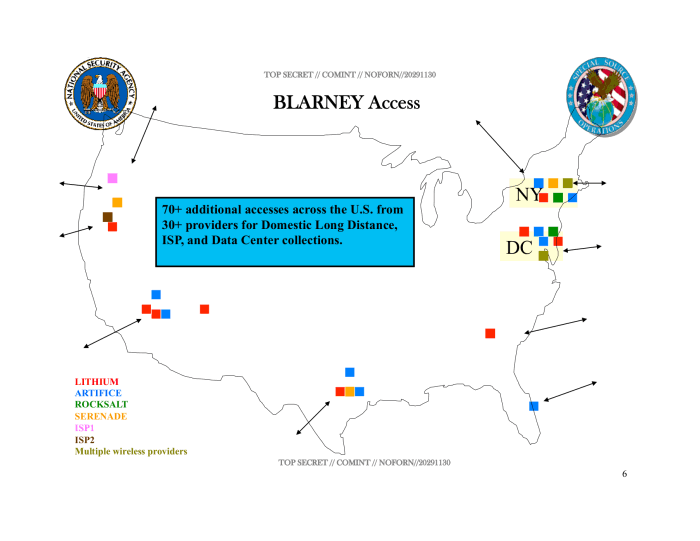
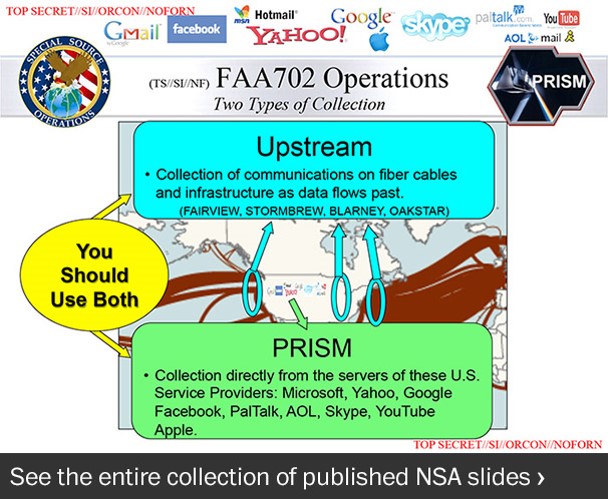
Again, NSA is able to identify both the sender and recipient when hacking is involved. Thanks largely to the material released by Edward Snowden, we can provide a full picture of NSA's extensive domestic data-collection network including Upstream programs like Fairview, Stormbrew and Blarney. These include at least 30 companies in the U.S. operating the fiber networks that carry the Public Switched Telephone Network as well as the World Wide Web. This gives NSA unparalleled access to data flowing within the U.S. and data going out to the rest of the world, as well as data transiting the U.S.
In other words, any data that is passed from the servers of the Democratic National Committee (DNC) or of Hillary Rodham Clinton (HRC) - or any other server in the U.S. - is collected by the NSA. These data transfers carry destination addresses in what are called packets, which enable the transfer to be traced and followed through the network.
Packets: Emails being passed across the World Wide Web are broken down into smaller segments called packets. These packets are passed into the network to be delivered to a recipient. This means the packets need to be reassembled at the receiving end.
To accomplish this, all the packets that form a message are assigned an identifying number that enables the receiving end to collect them for reassembly. Moreover, each packet carries the originator and ultimate receiver Internet protocol number (either IPV4 or IPV6) that enables the network to route data.
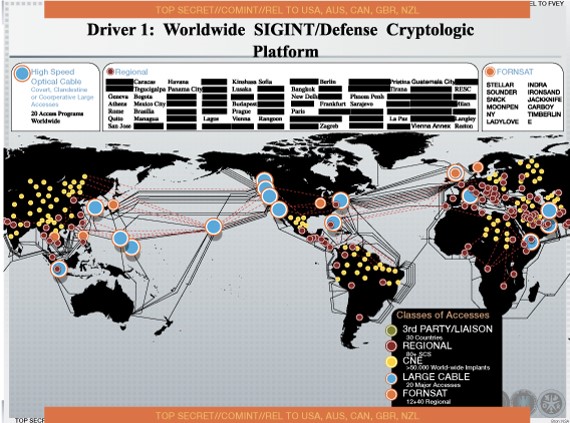
When email packets leave the U.S., the other "Five Eyes" countries (the U.K., Canada, Australia, and New Zealand) and the seven or eight additional countries participating with the U.S. in bulk-collection of everything on the planet would also have a record of where those email packets went after leaving the U.S.
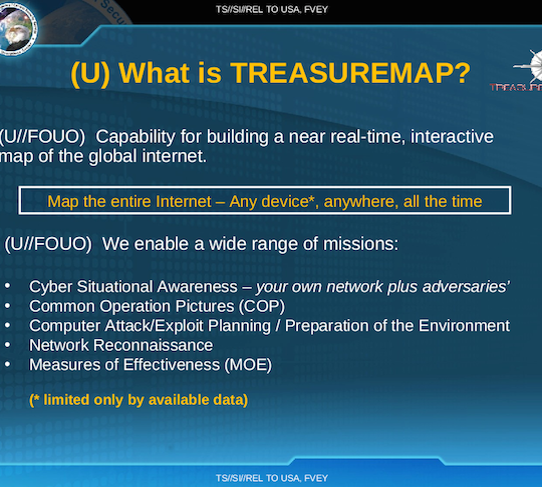
These collection resources are extensive [see attached NSA slides 1, 2, 3, 4, 5]; they include hundreds of trace route programs that trace the path of packets going across the network and tens of thousands of hardware and software implants in switches and servers that manage the network. Any emails being extracted from one server going to another would be, at least in part, recognizable and traceable by all these resources.
The bottom line is that the NSA would know where and how any "hacked" emails from the DNC, HRC or any other servers were routed through the network. This process can sometimes require a closer look into the routing to sort out intermediate clients, but in the end sender and recipient can be traced across the network.
The various ways in which usually anonymous spokespeople for U.S. intelligence agencies are equivocating - saying things like "our best guess" or "our opinion" or "our estimate" etc. - shows that the emails alleged to have been "hacked" cannot be traced across the network. Given NSA's extensive trace capability, we conclude that DNC and HRC servers alleged to have been hacked were, in fact, not hacked.
The evidence that should be there is absent; otherwise, it would surely be brought forward, since this could be done without any danger to sources and methods. Thus, we conclude that the emails were leaked by an insider - as was the case with Edward Snowden and Chelsea Manning. Such an insider could be anyone in a government department or agency with access to NSA databases, or perhaps someone within the DNC.
As for the comments to the media as to what the CIA believes, the reality is that CIA is almost totally dependent on NSA for ground truth in the communications arena. Thus, it remains something of a mystery why the media is being fed strange stories about hacking that have no basis in fact. In sum, given what we know of NSA's existing capabilities, it beggars belief that NSA would be unable to identify anyone - Russian or not - attempting to interfere in a U.S. election by hacking.
For the Steering Group, Veteran Intelligence Professionals for Sanity (VIPS)
William Binney, former Technical Director, World Geopolitical & Military Analysis, NSA; co-founder, SIGINT Automation Research Center (ret.)
Mike Gravel, former Adjutant, top secret control officer, Communications Intelligence Service; special agent of the Counter Intelligence Corps and former United States Senator
Larry Johnson, former CIA Intelligence Officer & former State Department Counter-Terrorism Official
Ray McGovern, former US Army infantry/intelligence officer & CIA analyst (ret.)
Elizabeth Murray, Deputy National Intelligence Officer for Middle East, CIA (ret.)
Kirk Wiebe, former Senior Analyst, SIGINT Automation Research Center, NSA (ret.)
ALERT MEMORANDUM FOR: The President
FROM: Veteran Intelligence Professionals for Sanity
SUBJECT: PREVENTING STILL WORSE IN SYRIA
We write to alert you, as we did President George W. Bush, six weeks before the attack on Iraq, that the consequences of limiting your circle of advisers to a small, relatively inexperienced coterie with a dubious record for wisdom can prove disastrous.* Our concern this time regards Syria.
We are hoping that your President's Daily Brief tomorrow will give appropriate attention to Saturday's warning by Russia's Foreign Ministry spokesperson Maria Zakharova: "If the US launches a direct aggression against Damascus and the Syrian Army, it would cause a terrible, tectonic shift not only in the country, but in the entire region."
Speaking on Russian TV, she warned of those whose "logic is 'why do we need diplomacy' ... when there is power ... and methods of resolving a problem by power. We already know this logic; there is nothing new about it. It usually ends with one thing - full-scale war."
We are also hoping that this is not the first you have heard of this - no doubt officially approved - statement. If on Sundays you rely on the "mainstream" press, you may well have missed it. In the Washington Post, an abridged report of Zakharova's remarks (nothing about "full-scare war") was buried in the last paragraph of an 11-paragraph article titled "Hospital in Aleppo is hit again by bombs." Sunday's New York Times totally ignored the Foreign Ministry spokesperson's statements.
In our view, it would be a huge mistake to allow your national security advisers to follow the example of the Post and Times in minimizing the importance of Zakharova's remarks.
Events over the past several weeks have led Russian officials to distrust Secretary of State John Kerry. Indeed, Foreign Minister Sergey Lavrov, who parses his words carefully, has publicly expressed that distrust. Some Russian officials suspect that Kerry has been playing a double game; others believe that, however much he may strive for progress through diplomacy, he cannot deliver on his commitments because the Pentagon undercuts him every time. We believe that this lack of trust is a challenge that must be overcome and that, at this point, only you can accomplish this.
It should not be attributed to paranoia on the Russians' part that they suspect the Sept. 17 U.S. and Australian air attacks on Syrian army troops that killed 62 and wounded 100 was no "mistake," but rather a deliberate attempt to scuttle the partial cease-fire Kerry and Lavrov had agreed on - with your approval and that of President Putin - that took effect just five days earlier.
In public remarks bordering on the insubordinate, senior Pentagon officials showed unusually open skepticism regarding key aspects of the Kerry-Lavrov deal. We can assume that what Lavrov has told his boss in private is close to his uncharacteristically blunt words on Russian NTV on Sept. 26:
"My good friend John Kerry ... is under fierce criticism from the US military machine. Despite the fact that, as always, [they] made assurances that the US Commander in Chief, President Barack Obama, supported him in his contacts with Russia (he confirmed that during his meeting with President Vladimir Putin), apparently the military does not really listen to the Commander in Chief."
Lavrov's words are not mere rhetoric. He also criticized JCS Chairman Joseph Dunford for telling Congress that he opposed sharing intelligence with Russia, "after the agreements concluded on direct orders of Russian President Vladimir Putin and US President Barack Obama stipulated that they would share intelligence. ... It is difficult to work with such partners. ..."
Policy differences between the White House and the Pentagon are rarely as openly expressed as they are now over policy on Syria. We suggest you get hold of a new book to be released this week titled The General vs. the President: MacArthur and Truman at the Brink of Nuclear War by master historian H. W. Brands. It includes testimony, earlier redacted, that sheds light on why President Truman dismissed WWII hero Gen. Douglas MacArthur from command of U.N. forces in Korea in April 1951. One early reviewer notes that "Brands's narrative makes us wonder about challenges of military versus civilian leadership we still face today." You may find this new book more relevant at this point in time than the Team of Rivals.
The door to further negotiations remains ajar. In recent days, officials of the Russian foreign and defense ministries, as well as President Putin's spokesman, have carefully avoided shutting that door, and we find it a good sign that Secretary Kerry has been on the phone with Foreign Minister Lavrov. And the Russians have also emphasized Moscow's continued willingness to honor previous agreements on Syria.
In the Kremlin's view, Russia has far more skin in the game than the U.S. does. Thousands of Russian dissident terrorists have found their way to Syria, where they obtain weapons, funding, and practical experience in waging violent insurgency. There is understandable worry on Moscow's part over the threat they will pose when they come back home. In addition, President Putin can be assumed to be under the same kind of pressure you face from the military to order it to try to clean out the mess in Syria "once and for all," regardless how dim the prospects for a military solution are for either side in Syria.
We are aware that many in Congress and the "mainstream" media are now calling on you to up the ante and respond - overtly or covertly or both - with more violence in Syria. Shades of the "Washington Playbook," about which you spoke derisively in interviews with the Atlantic's Jeffrey Goldberg earlier this year. We take some encouragement in your acknowledgment to Goldberg that the "playbook" can be "a trap that can lead to bad decisions" - not to mention doing "stupid stuff."
Goldberg wrote that you felt the Pentagon had "jammed" you on the troop surge for Afghanistan seven years ago and that the same thing almost happened three years ago on Syria, before President Putin persuaded Syria to surrender its chemical weapons for destruction. It seems that the kind of approach that worked then should be tried now, as well - particularly if you are starting to feel jammed once again.
Incidentally, it would be helpful toward that end if you had one of your staffers tell the "mainstream" media to tone down it puerile, nasty - and for the most part unjustified and certainly unhelpful - personal vilification of President Putin.
Renewing direct dialogue with President Putin might well offer the best chance to ensure an end, finally, to unwanted "jamming." We believe John Kerry is correct in emphasizing how frightfully complicated the disarray in Syria is amid the various vying interests and factions. At the same time, he has already done much of the necessary spadework and has found Lavrov for the most part, a helpful partner.
Still, in view of lingering Russian - and not only Russian - skepticism regarding the strength of your support for your secretary of state, we believe that discussions at the highest level would be the best way to prevent hotheads on either side from risking the kind of armed confrontation that nobody should want.
Therefore, we strongly recommend that you invite President Putin to meet with you in a mutually convenient place, in order to try to sort things out and prevent still worse for the people of Syria.
In the wake of the carnage of World War II, Winston Churchill made an observation that is equally applicable to our 21st Century: "To jaw, jaw, jaw, is better than to war, war, war."
* In a Memorandum to President Bush criticizing Colin Powell's address to the UN earlier on February 5, 2003, VIPS ended with these words: "After watching Secretary Powell today, we are convinced that you would be well served if you widened the discussion ... beyond the circle of those advisers clearly bent on a war for which we see no compelling reason and from which we believe the unintended consequences are likely to be catastrophic."
For the Steering Group, Veteran Intelligence Professionals for Sanity
William Binney, former Technical Director, World Geopolitical & Military Analysis, NSA; co-founder, SIGINT Automation Research Center (ret.)
Fred Costello, Former Russian Linguist, USAF
Mike Gravel, former Adjutant, top secret control officer, Communications Intelligence Service; special agent of the Counter Intelligence Corps and former United States Senator
Matthew Hoh, former Capt., USMC, Iraq & Foreign Service Officer, Afghanistan (associate VIPS)
Larry C. Johnson, CIA & State Department (ret.)
John Kiriakou, former CIA counterterrorism officer and former senior investigator, Senate Foreign Relations Committee
Linda Lewis, WMD preparedness policy analyst, USDA (ret.) (associate VIPS)
Edward Loomis, NSA, Cryptologic Computer Scientist (ret.)
Ray McGovern, former US Army infantry/intelligence officer & CIA analyst (ret.)
Elizabeth Murray, Deputy National Intelligence Officer for Middle East, CIA (ret.)
Todd Pierce, MAJ, US Army Judge Advocate (ret.)
Coleen Rowley, Division Counsel & Special Agent, FBI (ret.)
Kirk Wiebe, former Senior Analyst, SIGINT Automation Research Center, NSA, (ret.)
Robert Wing, former Foreign Service Officer
Ann Wright, U.S. Army Reserve Colonel (ret) and former U.S. Diplomat
MEMORANDUM FOR: Sen. Dianne Feinstein, Vice Chairman, Senate Select Committee on Intelligence
FROM: Veteran Intelligence Professionals for Sanity
SUBJECT: U.S. Media Mum On How Your Committee Faced Down Both CIA and Obama
We write to thank you for your unwavering support for your extraordinarily courageous and tenacious staff in (1) investigating CIA torture under the Bush/Cheney administration and (2) resisting CIA/White House attempts under the Obama administration to cover up heinous torture crimes like waterboarding.
We confess to having been shocked at the torture detailed in the version of the executive summary your Committee released on December 9, 2014. We found ourselves wondering what additional behavior could have been deemed so repugnant that the White House and CIA insisted it be redacted; and if the entire 6,700-page investigation - with whatever redaction might be truly necessary - would ever see the light of day. We think you could take steps now to make it less likely that the full report be deep-sixed, and we will make some suggestions below toward that end.
With well over 400 years of intelligence experience under our collective belt, we wondered how you managed to get the investigation finished and the executive summary up and out (though redacted). We now know the backstory - thanks to the unstinting courage of the committee's principal investigator Daniel Jones, who has been interviewed by Spencer Ackerman, an investigative reporter for The (UK) Guardian newspaper. The titanic struggle depicted by Ackerman reads like a crime novel; sadly, the four-part series is nonfiction:
I. "Senate investigator breaks silence about CIA's 'failed coverup' of torture report"
II. "Inside the fight to reveal the CIA's torture secrets"
III. " 'A constitutional crisis': the CIA turns on the Senate"
IV. "No looking back: the CIA torture report's aftermath"
Ackerman's reporting on Jones's tenacity in facing down the gorilla CIA makes abundantly clear how richly deserved was the encomium you gave Jones when he left the committee staff in December 2015.
You noted, "Without his indefatigable work on the Intelligence Committee staff, the Senate report on the CIA's Detention and Interrogation Program would not have been completed, nor would its 525-page executive summary have been released to the public."
It seems equal praise might well be due to any Snowden-like patriot/whistleblower who "inadvertently" included the "Panetta Review" in the reams of material given your committee by the CIA.
Remarkably, a full week after The Guardian carried Ackerman's revelations, none has been picked up by U.S. "mainstream" newspapers. Not the New York Times, the Wall Street Journal, the Washington Post - not even The Hill.
(As for alternative media, Charles P. Pierce's timely piece for Esquire whetted his readers' appetite for the gripping detail of the Guardian series, explaining that it would be "unfair both to Ackerman's diligence and Jones's courage" to try to summarize even just the first installment. "Read the whole damn thing," Pierce advises.)
And so, the culprits who should be hanging their heads in shame are out and about, with some still collecting book royalties and some blithely working for this or that candidate for president. As if nothing happened. Sadly, given the soporific state of our mainstream media - particularly on sensitive issues like these - their silence is nothing new, although it does seem to have gotten even worse in recent years.
"The public is entitled to the entire story about the CIA torture program and its lies to Congress, the White House, and to us."
The late William Colby, CIA director from 1973 to 1976, has been quoted as saying: "The CIA owns everyone of any significance in the major media." Whether or not Colby was quoted correctly, the experience of the past several decades suggests it is largely true. Better sourced is a quote from William Casey, CIA director from 1981 to 1987: "We'll know our disinformation program is complete when everything the American public believes is false."
In these circumstances, we know from sad experience that there is no way any of us can get on any of the Sunday talk shows, for example - despite our enviable record for getting it right. Nor does it seem likely that any of the "mainstream" media will invite you to discuss the highly instructive revelations in The Guardian. We respectfully suggest that you take the initiative to obtain media exposure for this very important story.
One additional request: As you and your investigators know better than anyone, it is essential to safeguard the integrity not only of the unredacted executive summary but also of the entire 6,700-page committee report on the CIA's Detention and Interrogation Program.
And, again, you are aware that as soon as Sen. Richard Burr, R-North Carolina, took the gavel from you, he took steps seemingly aimed at ensuring that the full report never sees the light of day. Could you ask him why, as soon as he became chair, he asked the executive branch to transfer their copies to the Senate Intelligence Committee?
Many interpreted that as an ill-disguised attempt to thwart holding accountable those responsible for the abuses. Moreover, if the report cannot be reviewed by those who might be asked to participate in activities like torture in the future, how is it even possible for anyone to learn from the prior unfortunate experience?
The public is entitled to the entire story about the CIA torture program and its lies to Congress, the White House, and to us. Any attempt to bury the fullest investigation of the torture program - an investigation that provides an example of Congressional oversight at its best - would undermine the democratic accountability that is supposed to be provided by the separation of powers.
"We believe you will agree that more needs to be done to replant the moral moorings of honesty that must anchor the intelligence profession to which we have given so many years."
Furthermore, as you were quoted in the Guardian series, the agency searches "may have undermined the constitutional framework essential to effective congressional oversight of intelligence activities or any other government function . . ."
Senator Jay Rockefeller, D-West Virginia, was exactly on point: "You either have oversight and separation of powers with the checks and balances that come with that, or you don't. It's amazing that, once again, no one at the CIA was held accountable." Consequently, the issue now is not only the cover-up of torture by the CIA but - at least equally important - the "unbridled agency that spied on Americans (including Senate Intelligence Committee staffers) as eagerly as they spied on foreign adversaries," as the Guardian described it in referring to the Church Committee investigation in the 1970s.
Does American democracy deserve any less than an intense investigation of the CIA's obstruction of the democratic process in the 2000s?
The Guardian revelations make it still more difficult for the kind of excuses made by those who can hardly pretend to be disinterested observers - former CIA directors George Tenet, Porter Goss, Michael Hayden, for example - who wrote Rebuttal: The CIA Responds to the Senate Intelligence Committee's Study of Its Detention and Interrogation Program, published on September 9, 2015. We published our own (VIPS) critique of "Rebuttal" five days later. And before the final vote on John Brennan's nomination to become CIA director, we tried to warn you not to trust him.
We believe you will agree that more needs to be done to replant the moral moorings of honesty that must anchor the intelligence profession to which we have given so many years. And we think that one step in that direction would be for you to seize this new opportunity to give prominence to the edifying story of how your committee and its staffers stepped up so effectively to their responsibilities in investigating and exposing the very sad and delicate chapter of CIA torture.
The play-by-play provided by the Guardian series, with its appropriate focus on the top investigator Daniel Jones, has created an opportunity we hope will not be squandered; a chance to tell a truly uplifting story sure to encourage others to behave in similarly exemplary manner.
For the Steering Group, Veteran Intelligence Professionals for Sanity (VIPS)
Jean Maria Arrigo, PhD, member of 2005 American Psychological Association task force evaluating the role of psychologists in U.S. intelligence and military interrogations of detainees (associate VIPS)
Eugene DeFriest Betit, Ph. D., DIA, US Army (ret.)
Thomas Drake, former Senior Executive, NSA
Bogdan Dzakovic, Former Team Leader of Federal Air Marshals and Red Team, FAA Security, (ret.) (associate VIPS)
Mike Gravel, former Adjutant, top secret control officer, Communications Intelligence Service; special agent of the Counter Intelligence Corps and former United States Senator
Matthew Hoh, former Capt., USMC, Iraq & Foreign Service Officer, Afghanistan (associate VIPS)
Larry C Johnson, CIA & State Department (ret.)
Michael S. Kearns, Captain, USAF (Ret.); ex-Master SERE Instructor for Strategic Reconnaissance Operations (NSA/DIA) and Special Mission Units (JSOC)
John Kiriakou, Former CIA Counterterrorism Officer and former senior investigator, Senate Foreign Relations Committee
Edward Loomis, NSA, Cryptologic Computer Scientist (ret.)
Linda Lewis, WMD preparedness policy analyst, USDA (ret.) (associate VIPS)
David MacMichael, National Intelligence Council (ret.)
Ray McGovern, former US Army infantry/intelligence officer & CIA analyst (ret.)
Elizabeth Murray, Deputy National Intelligence Officer for Near East, CIA and National Intelligence Council (ret.)
Todd E. Pierce, MAJ, US Army Judge Advocate (Ret.)
Coleen Rowley, FBI Special Agent and former Minneapolis Division Legal Counsel (ret.)
Scott Ritter, former MAJ., USMC, former UN Weapon Inspector, Iraq
Peter Van Buren, U.S. Department of State, Foreign Service Officer (ret.) (associate VIPS)
Kirk Wiebe, former Senior Analyst, SIGINT Automation Research Center, NSA
Lawrence Wilkerson, Colonel (USA, ret.), Distinguished Visiting Professor, College of William and Mary (associate VIPS)
Valerie Plame Wilson, former CIA Operations Officer
Ann Wright, Col., US Army (ret.); Foreign Service Officer (resigned)
MEMORANDUM FOR: Angela Merkel, Chancellor of Germany
FROM: Veteran Intelligence Professionals for Sanity (VIPS
SUBJECT: NATO Summit in Warsaw
REFERENCE: Our Memorandum to You, August 30, 2014
We longtime U.S. intelligence officers again wish to convey our concerns and cautions directly to you prior to a critically important NATO summit - the meeting that begins on July 8 in Warsaw. We were gratified to learn that our referenced memorandum reached you and your advisers before the NATO summit in Wales, and that others too learned of our initiative via the Sueddeutsche Zeitung, which published a full report on our memorandum on Sept. 4, the day that summit began.
Wales to Warsaw
The Warsaw summit is likely to be at least as important as the last one in Wales and is likely to have even more far-reaching consequences. We find troubling - if not surprising - NATO Secretary General Jens Stoltenberg's statement at a pre-summit press event on July 4 that NATO members will agree to "further enhance NATOs military presence in the eastern part of the alliance," adding that the alliance will see its "biggest reinforcement since the Cold War."
The likelihood of a military clash in the air or at sea - accidental or intentional - has grown sharply, the more so since, as we explain below, President Obama's control over top U.S./NATO generals, some of whom like to play cowboy, is tenuous. Accordingly we encourage you, as we did before the last NATO summit, to urge your NATO colleagues to bring a "degree of judicious skepticism" to the table at Warsaw - especially with regard to the perceived threat from Russia.
Many of us have spent decades studying Moscow's foreign policy. We shake our heads in disbelief when we see Western leaders seemingly oblivious to what it means to the Russians to witness exercises on a scale not seen since Hitler's armies launched "Unternehmen Barbarossa" 75 years ago, leaving 25 million Soviet citizens dead. In our view, it is irresponsibly foolish to believe that Russian President Vladimir Putin will not take countermeasures - at a time and place of his own choosing.
Putin does not have the option of trying to reassure his generals that what they hear and see from NATO is mere rhetoric and posturing. He is already facing increased pressure to react in an unmistakably forceful way. In sum, Russia is bound to react strongly to what it regards as the unwarranted provocation of large military exercises along its western borders, including in Ukraine.
Before things get still worse, seasoned NATO leaders need to demonstrate a clear preference for statesmanship and give-and-take diplomacy over saber-rattling. Otherwise, some kind of military clash with Russia is likely, with the ever-present danger of escalation to a nuclear exchange.
Extremely worrisome is the fact that many second-generation NATO leaders seem blithely unaware - or even dismissive - of that looming possibility. Demagoguery like that coming from former Polish President Lech Walesa, who brags that he would "shoot" at Russian jets that buzz U.S. destroyers assuredly are not at all helpful. Walesa's tone, however, does reflect the macho attitude prevailing today in Poland and some other NATO newcomers.
We believe Foreign Minister Frank-Walter Steinmeier was correct to point out that military posturing on Russia's borders will bring less regional security. We applaud his admonition that, "We are well advised not to create pretexts to renew an old confrontation."
A Need For Candor
Speaking of "pretexts to renew an old confrontation," we believe the time has come to acknowledge that the marked increase in East-West tensions over the past two years originally stemmed from the Western-sponsored coup d'etat in Kiev on Feb. 22, 2014, and Russia's reaction in annexing Crimea.
Although we have a cumulative total of hundreds of years of experience in intelligence, we had never before seen planning for a coup d'etat exposed weeks in advance - and then carried out anyway. Few seem to remember that in early February 2014, YouTube published a recording of an intercepted conversation between U.S. Assistant Secretary of State Victoria Nuland and the U.S. ambassador in Kiev, during which "Yats" (for Arseniy Yatsenyuk) was identified as Washington's choice to become the new prime minister of the coup government in Kiev.
This unique set of circumstances prompted widely respected analyst George Friedman, president of the think tank STRATFOR, to label the Putsch in Kiev on Feb. 22, 2014, "really the most blatant coup in history."
If one listens only to Western politicians and the corporate media, however, their version of recent history in Eastern Europe begins on Feb. 23, 2014. A particularly blatant example of this came on June 30, when U.S. Ambassador to NATO Douglas Lute spoke at a pre-summit press briefing:
"beginning in 2014 and still to this day, we're moving into a new period in NATO's long history. Why do I say that? Here's the evidence I cite. So the first thing that happened in 2014 that marks this change is a newly aggressive, newly assertive Russia under Vladimir Putin. So in late February, early March of 2014, the seizing, the occupying of Crimea followed quickly by the illegal political annexation of Crimea. ... Well, any notion of strategic partnership came to an abrupt halt in the first months of 2014." (Emphasis added)
In view of the coup d'etat and post-coup instability in Ukraine, what Ambassador Lute goes on to say about NATO's professed desire for stability in Ukraine comes across as disingenuous. Far more important, it puts Russia on notice that - in the U.S. view, at least - meddling on the "periphery" between NATO and Russia will continue.
According to Lute, one of the "key themes" at Warsaw will be: "What do we do about the periphery." Lute explains: "Here we talk about projecting stability. So we don't have an obligation to defend states beyond NATO's territory, but we realize it's in our interest to make them as stable as possible."
We suggest that it is past time for Western leaders to admit that there is not one scintilla of evidence of any Russian plan to annex Crimea before the coup in Kiev and the coup leaders began talking about Ukraine joining NATO. If senior NATO leaders continue to be unable or unwilling to distinguish between cause and effect, increasing tension is inevitable with potentially disastrous results - all of them unnecessary and avoidable, in our view.
Ukraine: Still Festering
In our August 2014 memorandum, we suggested that you be "appropriately suspicious of charges made by the U.S. State Department and NATO officials alleging a Russian invasion of Ukraine." Actually, the gravity of the situation was considerably worse than we realized at the time.
We now know that U.S. Air Force Gen. Philip Breedlove, who was Supreme NATO Commander until two months ago, was pressing hard for confrontation with Russia and the anti-coup separatists in eastern Ukraine. This comes through clearly in Breedlove's recently disclosed emails, which now confirm what we believed in 2014; namely, that everyone needed to examine closely Breedlove's exaggerated claims, many of them based on fuzzy photos and other highly dubious "intelligence."
Lobbying for approval to wage a proxy war with Russia in Ukraine, Breedlove was highly critical of President Barack Obama's policy, which Breedlove disparaged as simply: "Do not get me into a war." (As though this were some kind of cowardly order!)
The emails show that behind Obama's back, Breedlove kept trying to "leverage, cajole, convince or coerce the U.S. to react" to Russia. One of Breedlove's email correspondents wrote back to him: "Given Obama's instruction to you not to start a war, this may be a tough sell," but this did not stop Breedlove from trying.
In 2015, as your own intelligence analysts were able to tell you, Breedlove went beyond hyperbole to outright fabrication with claims that "well over a thousand combat vehicles, Russian combat forces, some of the most sophisticated air defense weapons, and battalions of artillery" had been sent to eastern Ukraine.
These were the kinds of faux claims Breedlove used in attempts to enlist help from the senior military and Congress in getting Obama to supply weapons to Ukrainian armed forces.
Lest we seem to be singling out Gen. Breedlove, his predecessor as Supreme NATO Commander, Adm. James Stavridis, was hardly provided good example. A year after the U.S. led some NATO countries in a Blitz of aircraft and missile strikes against Libyan President Muammar Gaddafi, Stavridis and former U.S. Ambassador to NATO Ivo Daalder wrote in Foreign Affairs: "NATO's operation in Libya has rightly been hailed as a model intervention."
The operation was just the opposite, of course. The chaos now reigning in Libya, with hundreds of refugees drowning in the Mediterranean, offers abundant proof that your government's decision to keep Germany at arms-length from that "model intervention" was a wise one.
While it is somewhat awkward for us to offer such candid comments on the character and caliber of the most senior U.S. generals and admirals - including those, like Ambassador Lute, who end up getting appointed to senior political positions at NATO - such a critique is unavoidable. The important reality to which we draw your attention pertains not only to their qualifications, but also to their dismissive attitude toward President Obama.
We observed in our Aug. 30, 2014 memorandum that President Obama "has only tenuous control over the policymakers in his administration." That this includes senior military leaders can be seen in Obama's failure to remove Gen. Breedlove, who - in addition to his intense maneuvering behind Obama's back - made little effort to hide his open disdain for the cautious approach of his commander in chief toward the possibility of armed confrontation in volatile places like Ukraine.
An Appropriate "Nein!"
One factor encouraging us to write to you again is your proven record of insistence on tenacious diplomacy rather than saber rattling and provocation. We noted, for example, that at a press conference with President Obama in Washington on Feb. 9, 2015, you personally experienced Breedlove-type pressure for sending lethal weaponry to Ukraine - the kind of pressure still being applied to Obama himself. You stuck to your guns, so to speak, when the first designated questioner noted that the U.S. was considering providing lethal weapons to Ukraine and that your view was "very different."
"I have given you my opinion on the export of arms," was your unequivocal answer. Nor did you diverge from your insistent preference for diplomacy over arms, as you replied to a final, plaintive question: "Mrs. Merkel, ... diplomacy, as you said yourself, has not brought much progress. Can you understand the impatience of the Americans when they say we ought to now deliver weapons?"
We believe your resolute "nein" to providing weapons to Ukraine was a key factor in scuttling that ill-conceived idea last year. And, as you know far better than we, your clearly expressed stance helped bring about a ceasefire that, however imperfect, was infinitely better than the escalation of fighting that would have inevitably resulted from sending weapons to Kiev's government forces.
You stuck to your position, even though it put you in opposition to nearly all political, military, and media voices in the U.S., which were expressing disdain for diplomacy and preference instead for war.
It is inevitable that there will be more proposals to send weapons to the Kiev government, particularly in view of the continued hostilities in eastern Ukraine. We hope that unbiased scrutiny can be given to which parties are responsible for blocking full implementation of the Minsk accords that you, Foreign Minister Steinmeier, and your French and Russian counterparts have worked hard to offer as a plan for peace in Ukraine.
Secretary of State John Kerry is visiting Kiev on July 7, a day before the Warsaw summit opens. He might be asked to share his impressions on the stormy political events in Ukraine over the past few months.
In our view, things have gone from bad to worse there, with Andriy Parubiy now speaker of the Ukrainian parliament. Parubiy is one of the most conspicuous leaders of Ukrainian ultra-nationalist, and outright neo-Nazi, movements. In 1991 he founded the Social-National Party of Ukraine, together with Oleh Tyahnybok, another February 2014 coup plotter, who now leads the extreme right Svoboda party
The name of Parubiy's Social-National Party was chosen to identify it with Hitler's National Socialist Party. Its of?cial symbol is the somewhat modi?ed Wolf's Hook (Wolfsangel), used by the SS. Both parties blame Russia for the ills besetting Ukraine.
Parubiy as Parliament Speaker makes a mockery of NATO Secretary General Stoltenberg's insistence that NATO has resolved to make sure that a law-abiding Kiev is "committed to democracy."
On Monday, Parubiy stated on TV, "I have not supported the Minsk agreements from the very start," adding that Moscow's "plans on Ukraine may be stopped only by force and international sanctions."
Also on Monday, Kremlin spokesman Dmitry Peskov told reporters that Ukraine has not made any new effort to facilitate implementation of the Minsk accords that call for a ceasefire, weapons withdrawal, local elections in eastern Ukraine, and constitutional reform.
Doing the Possible in Poland
Instead of muscle flexing and saber rattling, it would likely be more constructive if NATO leaders held a serious discussion regarding Kiev's recalcitrance on the Minsk accords. An open discussion would mean avoiding the usual knee-jerk, wholesale identification with Ukraine's long list of real and imagined grievances against Russia.
U.S. Ambassador Lute might be asked if knows anyone with the kind of influence with Kiev that it would take to break the logjam and move events toward implementation of the peace agreements so painstakingly worked out at Minsk.
Another worthwhile endeavor would be to establish a NATO working group to respond to Russia's suggestion to devise organizational and technical measures to prevent close encounters or clashes of aircraft over the Baltic Sea.
Lastly, it would be highly constructive if NATO would take responsibility for assessing the fundamental factors behind the hideous outbreak of the terrorist acts that took so many lives over recent days in Istanbul, Dhaka, Bangladesh, and Baghdad. In this context, as well as in central Europe, violence begets violence. It should not be beyond the capability of NATO to undertake a fresh, hard look at why terrorism continues to increase, and to attempt to come up with new, more imaginative, less violent ways to address the issues that ultimately fuel the curse of terrorism.
NOTE: As is our custom, we are sending the White House a copy of this memorandum. We would like you to know, however, that we rarely receive any acknowledgement that our memoranda get through to President Obama - or that the he pays them any heed if they do reach his desk. We suspect that the wide generation gap between his relatively young advisers and the longtime collective experience that we in VIPS bring to the table may, in part, account for this. Therefore, if you find our thoughts informative - perhaps even provocative - we suggest that, when you see the President on Friday in Warsaw, you urge the President to obtain and read his copy.
For the Steering Group of Veteran Intelligence Professionals for Sanity
William Binney, former Technical Director, NSA; co-founder, SIGINT Automation Research Center (ret.)
Graham E. Fuller, Vice-Chair, National Intelligence Council (ret.)
Philip Giraldi, CIA, Operations Officer (ret.)
Mike Gravel, former special agent of the Counter Intelligence Corps. former United States Senator from Alaska
Matthew Hoh, former Capt., USMC, Iraq & Foreign Service Officer, Afghanistan (associate VIPS)
Larry C Johnson, CIA & State Department (ret.)
Brady Kiesling, Foreign Service Officer, Political Counselor, Embassy Athens, (ret.) (associate VIPS)
John Kiriakou, Former CIA Counterterrorism Officer
David MacMichael, National Intelligence Council (ret.)
Ray McGovern, former US Army infantry/intelligence officer & CIA analyst (ret.)
Elizabeth Murray, Deputy National Intelligence Officer for Middle East, CIA (ret.)
Torin Nelson, Former HUMINT Officer, U.S. Department of the Army
Todd Pierce, MAJ, US Army Judge Advocate (ret.)
Scott Ritter, former Maj., USMC, former UN Weapon Inspector, Iraq
Coleen Rowley, Division Counsel & Special Agent, FBI (ret.)
Peter Van Buren, U.S. Department of State, Foreign Service Officer (ret.) (associate VIPS)
Ann Wright, U.S. Army Reserve Colonel (ret) and former U.S. Diplomat
Now that the 2016 primary season is drawing to a close, many are contemplating the impact the presidential campaign of Vermont Senator Bernie Sanders will have on the American political landscape, both in the near future and years, perhaps decades, down the line.
Now that the 2016 primary season is drawing to a close, many are contemplating the impact the presidential campaign of Vermont Senator Bernie Sanders will have on the American political landscape, both in the near future and years, perhaps decades, down the line.
To start, by articulating and passionately advocating for ambitious policy goals, Sanders has, in just a few months, lifted the expectations of voters who have long been content to usher in, reluctantly, the least bad of the two neoliberal, corporate-friendly candidates.
"Though he has effectively lost the Democratic nomination to Hillary Clinton, Sanders, along with the progressives who have organized within and around his campaign, is winning the ideological war. "He has, furthermore, broadened the limits of discourse within the Democratic Party by bringing fights that have been ongoing for years -- though largely unacknowledged by the Democratic establishment -- to the national stage.
Stepping over dogmatic political guardrails, Sanders, during televised debates viewed by millions, denounced American imperialism and spoke powerfully in favor of Palestinian rights.
He has argued, consistently and forcefully, that the political system has been captured by organized wealth -- a capture that has eroded the middle class, worsened deep poverty, and sent extraordinary wealth to the top. He has pointed to the fact that, despite the United States' status as the world's wealthiest nation, conditions in many American cities are comparable to the destitution experienced in poverty-stricken, highly oppressive countries.
And, much to the consternation of corporate Democrats, he has laid bare the rightward shift of a party that, as Thomas Frank has documented, long ago abandoned working people in favor of the wealthier, more politically influential professional class.
To combat Sanders, Democrats fell in line behind a vision of change that is inadequate to address the problems we face, revealing repeatedly their disdain for mass politics, inclusion, and transparency. By doing so, they have justified the view of many Americans, who believe that the two-party system is fatally flawed and unrepresentative of their interests.
Sanders has also revived the message that many Democrats fail to appreciate: That the fight against worsening economic inequality is central to the fight against various forms of social inequality, as Martin Luther King Jr. understood.
Though he has effectively lost the Democratic nomination to Hillary Clinton, Sanders, along with the progressives who have organized within and around his campaign, is winning the ideological war. And by staying in the race as he has vowed to do all along, Sanders is using the clout he has accumulated to force what he has called a "fundamental transformation of the Democratic Party."
"Clinton, and the 40-year ideological campaign she represents, has lost the battle of ideas," writes Naomi Klein in a piece arguing that the left is not just winning the war of ideas, but that the left has already won. "The spell of neoliberalism has been broken, crushed under the weight of lived experience and a mountain of data."
The lived experience to which Klein refers is that of millions of Americans -- in fact, according to a recent survey, a large majority of Americans -- who believe that the political process is broken, and that government does not work for them. It is the experience of millions of Americans who have been left behind by two political parties driven by a core ideological commitment -- neoliberalism -- that has outsourced jobs, suppressed wages, worsened inequality, and pushed working families downward.
Between 1998 and 2013, while those in the top 10% saw their incomes soar by almost 75%, American families on average saw their incomes drop sharply, with the working class bearing the worst of the decline.
And while government increasingly tailors its policies to the desires of economic elites, the rest of the population must endure soaring rent prices, crumbling infrastructure, flattened wages, austere budgets, overwhelming college debt, and the general economic anxiety that has infected even families that would otherwise be considered middle class.
The austerity inflicted by those looking to maximize private profit at the expense of the public has had horrendous effects in cities like Flint, where the public has been conditioned by failing institutions to fear even the most basic of services, and in Baltimore, where, in many neighborhoods, the life expectancy has fallen below that of North Korea.
In the wealthiest nation in the world, sixteen million children live in poverty, the infant mortality rate is horrendous, and over a million families are attempting to survive on $2.00 a day.
Corporate Democrats have proposed little that would bring about a radical departure from these trends.
While tepidly supporting a $15 minimum wage by saying she would sign it into law if it reached her desk, Hillary Clinton has played the same game party liberals have played for decades -- pay fealty to progressive causes but, once the nomination is achieved, "pivot" to the center and beyond.
By remaining in the race, Bernie Sanders has continued to place pressure on the Democratic establishment, not allowing Clinton to renege on her promise to keep the plight of the millions failed by both of America's major political parties at the center of the Democratic platform. His persistence has already had a significant impact.
But, even in the face of such encouraging signs, I have to ultimately disagree with Klein's conclusion. While the left is winning the war of ideas in many important ways, it is not yet time to declare victory.
Klein is correct to argue, for instance, that majorities favor some of the more ambitious proposals of the Sanders campaign: Single-payer healthcare, in particular.
"While the left is winning the war of ideas in many important ways, it is not yet time to declare victory."
She is also correct that public opinion is, in many ways, to the left of elite opinion. Most Americans believe that the economy is rigged, that too much power rests in the hands of a few large corporations, and that the rich should pay more in taxes.
But Klein seems to underestimate the backlash that is sure to come (as it has in the past) from business and their representatives in government -- both Democrats and Republicans -- as progressive causes move from opinion to action. She also fails to provide crucial context: Although public opinion is often on the side of progressive causes, government, as Martin Gilens and Benjamin Page have documented, is utterly unresponsive to the desires of the population -- and quite responsive to those of elites.
Finally, Klein under-emphasizes the willingness of Democrats to use the looming Republican threat as an argument against advancing progressive reforms -- and, also, their willingness to collude with Republicans to ram through corporate-friendly agreements in the face of progressive opposition.
In short, Democrats have yet to demonstrate that they have halted, let alone reversed, the rightward lurch of the party that has led it to embrace welfare reform, disastrous "trade" agreements, deregulation, and interventionism abroad.
Klein's optimism is inspiring, but the left cannot fail to anticipate the inevitable reaction that comes with democratic progress. And prematurely declaring victory ignores the important (and unavoidable) role losses play in the pursuit of change, creating a kind of false confidence. Defeats, as I.F. Stone observed, are, in an important sense, the necessary precursor for victories down the line.
Klein, though, is correct to place less emphasis on the fact that Sanders has lost in the realm of electoral formalities -- elections, as Carl Beijer notes, play an "extraordinarily limited role" in the advancement of the left's agenda.
Still, they can provide evidence of progress.
" Ralph Nader won 2.75% of the vote in 2000. Mike Gravel finished with less than one percent in 2008," Beijer writes. "Sanders, having run well to the left of both, is likely to finish his campaign with around 43% of the popular vote. I have never been so optimistic."
There is, however, still much work ahead, and significant barriers to overcome. To ignore these facts is to replace necessary optimism and hope with a rose-tinted outlook that simply doesn't comport with the lived experience of millions.
And entrenched interests, as history shows, will not bow to popular movements without an intense, and often devastating, struggle.
The DC press says it's getting down to the wire on a possible vote in the House on fast track to substantially pre-approve the Trans-Pacific Partnership and other pending trade deals, with a vote possible as early as Thursday.
Democratic presidential candidate Bernie Sanders, who was a close second in a recent straw poll of Wisconsin Democrats, has called for a "political revolution" to revitalize democracy in the United States.
Is Sanders ready to walk the walk?
There's a big difference between voting no on something and doing everything in your power to stop it. Senator Dick Durbin voted no on the Iraq war. So he's innocent, right? You can't blame him for the war; he was against it. But in April 2007, Durbin gave a remarkable speech on the Senate floor. He said that as a member of the Senate intelligence committee, he had known at the time that the American people were being misled into the Iraq war, that the classified intelligence being given to members of Congress didn't match the public rhetoric of the Bush Administration about the supposed threat to the U.S. from Iraq. But, he said, he kept this information to himself because he was sworn to secrecy as a member of the intelligence committee.
We Interrupt This Article with an Urgent Message! Common Dreams is a not-for-profit news service. All of our content is free to you - no subscriptions; no ads. We are funded by donations from our readers. This media model only works if enough readers pitch in. We have millions of readers every month and, it seems, too many take our survival for granted. It isn't. Our critical Mid-Year fundraiser is off to a very slow start - only 206 readers have contributed a total of $7,500 so far. We must raise $42,500 more before we can end this fundraising campaign and get back to focusing on what we do best.
|
I strongly credit Durbin for giving this speech, but I don't credit him for the previous inaction that he confessed. It was his job as a member of the intelligence committee to tell the American people that the intelligence didn't match the Bush Administration's rhetoric. Of course, it was other people's job too; he was the one who subsequently confessed to inaction. He voted no on the war, but he didn't do everything he could have done, everything he should have done, in order to stop it.
Similarly, House Minority Leader Nancy Pelosi may vote no on the TPP. But if the inside DC press is right, she is doing what she can to help the Administration get the Democratic votes it needs to pass fast track to enable the TPP. Even if she votes no, it will certainly be true that she didn't do everything that she could do to stop it.
How about Bernie? He voted no in the Senate on fast track. But has he done everything he could do to stop it?
Here's one thing Bernie could do that he hasn't done: he could publish the text of the TPP.
The Administration has kept the TPP text classified. This is an abuse of the Administration's classification power, which is only supposed to be used for secrets whose revelation would endanger our national security. As veteran financial journalist Alan Beattie has pointed out, other international agreements have been open to the public while they were being negotiated, including trade agreements. Moreover, under the precedent established by the ACLU's FOIA lawsuit over the Administration's classification of the drone strike memos, the Administration forfeited its right to keep the TPP text classified when it engaged in a public fight with Senator Elizabeth Warren over the contents of the agreement. Either the contents are secret or they're not. To treat them as secret for critics but not for proponents is an anti-democratic abuse of classification power.
Here's how we know for sure that Bernie hasn't done something that he could do: because Rep. Darrell Issa published a chapter of the TPP that had previously been leaked. If Issa could do it, Sanders can do it. Three chapters of the TPP have now been published by WikiLeaks, and if WikiLeaks' reward offer for the remaining chapters is successful, new chapters of the TPP will soon be forthcoming. Sanders could publish these chapters on his website; he could try to read them into the Congressional Record, as Senator Mike Gravel read the Pentagon Papers into the Congressional Record.
At this writing, nearly 50,000 Americans have signed a joint petition led by 11 national groups calling on members of Congress to do everything in their power to publish the TPP before any House vote on fast track. If you think Bernie Sanders should walk the walk, you can tell him so here.