SUBSCRIBE TO OUR FREE NEWSLETTER
Daily news & progressive opinion—funded by the people, not the corporations—delivered straight to your inbox.
5
#000000
#FFFFFF
To donate by check, phone, or other method, see our More Ways to Give page.
Daily news & progressive opinion—funded by the people, not the corporations—delivered straight to your inbox.
(Photo: Quinn Dombrowski/flickr/cc)
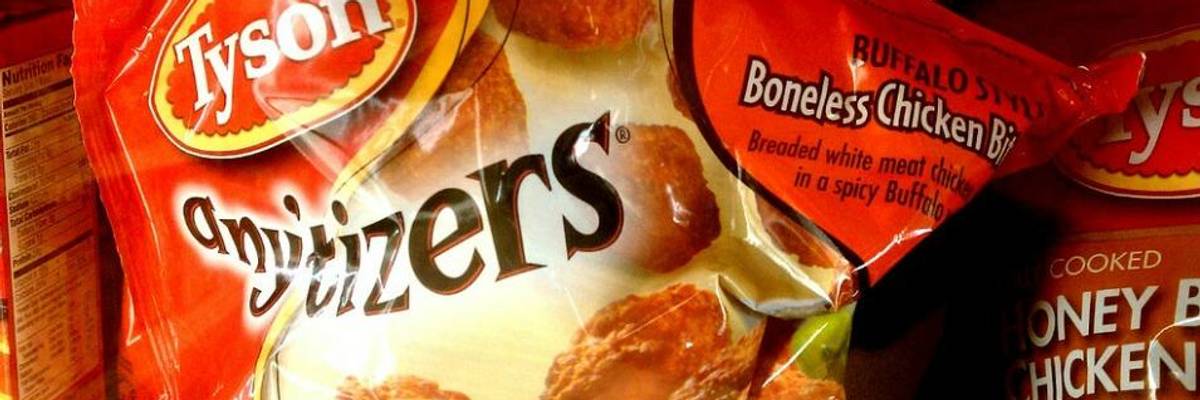
Tyson Foods, the nation's largest processor of meat and poultry, announced today that it will eliminate the use human antibiotics for raising chickens in its US operations by September 2017, while also developing an action plan for turkey, beef and pork, as well its chicken produced abroad. By our math, Tyson's pledge means that more one-third of the entire US chicken industry has now eliminated or pledged to eliminate routine use of medically-important antibiotics. Folks, I'm going to call it and say we've now hit the tipping point for getting the chicken industry off antibiotics.
Tyson's announcement comes at a time when scientists are sounding the alarm over rising rates of antibiotic resistance. Here's the problem: Livestock operators around the country--and the world--rely on antibiotics to make animals grow faster or help them survive crowded, unsanitary, stressful living conditions that are typical of large-scale industrial livestock and poultry operations. When antibiotics are used day after day, some bacteria become resistant, multiply, and can spread to our communities. When these antibiotics are the same as those used in human medicine, bacteria that become resistant on the farm can threaten the efficacy of the drugs we rely on when we get sick (of course overuse of these drugs by humans is also a major cause of the problem).
Tyson's commitment follows a hopeful series of similar pledges by other major food companies, including Perdue, McDonald's, Chick-fil-A, and Pilgrim's. A longer list, including Panera Bread, Chipotle, Whole Foods, Applegate and others have already been providing customers with meat and poultry from animals raised without antibiotics for years.
But none come close to Tyson in scale. According to WATTAgNet.com, an industry journal, Tyson Foods processes over 38 million broiler chickens per week, by far the largest US producer. Among the top 20 broiler companies (which likely control nearly all of the nation's broiler chicken production), Tyson controls 23%. Combined, the production volumes of Perdue (which announced it had already eliminated medically-important antibiotics from 95% of its birds last fall), Pilgrims (which announced this month that it will eliminate all antibiotics from 25% of its flock), and Fieldale Farms (which we gather is nearly all antibiotic-free) add up to 38% of all the chickens raised by the top 20 companies in the industry. That sure looks like a tipping point!
Now we have to make sure the industry actually tips.
Tyson also promised today to be fully transparent about its future antibiotic use in its chicken production, reporting annually on its progress towards the 2017 goal--a significant precedent in a secretive industry. We hope this will include a technical but important clarification about how the company is defining "human antibiotics". (Specifically, whether the company is eliminating all antibiotics that belong to classes of drugs important to human medicine or exclusively human antibiotics, a subset of that former category. This matters because resistance that develops to one antibiotic in a medically-important class of drugs, even if it's not used in human medicine, may also spur development of cross resistance to other antibiotics in that same class, which are).
Transparency and accountability will be essential to ensuring that Tyson and other companies follow through and deliver on antibiotic stewardship promises. Tyson stumbled with antibiotic stewardship in 2007 after marketing a product as being raised without antibiotics when in fact antibiotics were used in chicken eggs pre-hatch. That product line was pulled. To eliminate any shadow of a doubt, we urge Tyson, Perdue, Pilgrims and others to contract with third-party verifiers to verify antibiotic stewardship policies and report on progress in meeting antibiotic use reduction goals.
With the top three chicken companies taking decisive action to reduce antibiotics use, the rest of the broiler industry needs to step up to the plate. The scientific evidence justifying the urgent need to ratchet down livestock use of antibiotics has been settled for years. Now there's no question about the economic viability of phasing out these drugs. It's time for the chicken industry to make real antibiotic stewardship an industry-wide standard--and for producers of turkey, beef and pork to catch up.
Dear Common Dreams reader, It’s been nearly 30 years since I co-founded Common Dreams with my late wife, Lina Newhouser. We had the radical notion that journalism should serve the public good, not corporate profits. It was clear to us from the outset what it would take to build such a project. No paid advertisements. No corporate sponsors. No millionaire publisher telling us what to think or do. Many people said we wouldn't last a year, but we proved those doubters wrong. Together with a tremendous team of journalists and dedicated staff, we built an independent media outlet free from the constraints of profits and corporate control. Our mission has always been simple: To inform. To inspire. To ignite change for the common good. Building Common Dreams was not easy. Our survival was never guaranteed. When you take on the most powerful forces—Wall Street greed, fossil fuel industry destruction, Big Tech lobbyists, and uber-rich oligarchs who have spent billions upon billions rigging the economy and democracy in their favor—the only bulwark you have is supporters who believe in your work. But here’s the urgent message from me today. It's never been this bad out there. And it's never been this hard to keep us going. At the very moment Common Dreams is most needed, the threats we face are intensifying. We need your support now more than ever. We don't accept corporate advertising and never will. We don't have a paywall because we don't think people should be blocked from critical news based on their ability to pay. Everything we do is funded by the donations of readers like you. When everyone does the little they can afford, we are strong. But if that support retreats or dries up, so do we. Will you donate now to make sure Common Dreams not only survives but thrives? —Craig Brown, Co-founder |
Tyson Foods, the nation's largest processor of meat and poultry, announced today that it will eliminate the use human antibiotics for raising chickens in its US operations by September 2017, while also developing an action plan for turkey, beef and pork, as well its chicken produced abroad. By our math, Tyson's pledge means that more one-third of the entire US chicken industry has now eliminated or pledged to eliminate routine use of medically-important antibiotics. Folks, I'm going to call it and say we've now hit the tipping point for getting the chicken industry off antibiotics.
Tyson's announcement comes at a time when scientists are sounding the alarm over rising rates of antibiotic resistance. Here's the problem: Livestock operators around the country--and the world--rely on antibiotics to make animals grow faster or help them survive crowded, unsanitary, stressful living conditions that are typical of large-scale industrial livestock and poultry operations. When antibiotics are used day after day, some bacteria become resistant, multiply, and can spread to our communities. When these antibiotics are the same as those used in human medicine, bacteria that become resistant on the farm can threaten the efficacy of the drugs we rely on when we get sick (of course overuse of these drugs by humans is also a major cause of the problem).
Tyson's commitment follows a hopeful series of similar pledges by other major food companies, including Perdue, McDonald's, Chick-fil-A, and Pilgrim's. A longer list, including Panera Bread, Chipotle, Whole Foods, Applegate and others have already been providing customers with meat and poultry from animals raised without antibiotics for years.
But none come close to Tyson in scale. According to WATTAgNet.com, an industry journal, Tyson Foods processes over 38 million broiler chickens per week, by far the largest US producer. Among the top 20 broiler companies (which likely control nearly all of the nation's broiler chicken production), Tyson controls 23%. Combined, the production volumes of Perdue (which announced it had already eliminated medically-important antibiotics from 95% of its birds last fall), Pilgrims (which announced this month that it will eliminate all antibiotics from 25% of its flock), and Fieldale Farms (which we gather is nearly all antibiotic-free) add up to 38% of all the chickens raised by the top 20 companies in the industry. That sure looks like a tipping point!
Now we have to make sure the industry actually tips.
Tyson also promised today to be fully transparent about its future antibiotic use in its chicken production, reporting annually on its progress towards the 2017 goal--a significant precedent in a secretive industry. We hope this will include a technical but important clarification about how the company is defining "human antibiotics". (Specifically, whether the company is eliminating all antibiotics that belong to classes of drugs important to human medicine or exclusively human antibiotics, a subset of that former category. This matters because resistance that develops to one antibiotic in a medically-important class of drugs, even if it's not used in human medicine, may also spur development of cross resistance to other antibiotics in that same class, which are).
Transparency and accountability will be essential to ensuring that Tyson and other companies follow through and deliver on antibiotic stewardship promises. Tyson stumbled with antibiotic stewardship in 2007 after marketing a product as being raised without antibiotics when in fact antibiotics were used in chicken eggs pre-hatch. That product line was pulled. To eliminate any shadow of a doubt, we urge Tyson, Perdue, Pilgrims and others to contract with third-party verifiers to verify antibiotic stewardship policies and report on progress in meeting antibiotic use reduction goals.
With the top three chicken companies taking decisive action to reduce antibiotics use, the rest of the broiler industry needs to step up to the plate. The scientific evidence justifying the urgent need to ratchet down livestock use of antibiotics has been settled for years. Now there's no question about the economic viability of phasing out these drugs. It's time for the chicken industry to make real antibiotic stewardship an industry-wide standard--and for producers of turkey, beef and pork to catch up.
Tyson Foods, the nation's largest processor of meat and poultry, announced today that it will eliminate the use human antibiotics for raising chickens in its US operations by September 2017, while also developing an action plan for turkey, beef and pork, as well its chicken produced abroad. By our math, Tyson's pledge means that more one-third of the entire US chicken industry has now eliminated or pledged to eliminate routine use of medically-important antibiotics. Folks, I'm going to call it and say we've now hit the tipping point for getting the chicken industry off antibiotics.
Tyson's announcement comes at a time when scientists are sounding the alarm over rising rates of antibiotic resistance. Here's the problem: Livestock operators around the country--and the world--rely on antibiotics to make animals grow faster or help them survive crowded, unsanitary, stressful living conditions that are typical of large-scale industrial livestock and poultry operations. When antibiotics are used day after day, some bacteria become resistant, multiply, and can spread to our communities. When these antibiotics are the same as those used in human medicine, bacteria that become resistant on the farm can threaten the efficacy of the drugs we rely on when we get sick (of course overuse of these drugs by humans is also a major cause of the problem).
Tyson's commitment follows a hopeful series of similar pledges by other major food companies, including Perdue, McDonald's, Chick-fil-A, and Pilgrim's. A longer list, including Panera Bread, Chipotle, Whole Foods, Applegate and others have already been providing customers with meat and poultry from animals raised without antibiotics for years.
But none come close to Tyson in scale. According to WATTAgNet.com, an industry journal, Tyson Foods processes over 38 million broiler chickens per week, by far the largest US producer. Among the top 20 broiler companies (which likely control nearly all of the nation's broiler chicken production), Tyson controls 23%. Combined, the production volumes of Perdue (which announced it had already eliminated medically-important antibiotics from 95% of its birds last fall), Pilgrims (which announced this month that it will eliminate all antibiotics from 25% of its flock), and Fieldale Farms (which we gather is nearly all antibiotic-free) add up to 38% of all the chickens raised by the top 20 companies in the industry. That sure looks like a tipping point!
Now we have to make sure the industry actually tips.
Tyson also promised today to be fully transparent about its future antibiotic use in its chicken production, reporting annually on its progress towards the 2017 goal--a significant precedent in a secretive industry. We hope this will include a technical but important clarification about how the company is defining "human antibiotics". (Specifically, whether the company is eliminating all antibiotics that belong to classes of drugs important to human medicine or exclusively human antibiotics, a subset of that former category. This matters because resistance that develops to one antibiotic in a medically-important class of drugs, even if it's not used in human medicine, may also spur development of cross resistance to other antibiotics in that same class, which are).
Transparency and accountability will be essential to ensuring that Tyson and other companies follow through and deliver on antibiotic stewardship promises. Tyson stumbled with antibiotic stewardship in 2007 after marketing a product as being raised without antibiotics when in fact antibiotics were used in chicken eggs pre-hatch. That product line was pulled. To eliminate any shadow of a doubt, we urge Tyson, Perdue, Pilgrims and others to contract with third-party verifiers to verify antibiotic stewardship policies and report on progress in meeting antibiotic use reduction goals.
With the top three chicken companies taking decisive action to reduce antibiotics use, the rest of the broiler industry needs to step up to the plate. The scientific evidence justifying the urgent need to ratchet down livestock use of antibiotics has been settled for years. Now there's no question about the economic viability of phasing out these drugs. It's time for the chicken industry to make real antibiotic stewardship an industry-wide standard--and for producers of turkey, beef and pork to catch up.