SUBSCRIBE TO OUR FREE NEWSLETTER
Daily news & progressive opinion—funded by the people, not the corporations—delivered straight to your inbox.
5
#000000
#FFFFFF
To donate by check, phone, or other method, see our More Ways to Give page.


Daily news & progressive opinion—funded by the people, not the corporations—delivered straight to your inbox.
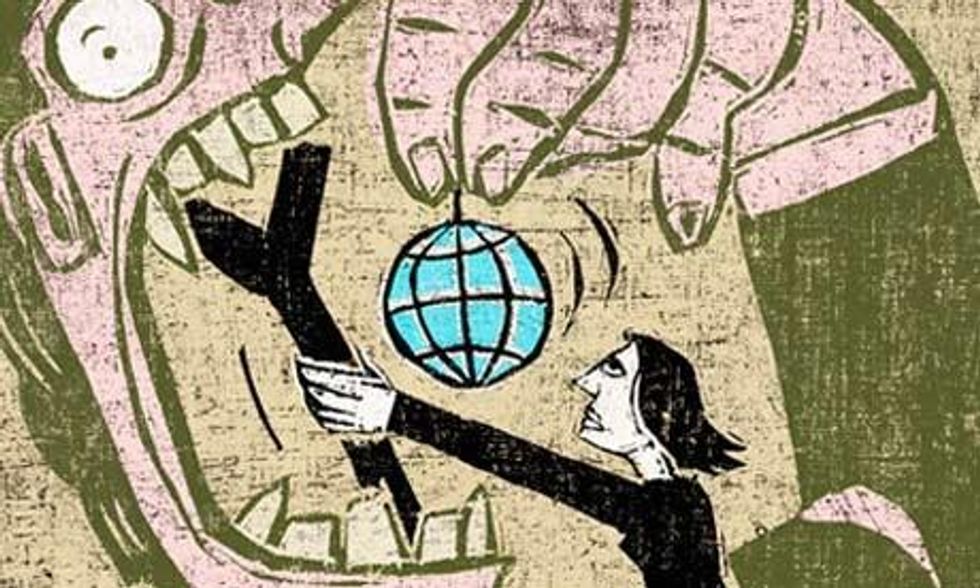
Worn down by hope. That's the predicament of those who have sought to defend the earth's living systems. Every time governments meet to discuss the environmental crisis, we are told that this is the "make or break summit", on which the future of the world depends. The talks might have failed before, but this time the light of reason will descend upon the world.

We know it's rubbish, but we allow our hopes to be raised, only to witness 190 nations arguing through the night over the use of the subjunctive in paragraph 286. We know that at the end of this process the UN secretary general, whose job obliges him to talk nonsense in an impressive number of languages, will explain that the unresolved issues (namely all of them) will be settled at next year's summit. Yet still we hope for something better.
This week's earth summit in Rio de Janeiro is a ghost of the glad, confident meeting 20 years ago. By now, the leaders who gathered in the same city in 1992 told us, the world's environmental problems were to have been solved. But all they have generated is more meetings, which will continue until the delegates, surrounded by rising waters, have eaten the last rare dove, exquisitely presented with an olive leaf roulade. The biosphere that world leaders promised to protect is in a far worse state than it was 20 years ago. Is it not time to recognize that they have failed?
These summits have failed for the same reason that the banks have failed. Political systems that were supposed to represent everyone now return governments of millionaires, financed by and acting on behalf of billionaires. The past 20 years have been a billionaires' banquet. At the behest of corporations and the ultra-rich, governments have removed the constraining decencies - the laws and regulations - which prevent one person from destroying another. To expect governments funded and appointed by this class to protect the biosphere and defend the poor is like expecting a lion to live on gazpacho.
You have only to see the way the United States has savaged the Earth summit's draft declaration to grasp the scale of this problem. The word "equitable", the US insists, must be cleansed from the text. So must any mention of the right to food, water, health, the rule of law, gender equality and women's empowerment. So must a clear target of preventing two degrees of global warming. So must a commitment to change "unsustainable consumption and production patterns", and to decouple economic growth from the use of natural resources.
Political systems that were supposed to represent everyone now return governments of millionaires, financed by and acting on behalf of billionaires
Most significantly, the US delegation demands the removal of many of the foundations agreed by a Republican president in Rio in 1992. In particular, it has set out to purge all mention of the core principle of that Earth summit: common but differentiated responsibilities. This means that while all countries should strive to protect the world's resources, those with the most money and who have done the most damage should play a greater part.
This is the government, remember, not of George W Bush but of Barack Obama. The paranoid, petty, unilateralist sabotage of international agreements continues uninterrupted. To see Obama backtracking on the commitments made by Bush the elder 20 years ago is to see the extent to which a tiny group of plutocrats has asserted its grip on policy.
While the destructive impact of the US in Rio is greater than that of any other nation, this does not excuse our own failures. The British government prepared for the Earth summit by wrecking both our own Climate Change Act and the European energy efficiency directive. David Cameron will not be attending the Earth summit. Nor will Ed Davey, the energy and climate change secretary (which is probably a blessing, as he's totally useless).
Needless to say, Cameron, with other absentees such as Obama and Angela Merkel, are attending the G20 summit in Mexico, which takes place immediately before Rio. Another tenet of the 1992 summit - that economic and environmental issues should not be treated in isolation - goes up in smoke.
The environmental crisis cannot be addressed by the emissaries of billionaires. It is the system that needs to be challenged, not the individual decisions it makes. In this respect the struggle to protect the biosphere is the same as the struggle for redistribution, for the protection of workers' rights, for an enabling state, for equality before the law.
So this is the great question of our age: where is everyone? The monster social movements of the 19th century and first 80 years of the 20th have gone, and nothing has replaced them. Those of us who still contest unwarranted power find our footsteps echoing through cavernous halls once thronged by multitudes. When a few hundred people do make a stand - as the Occupy campers have done - the rest of the nation just waits for them to achieve the kind of change that requires the sustained work of millions.
Without mass movements, without the kind of confrontation required to revitalize democracy, everything of value is deleted from the political text. But we do not mobilize, perhaps because we are endlessly seduced by hope. Hope is the rope from which we all hang.
Dear Common Dreams reader, It’s been nearly 30 years since I co-founded Common Dreams with my late wife, Lina Newhouser. We had the radical notion that journalism should serve the public good, not corporate profits. It was clear to us from the outset what it would take to build such a project. No paid advertisements. No corporate sponsors. No millionaire publisher telling us what to think or do. Many people said we wouldn't last a year, but we proved those doubters wrong. Together with a tremendous team of journalists and dedicated staff, we built an independent media outlet free from the constraints of profits and corporate control. Our mission has always been simple: To inform. To inspire. To ignite change for the common good. Building Common Dreams was not easy. Our survival was never guaranteed. When you take on the most powerful forces—Wall Street greed, fossil fuel industry destruction, Big Tech lobbyists, and uber-rich oligarchs who have spent billions upon billions rigging the economy and democracy in their favor—the only bulwark you have is supporters who believe in your work. But here’s the urgent message from me today. It's never been this bad out there. And it's never been this hard to keep us going. At the very moment Common Dreams is most needed, the threats we face are intensifying. We need your support now more than ever. We don't accept corporate advertising and never will. We don't have a paywall because we don't think people should be blocked from critical news based on their ability to pay. Everything we do is funded by the donations of readers like you. When everyone does the little they can afford, we are strong. But if that support retreats or dries up, so do we. Will you donate now to make sure Common Dreams not only survives but thrives? —Craig Brown, Co-founder |
Worn down by hope. That's the predicament of those who have sought to defend the earth's living systems. Every time governments meet to discuss the environmental crisis, we are told that this is the "make or break summit", on which the future of the world depends. The talks might have failed before, but this time the light of reason will descend upon the world.

We know it's rubbish, but we allow our hopes to be raised, only to witness 190 nations arguing through the night over the use of the subjunctive in paragraph 286. We know that at the end of this process the UN secretary general, whose job obliges him to talk nonsense in an impressive number of languages, will explain that the unresolved issues (namely all of them) will be settled at next year's summit. Yet still we hope for something better.
This week's earth summit in Rio de Janeiro is a ghost of the glad, confident meeting 20 years ago. By now, the leaders who gathered in the same city in 1992 told us, the world's environmental problems were to have been solved. But all they have generated is more meetings, which will continue until the delegates, surrounded by rising waters, have eaten the last rare dove, exquisitely presented with an olive leaf roulade. The biosphere that world leaders promised to protect is in a far worse state than it was 20 years ago. Is it not time to recognize that they have failed?
These summits have failed for the same reason that the banks have failed. Political systems that were supposed to represent everyone now return governments of millionaires, financed by and acting on behalf of billionaires. The past 20 years have been a billionaires' banquet. At the behest of corporations and the ultra-rich, governments have removed the constraining decencies - the laws and regulations - which prevent one person from destroying another. To expect governments funded and appointed by this class to protect the biosphere and defend the poor is like expecting a lion to live on gazpacho.
You have only to see the way the United States has savaged the Earth summit's draft declaration to grasp the scale of this problem. The word "equitable", the US insists, must be cleansed from the text. So must any mention of the right to food, water, health, the rule of law, gender equality and women's empowerment. So must a clear target of preventing two degrees of global warming. So must a commitment to change "unsustainable consumption and production patterns", and to decouple economic growth from the use of natural resources.
Political systems that were supposed to represent everyone now return governments of millionaires, financed by and acting on behalf of billionaires
Most significantly, the US delegation demands the removal of many of the foundations agreed by a Republican president in Rio in 1992. In particular, it has set out to purge all mention of the core principle of that Earth summit: common but differentiated responsibilities. This means that while all countries should strive to protect the world's resources, those with the most money and who have done the most damage should play a greater part.
This is the government, remember, not of George W Bush but of Barack Obama. The paranoid, petty, unilateralist sabotage of international agreements continues uninterrupted. To see Obama backtracking on the commitments made by Bush the elder 20 years ago is to see the extent to which a tiny group of plutocrats has asserted its grip on policy.
While the destructive impact of the US in Rio is greater than that of any other nation, this does not excuse our own failures. The British government prepared for the Earth summit by wrecking both our own Climate Change Act and the European energy efficiency directive. David Cameron will not be attending the Earth summit. Nor will Ed Davey, the energy and climate change secretary (which is probably a blessing, as he's totally useless).
Needless to say, Cameron, with other absentees such as Obama and Angela Merkel, are attending the G20 summit in Mexico, which takes place immediately before Rio. Another tenet of the 1992 summit - that economic and environmental issues should not be treated in isolation - goes up in smoke.
The environmental crisis cannot be addressed by the emissaries of billionaires. It is the system that needs to be challenged, not the individual decisions it makes. In this respect the struggle to protect the biosphere is the same as the struggle for redistribution, for the protection of workers' rights, for an enabling state, for equality before the law.
So this is the great question of our age: where is everyone? The monster social movements of the 19th century and first 80 years of the 20th have gone, and nothing has replaced them. Those of us who still contest unwarranted power find our footsteps echoing through cavernous halls once thronged by multitudes. When a few hundred people do make a stand - as the Occupy campers have done - the rest of the nation just waits for them to achieve the kind of change that requires the sustained work of millions.
Without mass movements, without the kind of confrontation required to revitalize democracy, everything of value is deleted from the political text. But we do not mobilize, perhaps because we are endlessly seduced by hope. Hope is the rope from which we all hang.

Worn down by hope. That's the predicament of those who have sought to defend the earth's living systems. Every time governments meet to discuss the environmental crisis, we are told that this is the "make or break summit", on which the future of the world depends. The talks might have failed before, but this time the light of reason will descend upon the world.

We know it's rubbish, but we allow our hopes to be raised, only to witness 190 nations arguing through the night over the use of the subjunctive in paragraph 286. We know that at the end of this process the UN secretary general, whose job obliges him to talk nonsense in an impressive number of languages, will explain that the unresolved issues (namely all of them) will be settled at next year's summit. Yet still we hope for something better.
This week's earth summit in Rio de Janeiro is a ghost of the glad, confident meeting 20 years ago. By now, the leaders who gathered in the same city in 1992 told us, the world's environmental problems were to have been solved. But all they have generated is more meetings, which will continue until the delegates, surrounded by rising waters, have eaten the last rare dove, exquisitely presented with an olive leaf roulade. The biosphere that world leaders promised to protect is in a far worse state than it was 20 years ago. Is it not time to recognize that they have failed?
These summits have failed for the same reason that the banks have failed. Political systems that were supposed to represent everyone now return governments of millionaires, financed by and acting on behalf of billionaires. The past 20 years have been a billionaires' banquet. At the behest of corporations and the ultra-rich, governments have removed the constraining decencies - the laws and regulations - which prevent one person from destroying another. To expect governments funded and appointed by this class to protect the biosphere and defend the poor is like expecting a lion to live on gazpacho.
You have only to see the way the United States has savaged the Earth summit's draft declaration to grasp the scale of this problem. The word "equitable", the US insists, must be cleansed from the text. So must any mention of the right to food, water, health, the rule of law, gender equality and women's empowerment. So must a clear target of preventing two degrees of global warming. So must a commitment to change "unsustainable consumption and production patterns", and to decouple economic growth from the use of natural resources.
Political systems that were supposed to represent everyone now return governments of millionaires, financed by and acting on behalf of billionaires
Most significantly, the US delegation demands the removal of many of the foundations agreed by a Republican president in Rio in 1992. In particular, it has set out to purge all mention of the core principle of that Earth summit: common but differentiated responsibilities. This means that while all countries should strive to protect the world's resources, those with the most money and who have done the most damage should play a greater part.
This is the government, remember, not of George W Bush but of Barack Obama. The paranoid, petty, unilateralist sabotage of international agreements continues uninterrupted. To see Obama backtracking on the commitments made by Bush the elder 20 years ago is to see the extent to which a tiny group of plutocrats has asserted its grip on policy.
While the destructive impact of the US in Rio is greater than that of any other nation, this does not excuse our own failures. The British government prepared for the Earth summit by wrecking both our own Climate Change Act and the European energy efficiency directive. David Cameron will not be attending the Earth summit. Nor will Ed Davey, the energy and climate change secretary (which is probably a blessing, as he's totally useless).
Needless to say, Cameron, with other absentees such as Obama and Angela Merkel, are attending the G20 summit in Mexico, which takes place immediately before Rio. Another tenet of the 1992 summit - that economic and environmental issues should not be treated in isolation - goes up in smoke.
The environmental crisis cannot be addressed by the emissaries of billionaires. It is the system that needs to be challenged, not the individual decisions it makes. In this respect the struggle to protect the biosphere is the same as the struggle for redistribution, for the protection of workers' rights, for an enabling state, for equality before the law.
So this is the great question of our age: where is everyone? The monster social movements of the 19th century and first 80 years of the 20th have gone, and nothing has replaced them. Those of us who still contest unwarranted power find our footsteps echoing through cavernous halls once thronged by multitudes. When a few hundred people do make a stand - as the Occupy campers have done - the rest of the nation just waits for them to achieve the kind of change that requires the sustained work of millions.
Without mass movements, without the kind of confrontation required to revitalize democracy, everything of value is deleted from the political text. But we do not mobilize, perhaps because we are endlessly seduced by hope. Hope is the rope from which we all hang.