SUBSCRIBE TO OUR FREE NEWSLETTER
Daily news & progressive opinion—funded by the people, not the corporations—delivered straight to your inbox.
5
#000000
#FFFFFF
To donate by check, phone, or other method, see our More Ways to Give page.
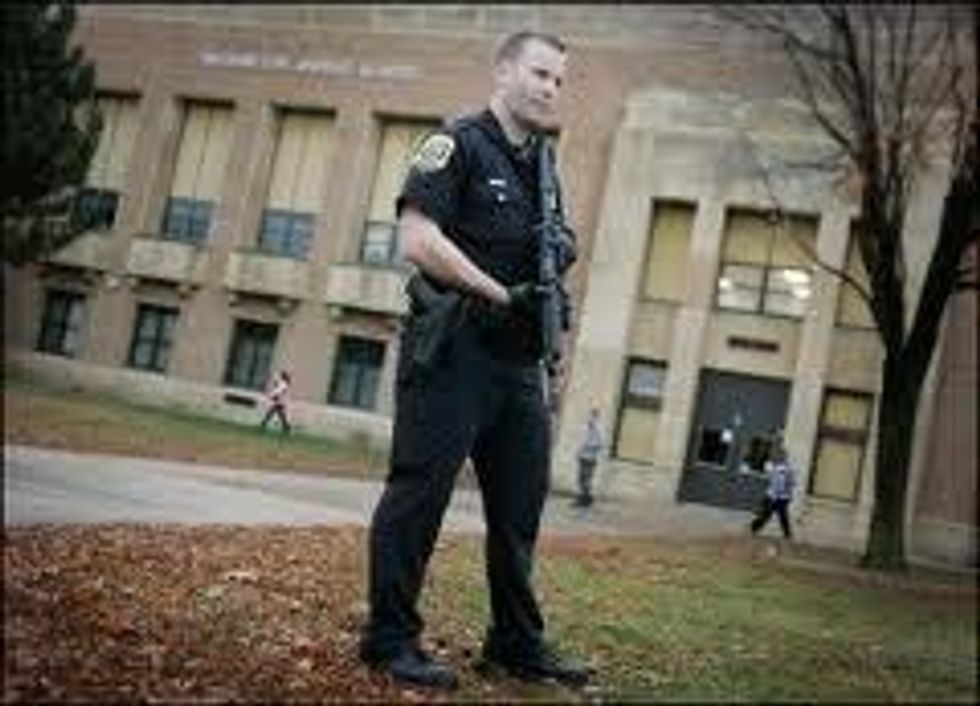
Few headlines are more jarring than the one that accompanied a recent front-page Inquirer story on school policing in Houston: "Armed with guns and understanding." The image is at odds with what most people want in their public schools. Understanding? Yes. Guns? No.
Extensive research has shown that increased police presence in schools has not solved student discipline problems. Nor is there any evidence that it has made schools safer - and that holds true whether the officers are armed or not. Research also shows that putting a commissioned police force in schools leads to increased court referrals, placing students at significantly higher risk of failure in school and extended involvement in the juvenile and adult criminal justice systems.
Before assigning armed, commissioned police officers to the Philadelphia schools, city leaders should carefully consider the drawbacks we've experienced in Texas. Texas Appleseed, the public-interest law center I work for, found that assigning more police officers to schools coincided with a dramatic increase in student arrests, as well as misdemeanor ticketing for low-level offenses that used to mean a trip to the principal's office. About 300,000 such tickets are issued annually in Texas to children as young as 6, triggering court appearances, fines, community service, and in some cases a criminal record.
As it happens, an Appleseed analysis of student ticketing in Texas school districts over the course of a year put Houston schools at the top of the list, with 4,828 tickets issued. Houston police did not produce data on student arrests, but thousands are arrested each year in districts of comparable size.
Texas legislative and judicial leaders are attempting to rein in such ticketing and arrests in schools, with the support of concerned parents, court personnel, advocacy groups, and educators. This year, state lawmakers moved to end the ticketing of elementary-school students for nonviolent offenses, a practice that was allowed to flourish because of the presence of commissioned police officers in Texas schools.
The chief justice of the Texas Supreme Court, Wallace B. Jefferson, has asked the judiciary's top policymaking body to look into the "criminalization of student misbehavior" and to recommend ways to minimize the courts' involvement in school discipline. He has strongly criticized the "uneven application of discretionary sanctions across school systems," which has resulted in disproportionate suspensions, expulsions, ticketing, and arrests among African American and special-education students.
Philadelphia can learn from Texas' experience and consider alternatives to rushing to place armed police officers in its schools. For example, a growing number of schools in Texas and across the country are investing in campus-wide training to reinforce positive student behavior and identify high-risk students for more intensive intervention.
Such strategies can prevent ordeals like the one endured by an 8-year-old autistic student in San Antonio. The student's mother appeared on a local news broadcast to express outrage that her son was handcuffed by a school police officer after he had a tantrum.
"It felt like some kind of freak show," she told a television reporter. "I could hear him begging. He was saying, 'Please take these off,' and he was crying. When I saw him on the floor, he was soaked in sweat."
No parent wants her child to experience this kind of needless trauma at school. When it comes to our children, we need to arm ourselves with understanding, not force.
Few headlines are more jarring than the one that accompanied a recent front-page Inquirer story on school policing in Houston: "Armed with guns and understanding." The image is at odds with what most people want in their public schools. Understanding? Yes. Guns? No.
Extensive research has shown that increased police presence in schools has not solved student discipline problems. Nor is there any evidence that it has made schools safer - and that holds true whether the officers are armed or not. Research also shows that putting a commissioned police force in schools leads to increased court referrals, placing students at significantly higher risk of failure in school and extended involvement in the juvenile and adult criminal justice systems.
Before assigning armed, commissioned police officers to the Philadelphia schools, city leaders should carefully consider the drawbacks we've experienced in Texas. Texas Appleseed, the public-interest law center I work for, found that assigning more police officers to schools coincided with a dramatic increase in student arrests, as well as misdemeanor ticketing for low-level offenses that used to mean a trip to the principal's office. About 300,000 such tickets are issued annually in Texas to children as young as 6, triggering court appearances, fines, community service, and in some cases a criminal record.
As it happens, an Appleseed analysis of student ticketing in Texas school districts over the course of a year put Houston schools at the top of the list, with 4,828 tickets issued. Houston police did not produce data on student arrests, but thousands are arrested each year in districts of comparable size.
Texas legislative and judicial leaders are attempting to rein in such ticketing and arrests in schools, with the support of concerned parents, court personnel, advocacy groups, and educators. This year, state lawmakers moved to end the ticketing of elementary-school students for nonviolent offenses, a practice that was allowed to flourish because of the presence of commissioned police officers in Texas schools.
The chief justice of the Texas Supreme Court, Wallace B. Jefferson, has asked the judiciary's top policymaking body to look into the "criminalization of student misbehavior" and to recommend ways to minimize the courts' involvement in school discipline. He has strongly criticized the "uneven application of discretionary sanctions across school systems," which has resulted in disproportionate suspensions, expulsions, ticketing, and arrests among African American and special-education students.
Philadelphia can learn from Texas' experience and consider alternatives to rushing to place armed police officers in its schools. For example, a growing number of schools in Texas and across the country are investing in campus-wide training to reinforce positive student behavior and identify high-risk students for more intensive intervention.
Such strategies can prevent ordeals like the one endured by an 8-year-old autistic student in San Antonio. The student's mother appeared on a local news broadcast to express outrage that her son was handcuffed by a school police officer after he had a tantrum.
"It felt like some kind of freak show," she told a television reporter. "I could hear him begging. He was saying, 'Please take these off,' and he was crying. When I saw him on the floor, he was soaked in sweat."
No parent wants her child to experience this kind of needless trauma at school. When it comes to our children, we need to arm ourselves with understanding, not force.
Few headlines are more jarring than the one that accompanied a recent front-page Inquirer story on school policing in Houston: "Armed with guns and understanding." The image is at odds with what most people want in their public schools. Understanding? Yes. Guns? No.
Extensive research has shown that increased police presence in schools has not solved student discipline problems. Nor is there any evidence that it has made schools safer - and that holds true whether the officers are armed or not. Research also shows that putting a commissioned police force in schools leads to increased court referrals, placing students at significantly higher risk of failure in school and extended involvement in the juvenile and adult criminal justice systems.
Before assigning armed, commissioned police officers to the Philadelphia schools, city leaders should carefully consider the drawbacks we've experienced in Texas. Texas Appleseed, the public-interest law center I work for, found that assigning more police officers to schools coincided with a dramatic increase in student arrests, as well as misdemeanor ticketing for low-level offenses that used to mean a trip to the principal's office. About 300,000 such tickets are issued annually in Texas to children as young as 6, triggering court appearances, fines, community service, and in some cases a criminal record.
As it happens, an Appleseed analysis of student ticketing in Texas school districts over the course of a year put Houston schools at the top of the list, with 4,828 tickets issued. Houston police did not produce data on student arrests, but thousands are arrested each year in districts of comparable size.
Texas legislative and judicial leaders are attempting to rein in such ticketing and arrests in schools, with the support of concerned parents, court personnel, advocacy groups, and educators. This year, state lawmakers moved to end the ticketing of elementary-school students for nonviolent offenses, a practice that was allowed to flourish because of the presence of commissioned police officers in Texas schools.
The chief justice of the Texas Supreme Court, Wallace B. Jefferson, has asked the judiciary's top policymaking body to look into the "criminalization of student misbehavior" and to recommend ways to minimize the courts' involvement in school discipline. He has strongly criticized the "uneven application of discretionary sanctions across school systems," which has resulted in disproportionate suspensions, expulsions, ticketing, and arrests among African American and special-education students.
Philadelphia can learn from Texas' experience and consider alternatives to rushing to place armed police officers in its schools. For example, a growing number of schools in Texas and across the country are investing in campus-wide training to reinforce positive student behavior and identify high-risk students for more intensive intervention.
Such strategies can prevent ordeals like the one endured by an 8-year-old autistic student in San Antonio. The student's mother appeared on a local news broadcast to express outrage that her son was handcuffed by a school police officer after he had a tantrum.
"It felt like some kind of freak show," she told a television reporter. "I could hear him begging. He was saying, 'Please take these off,' and he was crying. When I saw him on the floor, he was soaked in sweat."
No parent wants her child to experience this kind of needless trauma at school. When it comes to our children, we need to arm ourselves with understanding, not force.