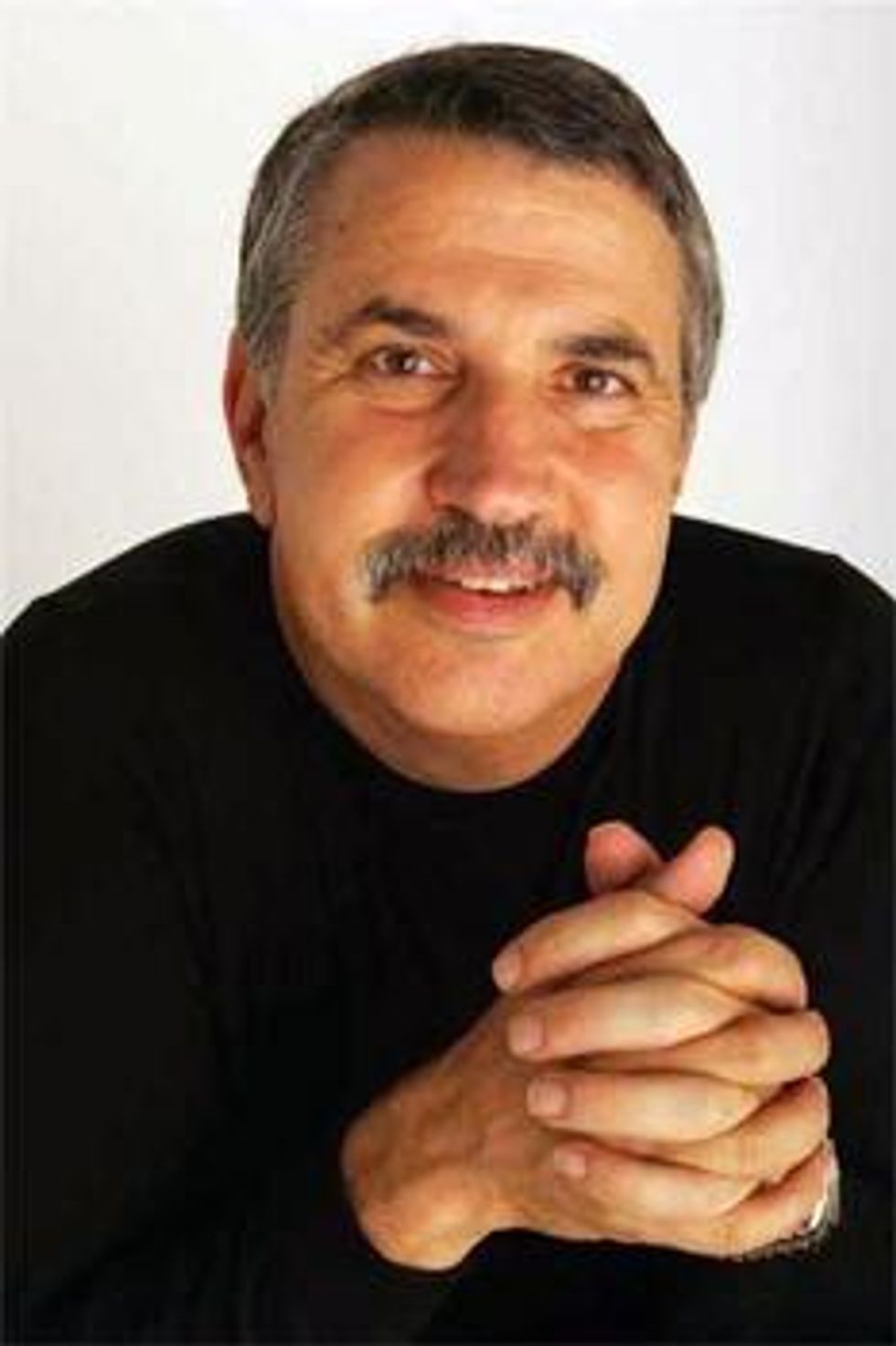
Thomas Friedman is once again orthogonal to reality. In his column today he urges a "grand bargain" where the Republicans abandon extremists of the right and agree to tax increases and Democrats abandon extremists of the left and agree to cut Medicare and Social Security (euphemistically referred to as "entitlements").
Thomas Friedman Thinks the Tea Partiers Are Extremists of the Left
Thomas Friedman is once again orthogonal to reality. In his column today he urges a "grand bargain" where the Republicans abandon extremists of the right and agree to tax increases and Democrats abandon extremists of the left and agree to cut Medicare and Social Security (euphemistically referred to as "entitlements"). There is one little problem with Friedman's story.

Support for Social Security and Medicare is not confined to extremists of the left. Overwhelming majorities of every group, including Republicans and self-identified supporters of the Tea Party, are opposed to cuts to Social Security and Medicare. The only people who seem to support such cuts are wealthy people like Mr. Friedman.
The reality is that Social Security is easily affordable as everyone familiar with the projections knows. According to the latest projections from the Congressional Budget Office the program can pay every penny of benefits for more than a quarter century with no changes whatsoever. To make the program fully solvent throughout its 75-year planning horizon would require a tax increase is equal to 5 percent of the wage growth projected over the next 30 years. This is why people familiar with the program's finances are generally unwilling to support cuts in Social Security benefits, unlike Mr. Friedman.
Medicare is more of an issue, but that is because the U.S. health care system is broken. We already pay more than twice as much per person for our health care as people in other wealthy countries. This gap is projected to increase in the decades ahead. If we had the same per person health care costs as any other wealthy country we would be looking at huge budget surpluses, not deficits. This is why serious people focus on fixing the health care system, not cutting Medicare.
The large deficits the country currently faces are due to an economic collapse caused by Wall Street greed and the incompetence of people with names like Alan Greenspan, Ben Bernanke, and Hank Paulson. Mr Friedman doesn't call for sacrifices from these people, for example with a financial speculation tax like the one recently proposed by German Chancellor Angela Merkel and French President Nicolas Sarkozy.
An Urgent Message From Our Co-Founder
Dear Common Dreams reader, The U.S. is on a fast track to authoritarianism like nothing I've ever seen. Meanwhile, corporate news outlets are utterly capitulating to Trump, twisting their coverage to avoid drawing his ire while lining up to stuff cash in his pockets. That's why I believe that Common Dreams is doing the best and most consequential reporting that we've ever done. Our small but mighty team is a progressive reporting powerhouse, covering the news every day that the corporate media never will. Our mission has always been simple: To inform. To inspire. And to ignite change for the common good. Now here's the key piece that I want all our readers to understand: None of this would be possible without your financial support. That's not just some fundraising cliche. It's the absolute and literal truth. We don't accept corporate advertising and never will. We don't have a paywall because we don't think people should be blocked from critical news based on their ability to pay. Everything we do is funded by the donations of readers like you. Will you donate now to help power the nonprofit, independent reporting of Common Dreams? Thank you for being a vital member of our community. Together, we can keep independent journalism alive when it’s needed most. - Craig Brown, Co-founder |
Thomas Friedman is once again orthogonal to reality. In his column today he urges a "grand bargain" where the Republicans abandon extremists of the right and agree to tax increases and Democrats abandon extremists of the left and agree to cut Medicare and Social Security (euphemistically referred to as "entitlements"). There is one little problem with Friedman's story.

Support for Social Security and Medicare is not confined to extremists of the left. Overwhelming majorities of every group, including Republicans and self-identified supporters of the Tea Party, are opposed to cuts to Social Security and Medicare. The only people who seem to support such cuts are wealthy people like Mr. Friedman.
The reality is that Social Security is easily affordable as everyone familiar with the projections knows. According to the latest projections from the Congressional Budget Office the program can pay every penny of benefits for more than a quarter century with no changes whatsoever. To make the program fully solvent throughout its 75-year planning horizon would require a tax increase is equal to 5 percent of the wage growth projected over the next 30 years. This is why people familiar with the program's finances are generally unwilling to support cuts in Social Security benefits, unlike Mr. Friedman.
Medicare is more of an issue, but that is because the U.S. health care system is broken. We already pay more than twice as much per person for our health care as people in other wealthy countries. This gap is projected to increase in the decades ahead. If we had the same per person health care costs as any other wealthy country we would be looking at huge budget surpluses, not deficits. This is why serious people focus on fixing the health care system, not cutting Medicare.
The large deficits the country currently faces are due to an economic collapse caused by Wall Street greed and the incompetence of people with names like Alan Greenspan, Ben Bernanke, and Hank Paulson. Mr Friedman doesn't call for sacrifices from these people, for example with a financial speculation tax like the one recently proposed by German Chancellor Angela Merkel and French President Nicolas Sarkozy.
Thomas Friedman is once again orthogonal to reality. In his column today he urges a "grand bargain" where the Republicans abandon extremists of the right and agree to tax increases and Democrats abandon extremists of the left and agree to cut Medicare and Social Security (euphemistically referred to as "entitlements"). There is one little problem with Friedman's story.

Support for Social Security and Medicare is not confined to extremists of the left. Overwhelming majorities of every group, including Republicans and self-identified supporters of the Tea Party, are opposed to cuts to Social Security and Medicare. The only people who seem to support such cuts are wealthy people like Mr. Friedman.
The reality is that Social Security is easily affordable as everyone familiar with the projections knows. According to the latest projections from the Congressional Budget Office the program can pay every penny of benefits for more than a quarter century with no changes whatsoever. To make the program fully solvent throughout its 75-year planning horizon would require a tax increase is equal to 5 percent of the wage growth projected over the next 30 years. This is why people familiar with the program's finances are generally unwilling to support cuts in Social Security benefits, unlike Mr. Friedman.
Medicare is more of an issue, but that is because the U.S. health care system is broken. We already pay more than twice as much per person for our health care as people in other wealthy countries. This gap is projected to increase in the decades ahead. If we had the same per person health care costs as any other wealthy country we would be looking at huge budget surpluses, not deficits. This is why serious people focus on fixing the health care system, not cutting Medicare.
The large deficits the country currently faces are due to an economic collapse caused by Wall Street greed and the incompetence of people with names like Alan Greenspan, Ben Bernanke, and Hank Paulson. Mr Friedman doesn't call for sacrifices from these people, for example with a financial speculation tax like the one recently proposed by German Chancellor Angela Merkel and French President Nicolas Sarkozy.