
The Arab Spring may have largely sprung, but for women in Saudi Arabia, it's still blooming. Since the announcement this April that Saudi women will, once again, not be allowed to vote in September's countrywide elections, coalitions of women activists have been organizing.
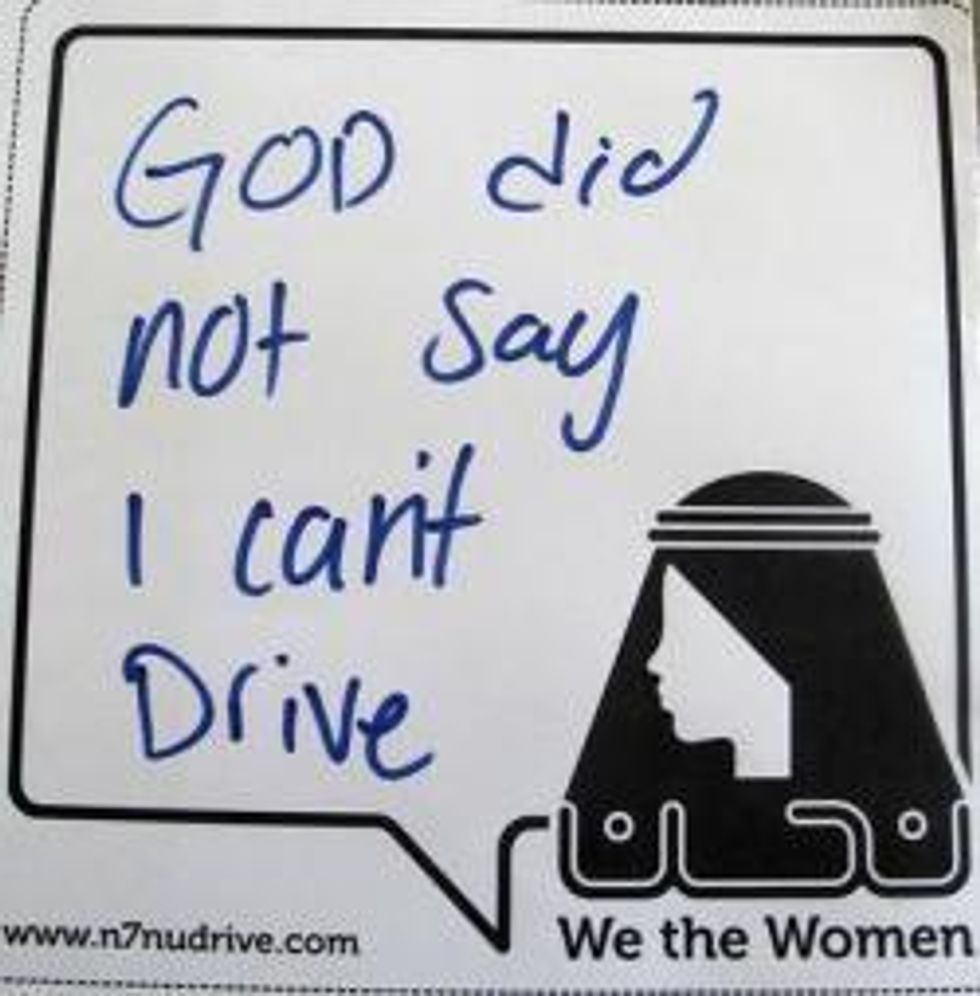
Women in Saudi Arabia have long withstood extraordinary oppression - including male guardianship laws, prohibition of driving, and the lack of educational, economic, and political access - which they are working to dismantle. Earlier this year, social networking platforms served as a launch pad for the Saudi Women Revolution, which laid out a number of requests for increased freedom and rights - the right to drive among them.
In June the Women2Drive campaign, a concerted effort of Saudi women bloggers and activists deeply rooted in social media, was launched to overturn the driving ban. As if the full list of rights demanded by the Saudi Women Revolution back in April was too overwhelming for the world to comprehend, it seems that narrowing the campaign to focus on driving as an entry point has proved a powerful advocacy tool that has quickly garnered global media attention and support.
Saudi women advocates organized a "drive-in" on June 17, encouraging Saudi women holding international driver's licenses to drive their cars across the country and record videos of themselves doing so. The collection of brief and shaky videos of women simply driving, unremarkable in any other context, is both moving and inspirational to watch.
International Reaction
Up until now, the Women2Drive campaign had subsisted largely on grassroots social media support. Then the group smartly put the screws to some of the world's top diplomats and women's rights crusaders, calling publicly on U.S. Secretary of State Hillary Clinton and Lady Catherine Ashton, the EU's high representative of foreign affairs and security policy, to offer support.
On June 21, Secretary Clinton gave the following statement:
What these women are doing is brave and what they are seeking is right. [...] I am moved by it, and I support them. [...] But I want to, again, underscore and emphasize that this is not about the United States. It's not about what any of us on the outside say. It is about the women themselves and their right to raise their concerns with their own government.
Her nuance is understandable, given the close and complex U.S.-Saudi political ties, yet perhaps not all that defensible. Secretary Clinton has never been one to restrict her beliefs about women's rights to U.S. boundaries, granting her legitimacy as a global rights advocate. Last year, she bluntly chided Canadian Prime Minister Stephen Harper for thinking he could omit safe abortion and contraception from the G8 maternal health funding scheme. Driving is an infinitely more mundane issue than abortion or contraception, but the United States is unwilling to risk its relationship with Saudi Arabia by raising a fuss.
Lady Ashton likewise released a subdued statement of support calling Saudi women advocates "courageous" for their efforts. However measured their responses, there is great symbolic significance to Clinton and Ashton's public support. Yet it is clear that no further political muscle will be devoted to this cause at the time, and perhaps Saudi women advocates should consider looking elsewhere.
UN Women
What about UN Women, the new superagency launched in 2010 to steward global women's rights? Where is their public declaration of support and guidance on a successful advocacy strategy moving forward? In April, I suggested that UN Women had a unique obligation to support the Saudi women's rights movement after electing the country to its elite advisory board amid international outcry. Unlike the United States, the UN isn't bound by a complicated bilateral relationship with Riyadh. Rather, with Saudi Arabia sitting on both the UN Human Rights Council and UN Women boards, there is opportunity for leverage.
Since its inception in September 2010, UN Women has enjoyed a jubilant coming-out year. With the impressive Michelle Bachelet at the helm, and the weight of several women-focused UN campaigns behind it, UN Women has gained global media attention, and excitement for its efforts is growing. Earlier this month they launched their flagship report Progress of the World's Women, an impressive summation of progress and shortcomings in global women's rights.
The new report includes pointed policy recommendations for improving women's rights worldwide, such as the institution of gender quotas, an increased number of women in law enforcement, and additional support for women's legal organizations. The report has garnered well-deserved enthusiasm from the global development community, and it is a good sign that the superagency is both serious about its mission and has the influence and deftness to achieve it.
Yet the report does not include any particular mention of the status of women in Saudi Arabia or the serious regulations that burden their daily lives. UN Women's own newfound global support comes at an opportune time, as it can now focus on ongoing women's rights movements, as in Saudi Arabia. UN Women should help leverage the awareness raised through the Saudi Women Revolution and Women2Drive social media campaigns, working with Saudi women and political leaders to consider concrete next steps on the policy and practical levels.
The car is warmed and ready, and Saudi women are behind the wheel. Is the UN going to come along for the ride?
The Arab Spring may have largely sprung, but for women in Saudi Arabia, it's still blooming. Since the announcement this April that Saudi women will, once again, not be allowed to vote in September's countrywide elections, coalitions of women activists have been organizing.
Women in Saudi Arabia have long withstood extraordinary oppression - including male guardianship laws, prohibition of driving, and the lack of educational, economic, and political access - which they are working to dismantle. Earlier this year, social networking platforms served as a launch pad for the Saudi Women Revolution, which laid out a number of requests for increased freedom and rights - the right to drive among them.
In June the Women2Drive campaign, a concerted effort of Saudi women bloggers and activists deeply rooted in social media, was launched to overturn the driving ban. As if the full list of rights demanded by the Saudi Women Revolution back in April was too overwhelming for the world to comprehend, it seems that narrowing the campaign to focus on driving as an entry point has proved a powerful advocacy tool that has quickly garnered global media attention and support.
Saudi women advocates organized a "drive-in" on June 17, encouraging Saudi women holding international driver's licenses to drive their cars across the country and record videos of themselves doing so. The collection of brief and shaky videos of women simply driving, unremarkable in any other context, is both moving and inspirational to watch.
International Reaction
Up until now, the Women2Drive campaign had subsisted largely on grassroots social media support. Then the group smartly put the screws to some of the world's top diplomats and women's rights crusaders, calling publicly on U.S. Secretary of State Hillary Clinton and Lady Catherine Ashton, the EU's high representative of foreign affairs and security policy, to offer support.
On June 21, Secretary Clinton gave the following statement:
What these women are doing is brave and what they are seeking is right. [...] I am moved by it, and I support them. [...] But I want to, again, underscore and emphasize that this is not about the United States. It's not about what any of us on the outside say. It is about the women themselves and their right to raise their concerns with their own government.
Her nuance is understandable, given the close and complex U.S.-Saudi political ties, yet perhaps not all that defensible. Secretary Clinton has never been one to restrict her beliefs about women's rights to U.S. boundaries, granting her legitimacy as a global rights advocate. Last year, she bluntly chided Canadian Prime Minister Stephen Harper for thinking he could omit safe abortion and contraception from the G8 maternal health funding scheme. Driving is an infinitely more mundane issue than abortion or contraception, but the United States is unwilling to risk its relationship with Saudi Arabia by raising a fuss.
Lady Ashton likewise released a subdued statement of support calling Saudi women advocates "courageous" for their efforts. However measured their responses, there is great symbolic significance to Clinton and Ashton's public support. Yet it is clear that no further political muscle will be devoted to this cause at the time, and perhaps Saudi women advocates should consider looking elsewhere.
UN Women
What about UN Women, the new superagency launched in 2010 to steward global women's rights? Where is their public declaration of support and guidance on a successful advocacy strategy moving forward? In April, I suggested that UN Women had a unique obligation to support the Saudi women's rights movement after electing the country to its elite advisory board amid international outcry. Unlike the United States, the UN isn't bound by a complicated bilateral relationship with Riyadh. Rather, with Saudi Arabia sitting on both the UN Human Rights Council and UN Women boards, there is opportunity for leverage.
Since its inception in September 2010, UN Women has enjoyed a jubilant coming-out year. With the impressive Michelle Bachelet at the helm, and the weight of several women-focused UN campaigns behind it, UN Women has gained global media attention, and excitement for its efforts is growing. Earlier this month they launched their flagship report Progress of the World's Women, an impressive summation of progress and shortcomings in global women's rights.
The new report includes pointed policy recommendations for improving women's rights worldwide, such as the institution of gender quotas, an increased number of women in law enforcement, and additional support for women's legal organizations. The report has garnered well-deserved enthusiasm from the global development community, and it is a good sign that the superagency is both serious about its mission and has the influence and deftness to achieve it.
Yet the report does not include any particular mention of the status of women in Saudi Arabia or the serious regulations that burden their daily lives. UN Women's own newfound global support comes at an opportune time, as it can now focus on ongoing women's rights movements, as in Saudi Arabia. UN Women should help leverage the awareness raised through the Saudi Women Revolution and Women2Drive social media campaigns, working with Saudi women and political leaders to consider concrete next steps on the policy and practical levels.
The car is warmed and ready, and Saudi women are behind the wheel. Is the UN going to come along for the ride?
The Arab Spring may have largely sprung, but for women in Saudi Arabia, it's still blooming. Since the announcement this April that Saudi women will, once again, not be allowed to vote in September's countrywide elections, coalitions of women activists have been organizing.
Women in Saudi Arabia have long withstood extraordinary oppression - including male guardianship laws, prohibition of driving, and the lack of educational, economic, and political access - which they are working to dismantle. Earlier this year, social networking platforms served as a launch pad for the Saudi Women Revolution, which laid out a number of requests for increased freedom and rights - the right to drive among them.
In June the Women2Drive campaign, a concerted effort of Saudi women bloggers and activists deeply rooted in social media, was launched to overturn the driving ban. As if the full list of rights demanded by the Saudi Women Revolution back in April was too overwhelming for the world to comprehend, it seems that narrowing the campaign to focus on driving as an entry point has proved a powerful advocacy tool that has quickly garnered global media attention and support.
Saudi women advocates organized a "drive-in" on June 17, encouraging Saudi women holding international driver's licenses to drive their cars across the country and record videos of themselves doing so. The collection of brief and shaky videos of women simply driving, unremarkable in any other context, is both moving and inspirational to watch.
International Reaction
Up until now, the Women2Drive campaign had subsisted largely on grassroots social media support. Then the group smartly put the screws to some of the world's top diplomats and women's rights crusaders, calling publicly on U.S. Secretary of State Hillary Clinton and Lady Catherine Ashton, the EU's high representative of foreign affairs and security policy, to offer support.
On June 21, Secretary Clinton gave the following statement:
What these women are doing is brave and what they are seeking is right. [...] I am moved by it, and I support them. [...] But I want to, again, underscore and emphasize that this is not about the United States. It's not about what any of us on the outside say. It is about the women themselves and their right to raise their concerns with their own government.
Her nuance is understandable, given the close and complex U.S.-Saudi political ties, yet perhaps not all that defensible. Secretary Clinton has never been one to restrict her beliefs about women's rights to U.S. boundaries, granting her legitimacy as a global rights advocate. Last year, she bluntly chided Canadian Prime Minister Stephen Harper for thinking he could omit safe abortion and contraception from the G8 maternal health funding scheme. Driving is an infinitely more mundane issue than abortion or contraception, but the United States is unwilling to risk its relationship with Saudi Arabia by raising a fuss.
Lady Ashton likewise released a subdued statement of support calling Saudi women advocates "courageous" for their efforts. However measured their responses, there is great symbolic significance to Clinton and Ashton's public support. Yet it is clear that no further political muscle will be devoted to this cause at the time, and perhaps Saudi women advocates should consider looking elsewhere.
UN Women
What about UN Women, the new superagency launched in 2010 to steward global women's rights? Where is their public declaration of support and guidance on a successful advocacy strategy moving forward? In April, I suggested that UN Women had a unique obligation to support the Saudi women's rights movement after electing the country to its elite advisory board amid international outcry. Unlike the United States, the UN isn't bound by a complicated bilateral relationship with Riyadh. Rather, with Saudi Arabia sitting on both the UN Human Rights Council and UN Women boards, there is opportunity for leverage.
Since its inception in September 2010, UN Women has enjoyed a jubilant coming-out year. With the impressive Michelle Bachelet at the helm, and the weight of several women-focused UN campaigns behind it, UN Women has gained global media attention, and excitement for its efforts is growing. Earlier this month they launched their flagship report Progress of the World's Women, an impressive summation of progress and shortcomings in global women's rights.
The new report includes pointed policy recommendations for improving women's rights worldwide, such as the institution of gender quotas, an increased number of women in law enforcement, and additional support for women's legal organizations. The report has garnered well-deserved enthusiasm from the global development community, and it is a good sign that the superagency is both serious about its mission and has the influence and deftness to achieve it.
Yet the report does not include any particular mention of the status of women in Saudi Arabia or the serious regulations that burden their daily lives. UN Women's own newfound global support comes at an opportune time, as it can now focus on ongoing women's rights movements, as in Saudi Arabia. UN Women should help leverage the awareness raised through the Saudi Women Revolution and Women2Drive social media campaigns, working with Saudi women and political leaders to consider concrete next steps on the policy and practical levels.
The car is warmed and ready, and Saudi women are behind the wheel. Is the UN going to come along for the ride?