SUBSCRIBE TO OUR FREE NEWSLETTER
Daily news & progressive opinion—funded by the people, not the corporations—delivered straight to your inbox.
5
#000000
#FFFFFF
To donate by check, phone, or other method, see our More Ways to Give page.
LONDON -- UK Uncut has achieved a quite astonishing level of prominence in a shockingly short amount of time. It was only seven months ago that their first action began when "around 70 people ran along Oxford Street, entered Vodafone's flagship store and sat down".
Mention the name of the group to your average person in the street (as opposed to a dreadlocked, sandal-wearing tofu-muncher, or whatever "leftwing activist" brings to mind) and surprisingly, it's quite likely that he'll not only have heard of them, he agrees with what they stand for.
That was my experience at the March for the Alternative on 26 March. I was at a coffee shop close to Fortnum & Mason when I got talking to a man, in his late 70s, on a trip to London. He had a copy of the Telegraph under one arm and, if I was going to speculate (I am), I'd say he might have voted Tory at some point in his life. Talking about the occupation of Fortnum & Mason, he said: "I don't agree with using violence, but why shouldn't banks pay their taxes if I do?"
That's one of the secrets of UK Uncut's success. A simple and popular message: if we pay our taxes, why shouldn't they?
Let's assume archetypal Gauloise-smoking, hard-drinking French philosopher Guy Debord, the doyen of the May 1968 protesters, was right. We live in a society of the spectacle, which the media feed on and reproduce for our entertainment. What groups such as UK Uncut must do to catch the attention of the news providers is to create an even bigger spectacle. In other words, you can only do the same thing for so long before you lose the attention. Firstly, of the mainstream news providers and then you, the viewer at home: anxiously turning the page, clicking on a new link or flicking through the channels to find out why Cheryl Cole has been bumped from The X Factor.
I'm not directly involved with any of the UK Uncut groups, although I completely agree with what they say about the cuts. I'm encouraged to see from the website that at least one action taking place this Saturday as far as I can tell, involves something more than just occupying a bank. Here's hoping. The last thing I want to see is the campaigners getting sidelined into the anti-cuts equivalent of the Hare Krishnas, routinely wandering up and down Oxford Street chanting. Perhaps UK Uncut should turn to the past for inspiration. Here are four spectacles that got the message across:
Like UK Uncut, the Youth International party had no formal hierarchy or membership. Although known for many pranks, including nominating a pig for president and applying to levitate the Pentagon, one of the Yippies' early spectacles involved co-founders Abbie Hoffman, Jerry Rubin and others joining a tour of the New York Stock Exchange. Once inside, they threw hundreds of dollar bills down on to the trading floor and watched the frenzy below as the bankers fought each other to grab them. I'm going to gloss over Rubin later becoming a stockbroker.
A controversial one, this, and one I hesitated whether to include. A huge protest in London against the shortly-to-be-introduced poll tax ended in violent confrontations between police and protesters. The crowd in Trafalgar Square had been subjected to a neolithic version of what I suspect would now be described as kettling. The violence was regrettable, but it brought the countrywide opposition to the tax to a head and hammered home the message that it was a step too far, even for Thatcher. She was forced out later that year.
A protest in the British colony of Massachusetts against the British government-imposed Tea Act. Not actually about high taxes (sorry, modern rightwing "teabaggers") but more about "taxation without representation". There was a standoff between protesters in Boston and the governor over tea ships docked there. After a meeting, a group of between 30 and 130 men boarded the ships and dumped all 342 tea chests in the harbour. A key event in the fight for American independence. As a mark of respect, all black tea in the US now tastes as if it has been brewed in saltwater.
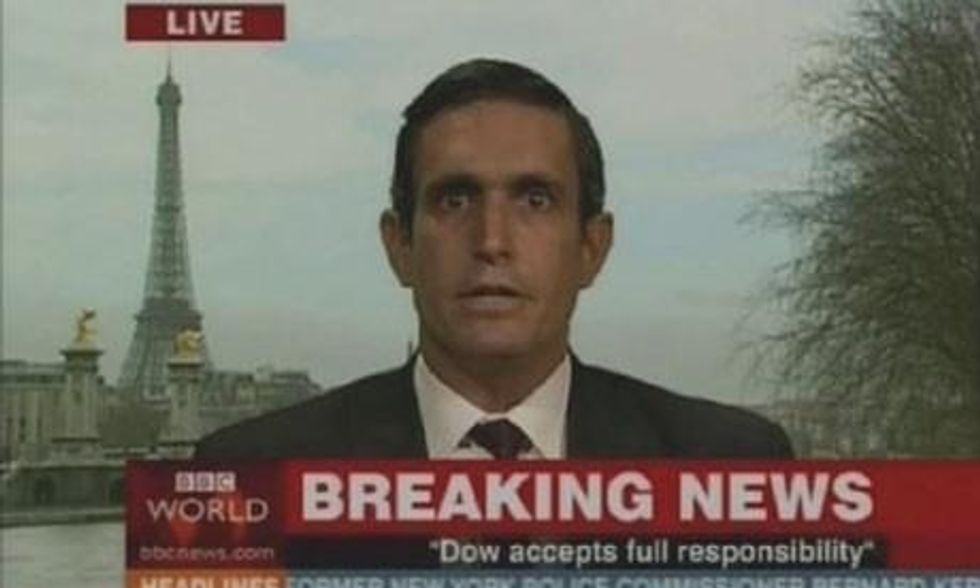
The Yes Men are two "culture jammers", Andy Bichlbaum and Mike Bonanno, and their network of supporters. On the 20th anniversary of the Bhopal chemical disaster, which the now Dow-owned Union Carbide was responsible for, Bichlbaum appeared on BBC World as "Jude Finisterra", a spokesman for Dow. Finisterra (think about it) said Dow planned to liquidate Union Carbide and use the $12bn to pay to clean up the site and for the survivors' medical care. Before the hoax was discovered, Dow's stock lost $2bn in value. This year, the Yes Men worked with US Uncut to put out a press release as General Electric, picked up by AP, saying the company would return its entire 2010 tax refund of $3.2bn to the US Treasury. As a result, GE's market value briefly slumped by $3.5bn.
LONDON -- UK Uncut has achieved a quite astonishing level of prominence in a shockingly short amount of time. It was only seven months ago that their first action began when "around 70 people ran along Oxford Street, entered Vodafone's flagship store and sat down".
Mention the name of the group to your average person in the street (as opposed to a dreadlocked, sandal-wearing tofu-muncher, or whatever "leftwing activist" brings to mind) and surprisingly, it's quite likely that he'll not only have heard of them, he agrees with what they stand for.
That was my experience at the March for the Alternative on 26 March. I was at a coffee shop close to Fortnum & Mason when I got talking to a man, in his late 70s, on a trip to London. He had a copy of the Telegraph under one arm and, if I was going to speculate (I am), I'd say he might have voted Tory at some point in his life. Talking about the occupation of Fortnum & Mason, he said: "I don't agree with using violence, but why shouldn't banks pay their taxes if I do?"
That's one of the secrets of UK Uncut's success. A simple and popular message: if we pay our taxes, why shouldn't they?
Let's assume archetypal Gauloise-smoking, hard-drinking French philosopher Guy Debord, the doyen of the May 1968 protesters, was right. We live in a society of the spectacle, which the media feed on and reproduce for our entertainment. What groups such as UK Uncut must do to catch the attention of the news providers is to create an even bigger spectacle. In other words, you can only do the same thing for so long before you lose the attention. Firstly, of the mainstream news providers and then you, the viewer at home: anxiously turning the page, clicking on a new link or flicking through the channels to find out why Cheryl Cole has been bumped from The X Factor.
I'm not directly involved with any of the UK Uncut groups, although I completely agree with what they say about the cuts. I'm encouraged to see from the website that at least one action taking place this Saturday as far as I can tell, involves something more than just occupying a bank. Here's hoping. The last thing I want to see is the campaigners getting sidelined into the anti-cuts equivalent of the Hare Krishnas, routinely wandering up and down Oxford Street chanting. Perhaps UK Uncut should turn to the past for inspiration. Here are four spectacles that got the message across:
Like UK Uncut, the Youth International party had no formal hierarchy or membership. Although known for many pranks, including nominating a pig for president and applying to levitate the Pentagon, one of the Yippies' early spectacles involved co-founders Abbie Hoffman, Jerry Rubin and others joining a tour of the New York Stock Exchange. Once inside, they threw hundreds of dollar bills down on to the trading floor and watched the frenzy below as the bankers fought each other to grab them. I'm going to gloss over Rubin later becoming a stockbroker.
A controversial one, this, and one I hesitated whether to include. A huge protest in London against the shortly-to-be-introduced poll tax ended in violent confrontations between police and protesters. The crowd in Trafalgar Square had been subjected to a neolithic version of what I suspect would now be described as kettling. The violence was regrettable, but it brought the countrywide opposition to the tax to a head and hammered home the message that it was a step too far, even for Thatcher. She was forced out later that year.
A protest in the British colony of Massachusetts against the British government-imposed Tea Act. Not actually about high taxes (sorry, modern rightwing "teabaggers") but more about "taxation without representation". There was a standoff between protesters in Boston and the governor over tea ships docked there. After a meeting, a group of between 30 and 130 men boarded the ships and dumped all 342 tea chests in the harbour. A key event in the fight for American independence. As a mark of respect, all black tea in the US now tastes as if it has been brewed in saltwater.
The Yes Men are two "culture jammers", Andy Bichlbaum and Mike Bonanno, and their network of supporters. On the 20th anniversary of the Bhopal chemical disaster, which the now Dow-owned Union Carbide was responsible for, Bichlbaum appeared on BBC World as "Jude Finisterra", a spokesman for Dow. Finisterra (think about it) said Dow planned to liquidate Union Carbide and use the $12bn to pay to clean up the site and for the survivors' medical care. Before the hoax was discovered, Dow's stock lost $2bn in value. This year, the Yes Men worked with US Uncut to put out a press release as General Electric, picked up by AP, saying the company would return its entire 2010 tax refund of $3.2bn to the US Treasury. As a result, GE's market value briefly slumped by $3.5bn.
LONDON -- UK Uncut has achieved a quite astonishing level of prominence in a shockingly short amount of time. It was only seven months ago that their first action began when "around 70 people ran along Oxford Street, entered Vodafone's flagship store and sat down".
Mention the name of the group to your average person in the street (as opposed to a dreadlocked, sandal-wearing tofu-muncher, or whatever "leftwing activist" brings to mind) and surprisingly, it's quite likely that he'll not only have heard of them, he agrees with what they stand for.
That was my experience at the March for the Alternative on 26 March. I was at a coffee shop close to Fortnum & Mason when I got talking to a man, in his late 70s, on a trip to London. He had a copy of the Telegraph under one arm and, if I was going to speculate (I am), I'd say he might have voted Tory at some point in his life. Talking about the occupation of Fortnum & Mason, he said: "I don't agree with using violence, but why shouldn't banks pay their taxes if I do?"
That's one of the secrets of UK Uncut's success. A simple and popular message: if we pay our taxes, why shouldn't they?
Let's assume archetypal Gauloise-smoking, hard-drinking French philosopher Guy Debord, the doyen of the May 1968 protesters, was right. We live in a society of the spectacle, which the media feed on and reproduce for our entertainment. What groups such as UK Uncut must do to catch the attention of the news providers is to create an even bigger spectacle. In other words, you can only do the same thing for so long before you lose the attention. Firstly, of the mainstream news providers and then you, the viewer at home: anxiously turning the page, clicking on a new link or flicking through the channels to find out why Cheryl Cole has been bumped from The X Factor.
I'm not directly involved with any of the UK Uncut groups, although I completely agree with what they say about the cuts. I'm encouraged to see from the website that at least one action taking place this Saturday as far as I can tell, involves something more than just occupying a bank. Here's hoping. The last thing I want to see is the campaigners getting sidelined into the anti-cuts equivalent of the Hare Krishnas, routinely wandering up and down Oxford Street chanting. Perhaps UK Uncut should turn to the past for inspiration. Here are four spectacles that got the message across:
Like UK Uncut, the Youth International party had no formal hierarchy or membership. Although known for many pranks, including nominating a pig for president and applying to levitate the Pentagon, one of the Yippies' early spectacles involved co-founders Abbie Hoffman, Jerry Rubin and others joining a tour of the New York Stock Exchange. Once inside, they threw hundreds of dollar bills down on to the trading floor and watched the frenzy below as the bankers fought each other to grab them. I'm going to gloss over Rubin later becoming a stockbroker.
A controversial one, this, and one I hesitated whether to include. A huge protest in London against the shortly-to-be-introduced poll tax ended in violent confrontations between police and protesters. The crowd in Trafalgar Square had been subjected to a neolithic version of what I suspect would now be described as kettling. The violence was regrettable, but it brought the countrywide opposition to the tax to a head and hammered home the message that it was a step too far, even for Thatcher. She was forced out later that year.
A protest in the British colony of Massachusetts against the British government-imposed Tea Act. Not actually about high taxes (sorry, modern rightwing "teabaggers") but more about "taxation without representation". There was a standoff between protesters in Boston and the governor over tea ships docked there. After a meeting, a group of between 30 and 130 men boarded the ships and dumped all 342 tea chests in the harbour. A key event in the fight for American independence. As a mark of respect, all black tea in the US now tastes as if it has been brewed in saltwater.
The Yes Men are two "culture jammers", Andy Bichlbaum and Mike Bonanno, and their network of supporters. On the 20th anniversary of the Bhopal chemical disaster, which the now Dow-owned Union Carbide was responsible for, Bichlbaum appeared on BBC World as "Jude Finisterra", a spokesman for Dow. Finisterra (think about it) said Dow planned to liquidate Union Carbide and use the $12bn to pay to clean up the site and for the survivors' medical care. Before the hoax was discovered, Dow's stock lost $2bn in value. This year, the Yes Men worked with US Uncut to put out a press release as General Electric, picked up by AP, saying the company would return its entire 2010 tax refund of $3.2bn to the US Treasury. As a result, GE's market value briefly slumped by $3.5bn.