

SUBSCRIBE TO OUR FREE NEWSLETTER
Daily news & progressive opinion—funded by the people, not the corporations—delivered straight to your inbox.
5
#000000
#FFFFFF
To donate by check, phone, or other method, see our More Ways to Give page.
Daily news & progressive opinion—funded by the people, not the corporations—delivered straight to your inbox.
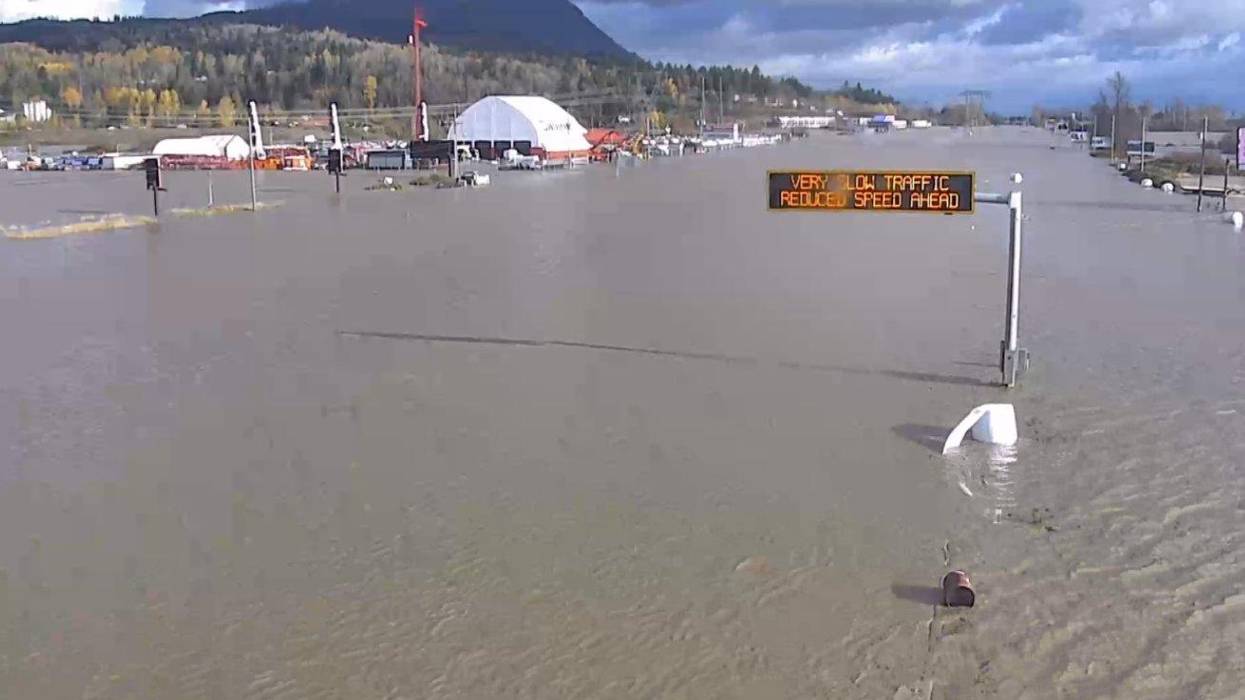
After a summer that featured the "world's most extreme heatwave in modern history," which experts linked to human-caused global heating, the Pacific Northwest was inundated with floodwaters Monday, fueling fresh calls for ambitious action to combat the climate emergency.
The recent rain and subsequent flooding--which came on the heels of the COP26 climate summit in Scotland--led to evacuations, power outages, rescues, school closures, and stranded vehicles in Washington state and British Columbia, Canada.
"We are in a climate emergency," meteorologist and writer Eric Holthaus tweeted regarding the "torrential flooding."
Washington Gov. Jay Inslee, a Democrat who ran for president in 2020 on a climate-focused platform and attended COP26 earlier this month, issued a severe weather emergency proclamation for 14 counties.
Inslee's office said in a statement that "the severe storm with floods, landslides, mudslides, and the potential for straight-line winds is causing road closures, the need to establish alternate transportation routes, evacuations, impacts to local utility services including significant power outages, localized reductions in available drinking water, and damage to homes and other public and private property and infrastructure."
Citing data from PowerOutage.Us, NBC News reported that "about 70,000 utility customers in Washington were without power early Tuesday."
As NBC detailed:
An atmospheric river--a plume of moisture that stretches across the Pacific and near Hawaii--has been aimed toward the region since last week, said Joe Boomgard-Zagrodnik, an agricultural meteorologist at Washington State University.
Beginning Thursday, a trio of storms tapped into that moisture and hammered areas north of Seattle and on Washington's Olympic Peninsula with driving rainfall.
Atmospheric river patterns are not uncommon in the region, but the barrage of storms comes during a historically wet fall. And the flooding strikes a region that suffered a heat wave that set records in June, became smothered with wildfire smoke in August and remained abnormally dry for much of summer.
"We were super hot and dry in the summer, and the switch flips. It definitely matches what the climate models show for the future around here--hotter, dryer summers and wetter winters," said Boomgard-Zagrodnik. "Our infrastructure isn't designed for that."
Noting that the National Weather Service (NWS) issued flood warnings for at least 12 rivers as of Monday afternoon, AccuWeather highlighted some new records:
An NWS river gauge showed that the Bogachiel River near La Push, Washington, had broken its all-time record high level Monday at 44.93 feet. The previous record for the station was 42.64 feet, set on November 6, 2006. The Nooksack River at North Cedarville, Washington, also broke its record Monday at 150.35 feet, versus the record of 149.61 feet on November 6, 2006. The river was seen still raging Monday evening. The Skagit River near Mount Vernon was forecast to break its record Tuesday and was already at 35 feet Monday evening, forcing officials to close bridges.
Chris Elder, the primary Whatcom County employee managing climate action, told The Bellingham Herald on Monday, "The reality is the impacts are happening."
Standing on his property near the Nooksack River's South Fork, which had flooded an agricultural field used by bison, Elder said, "It's wild, it's the highest I've ever seen it."
North of the U.S. border, Environment Canada meteorologist Armel Castellan told The Globe and Mail that two months of unusually heavy rains preceded the "very potent and strong" weather system that hit British Columbia this weekend.
"The conditions... have been historic," Castellan said, "with many locations getting an average amount of rain for November in under 48 hours."
The Toronto Star reported that "B.C. leaders are not yet saying whether the atmospheric river rainstorm is one of the largest seen in the province, but the speed with which it has wrought destruction and disruption already makes it a monumental disaster and is bringing back memories of the widespread wildfires that took place over the summer--many in the same regions now being hit by the storms."
The newspaper added that "the entire town of Merritt, B.C., home to 7,000 people, evacuated their homes Monday morning, as water from the rushing Coldwater River breached its banks and filled up the streets of surrounding communities as though they were part of a stoppered bathtub."
Along with Merritt, where the municipal wastewater treatment plant failed, an evacuation order was issued for the nearby Nooaitch Indian Band and other communities, according to CBC.
In Vancouver, the province's most populous city, every major highway was shut down Monday afternoon. There were road closures across B.C., and surging rivers even washed away portions of the Coquihalla and Trans Canada highways.
CBC reported that there is currently no timeline for schools to reopen in Merritt or Princeton, where the Tulameen and Similkameen rivers overflowed, forcing evacuations.
Princeton Mayor Spencer Coyne also told CBC journalist Heather Hiscox that residents of his flooded community could go days without heat because of a broken natural gas line.
Author and activist Bill McKibben, co-founder of the environmental group 350.org, noted the "sadly ironic twist" that the flooding shut down a tar sands pipeline controversially owned by the Canadian government in spite of Liberal Prime Minister Justin Trudeau's claims to support climate action and scientists' warnings about the need to keep fossil fuels in the ground.
"The Trans Mountain pipeline has been temporarily shut down because of flooding in the area of Hope," according to CBC, "and all construction on the pipeline expansion project has been halted in the Lower Mainland."
Greenpeace Canada referenced the pipeline in a Tuesday tweet targeting the country's minister of environment and climate change, Steven Guilbeault.
"The people of B.C. don't need your thoughts. They need you... to ACT NOW on the climate crisis in front of us," the group said. "#StopTMX, end fossil fuels."
This post has been updated with comment from Greenpeace Canada.
The grand opening of a Trump Hotel in Vancouver, British Columbia, on Tuesday was met with loud demonstrations and shunned by city officials in protest of the Trump administration's harsh anti-immigration stance.
"None of us will be [at the opening]," Kerry Jang, a city council member, told the Washington Post. "It's got bad karma, that place."
Illustrating the ramifications of President Donald Trump's failure to divest himself from his vast business empire, Trump's children Eric, Donald Jr., and Tiffany Trump traveled to Vancouver in a "cocoon of Secret Service" paid for by American taxpayers. A "Trump Welcome Party," featuring protests, music, and anti-Trump speeches, was there to greet them.
While the protests planned are peaceful, the U.S. consulate issued a warning to American citizens, telling them to stay away from the tower on Monday.
"We want to push back against this emboldening of hatred and misogyny and xenophobia and racism," Mathew Kagis, one of the organizers behind the welcome party, told the Guardian. "Those aren't values that we have and we want it to be made really clear."
The demonstrations are focused on the Trump administration's sweeping orders against immigrants, an issue that has hit close to home. Forty percent of Vancouver's population is immigrants, and since the travel ban Canada has seen a marked increase in refugees and migrants attempting to cross the U.S.-Canada border in Minnesota and Montana on foot. The rugged, hours-long journey in below-freezing temperatures and high winds has led to at least two migrants losing all of their fingers to frostbite.
"This is really scary stuff so we just felt that there needed to be a really vocal and public pushback," Kagis told the Guardian.
Follow along with the opening and the protests under the hashtag #TrumpVancouver:
The mayor of Vancouver, B.C., announced late Tuesday that an empty lot, the site of a tent city of homeless residents and affordable housing activists, will be transformed into subsidized housing for seniors and people on welfare.
The announcement marked a rare progressive victory in a city marred by rapid gentrification, a years-long housing crunch, and an influx of foreign money that has transformed the coastal community into a "playground for the rich."
"We've come to an agreement to make sure that the 58 West Hastings site is 100 per cent social housing," Vancouver Mayor Gregor Robertson said, according to CBC.
"Part of this is making sure this building is available to people who are on welfare, who are on pensions," Robertson added.
Activists built the tent city at 58 West Hastings Street--a long-contested site in Vancouver's fraught battle over housing--last month to protest a lack of affordable housing and skyrocketing homelessness.
As a result of Vancouver's ongoing real estate boom, a staggering 90 percent of one bedroom houses are now valued at more than $1 million CAD. The city's real estate price hike is outpacing New York and London, and its housing is Canada's priciest.
The tent city was the brainchild of local progressive groups Vancouver Area Network of Drug Users (VANDU) and the International League of People's Struggles (ILPS), created during a day of action to call attention to the housing crisis on July 9.
The occupation of the empty lot was intended to show that "the housing and homelessness crisis is not just a matter of the so-called 'street homeless,'" the organizers wrote.
"The crisis includes more than 100,000 people throughout B.C. who are evicted, couch surfing, displaced, underhoused, pushed out of tent cities, criminalized, and homeless," they continued. "We are calling out for homeless and evicted people to join these occupations, take them back from development corporations, and transform them from protests to spaces of survival, safety, and community."
Activists declared: "We are here, holding this space, because we refuse to sit idly by while our community members suffer the indignity of homelessness, the shelter system and unsafe, unhealthy, and inadequate housing!"
Only days after its creation, VANDU reported that the tent city was filled to capacity and forced to turn away homeless people who hoped to find refuge there.
And despite Robertson's vow to rezone the site and build "as many as 300 homes" there, Global News reports that one local homeless advocate, Jean Didieu, "was happy about the announcement--but he's not celebrating just yet."
Didieu told the news outlet that Robertson "has committed a lot of promises for us, for ending homelessness for so many years."
Yet local housing advocacy group Carnegie Community Action Project pointed out that the mayor's decision is relatively small in scope:
Homelessness in Vancouver remains at record heights.