SUBSCRIBE TO OUR FREE NEWSLETTER
Daily news & progressive opinion—funded by the people, not the corporations—delivered straight to your inbox.
5
#000000
#FFFFFF
To donate by check, phone, or other method, see our More Ways to Give page.


Daily news & progressive opinion—funded by the people, not the corporations—delivered straight to your inbox.
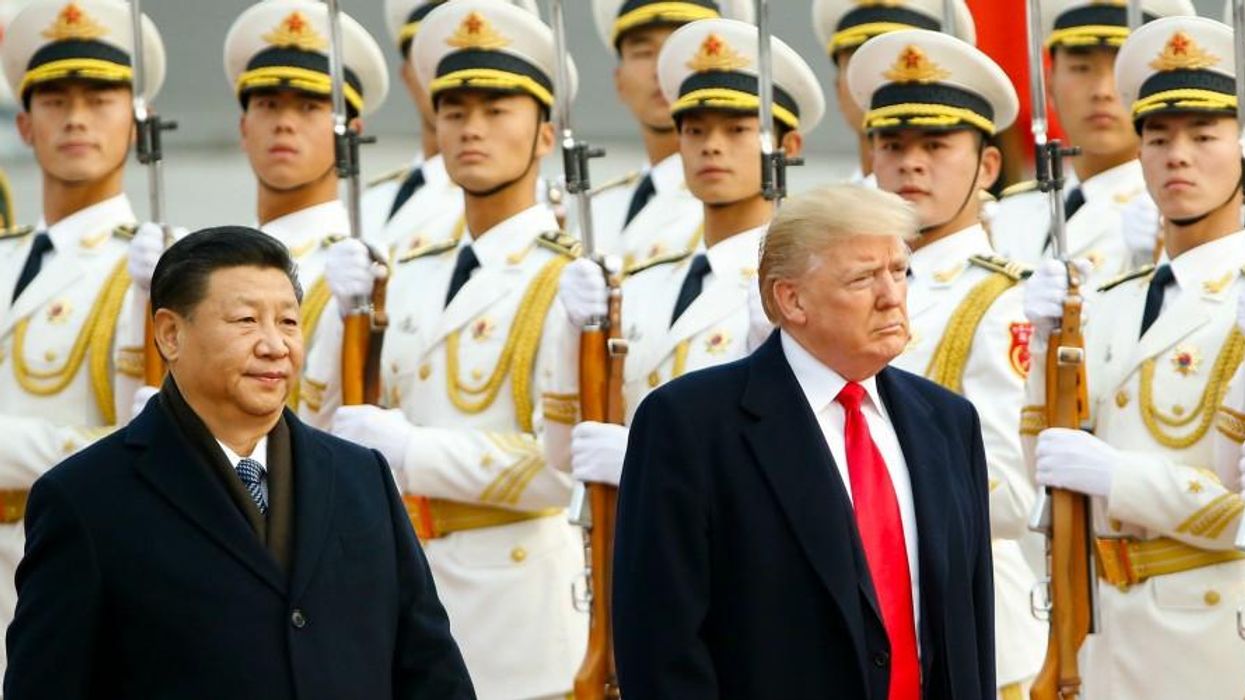
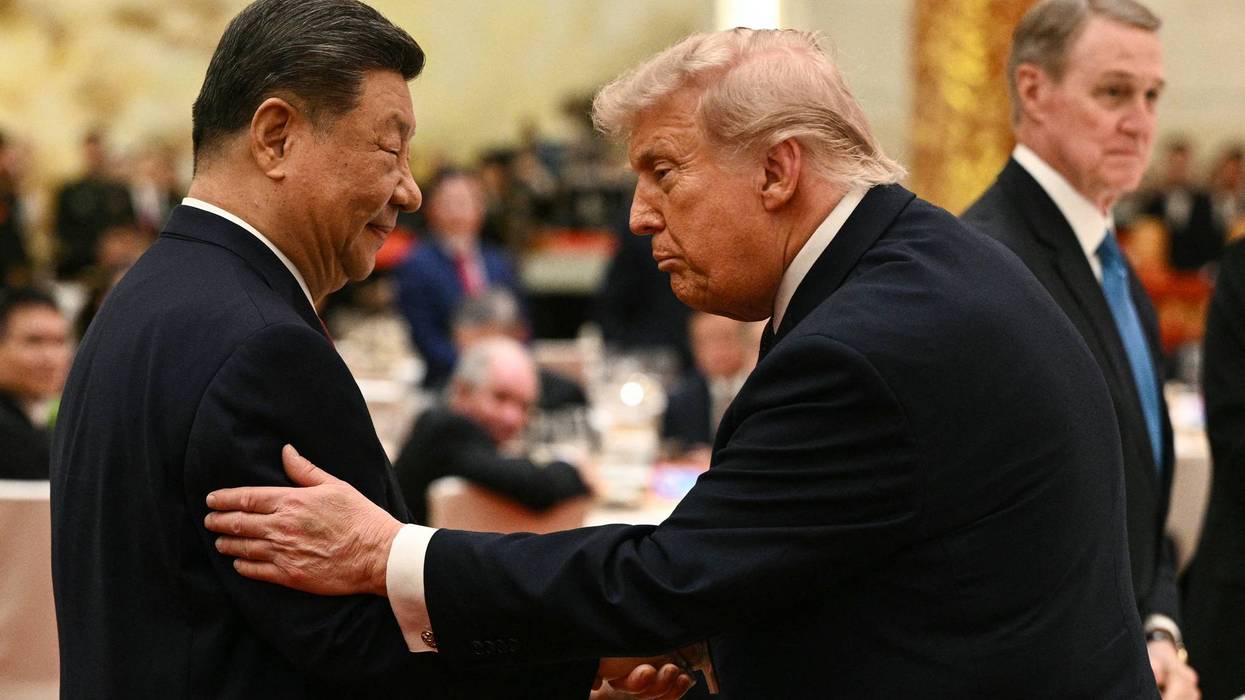
“Americans are increasingly supportive of US-China cooperation, while tensions with China do not serve American interests,” said dozens of anti-war groups as President Trump met with Chinese President Xi.
As US President Donald Trump meets with Chinese President Xi Jinping, a coalition of anti-war groups is calling on Congress to pressure the administration to "prioritize peace, cooperation, and stability" at a time when the US-China relationship is increasingly hostile.
“Americans are increasingly supportive of US-China cooperation, while tensions with China do not serve American interests,” argued the coalition, which includes Just Foreign Policy, Win Without War, the Friends Committee on National Legislation, Our Revolution, and dozens of other groups in a letter sent to members of Congress on Thursday.
They cited recent surveys showing that negative perceptions of China are consistently falling among Americans, including a Pew Research poll from January, which showed that just 28% of Americans viewed China as an "enemy" compared with 42% who saw it that way in 2024.
“At a time when so many domestic needs are going unmet, a confrontational posture toward China is costing untold billions of dollars in military build-up, trade and energy disruption, and securitization of technology—money that could and should be spent on the things Americans need at home," the coalition continued.
Trump's first visit to China in nearly a decade comes amid a global energy crisis caused by his war in Iran, a conflict where China has expressed a desire to act as a mediator.
While the coalition denounced Trump's war as "an unauthorized war of choice" that has led the world to a "deeply dangerous and uncertain place," it also said it presented an opportunity for the US and China to engage in diplomacy in hopes of putting the relationship "on a more stable footing."
Xi said that Taiwan remains the "most important issue in China-US relations” as the talks kicked off, warning that if mishandled, it could create a "very dangerous situation."
Secretary of State Marco Rubio said after a meeting on Thursday that the decadesold "One China Policy," which takes no explicit view on Taiwan's sovereignty, hasn't changed. Though he warned that it would be “a terrible mistake” for China to attempt to seize the island by force.
Friction between the US and China has only been heightened after Trump announced the sale of more than $11 billion worth of weapons to Taiwan in December, the largest ever arms sale to the island. At the time, China said the sale "gravely violates" the One China Policy.
The anti-war coalition warned that "current military and political trends in the United States, China, and Taiwan are moving us closer to a serious crisis or conflict over the island" and called on the US to "revitalize its One China Policy and press Beijing to reaffirm its focus on peaceful unification, with no timeline."
“Diplomacy with Beijing, rather than military posturing or arms racing across the Taiwan Strait,” they said, “is the only realistic path forward, especially since the American public has little interest in participating in a military conflict against China in defense of Taiwan.”
According to a survey by the Institute for Global Affairs in November, just 35% of Americans said they'd support the US sending troops to defend Taiwan if it were to be attacked by China. In a January poll commissioned by The New Republic, just 10% of Democratic voters said they wanted their party to support sending troops, and 30% wanted it to support sending weapons.
But Democratic leadership has pressured Trump to take the opposite approach and ramp up hostility toward Beijing in advance of this week's talks.
On Wednesday, Rep. Gregory Meeks (D-NY), the ranking member of the House Foreign Affairs Committee, was joined by Reps. Ro Khanna (D-Calif.), Jim Himes (D-Ct.), and Rep. Adam Smith (D-Wash.) to send a letter urging Trump to approve a delayed $14 billion arms sale to Taiwan ahead of his visit.
The Democrats on the House Foreign Affairs Committee joined in support for the sale, saying that "Trump must reaffirm in his meeting with Xi that the US will continue to uphold our longstanding One-China policy while standing firmly with Taiwan’s democracy and security. And he must make that clear by notifying Congress of the $14 billion arms sales to Taiwan. Anything else would undermine American credibility."
Just Foreign Policy (JFP) countered that the request to send more weapons just before talks were set to begin was "deeply unserious" and an "absurdly ill-timed move that would sabotage diplomacy—or worse."
Jake Werner, the director of the East Asia program at the Quincy Institute for Responsible Statecraft—another signatory to the anti-war letter—warned that while Democrats should confront Trump on the issue of China, they shouldn't goad him into an even more hawkish approach.
“If you want to attack Trump, that's great, but you should attack Trump on the basis of prudent, conflict-avoiding principles,” Werner said. “They should be criticizing him not for engaging in diplomacy, but for engaging in the wrong kind of diplomacy.”
In their letter to Congress, these and the other anti-war groups pushed for a similar diplomatic approach to other sources of tension with China, arguing that the US should take no position on the sovereignty of disputed territory in the South China Sea.
They also encouraged members of Congress to avoid creating "incentives" for other nations to adopt more confrontational stances toward China.
They singled out a first-ever test launch of an American Tomahawk missile in the Philippines last week, which had the capability to reach the Chinese mainland. Chinese military observers described it as the “worst provocation” in years by the US and suggested that Beijing should ramp up its air-defense and stealth-strike drone capabilities in response, according to the South China Morning Post.
The anti-war coalition said they "urge Congress to press the administration to avoid further escalatory signals and to instead pursue diplomacy to restore and expand non-proliferation agreements that can prevent a wasteful and dangerous arms race."
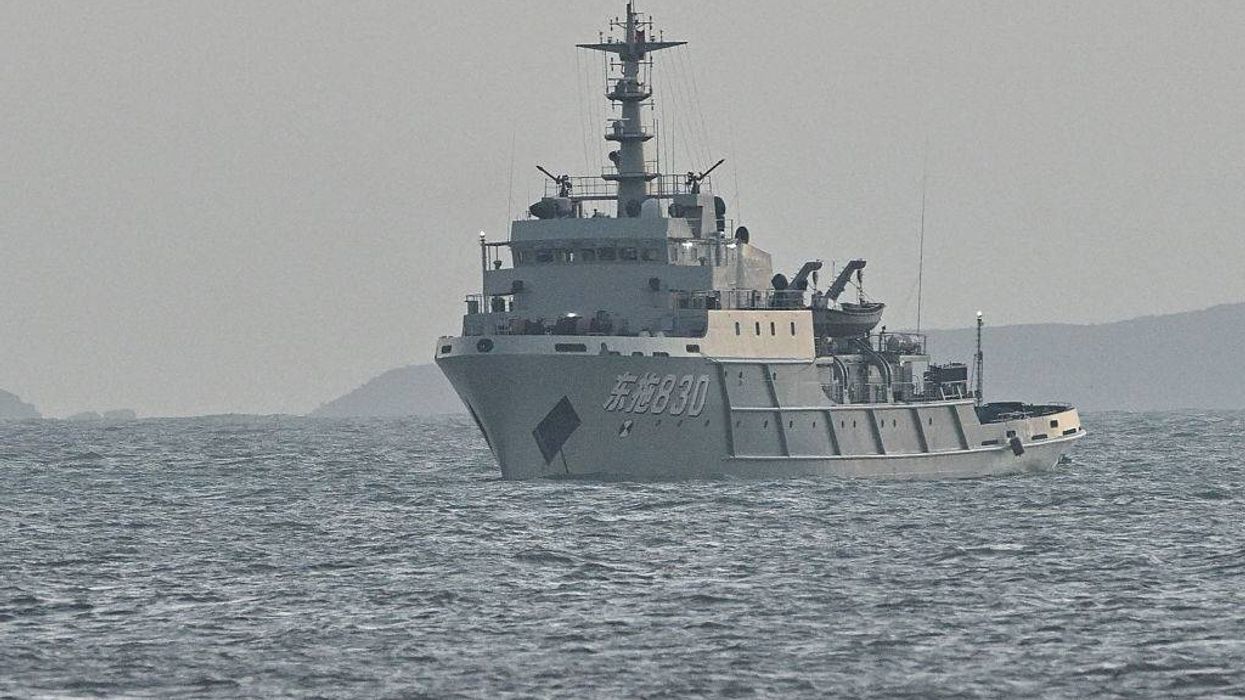
The Chinese military drills appear to be "an effort to gain air and maritime superiority and cut off external military support" for Taiwan, said one expert.
The Chinese military on Monday announced it was conducting "major military drills" around Taiwan weeks after the US announced an $11 billion arms deal with the island nation.
As reported by CNN, China is mobilizing its army, navy, and air force units around Taiwan in a move that it says should serve as a "serious warning" to any "external" forces interfering with the island, which China has long claimed as its territory.
Taiwan's government, meanwhile, responded by accusing China of conducting a campaign of "military intimidation," while vowing to "take concrete action to defend the values of democracy and freedom."
Su Tzu-yun, a research fellow at the Institute for National Defense and Security Research in Taipei, told German broadcaster Deutsche Welle that China's military drills appear to be "an effort to gain air and maritime superiority and cut off external military support."
William Yang, a senior Northeast Asia analyst at the International Crisis Group think tank, told DW that while Chinese military exercises around Taiwan are now regular occurrences, the speed with which China ramped up its latest exercises "shows that the Chinese People's Liberation Army is becoming increasingly capable of rapidly deploying forces to combat-ready positions."
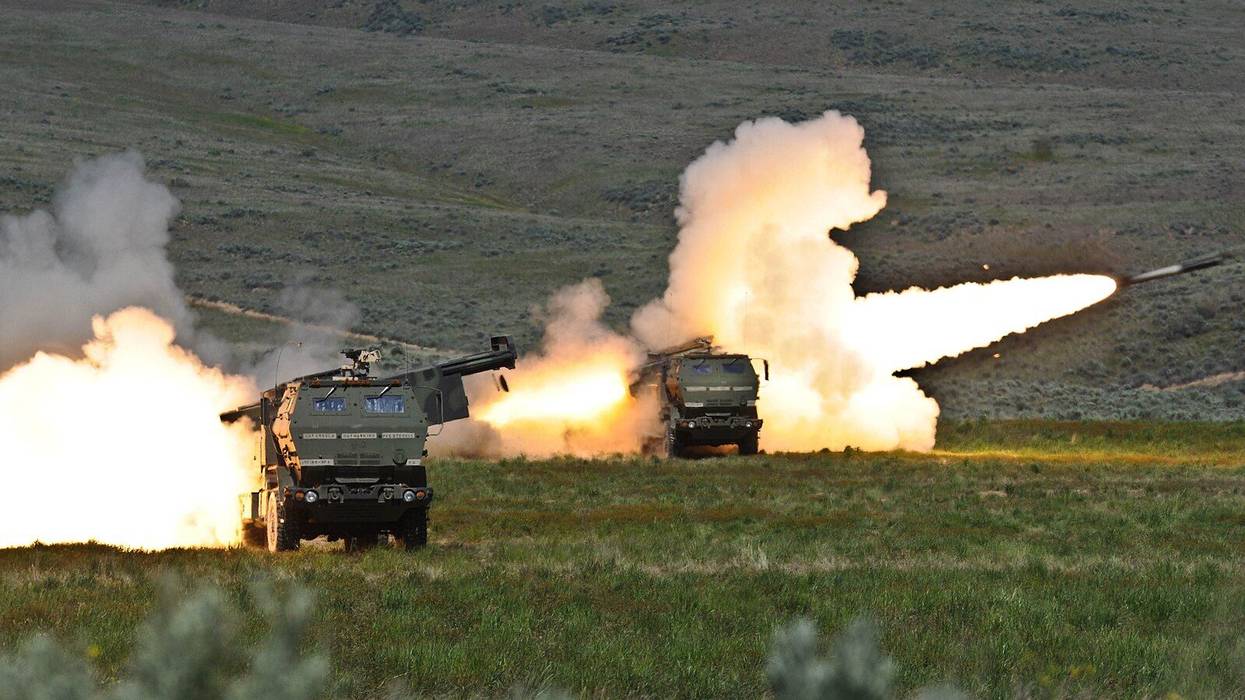
Although China did not mention the US directly when denouncing "external" powers, CNN noted that the decision to launch military drills came weeks after the US reached an $11 billion arms deal with Taiwan that included HIMARS rocket systems, anti-tank and anti-armor missiles, drones, howitzers, and military software.
China responded to this arms sale directly last week by announcing sanctions against US defense firms including Boeing, Northrop Grumman Systems Corporation, and L3Harris Maritime Services, according to the Guardian.
In announcing the sanctions against US firms, a Chinese foreign ministry spokesperson emphasized that "the Taiwan issue is the core of China's core interests and the first red line that cannot be crossed in China-US relations," while warning that "any provocative actions that cross the line on the Taiwan issue will be met with a strong response from China."
China's foreign minister warned that US weapons sales to Taipei "will only accelerate the push towards a perilous state of military confrontation across the Taiwan Strait."
The Chinese government on Thursday condemned the Trump administration's announcement of a proposed $11 billion weapons package for Taiwan, a move that Beijing said violates both the "One China" principle and an agreement in which the US pledged to reduce arms sales to Taipei.
The US State Department said the record $11.154 billion package contains a broad range of weaponry and other military equipment, including Lockheed Martin High Mobility Artillery Rocket Systems (HIMARS), Lockheed Martin Army Tactical Missile System (ATACMS) long-range missiles, BAE Systems M109A7 self-propelled howitzers, drones and tactical software, Javelin and TOW missiles, and M2A1 machine guns and other armaments.
"This proposed sale serves US national, economic, and security interests by supporting the recipient’s continuing efforts to modernize its armed forces and to maintain a credible defensive capability," the State Department said in a statement. "The proposed sale will help improve the security of the recipient and assist in maintaining political stability, military balance, and economic progress in the region."
Taiwanese leaders thanked the US for its continued efforts to help the island defend itself.
However, Chen Binhua, spokesperson for China's Taiwan Affairs Office, blasted the proposed sale as “flagrant interference in China’s internal affairs" that "severely undermines China’s sovereignty and security interests and sends erroneous signals to separatist forces."
Chen said that the arms package "gravely violates" the "One China" principle, which, to the US means that the People's Republic of China (PRC) is “the sole legal government of China," but to Beijing means that Taiwan—which it views as a breakaway province—is an inseparable part of the Chinese nation.
While the US acknowledges the PRC's position that there is but one China, Washington does not recognize or accept Beijing's stance. Although it has no formal diplomatic relations with Taipei, the US is obliged under the 1979 Taiwan Relations Act to "provide Taiwan with arms of a defensive character."
China says this directly contradicts US obligations under the so-called "Three Communiques" with Beijing—especially an August 17, 1982 agreement under which Washington pledged that it would respect PRC sovereignty and that it "intends gradually to reduce its sale of arms to Taiwan."
China has accused the US of violating the August 17 communique with each of its many arms sales to Taiwan.
"We urge the United States to immediately cease its policy of arming Taiwan and to stop condoning and supporting separatist forces advocating Taiwan independence," Chen said Thursday. "We urge the United States to exercise the utmost caution in handling the Taiwan issue.”
Chen added that US "warmongers" and Taiwan's ruling Democratic Progressive Party—which he accused of “stubbornly pursuing independence”—risk turning the island into a "powder keg" and the Taiwanese people into "cannon fodder."
Under pressure from the Trump administration to buy more US arms, Taiwanese President Lai Ching-te last month announced a special $40 billion budget for the purchase of weapons between 2026 and 2033.
The latest proposed US arms sale follows Congress' passage of the 2026 National Defense Authorization Act (NDAA), which authorizes up to $1 billion in funding for Taiwan's defense. US President Donald Trump is expected to imminently sign the record $900.6 billion bill into law.
Chinese Foreign Ministry spokesperson Guo Jiakun said Thursday that the US effort to contain China by arming Taiwan is "doomed to fail."
"It will only accelerate the push towards a perilous state of military confrontation across the Taiwan Strait,” he added.
Trump threatens other nations with tariffs, and offers to make them go away if they buy some fracked gas. It’s akin to a protection racket. Pay up, or your windows get broken.
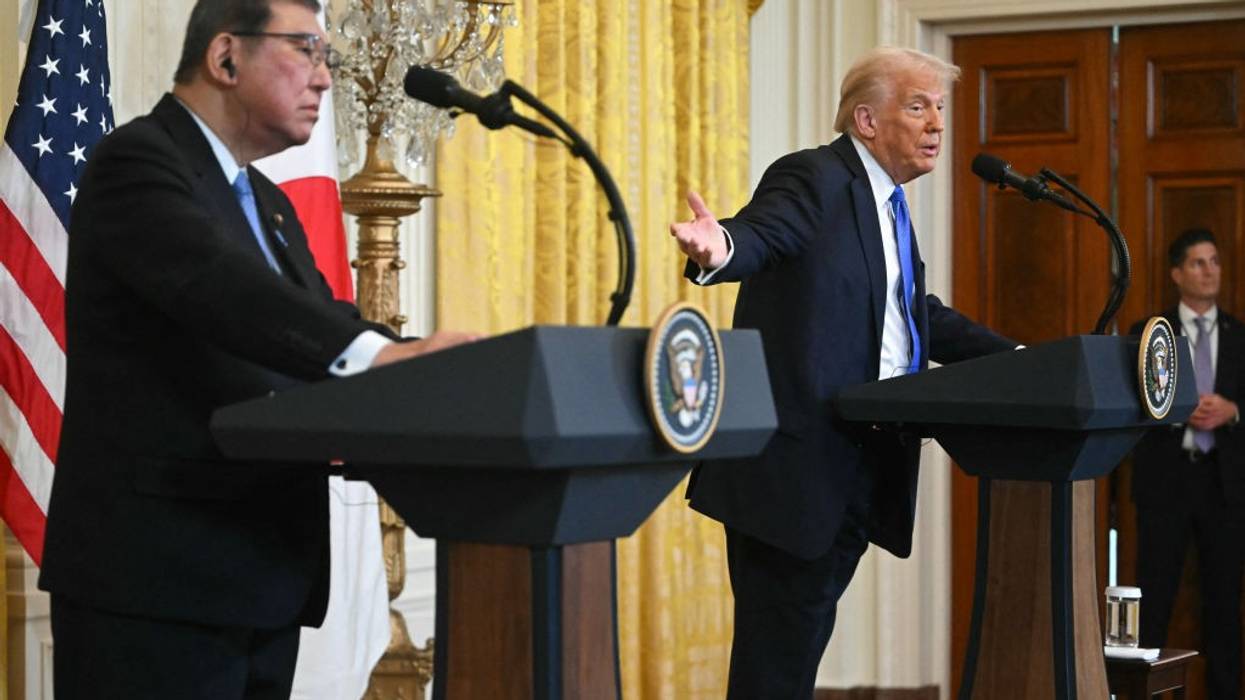
In the last few days, Taiwan, India and Japan made clear they will be buying exported American LNG in the months and years ahead. Why? Entirely in an effort to hold off tariffs from the Trump administration. As the Japanese prime minister put it,
“We will cooperate to strengthen energy security between the two countries including increasing exports of United States liquefied natural gas to Japan in a mutually beneficial manner.”
Here’s how Bloomberg described the Indian decision-making:
Indian importers are under pressure from the government to reach deals that could smooth relations with Trump, the people said, but they will be looking for the best possible terms before signing any agreements.
Meanwhile, as Sing Yee Ong reports from Taipei
Taiwan is preparing to buy more liquefied natural gas from the US to reduce its trade surplus and potentially avoid higher tariffs.
Oh, and more to come
South Korea, Vietnam and the European Union are among energy buyers trying to appease President Donald Trump — and reduce the threat of tariffs — by looking to increase purchases from the biggest exporter of the super-chilled fuel and largest producer of crude.
I want to highlight these shakedowns, which have mostly been lost amidst the thousand other terrible things the Trump administration has loosed upon the world, because I know that before long Big Oil will be holding them up as evidence that the world needs and wants more fossil fuel. In fact, the world wants to move in entirely the opposite direction: 85% of new electric generation in 2023 came from renewables, and the numbers for 2024 will almost certainly be higher. That, of course, terrifies the fossil fuel industry—which is why they spent record amounts on November’s election. As fracking baron Harold Hamm explained, “We’ve got to do this because it’s the most important election in our lifetime.”
And now they’re getting the payoff: Trump threatens tariffs, and offers to make them go away if they buy some LNG. It’s akin to a protection racket. Pay up, or your windows get broken. It’s not criminal—it’s all entirely legal. It’s just wrong.
This particular protection racket makes no sense for America at large. Forget, for a moment, that LNG is a huge driver of the climate change driving fire and flood (by the time you’ve shipped it overseas it’s far worse even than coal); exporting it in huge quantities also obviously drives up the price for Americans still reliant on fracked gas for heating and cooking. The Energy Information Administration just predicted that natural gas prices will rise 21 percent in the year ahead. Politico did the math
Paul Cicio, president of the Industrial Energy Consumers of America trade association, said U.S. LNG exports are pushing natural gas and electricity prices higher.
Every “dollar increase in natural gas costs consumers $34 billion plus about $20 billion in higher electricity cost,” Cicio said in a statement Tuesday. It's “only going to get worse from here as LNG exports increase.”t of the Industrial Energy Consumers of America trade association, said U.S. LNG exports are pushing natural gas and electricity prices higher.
As the Sierra Club points out, Trump’s strategy “makes no sense.” And they’re right—as long as we’re talking about the future of the planet or the cost to American consumers. But that’s not who Trump is thinking about. He’s got one constituency and one only: the Big Oil execs who bankrolled his campaign. For them, this is sweet payback, a 100-1 return on their investment.
And it’s a stark reminder that we have to fight back on the only turf we have: the fact that the sun and wind can deliver the same product as LNG, only more cheaply and much more cleanly. We can’t threaten tariffs to get our way; we can only make the case in such persuasive terms that we start to change the zeitgeist. That’s the point of SunDay project I described last week and that you are going to hear a lot more about. Many thanks to those who went to sunday.earth to help us draw some suns as we prepare for the official launch of this big effort. So many of you took part already. Here’s a beautiful example from the effervescent Ayana Johnson (whose book What If We Get It Right is a document for this tough moment):
And here’s one from Billy Parish, whose Solar Mosaic has financed something like ten percent of the rooftop solar in America
It may seem like a mug’s game to take on Trump’s thuggish power with economics, physics, music, art, and justice. But perhaps they still hold some force in this world—we shall see.
In all aspects of the U.S.-China rivalry, Trump will be pulled toward both increased militancy and combativeness and a more pragmatic, transactional approach.
Gaza, Haiti, Iran, Israel, Lebanon, Russia, Syria, Ukraine, and Venezuela: President-elect Donald Trump will face no shortage of foreign-policy challenges when he assumes office in January. None, however, comes close to China in scope, scale, or complexity. No other country has the capacity to resist his predictable antagonism with the same degree of strength and tenacity, and none arouses more hostility and outrage among MAGA Republicans.
In short, China is guaranteed to put President Trump in a difficult bind the second time around: He can either choose to cut deals with Beijing and risk being branded an appeaser by the China hawks in his party, or he can punish and further encircle Beijing, risking a potentially violent clash and possibly even nuclear escalation. How he chooses to resolve this quandary will surely prove the most important foreign test of his second term in office.
Make no mistake: China truly is considered The Big One by those in Trump’s entourage responsible for devising foreign policy. While they imagine many international challenges to their “America First” strategy, only China, they believe, poses a true threat to the continued global dominance of this country.
Trump will enter office in January with a toolkit of punitive measures for fighting China ready to roll along with strong support among his appointees for making them the law of the land.
“I feel strongly that the Chinese Communist Party has entered into a Cold War with the United States and is explicit in its aim to replace the liberal, Western-led world order that has been in place since World War II,” Rep. Michael Waltz (R-Fla.), Trump’s choice as national security adviser, declared at a 2023 event hosted by the Atlantic Council. “We’re in a global arms race with an adversary that, unlike any in American history, has the economic and the military capability to truly supplant and replace us.”
As Waltz and others around Trump see it, China poses a multi-dimensional threat to this country’s global supremacy. In the military domain, by building up its air force and navy, installing military bases on reclaimed islands in the South China Sea, and challenging Taiwan through increasingly aggressive air and naval maneuvers, it is challenging continued American dominance of the Western Pacific. Diplomatically, it’s now bolstering or repairing ties with key U.S. allies, including India, Indonesia, Japan, and the members of NATO. Meanwhile, it’s already close to replicating this country’s most advanced technologies, especially its ability to produce advanced microchips. And despite Washington’s efforts to diminish a U.S. reliance on vital Chinese goods, including critical minerals and pharmaceuticals, it remains a primary supplier of just such products to this country.
For many in the Trumpian inner circle, the only correct, patriotic response to the China challenge is to fight back hard. Both Rep. Waltz, Trump’s pick as national security adviser, and Sen. Marco Rubio (R-Fla.), his choice as secretary of state, have sponsored or supported legislation to curb what they view as “malign” Chinese endeavors in the United States and abroad.
Waltz, for example, introduced the American Critical Mineral Exploration and Innovation Act of 2020, which was intended, as he explained, “to reduce America’s dependence on foreign sources of critical minerals and bring the U.S. supply chain from China back to America.” Sen. Rubio has been equally combative in the legislative arena. In 2021, he authored the Uyghur Forced Labor Prevention Act, which banned goods produced in forced labor encampments in Xinjiang Province from entering the United States. He also sponsored several pieces of legislation aimed at curbing Chinese access to U.S. technology. Although these, as well as similar measures introduced by Waltz, haven’t always obtained the necessary congressional approval, they have sometimes been successfully bundled into other legislation.
In short, Trump will enter office in January with a toolkit of punitive measures for fighting China ready to roll along with strong support among his appointees for making them the law of the land. But of course, we’re talking about Donald Trump, so nothing is a given. Some analysts believe that his penchant for dealmaking and his professed admiration for Chinese strongman President Xi Jinping may lead him to pursue a far more transactional approach, increasing economic and military pressure on Beijing to produce concessions on, for example, curbing the export of fentanyl precursors to Mexico, but when he gets what he wants letting them lapse. Howard Lutnick, the billionaire investor from Cantor Fitzgerald whom he chose as Commerce secretary, claims that Trump actually “wants to make a deal with China,” and will use the imposition of tariffs selectively as a bargaining tool to do so.
What such a deal might look like is anyone’s guess, but it’s hard to see how Trump could win significant concessions from Beijing without abandoning some of the punitive measures advocated by the China hawks in his entourage. Count on one thing: This complicated and confusing dynamic will play out in each of the major problem areas in U.S.-China relations, forcing Trump to make critical choices between his transactional instincts and the harsh ideological bent of his advisers.
Of all the China-related issues in his second term in office, none is likely to prove more challenging or consequential than the future status of the island of Taiwan. At issue are Taiwan’s gradual moves toward full independence and the risk that China will invade the island to prevent such an outcome, possibly triggering U.S. military intervention as well. Of all the potential crises facing Trump, this is the one that could most easily lead to a great-power conflict with nuclear undertones.
When Washington granted diplomatic recognition to China in 1979, it “acknowledged” that Taiwan and the mainland were both part of “one China” and that the two parts could eventually choose to reunite. The U.S. also agreed to cease diplomatic relations with Taiwan and terminate its military presence there. However, under the Taiwan Relations Act of 1979, Washington was also empowered to cooperate with a quasi-governmental Taiwanese diplomatic agency, the Taipei Economic and Cultural Representative Office in the United States, and provide Taiwan with the weapons needed for its defense. Moreover, in what came to be known as “strategic ambiguity,” U.S. officials insisted that any effort by China to alter Taiwan’s status by force would constitute “a threat to the peace and security of the Western Pacific area” and would be viewed as a matter “of grave concern to the United States,” although not necessarily one requiring a military response.
If, however, he chooses to act “crazy” by embracing “strategic clarity” and stepping up military pressure on China, he would likely receive accolades from many of his supporters, while provoking a (potentially nuclear) war with China.
For decades, one president after another reaffirmed the “one China” policy while also providing Taiwan with increasingly powerful weaponry. For their part, Chinese officials repeatedly declared that Taiwan was a renegade province that should be reunited with the mainland, preferably by peaceful means. The Taiwanese, however, have never expressed a desire for reunification and instead have moved steadily toward a declaration of independence, which Beijing has insisted would justify armed intervention.
As such threats became more frequent and menacing, leaders in Washington continued to debate the validity of “strategic ambiguity,” with some insisting it should be replaced by a policy of “strategic clarity” involving an ironclad commitment to assist Taiwan should it be invaded by China. President Joe Biden seemed to embrace this view, repeatedly affirming that the U.S. was obligated to defend Taiwan under such circumstances. However, each time he said so, his aides walked back his words, insisting the U.S. was under no legal obligation to do so.
The Biden administration also boosted its military support for the island while increasing American air and naval patrols in the area, which only heightened the possibility of a future U.S. intervention should China invade. Some of these moves, including expedited arms transfers to Taiwan, were adopted in response to prodding from China hawks in Congress. All, however, fit with an overarching administration strategy of encircling China with a constellation of American military installations and U.S.-armed allies and partners.
From Beijing’s perspective, then, Washington is already putting extreme military and geopolitical pressure on China. The question is: Will the Trump administration increase or decrease those pressures, especially when it comes to Taiwan?
That Trump will approve increased arms sales to and military cooperation with Taiwan essentially goes without saying (as much, at least, as anything involving him does). The Chinese have experienced upticks in U.S. aid to Taiwan before and can probably live through another round of the same. But that leaves far more volatile issues up for grabs: Will he embrace “strategic clarity,” guaranteeing Washington’s automatic intervention should China invade Taiwan, and will he approve a substantial expansion of the American military presence in the region? Both moves have been advocated by some of the China hawks in Trump’s entourage, and both are certain to provoke fierce, hard-to-predict responses from Beijing.
Many of Trump’s closest advisers have, in fact, insisted on “strategic clarity” and increased military cooperation with Taiwan. Michael Waltz, for example, has asserted that the U.S. must “be clear we’ll defend Taiwan as a deterrent measure.” He has also called for an increased military presence in the Western Pacific. Similarly, last June, Robert C. O’Brien, Trump’s national security adviser from 2019 to 2021, wrote that the U.S. “should make clear” its “commitment” to “help defend” Taiwan, while expanding military cooperation with the island.
Trump himself has made no such commitments, suggesting instead a more ambivalent stance. In his typical fashion, in fact, he’s called on Taiwan to spend more on its own defense and expressed anger at the concentration of advanced chip-making on the island, claiming that the Taiwanese “did take about 100% of our chip business.” But he’s also warned of harsh economic measures were China to impose a blockade of the island, telling the editorial board of The Wall Street Journal, “I would say [to President Xi]: if you go into Taiwan, I’m sorry to do this, I’m going to tax you at 150% to 200%.” He wouldn’t need to threaten the use of force to prevent a blockade, he added, because President Xi “respects me and he knows I’m [expletive] crazy.”
Such comments reveal the bind Trump will inevitably find himself in when it comes to Taiwan this time around. He could, of course, try to persuade Beijing to throttle back its military pressure on the island in return for a reduction in U.S. tariffs—a move that would reduce the risk of war in the Pacific but leave China in a stronger economic position and disappoint many of his top advisers. If, however, he chooses to act “crazy” by embracing “strategic clarity” and stepping up military pressure on China, he would likely receive accolades from many of his supporters, while provoking a (potentially nuclear) war with China.
The question of tariffs represents another way in which Trump will face a crucial choice between punitive action and transactional options in his second term—or, to be more precise, in deciding how severe to make those tariffs and other economic hardships he will try to impose on China.
In January 2018, the first Trump administration imposed tariffs of 30% on imported solar panels and 20%-50% on imported washing machines, many sourced from China. Two months later, the administration added tariffs on imported steel (25%) and aluminum (10%), again aimed above all at China. And despite his many criticisms of Trump’s foreign and economic policies, President Biden chose to retain those tariffs, even adding new ones, notably on electric cars and other high-tech products. The Biden administration has also banned the export of advanced computer chips and chip-making technology to China in a bid to slow that country’s technological progress.
Accordingly, when Trump reassumes office on January 20, China will already be under stringent economic pressures from Washington. But he and his associates insist that those won’t be faintly enough to constrain China’s rise. The president-elect has said that, on day one of his new term, he will impose a 10% tariff on all Chinese imports and follow that with other harsh measures. Among such moves, the Trump team has announced plans to raise tariffs on Chinese imports to 60%, revoke China’s Permanent Normal Trade Relations (also known as “most favored nation”) status, and ban the transshipment of Chinese imports through third countries.
Most of Trump’s advisers have espoused such measures strongly. “Trump Is Right: We Should Raise Tariffs on China,” Marco Rubio wrote last May. “China’s anticompetitive tactics,” he argued, “give Chinese companies an unfair cost advantage over American companies… Tariffs that respond to these tactics prevent or reverse offshoring, preserving America’s economic might and promoting domestic investment.”
But Trump will also face possible pushback from other advisers who are warning of severe economic perturbations if such measures were to be enacted. China, they suggest, has tools of its own to use in any trade war with the U.S., including tariffs on American imports and restrictions on American firms doing business in China, including Elon Musk’s Tesla, which produces half of its cars there. For these and other reasons, the U.S.-China Business Council has warned that additional tariffs and other trade restrictions could prove disastrous, inviting “retaliatory measures from China, causing additional U.S. jobs and output losses.”
As in the case of Taiwan, Trump will face some genuinely daunting decisions when it comes to economic relations with China. If, in fact, he follows the advice of the ideologues in his circle and pursues a strategy of maximum pressure on Beijing, specifically designed to hobble China’s growth and curb its geopolitical ambitions, he could precipitate nothing short of a global economic meltdown that would negatively affect the lives of so many of his supporters, while significantly diminishing America’s own geopolitical clout. He might therefore follow the inclinations of certain of his key economic advisers like transition leader Howard Lutnick, who favor a more pragmatic, businesslike relationship with China. How Trump chooses to address this issue will likely determine whether the future involves increasing economic tumult and uncertainty or relative stability. And it’s always important to remember that a decision to play hardball with China on the economic front could also increase the risk of a military confrontation leading to full-scale war, even to World War III.
And while Taiwan and trade are undoubtedly the most obvious and challenging issues Trump will face in managing (mismanaging?) U.S.-China relations in the years ahead, they are by no means the only ones. He will also have to decide how to deal with increasing Chinese assertiveness in the South China Sea; continued Chinese economic and military-technological support for Russia in its war against Ukraine; and growing Chinese investments in Africa, Latin America, and elsewhere.
In these, and other aspects of the U.S.-China rivalry, Trump will be pulled toward both increased militancy and combativeness and a more pragmatic, transactional approach. During the campaign, he backed each approach, sometimes in the very same verbal outburst. Once in power, however, he will have to choose between them—and his decisions will have a profound impact on this country, China, and everyone living on this planet.
None of these appointments bode well for advocates of U.S. foreign policy restraint, let alone for those who voted for Trump hoping he would prioritize domestic problems over endless foreign wars.
On the campaign trail, President-elect Donald Trump promised a very different foreign policy from business as usual in Washington.
He said he would prioritize peace over “victory” in the escalating war in Ukraine, pull the United States back from foreign entanglements to focus on domestic problems, and generally oversee a period of prolonged peace, instead of the cycle of endless Great Power conflict we seem trapped in.
Yet if personnel is policy, as the saying goes, then Trump’s presidency will be far more in line with his Democratic predecessor’s foreign policy than with the vision he laid out over the past year. So far, his National Security Council picks have been a series of hawks with a history of opposing diplomacy and the end of U.S. wars, as well as favoring a more aggressive posture toward China, including intervening in a possible war over Taiwan.
At best, Trump’s picks will seek to simply replace one dangerous, nuclear-tinged Great Power conflict with another.
Take Trump’s pick for national security adviser, Rep. Michael Waltz (R-Fla.). Since his selection, Waltz certainly talks in line with the more restraint-oriented vision Trump campaigned on, fretting about the Biden administration’s recent escalation in Ukraine and calling for a “responsible end” to the war there.
But until relatively recently, the Florida congressman viewed the war in very similar terms to those of his hawkish colleagues on the other side of the aisle, reacting to the Russian invasion by warning it “violates the very fabric of international norms” and threatens “our Western values,” lamenting that President Joe Biden had not been more confrontational with Russia beforehand, and calling for the United States to “support Ukrainian resistance efforts” and turn the country “into a bloody quagmire” for Russia.
Over the months that followed, Waltz backed escalating the war (“Send the damn MiGs,” he tweeted in March 2022), complained that U.S. policy on the war was a “fiddle fart” that provided just enough arms “instead of going for the kill, instead of going for the win right now,” and charged that Biden was “letting fear of escalation be the primary driver of our policy in Ukraine.”
Waltz has shifted since, but largely because he sees a U.S.-China confrontation as a bigger priority. Waltz views China as “the most threatening adversary America has ever faced,” believes that Washington is already locked in a “Cold War” with Beijing and must “curb” its power, step up military aid to Taiwan, and end the policy of “strategic ambiguity” over the island nation, which has been at the core of decades of successful U.S. policy balancing deterrence without tipping into disastrous war.
He has also disparaged diplomacy with the Chinese government, and thinks U.S. forces should have stayed in Afghanistan to hang on to Bagram Airfield for possible use as a “second front” in a future U.S.-China war.
The rest of Trump’s national security team holds similar views. Sebastian Gorka, nominated for deputy assistant to the president, sees the Ukraine war in literally indistinguishable terms from hawks in the outgoing Biden administration: It is “unprovoked Russian aggression” that is not about NATO expansion but rather enlarging Russian territory; negotiations, peace, or an off-ramp are as futile as Neville Chamberlain’s deal with Hitler was; and the United States must continue military aid “to make the Russians bleed,” or Russian President Vladimir Putin will “take Poland and the Baltic states.”
Gorka is also a hawk on China, which he calls “the greatest threat to America.”
“We know the regime there wishes to have every nation in the world a defeated, vanquished nation, or a satrapy, a tributary nation,” Gorka said this past October, while giving a fawning interview to Gordon Chang, a discredited “China expert” who has repeatedly predicted the imminent collapse of the Chinese state.
In his 2018 book, Gorka called China’s undoubted goal of becoming a world power, and partly doing so through economic investment in the Global South, a form of “irregular warfare” (even as he admits it is little different from the actions “of the West a couple of centuries ago”). He has repeatedly suggested that China was about to invade Taiwan, including after its wayward spy balloon; gave former House Speaker Kevin McCarthy “kudos” for taking the inflammatory step of traveling to the island; and implied that U.S. lives should be expended to defend it.
Alex Wong, Trump’s pick for deputy national security adviser, agrees. Wong believes that Americans “have to be prepared for a level of tension, regional destabilization, and—yes—possible conflict [with China] that we have not seen since the end of World War II.” Wong noted he deliberately used that destructive, hot conflict as a reference point and not the Cold War.
A former foreign policy adviser for the super-hawkish Sen. Tom Cotton (R-Ark.) and the merely hawkish 2012 Mitt Romney presidential campaign, Wong served most recently as vice chair of a congressional commission that recommended training Taiwanese troops on U.S. soil—a highly provocative move to China’s leadership.
Because China is, unlike the former Soviet Union, highly integrated into the “system of the free world,” Wong has said, the U.S.-China conflict requires not just “out-competing them but extruding”—meaning, pushing out—“China from certain systems, whether economically, technologically, politically.” What that means for Wong is not just continuing the Biden administration’s economic warfare with the country, but also “an increased U.S. military presence” in the Indo-Pacific and to “seriously look at new investments in strategic nuclear forces, intermediate-range missiles, our naval fleet, and certain capabilities tuned to turning back an invasion of Taiwan,” as well as “expand[ing] the aperture of our military alliances” in the region, specifically with Japan and under AUKUS.
Wong does seem to favor extricating the United States from Ukraine, but, like Waltz, it’s because he views “Ukraine as an unfortunate diversion of U.S. attention from the Indo-Pacific” and wants to “responsibly shift U.S. military resources eastward”—in a way that, to take his words literally, will ramp up conflict with China and see the U.S. go directly to war in the case of a Chinese invasion of Taiwan.
None of these appointments bode well for advocates of U.S. foreign policy restraint, let alone for those who voted for Trump hoping he would prioritize domestic problems over endless foreign wars. At best, Trump’s picks will seek to simply replace one dangerous, nuclear-tinged Great Power conflict with another. At worst, they will not do the former, and embroil the United States into two of the latter.
The political will must be found to extinguish the violent conflicts that put us ever closer to nuclear annihilation.
This is a most unusual election season. While the media focuses on Georgia and Nevada polling, the world is aflame. Those who have the greatest power to stop the killing are either missing in action or profoundly complicit as they refuse to exercise their diplomatic leverage.
President Biden refuses to join rising European voices urging a ceasefire and negotiations for the Ukraine War and continues to deliver weapons to Israel that make the ongoing genocide in Gaza and murderous devastation of southern Lebanon possible. Donald Trump has welcomed Russia to invade NATO nations that don’t spend at least 2% of their GDP on their militaries, while he urges Netanyahu to “finish the job” in Gaza. Meanwhile Kamala Harris poses as a military hawk, promising the world’s “most lethal military” while talking her way pas serious questions.
U.N. General Secretary Guterres warns that “The world is becoming unhinged as geopolitical tensions rise and it seems incapable of coming together to respond to mounting challenges.” There are disturbing parallels to the forces that triggered the First World War. As in 1914, there are tensions between rising and declining powers, arms races with new technologies, complex alliance structures, intensifying nationalism, territorial competition, economic integration and intense competition, and wild card actors. Yet—unlike Sarajevo in 1914—an incident, accident, or miscalculation, today could trigger escalation to thermonuclear war.
With the Ukraine War, we face the dangers of political and military miscalculations leading to vertical (weapons) or horizontal (geographic) escalation. After its many nuclear threats, what might the Kremlin’s response be if Biden gives the okay and Kyiv launches a long-range missile at a Russian city, if Ukraine actually threatens Russia control of Crimea, or if a senior Russian political leader is killed by Ukrainian drones hitting in Moscow? What would happen if Russian missiles malfunction or purposely hit Polish cities?
Putin could respond by launching low-yield nuclear warheads. In addition to the resulting unimaginable devastation of Ukraine, our lives would also hang in the balance. There is no certainty that fighting a limited nuclear war is possible. A first limited strike could easily escalate to Armageddon.
In the Middle East, unable to eliminate Hamas or the idea of Palestinian nationalism, Prime Minister Netanyahu is pressing a second and greater Palestinian Nakba, and with his campaign of assassinations, the state terrorism of exploding pagers, and with his bombing campaign he seeks ethnic cleansing in southern Lebanon. Iran’s nuclear infrastructure could become an Israeli target, should the U.S. be drawn into the wider war with Netanyahu’s assassinations and bombings in Damascus and Iran.
On numerous occasions—most recently during the Iraq Wars—the U.S. has prepared and threatened to initiate nuclear attacks. What President Putin will tolerate on Russia’s southwestern flank before again rattling his nuclear sword is an unknown. But recall that in the first days of the 1973 October War Gold Meir threatened to unleash Israel’s “Temple Weapons.” We cannot expect the Arab Street to remain silent in the face of a second Nakba or that Hezbollah and Tehran will continue to calibrate their responses to Israel’s brutality.
Further east, the planet U.S.-Chinese competition for regional hegemony in the Taiwan Strait, the South and East China Seas, an accident or miscalculation could all too easily spark a great power, and potentially nuclear. The same applies to U.S.-Russian provocative shows of force in the Baltic and Black Seas. And then there are Korea and Sudan....
These wars and confrontations serve as major obstacles to the cooperation needed to address not only essential human needs like health, housing, education, jobs and more, but the other existential threat to humanity: the climate emergency. It is not for nothing that the Bulletin of the Atomic Scientists warns that it is 90 seconds to midnight.
Decades ago, Bob Dylan sang “there must be some kind of way out of here.” There is. It is the alternative that, buoyed by the protests of millions of people, served as the diplomatic paradigm that ended the Cold War: the ancient truth that no nation can achieve security at the expense of its rivals. With very few exceptions, and despite nations’ differences, peaceful coexistence and security can be achieved only through mutual recognition, and respectful, if difficult, win-win negotiations between rivals. It is called common security diplomacy.
Common Security is a realist, not an idealistic, approach to stop the killing, to relieve suffering, and to ensure human survival. Those who advocate common security have no illusions about how difficult such diplomacy can be or that it can address every problem we face.
In the early 1980s, as the U.S.-Soviet nuclear arms race and threats brought us to the brink of nuclear apocalypse. Sweden’s Prime Minister Olof Palme had the wisdom to convene The Independent Commission on Disarmament and Security Issues. It was comprised of the most senior national security advisors to Presidents Reagan and Gorbachev, including U.S. Secretary of State Cyrus Vance, Georgi Arbatov Gorbachev’s senior security advisor, Egon Bahr Germany’s Secretary of State, and others. Their mandate was to develop a strategy to halt the spiraling arms race and prevent a nuclear war. After difficult but rich discussions, they recognized that fears, as well as bureaucratic and vested interests, drove the arms race. They agreed that when for defensive purposes one side augments its nuclear forces, its rival experiences that as a threatening escalation, and responds in kind, inciting new fears and fueling a spiraling arms race.
The Commission’s answer was to insist on difficult diplomacy in which each side names its fears, does the difficult work of discerning win-win solutions that addressed legitimate fears and enhances each side’s sense of security. Their 1982 Common Security Report provided the paradigm for disarmament diplomacy that followed and resulted in the Intermediate Forces Treaty. The Soviets agreed to forego deployment of nuclear armed SS 20 missiles which would have held all of Europe hostage. And the U.S. committed not to deploy Pershing II missiles that could devastate Moscow and decapitate Soviet leadership in the Kremlin in eight minutes, as well as disavowing deployment of first strike nuclear armed cruise missiles in Europe. With that agreement, and the Gorbachev-Reagan 1985 statement that nuclear war cannot be won and must not be fought, the Cold War functionally came to an end in 1987 two years before the fall of the Berlin Wall.
We should also appreciate that it was popular movements, with millions of people demonstrating in cities and towns across the West and beyond for a halt to the arms race, as well as the wisdom of statesmen, that fueled the creation of the Palme Commission and its recommendations.
The INF Treaty was followed by the Paris Charter, the NATO Russia Founding Act, and the Organization for Security and Cooperation’s 1999 Charter for European Security. Each included the commitment that no nation would seek to enhance its national security at the expense of another. These commitments were enhanced by the 1991 Strategic Arms Reduction Treaty.
I am sorry to say that it was U.S. arrogance, beginning with President Bill Clinton, combined with the residual fears of many Eastern European nations, that led to NATO’s expansion to Russia’s borders and thus to the decline and then collapse of the European Common Security order.
To prevent a catastrophic war, the Palme Commission had recognized the need to engage in diplomacy. It stressed that “A doctrine of common security must replace the present expedient of deterrence through armaments. International peace must rest on a commitment to joint survival rather than the threat of mutual destruction.” It announced its support for the United Nations’ and Nuclear Nonproliferation Treaty’s “goal of general and complete disarmament.”
In 2021 and 2022, as great power confrontations again posed existential threats to survival and the Doomsday Clock approached midnight, non-governmental organizations updated the call for common security diplomacy to prevent catastrophe and to provide a foundation for a sustainable, if not perfect, peaceful international system. Led by the Palme Center, the International Peace Bureau, and the International Confederation of Trade Unions, and backed by a commission of present and former government and U.N. officials and scholars, they produced a successor report, Common Security 2022: For Our Shared Future. Drawing on the Palme Report, it reiterated that ”global peace and security are created jointly—that when your counterpart is not secure, you will not be secure either,” and they pointed to Common Security’s potential to “bring us back from the brink.”
Common Security 2022 was based on six principles that are universally applicable:
1. All people have the right to human security.
2. Building trust between nations and peoples is fundamental to peaceful and sustainable human existence.
3. There can be no common security without nuclear disarmament, strong limitations on conventional weapons, and reduced military expenditure.
4. Global and regional cooperation, multilateralism, and the rule of law are crucial to tackling many of the world’s challenges.
5. Dialogue, conflict prevention, and confidence-building measures must replace aggression and military force as a means of resolving disputes.
6. Better regulation, international law, and responsible governance need to be extended to address new military technologies.
How might these apply to the horrors of the current Middle East and Ukraine Wars and to the new cold war across the Indo-Pacific region?.
Hamas’s October 7 massacres were indeed abominations, but by blocking nonviolent opposition and meaningful diplomacy to brutal decades-long occupations, something had to explode. Neither Hamas nor Palestinian nationalism will be eliminated, even as there is no safe place to hide for Palestinians in Gaza and the West Bank or for increasing numbers of Lebanese. Predictably and tragically Israelis have earned and suffer pariah state isolation. Israel’s economy is flagging, and the country’s northern and southernmost communities have become uninhabitable.
Since the UN’s 1947 partition of Palestine, the world has understood the importance of a common security solution to this legacy of colonialism. The dignity and rights to national self-determination and security must be respected for each of the two peoples as well as between Israel and its neighbors. U.N. resolutions, the Arab Peace plan of 2022, and the sometimes secret 1970s and 80s negotiations between some of Israel’s founders and senior PLO figures have all sought a path for a two-state solution.
Since Israel’s conquest of the West Bank in 1967, Israeli settlements and highways have been designed to eliminate the possibility of the creation of a credible Palestinian state. But, as the former Israeli general and courageous peace campaigner Mattityahu Peled argued, what humans have created can be changed by humans. The establishment of a single secular democratic state may be an ideal worth aspiring to, but with decades of Palestinian and Israeli traumas that will reverberate for generations, such a possibility cannot be realized in the foreseeable future. It can only emerge after trust is restored following years of peaceful coexistence and mutual recognition. As the Palestinian journalist Ramy Khoury explains, with a two state agreement, the spectacular potential of each of these peoples and of the Arab world can be released and realized.
Khoury also reports that the destruction of Israel has never been Hezbollah’s ambition. Rather it has been to defend Lebanon’s long marginalized Shiite population, especially from Israeli attacks. That it would act in solidarity with Gazans under Israel’s indiscriminate massacres should come as no surprise,
Then Ukraine. Over the centuries it has been a divided nation. Its borders have constantly changed. It has been part of the Lithuanian, Polish, and Russian empires. It has been divided by language, religion, and economic ties. It is the borderland over which armies flowed in both directions. In addition to the devastation of Ukraine and its people, the post-Cold War security architecture was shattered on February 24, 2022. With it went all but a few remnants of trust and strategic stability established over sixty years
We now have numerous proposals for Ukrainian peace or an end to the war: Russian and Ukrainian, Chinese, Brazilian, and more. Most urgently we need a ceasefire and interrelated common security negotiations in three dimensions: Ukrainian-Russian leading to a Ukraine which is a neutral sovereign nation with credible security guarantees and as the Czech president recently acknowledged, territorial compromise; U.S/NATO- Russian negotiations for a new European security architecture; and U.S.-Russian negotiations to restore a modicum of trust and strategic stability, including renewal of arms control and even nuclear disarmament negotiations.
In conclusion and turning to the competition for regional and potentially global hegemony, there are the growing dangers of war across the Indo-Pacific region. A working group comprised of engaged scholars and national peace movement leaders from South Korea, Japan, India, Mongolia, the Philippines, the United States and the International Peace Bureau in Germany will soon release a Common Security report for the Indo-Pacific Region.* It identifies off ramps from the sleepwalking marches to what Australia’s former Prime Minister and current ambassador to the U.S. Kevin Rudd terms an “avoidable war.” The report’s key recommendations include:
1. Commitments to common security diplomacy and war under any circumstances must be prevented. Build common security via negotiations, diplomacy, trust, tolerance, and understanding of other cultures.
2. The U.S., China, and Taiwan take actions simultaneously to lower tensions in the Taiwan Strait to avert war. The Strait should be demilitarized, with a shared understanding that the solution to the Taiwan issue should not be by military means. There are specific recommendations for Beijing, Taipei, and the U.S.
3. Declare the end of the Korean War and conclude a Peace treaty. Reduce conventional armaments in Northeast Asia, denuclearize the Korean Peninsula and establish a Northeast Asian Nuclear-Weapon-Free Zone. War prevention and peacebuilding forums are needed that involve all parties to the Six Party Talks.
4. Demilitarization and denuclearization of the South China Sea. Respect the security interests of all nations involved in the Law of the Sea Treaty and the U.N. International Court of Arbitration decision. Multilateral and bilateral ASEAN-Chinese negotiations for a South China Sea code of conduct.
5. The legitimate security interests of small states must be respected by the major powers. The role of small states in facilitating regional security cooperation must be recognized.
6. Universalization of No First Use nuclear policies, Resumption of U.S.-Russian arms control negotiations. Strategic stability diplomacy between the U.S., China, Russia, and Japan. Establishment of nuclear weapons-free zones. Freeze in military spending as well as a halt to high-tech weaponization research, development, and deployment.
7. Avoid crystallization of strategic bloc building and related military alliances.
8. Active engagement of the peace movement - nationally and internationally.
How to achieve a second common security order? Several years ago, Noam Chomsky put it well, reminding us that we know the solutions to the existential threats facing humanity. The question, he said, is whether we have the political will to bring them into being.
This article is based on a talk given at a side event organized by the International Peace Bureau and the Rosa Luxemburg Stiftung during the United Nations Summit for the Future.
*Common Security In the Indo-Pacific Region is scheduled for release on October 8, 2024 and will be found here as well as on other websites."Without explicit legal rules, the world faces a grim future of automated killing that will place civilians everywhere in grave danger," one human rights expert said.
As drone warfare continues to proliferate worldwide and concerns grow over the use of artificial intelligence by militaries, Human Rights Watch on Monday backed United Nations' Secretary-General António Guterres' call for an international treaty to ban "killer robots" that select and attack targets without human oversight.
In an August 6 report, Guterres urged the international community to negotiate a treaty prohibiting lethal autonomous weapons systems by 2026. This is a widely supported idea, as 47 of the 58 submissions to the report from more than 73 countries endorsed either a ban or increased regulations.
"The U.N, secretary-general emphasizes the enormous detrimental effects removing human control over weapons systems would have on humanity," Mary Wareham, deputy crisis, conflict, and arms director at Human Rights Watch, said in a statement. "The already broad international support for tackling this concern should spur governments to start negotiations without delay."
The momentum behind a ban is building as armies around the world are increasingly deploying and testing militarized robots and drones. The U.S. military became the first nation to widely deploy drone warfare during its War on Terror campaigns in Afghanistan, Pakistan, Yemen, and Iraq following the attacks of 9/11. But today, from Israel's use of drones in Gaza and the West Bank to China and Russia's growing arsenals, the use of remotely operated weapons is rapidly expanding.
HRW's call came the same day that Russia launched an attack on Ukrainian energy infrastructure using around 200 missiles and drones. The attack killed at least five people and knocked out power and water in several parts of the country, Reuters reported.
"It was one of the biggest combined strikes. More than a hundred missiles of various types and about a hundred Shahed drones. And like most previous Russian strikes, this one is just as sneaky, targeting critical civilian infrastructure," Ukrainian President Volodymyr Zelenskyy said on Telegram.
Ukraine has also used long-range attack drones against Russia, targeting sites such as oil refineries and military airfields.
Also on Monday, North Korean state media reported that the country's leader Kim Jong Un had supervised a test of a North Korean attack drone.
Pictures showed a drone colliding with a target that looked like a South Korean K-2 main battle tank and obliterating it an a fiery explosion.
The North Korean test coincides with increased tensions with South Korea and the U.S. as well as a joint exercise by the two countries to prepare their militaries for a potential conflict with North Korea.
Noting their importance in modern warfare, Kim said he wanted North Korea to be equipped with drones "as soon as possible" and urged the manufacturing of several types including exploding drones, attack drones, and underwater suicide drones, according to North Korean state media.
Drones featured in another global hot spot as China sent two drones over the sea between Taiwan and Japan's westernmost island of Yonaguni on Friday, as the Joint Staff Office under Japan's Defense Ministry observed.
China's move followed two actions by the U.S. military: the first ever U.S. Marine Corps deployment of a radar capable of sensing aerial threats including drones from Yonaguni on July 29 during exercises and the sending of the destroyer USS Ralph Johnson to the Taiwan Strait on Thursday.
Israel has also used drones "systematically" in its ongoing war on Gaza.
In a February report, the Euro-Mediterranean Human Rights Monitor said it had confirmed that dozens of civilians had been killed by "small killer drones," including the Matrice 600 and LANIUS models. The drones were equipped with explosives, machine guns, and artificial intelligence.
"Israel is intentionally using them to target Palestinian civilians in the Gaza Strip," Euro-Med said, adding that "the majority of Israel's targeting takes place in public spaces where it is easy to distinguish fighters from civilians."
World leaders will have a chance to curb the proliferation of drones in warfare in New York in September, when they will convene at U.N. headquarters for the Summit of the Future, an initiative of Guterres.
The summit is expected to produce a "Pact for the Future," the current draft of which recommends acting "with urgency" toward international control of killer robots.
"The Summit of the Future provides an important opportunity for states to express high-level support for opening negotiations to ban and restrict autonomous weapons systems," Wareham said. "Without explicit legal rules, the world faces a grim future of automated killing that will place civilians everywhere in grave danger."
Each of the last five presidents, both Democrats and Republicans, have brought us closer to the brink. We desperately need leaders with a knack for peace who can steer the nation, and the world, toward a more secure and less dangerous future.
The overriding job of any U.S. president is to keep the nation safe. In the nuclear age, that mainly means avoiding nuclear Armageddon. Joe Biden’s reckless and incompetent foreign policy is pushing us closer to annihilation. He joins a long and undistinguished list of presidents who have gambled with Armageddon, including his immediate predecessor and rival, Donald Trump.
Talk of nuclear war is currently everywhere. Leaders of NATO countries call for Russia’s defeat and even dismemberment, while telling us not to worry about Russia’s 6,000 nuclear warheads. Ukraine uses NATO-supplied missiles to knock out parts of Russia’s nuclear-attack early-warning system inside Russia. Russia, in the meantime, engages in nuclear drills near its border with Ukraine. U.S. Secretary of State Antony Blinken and NATO Secretary-General Jens Stoltenberg give the green light to Ukraine to use NATO weapons to hit Russian territory as an increasingly desperate and extremist Ukrainian regime sees fit.
These leaders neglect at our greatest peril the most basic lesson of the nuclear confrontation between the U.S. and Soviet Union in the Cuban Missile Crisis, as told by President John F. Kennedy, one of the few American presidents in the nuclear age to take our survival seriously. In the aftermath of the crisis, Kennedy told us, and his successors:
Above all, while defending our own vital interests, nuclear powers must avert those confrontations which bring an adversary to a choice of either a humiliating retreat or a nuclear war. To adopt that kind of course in the nuclear age would be evidence only of the bankruptcy of our policy—or of a collective death-wish for the world.
Yet this is exactly what Biden is doing today, carrying out a bankrupt and reckless policy.
Nuclear war can easily arise from an escalation of non-nuclear war, or by a hothead leader with access to nuclear arms deciding on a surprise first strike, or by a gross miscalculation. The last of these nearly occurred even after Kennedy and his Soviet counterpart Nikita Khrushchev had negotiated an end to the Cuban Missile Crisis, when a disabled Soviet submarine came within a hair’s breadth of launching a nuclear-tipped torpedo.
The Doomsday Clock was at 17 minutes to midnight when Clinton came to office, but just 9 minutes when he left it. Bush pushed the clock to just 5 minutes, Obama to 3 minutes, and Trump to a mere 100 seconds. Now Biden has taken the clock to 90 seconds.
Most presidents, and most Americans, have little idea how close to the abyss we are. The Bulletin of Atomic Scientists, which was founded in 1947 in part to help the world avoid nuclear annihilation, established the Doomsday Clock to help the public understand the gravity of the risks we face. National security experts adjust the clock depending how far or how close we are to “midnight,” meaning extinction. They put the clock today at just 90 seconds to midnight, the closest that it’s ever been in the nuclear age.
The clock is a useful measure of which presidents have “gotten it” and which have not. The sad fact is that most presidents have recklessly gambled with our survival in the name of national honor, or to prove their personal toughness, or to avoid political attacks from the warmongers, or as the result of sheer incompetence. By a simple and straightforward count, five presidents have gotten it right, moving the clock away from midnight, while nine have moved us closer to Armageddon, including the most recent five.
Truman was president when the Doomsday Clock was unveiled in 1947, at 7 minutes to midnight. Truman stoked the nuclear arms race and left office with the clock at just 3 minutes to midnight. Eisenhower continued the nuclear arms race but also entered into the first-ever negotiations with the Soviet Union regarding nuclear disarmament. By the time he left office, the clock was put back to 7 minutes to midnight.
Kennedy saved the world by coolly reasoning his way through the Cuban Missile Crisis, rather than following the advice of hothead advisors who called for war (for a detailed account, see Martin Sherwin’s magisterial Gambling with Armageddon, 2020). He then negotiated the Partial Nuclear Test Ban Treaty with Khrushchev in 1963. By the time of his death, which may well have been a government coup resulting from Kennedy’s peace initiative, JFK had pushed the clock back to 12 minutes to midnight, a magnificent and historic achievement.
It was not to last. Lyndon Johnson soon escalated in Vietnam and pushed the clock back again to just 7 minutes to midnight. Richard Nixon eased tensions with both the Soviet Union and China, and concluded the Strategic Arms Limitation Treaty (SALT I), pushing the clock again to 12 minutes from midnight. Yet Gerald Ford and Jimmy Carter failed to secure SALT II, and Carter fatefully and unwisely gave a green light to the CIA in 1979 to destabilize Afghanistan. By the time Ronald Reagan took office, the clock was at just 4 minutes to midnight.
The next 12 years marked the end of the Cold War. Much of the credit is due to Mikhail Gorbachev, who aimed to reform the Soviet Union politically and economically, and to end the confrontation with the West. Yet credit is also due to Reagan and his successor George Bush, Sr., who successfully worked with Gorbachev to end the Cold War, which in turn was followed by the end of the Soviet Union itself in December 1991. By the time Bush left office, the Doomsday clock was at 17 minutes to midnight, the safest since the start of the nuclear age.
Sadly, the U.S. security establishment could not take “Yes” for an answer when Russia said an emphatic yes to peaceful and cooperative relations. The U.S. needed to “win” the Cold War, not just end it. It needed to declare itself and prove itself to be the sole superpower of the world, the one that would unilaterally write the rules of a new U.S.-led “rules-based order.” The post-1992 U.S. therefore launched wars and expanded its vast network of military bases as it saw fit, steadfastly and ostentatiously ignoring the red lines of other nations, indeed aiming to drive nuclear adversaries into humiliating retreats.
Since 1992, every president has left the U.S. and the world closer to nuclear annihilation than his predecessor. The Doomsday Clock was at 17 minutes to midnight when Clinton came to office, but just 9 minutes when he left it. Bush pushed the clock to just 5 minutes, Obama to 3 minutes, and Trump to a mere 100 seconds. Now Biden has taken the clock to 90 seconds.
Biden has led the U.S. into three fulminant crises, any one of which could end up in Armageddon. By insisting on NATO enlargement to Ukraine, against Russia’s bright red line, Biden has repeatedly pushed for Russia’s humiliating retreat. By siding with a genocidal Israel, he has stoked a new Middle East arms race and a dangerously expanding Middle East conflict. By taunting China over Taiwan, which the U.S. ostensibly recognizes as part of one China, he is inviting a war with China. Trump similarly stirred the nuclear pot on several fronts, most flagrantly with China and Iran.
Washington seems of a single mind these days: more funding for wars in Ukraine and Gaza, more armaments for Taiwan. We slouch ever closer to Armageddon. Polls show the American people overwhelmingly disapprove of U.S. foreign policy, but their opinion counts for very little. We need to shout for peace from every hilltop. The survival of our children and grandchildren depends on it.Massive expenditures have more to do with pork-barrel politics and a misguided “cover the globe” military strategy than a careful consideration of what might be needed for actual “defense.”
2023 was a year marked by devastating conflicts from Russia’s ongoing invasion of Ukraine to Hamas’s horrific terror attacks on Israel, from that country’s indiscriminate mass slaughter in Gaza to a devastating civil war in Sudan. And there’s a distinct risk of even worse to come this year. Still, there was one clear winner in this avalanche of violence, suffering, and war: the U.S. military-industrial complex.
In December, President Joe Biden signed a record authorization of $886 billion in “national defense” spending for 2024, including funds for the Pentagon proper and work on nuclear weapons at the Department of Energy. Add to that tens of billions of dollars more in likely emergency military aid for Ukraine and Israel, and such spending could well top $900 billion for the first time this year.
Meanwhile, the administration’s $100-billion-plus emergency military aid package that failed to pass Congress last month is likely to slip by in some form this year, while the House and Senate are almost guaranteed to add tens of billions more for “national defense” projects in specific states and districts, as happened in two of the last three years.
Annual spending on the costly, dysfunctional F-35 combat aircraft alone is greater than the entire budget of the Centers for Disease Control and Prevention.
Of course, before the money actually starts flowing, Congress needs to pass an appropriations bill for Fiscal Year 2024, clearing the way for that money to be spent. As of this writing, the House and Senate had indeed agreed to a tentative deal to sign onto the $886 billion that was authorized in December. A trillion-dollar version of such funding could be just around the corner. (If past practice is any guide, more than half of that sum could go directly to corporations, large and small.)
A trillion dollars is a hard figure to process. In the 1960s, when the federal budget was a fraction of what it is now, Republican Senator Everett Dirksen allegedly said, “A billion here, a billion there, and pretty soon you’re talking real money.” Whether he did or not, that quote neatly captures how congressional attitudes toward federal spending have changed. After all, today, a billion dollars is less than a rounding error at the Pentagon. The department’s budget is now hundreds of billions of dollars more than at the height of the Vietnam War and over twice what it was when President Dwight Eisenhower warned of the “unwarranted influence” wielded by what he called “the military-industrial complex.”
To offer just a few comparisons: Annual spending on the costly, dysfunctional F-35 combat aircraft alone is greater than the entire budget of the Centers for Disease Control and Prevention. In 2020, Lockheed Martin’s contracts with the Pentagon were worth more than the budgets of the State Department and the Agency for International Development combined, and its arms-related revenues continue to rival the government’s entire investment in diplomacy. One $13 billion aircraft carrier costs more than the annual budget of the Environmental Protection Agency. Overall, more than half of the discretionary budget Congress approves every year—basically everything the federal government spends other than on mandatory programs like Medicare and Social Security—goes to the Pentagon.
It would, I suppose, be one thing if such huge expenditures were truly needed to protect the country or make the world a safer place. However, they have more to do with pork-barrel politics and a misguided “cover the globe” military strategy than a careful consideration of what might be needed for actual “defense.”
The road to an $886-billion military budget authorization began early last year with a debt-ceiling deal negotiated by President Biden and then-House Speaker Kevin McCarthy. That rolled back domestic spending levels, while preserving the administration’s proposal for the Pentagon intact. McCarthy, since ousted as speaker, had been pressed by members of the right-wing “Freedom Caucus” and their fellow travelers for just such spending cuts. (He had little choice but to agree, since that group proved to be his margin of victory in a speaker’s race that ran to 15 ballots.)
There was a brief glimmer of hope that the budget cutters in the Freedom Caucus might also go after the bloated Pentagon budget rather than inflict all the fiscal pain on domestic programs. Prominent right-wing Republicans like Representative Jim Jordan (R-Ohio) pledged to put Pentagon spending reductions “on the table,” but then only went after the military’s alleged “woke agenda,” which boiled down to cutting a few billion dollars slated for fighting racism and sexual harassment while supporting reproductive freedom within the armed forces. Oh wait, Jordan also went after spending on the development of alternative energy sources as “woke.” In any case, he focused on just a minuscule share of the department’s overall budget.
Prominent Republicans outside Congress expressed stronger views about bringing the Pentagon to heel, but their perspectives got no traction on Capitol Hill. For instance, Kevin Roberts, the head of the Heritage Foundation, perhaps America’s most influential conservative think tank, made the case for reining in the Pentagon at American Conservative magazine:
In the past, Congress accepted the D.C. canard that a bigger budget alone equals a stronger military. But now, facing down a record debt to the tune of $242,000 per household, conservatives are ready to tackle an entrenched problem and confront the political establishment, unaccountable federal bureaucrats, and well-connected defense contractors all at once in order to keep the nation both solvent and secure.
Even more surprising, former Trump Secretary of Defense Christopher Miller released a memoir in which he called for a dramatic slashing of the Pentagon budget. “We could,” he argued, “cut our defense budget in half and it would still be twice as big as China’s.”
Ultimately, however, such critiques had zero influence over the Pentagon budget debate in the House, which quickly degenerated into a fight about a series of toxic amendments attacking reproductive freedom and LGTBQ and transgender rights in the military. Representative Colin Allred (D-Texas) rightly denounced such amendments as a “shameful display of extremism” and across-the-board opposition by Democrats ensured that the first iteration of the National Defense Authorization Act for fiscal year 2024 would be defeated and some of the most egregious Republican proposals eliminated later in the year.
In the meantime, virtually all mainstream press coverage and most congressional debate focused on those culture war battles rather than why this country was poised to shove so much money at the Pentagon in the first place.
Perhaps you won’t be surprised to learn that the strategic rationales put forward for the flood of new Pentagon outlays don’t faintly hold up to scrutiny. First and foremost in the Pentagon’s argument for virtually unlimited access to the Treasury is the alleged military threat posed by China. But as Dan Grazier of the Project on Government Oversight has pointed out, that country’s military strategy is “inherently defensive”:
[T]he investments being made [by China] are not suited for foreign adventurism but are instead designed to use relatively low-cost weapons to defend against massively expensive American weapons. The nation’s primary military strategy is to keep foreign powers, and especially theUnited States, as far away from its shores as possible in a policy the Chinese government calls ‘active defense.’
The greatest point of potential conflict between the U.S. and China is, of course, Taiwan. But a war over that island would come at a staggering cost for all concerned and might even escalate into a nuclear confrontation. A series of war games conducted by the Center for Strategic and International Studies (CSIS) found that, while the United States could indeed “win” a war defending Taiwan from a Chinese amphibious assault, it would be a Pyrrhic victory. “The United States and its allies lost dozens of ships, hundreds of aircraft, and tens of thousands of servicemembers,” it reported. “Taiwan saw its economy devastated. Further, the high losses damaged the U.S. global position for many years.” And a nuclear confrontation between China and the United States, which CSIS didn’t include in its assessment, would be a first-class catastrophe of almost unimaginable proportions.
The best route to preventing a future Chinese invasion of Taiwan would be to revive Washington’s “One China” policy that calls for China to commit itself to a peaceful resolution of Taiwan’s status and for the U.S. to forswear support for that island’s formal independence. In other words, diplomacy, rather than increasing the Pentagon budget to “win” such a war, would be the way to go.
The second major driver of higher Pentagon budgets is allegedly the strain on this country’s arms manufacturing base caused by supplying tens of billions of dollars of weaponry to Ukraine, including artillery shells and missiles that are running short in American stockpiles. The answer, according to the Pentagon and the arms industry, is to further supersize this country’s already humongous military-industrial complex to produce enough weaponry to supply Ukraine (and now Israel, too), while acquiring sufficient weapons systems for a future war with China.
There are two problems with such arguments. First, supplying Ukraine doesn’t justify a permanent expansion of the U.S. arms industry. In fact, such aid to Kyiv needs to be accompanied by a now-missing diplomatic strategy designed to head off an even longer, ever more grinding war.
Second, the kinds of weapons needed for a war with China would, for the most part, be different from those relevant to a land war in Ukraine, so weaponry sent to Ukraine would have little relevance to readiness for a potential war with China (which Washington should, in any case, be working to prevent, not preparing for).
Before investing ever more tax dollars in building an ever-expanding garrison state, the military strategy of the United States in the current global environment should be seriously debated. Just buying ever more bombs, missiles, drones, and next-generation artificial intelligence-driven weaponry is not, in fact, a strategy, though it is a boon to the military-industrial complex and an invitation to a destabilizing new arms race.
Unfortunately, neither Congress nor the Biden administration seems inclined to seriously consider an approach that would emphasize investing in diplomatic and economic tools over force or the threat of force. Given this country’s staggeringly expensive failures in its wars in Iraq and Afghanistan in this century (which cost trillions of dollars), resulting in hundreds of thousands of civilian casualties, and leaving staggering numbers of American veterans with physical and psychological injuries (as extensively documented by the Costs of War Project at Brown University), you might think a different approach to the use of your tax dollars was in order, but no such luck.
There are indeed a few voices in Congress advocating restraint at the Pentagon, including Representatives Mark Pocan (D-Wis.) and Barbara Lee (D-Calif.), who have proposed a $100 billion reduction in that department’s budget as a first step toward a more balanced national security policy. Such efforts, however, must overcome an inhospitable political environment created by the endlessly exaggerated military threats facing this country and the political power of the arms industry, as well as its allies in Washington. Those allies, of course, include President Biden, who has labeled the U.S. an “arsenal of democracy” in his efforts to promote a new round of weapons aid to Ukraine. Not unlike his predecessor, he is touting the potential benefits of arms-production investments in companies in electoral swing states.
A serious national conversation is needed on what a genuine defense strategy would look like, rather than one based on fantasies of global military dominance.
Sadly, throwing more money at the arms industry sacrifices future needs for short-term economic gains that are modest indeed. Were that money going into producing green jobs, a more resilient infrastructure, improved scientific and technical education, and a more robust public health system, we would find ourselves in a different world. Those should be the pillars of any American economic revival rather than the all-too-modest side effects of weapons development in fueling economic growth. Despite huge increases in funding since the 1980s, actual jobs in the arms manufacturing industry have, in fact, plummeted from three million to 1.1 million—and, mind you, those figures come from the arms industry’s largest trade association.
The United Auto Workers, one of the unions with the most members working in the arms industry, has recognized this reality and formed a Just Transition Committee. As noted by Spencer Ackerman at The Nation, it’s designed to “examine the size, scope, and impact of the U.S. military-industrial complex that employs thousands of UAW members and dominates the global arms trade.” According to Brandon Mancilla, director of the UAW’s Region 9A, which represents 50,000 active and retired workers in New York, New England, and Puerto Rico, the committee will “think about what it would mean to actually have a just transition, what used to be called a ‘peace conversion,’ of folks who work in the weapons and defense industry into something else.”
The UAW initiative parallels a sharp drop in unionization rates at major weapons makers (as documented by journalist Taylor Barnes). To cite two examples: in 1971, 69% of Lockheed Martin workers were unionized, while in 2022 that number was 19%; at Northrop Grumman today, a mere 4% of its employees are unionized, a dip that reflects a conscious strategy of the big weapons-making firms to outsource work to non-union subcontractors and states with anti-union “right to work” laws, while exporting tens of thousands of jobs overseas as part of multinational projects like the F-35 program. So much for the myth that defense industry jobs are more secure or have better pay and benefits than jobs in other parts of the economy.
A serious national conversation is needed on what a genuine defense strategy would look like, rather than one based on fantasies of global military dominance. Otherwise, the overly militarized approach to foreign and economic policy that has become the essence of Washington budget-making could be extended endlessly and disastrously into the future, something this country literally can’t afford to let happen.