Daniel Swain: I started out as a weather geek, even as a kid. When I went to UC Davis for an undergraduate degree in atmospheric science, I thought I might become a federal meteorologist with the National Weather Service. But at some point, I realized that some of the really big questions, both intellectually interesting and societally important, were at this weather-climate interface. We can predict the weather really well, but the climate is changing. What does that mean for the weather?
So, I came into climate from the weather side—day-to-day weather changes and operational forecasting. I still get to wear that weather-geek hat pretty regularly, even though today I would call myself a climate scientist. I exist at that boundary between weather and climate, which of course is not very distinct to begin with. It’s all the same fluid atmosphere and the same fluid ocean, just different densities.
If funding becomes dependent on whether a research topic aligns with the political priorities of whoever happens to be president, that fundamentally changes the scientific enterprise. It is difficult to overstate how destructive and dangerous that could be.
I’ve been known to call the ocean, “the atmosphere, but upside down and wet.” That comes from an Earth-system perspective. The atmosphere, ocean, biosphere, and cryosphere (frozen water) aren’t really distinct elements. That becomes more obvious with each passing decade as we try to predict and model these different Earth systems and discover we can’t do it very well unless we connect them. We can’t predict the atmosphere very well unless we connect it to the ocean, and vice versa.
Helvarg: So, let’s start at that large scale. People don’t necessarily think of the ocean as a driver of climate and weather, even though it covers more than 70% of the planet.
Swain: Exactly. We live on a water planet even though we don’t really think of it that way. Fundamentally, that is what Earth is. The fact that more than 70% of the planet is covered by water means that long-term variations in the atmosphere are largely driven by what’s happening in the ocean.
Climate change, as we think about it, is actually, to a first order, ocean warming. The majority of the accumulated heat is going into the oceans. Then it affects the atmosphere as some of that heat comes back out of the ocean and comes back to bite us on land. One way to think about global warming is that it is primarily a tremendous amount of extra energy accumulating in the oceans and then spilling over into the remaining third of the Earth that isn’t ocean covered.
Vicki Nichols Goldstein: We know that about 90% of the excess heat is being stored in the ocean. Why can the ocean absorb so much heat compared to land?
Swain: First, because most of the planet is ocean. If you’re warming the whole sphere, most of that warming is going to involve the ocean simply because that’s most of the planet. But there’s more to it. Water has an enormous specific heat capacity. It can absorb an incredible amount of energy compared to an equivalent mass of soil or rock. It can also absorb that energy over a very deep layer.
On land, we talk about geology over millions of years—mountains building and collapsing, continents colliding and diverging. But over a few decades, that’s not happening to a meaningful degree. The ocean moves much more rapidly. An individual water molecule at the surface can end up in the atmosphere through evaporation or thousands of feet down in the deep ocean within a couple of years. The ocean is therefore very good at transferring energy from the surface to the depths.
It’s not just that the ocean covers 70+% of the planet and absorbs a lot of the increased warmth at the surface. Through vertical circulation and currents, it transfers some of that heat downward and redistributes it across the planet—longitudinally, latitudinally, and vertically.
The atmosphere overturns very quickly. A cumulus cloud can go from your house up to 20,000 feet in 20 minutes during a thunderstorm. The ocean takes longer, but significant movement can still occur over weeks, months, and years. On land, comparable movement can take millennia to millions of years. That’s why the ocean and atmosphere are tightly coupled. They interact causally, bidirectionally, and continuously.
Helvarg: People also have a hard time grasping how rapidly this change has occurred. Since we began burning fossil fuels just a few centuries ago, we’ve been changing the physical nature of the ocean—its temperature, chemistry, circulation, even its color. What does increasing ocean heat mean in terms of marine heatwaves?
Swain: Marine heatwaves really just mean anomalously warm ocean temperatures. Usually, we’re talking about the surface ocean because that’s what we can observe most readily and where these heatwaves are often most pronounced. We’re seeing them emerge with much greater frequency, intensity, and spatial connectedness, year after year and decade after decade. Unfortunately, I don’t see that stopping.
We’re going to see continued acceleration in marine heatwaves for as long as planetary warming continues. And marine heatwaves can have a lot of staying power because the oceans evolve more slowly than the atmosphere. You get a blob of unusually warm water and, except under unusual circumstances, you can’t just blow it away with a strong wind the way you might end a heatwave over land. A large marine heatwave can take days, weeks, or months to dissipate because there’s so much thermal inertia in the ocean.
Ironically, that persistence is also part of why the ocean helps us predict the atmosphere. The ocean varies more slowly. It has more “memory,” and therefore its variations can exert a persistent influence on the atmosphere. At a fundamental level, as the air warms, the ocean beneath it is going to warm too—although it will warm more in some places than others because of ocean currents, circulation, and atmospheric conditions.
Goldstein: We hear a lot about La Niña and El Niño. What is actually happening during that transition?
Swain: El Niño and La Niña are parts of a broader pattern of natural ocean variability called the El Niño-Southern Oscillation, or ENSO.
El Niño is the warm phase. La Niña is the cool phase. Essentially, we’re talking about whether the eastern tropical Pacific, particularly the ocean off Peru and South America, is warmer or cooler than usual. That’s a region where there’s normally a lot of coastal upwelling, with cold water moving vertically upward from the deeper ocean. Despite being in the tropics, this keeps coastal temperatures relatively moderate.
During El Niño, that cold-water upwelling weakens as warm water from the western Pacific literally sloshes eastward, sometimes thousands of miles. The prevailing easterly winds that help drive the upwelling can also weaken or even reverse. When the eastern tropical Pacific warms substantially, that is fundamentally El Niño.
But the reason it matters globally is that ENSO performs something like a thermostat function in the global climate system. During La Niña, heat gets stored below the surface in the tropical Pacific. During El Niño, some of that accumulated heat is released from the ocean into the tropical atmosphere, where it spreads through the rest of the climate system.
Swain: Because El Niño unleashes stored energy from the tropical ocean, it increases the global average temperature. And in a warming world, when you put a big El Niño on top of long-term global warming, you increase the likelihood of new global temperature records. It also accelerates the hydrologic cycle.
The warmer the air, the greater the potential swings between extreme wet and extreme dry. Warmer air can hold more water vapor. It doesn’t necessarily do so everywhere, but it raises the ceiling on how much moisture can be present. That raises the ceiling on extreme precipitation events, but also on extreme drought and wildfire conditions in different places and at different times. Some parts of the world see increased flood risk during El Niño. Other places see increased drought risk. El Niño shifts weather patterns while global warming increases the potential magnitude of whatever those patterns produce.
Helvarg: Here on the West Coast, my experience with El Niño has generally meant more storminess. How strong is that relationship?
Swain: El Niño in general exerts a meaningful but sometimes hard-to-pinpoint influence on California because it’s just one of many relevant factors. But with a very strong El Niño, I think it’s a different story.
This is a message I’ve tried to communicate to people in emergency management and policy. Recent El Niño events haven’t always produced the canonical effects people expected. The 2015-16 El Niño, for example, was one of the strongest ever observed in the tropical Pacific, but we did not see extremely strong impacts in California. Some people took that to mean, “Well, what does El Niño really mean anyway?” My answer is: not much if it’s weak. But if it’s strong or very strong, it should significantly tilt the odds.
It can mean a significantly warmer California nearshore ocean. It can mean temporarily elevated local sea levels, increasing the risk of coastal flooding and marine heatwave impacts. And in winter it can significantly increase the odds of a wetter-than-average California winter, potentially even a very wet winter with increased flood risk.
But if you asked me for one single predictor in the global climate system that could provide three to six months’ advance notice of the potential for a very wet California winter, it would be a very strong El Niño.
Goldstein: What does that mean for mountain snowpack in California and across the West?
Swain: This is where things get tricky because precipitation means different things in a warming world. You can have a winter that isn’t particularly dry and still have very low snowpack because it’s simply too warm. Some places can actually be wetter than average and still have unusually low snowpack. So, a strong El Niño may increase precipitation in California, including the Sierra Nevada, and could bring needed water to parts of the Colorado River Basin.
But more precipitation doesn’t necessarily mean more snow (if it rains). We may see above-average precipitation in some mountainous regions while still seeing below-average snowpack. That can help alleviate drought, but it’s a very different picture from a cold, snowy winter.
Helvarg: Jumping from the Pacific to that other still-significant ocean, the Atlantic: Strong El Niño events are supposed to suppress Atlantic hurricanes. Is that right? And why?
Swain: This is a good example of global warming and El Niño pushing in different directions. El Niño usually decreases Atlantic hurricane activity, mainly because of its effect on vertical wind shear rather than temperature. Tropical cyclones don’t like strong winds at upper levels of the atmosphere because those winds can literally decapitate storms—shear them apart. El Niño tends to increase wind shear in the Atlantic hurricane development region, making it more difficult for hurricanes to form and strengthen.
But there’s a big asterisk. If you have record-warm waters in places like the Gulf of Mexico, and a storm manages to develop during a brief period when wind shear is low, you can still get an extremely strong hurricane. So, a strong El Niño may suppress the overall hurricane season, while exceptionally warm ocean water can supercharge a storm that does manage to develop.
That’s a good example of natural variability—El Niño and the Southern Oscillation—interacting with the decidedly unnatural long-term warming trend to produce outcomes we haven’t seen very often before. It’s also why, despite all our advances in prediction and historical data, science still has a lot to learn.
Goldstein: That brings us to science itself. The Trump administration is changing Office of Management and Budget rules in ways that could make federal research funding reflect presidential priorities. How does that affect climate research and communication?
Swain: This goes far beyond weather, climate, and oceans. It affects any domain requiring expert knowledge to make important decisions—from health to public policy to research funding. There has been a lot of focus on research funding, but it’s important to emphasize that this affects everything.
The degree of alarm in academic and research institutions is significant. Changes that politicize the federal grant system could make us vastly less able to understand how the world works and prepare for future contingencies—whether storms, floods, pandemics, or geopolitical disturbances. It also becomes much harder for people in science to remain nonpartisan and simply focus on their research.
If funding becomes dependent on whether a research topic aligns with the political priorities of whoever happens to be president, that fundamentally changes the scientific enterprise. It is difficult to overstate how destructive and dangerous that could be.
Goldstein: That’s why people have to follow these issues, raise their voices, and try to hold the line.
Helvarg: Democracy doesn’t guarantee that we’ll be good ocean stewards or base public policy on sound science. But without democratic means, it becomes far harder to move forward on existential challenges like climate change and ocean protection.


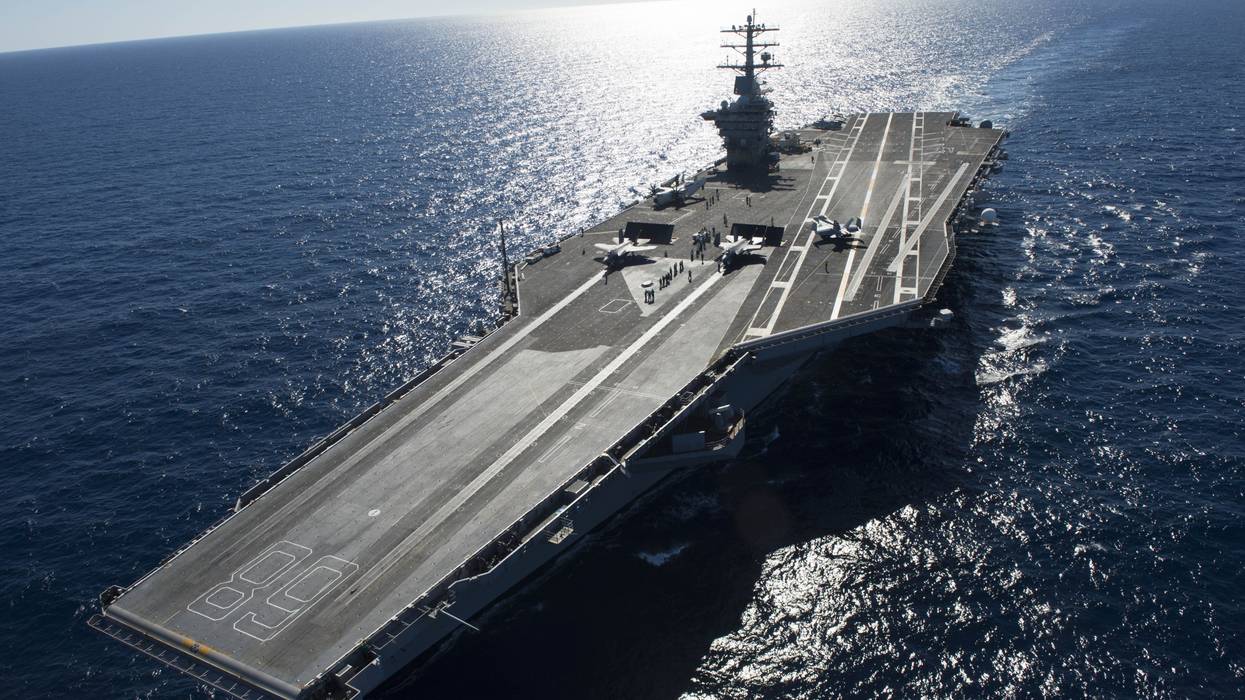
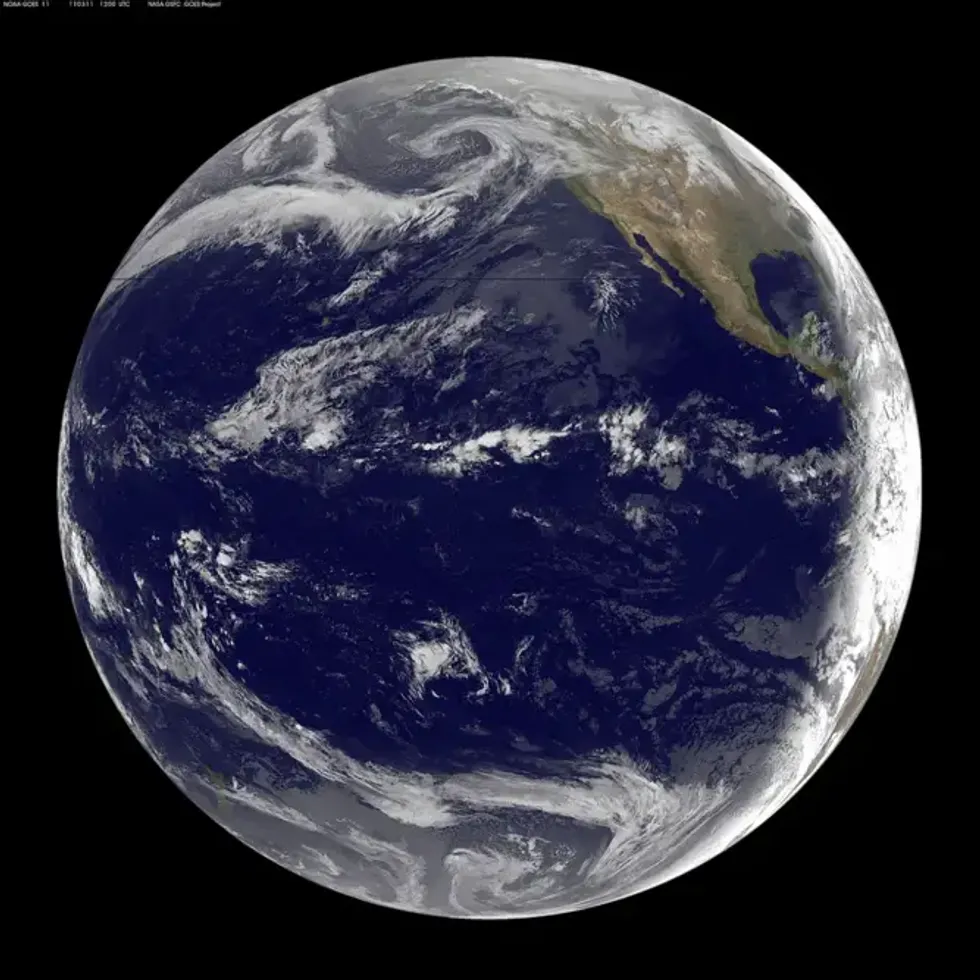 A more representative, less terra-centric view of our 70% water planet. (Photo by
 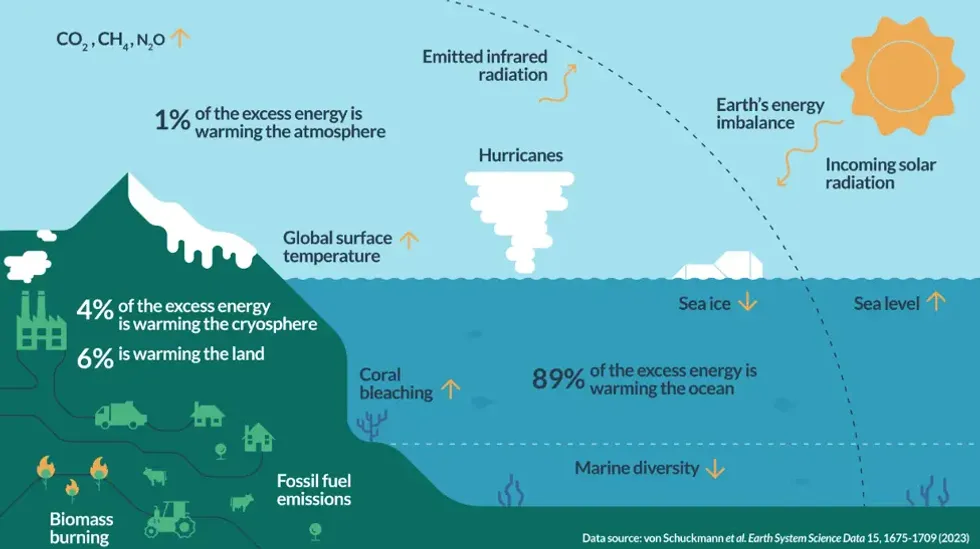 A depiction of how the Earth has dealt with the energy imbalance created mainly by burning fossil fuels and adding heat-trapping molecules to the atmosphere. The oceans have spared us the true brunt of global warming, storing 91% of excess heat, up from 89% when this visual was created three years ago.(Graphic by
 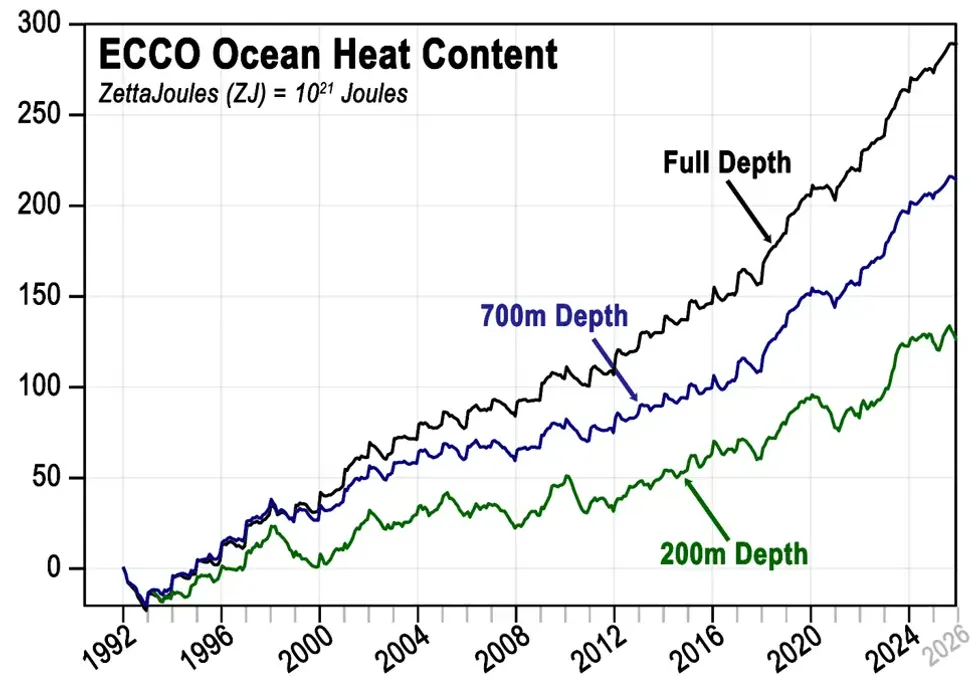 (Credit: ECCO
 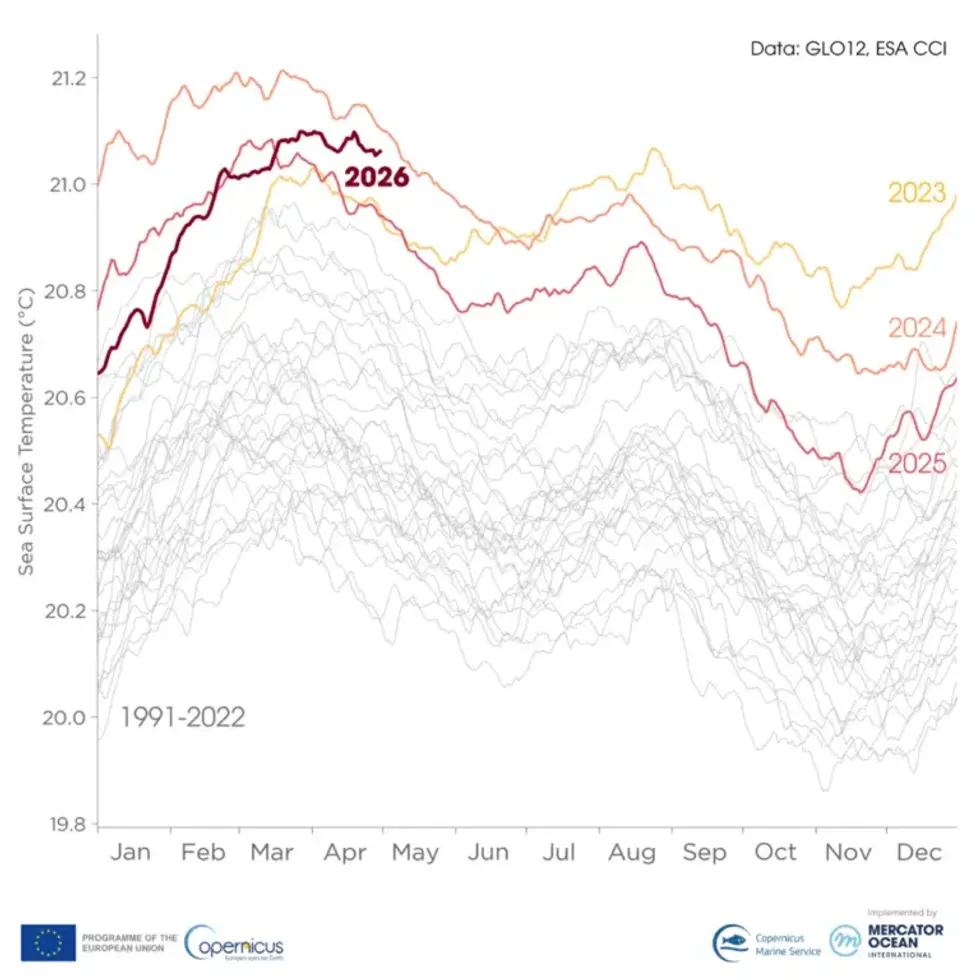 2026 sea surface temperatures are now rivaling those of 2024, the warmest year on record. (Graphic by
 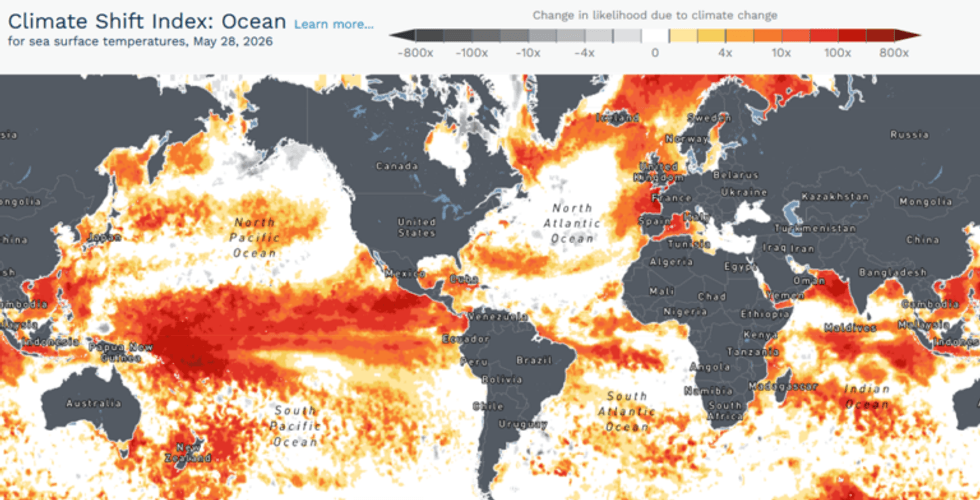 The role of climate change in driving warm ocean surface temperatures. (Graphic by