

SUBSCRIBE TO OUR FREE NEWSLETTER
Daily news & progressive opinion—funded by the people, not the corporations—delivered straight to your inbox.
5
#000000
#FFFFFF
To donate by check, phone, or other method, see our More Ways to Give page.
Daily news & progressive opinion—funded by the people, not the corporations—delivered straight to your inbox.

Bryan Hirsch, +41 76 547 3476
Susan Cavanagh, +41 78 626 4490
Today NGOs released an expose highlighting new tobacco industry
tactics to undermine implementation of the global tobacco treaty,
formally known as the World Health Organization Framework Convention on
Tobacco Control (WHO FCTC). The report comes at the midpoint of an
eight-day negotiating meeting on a protocol to the FCTC on illicit
tobacco trade, where tobacco giants such as Philip Morris International
(PMI), British American Tobacco (BAT) and Japan Tobacco (JT) have a
strong presence. The document, produced by Corporate Accountability
International and the Network for Accountability of Tobacco
Transnationals (NATT), criticizes FCTC Parties such as Lebanon and the
Philippines for collaborating with tobacco corporations and falling
short of commitments under the treaty.
FCTC Article 5.3 obligates treaty Parties to "protect [public
health] policies from commercial and other vested interests of the
tobacco industry in accordance with national law." Guidelines for the
implementation of this measure were adopted at the third Conference of
Parties (COP) last November in Durban, South Africa (full text
available online: https://www.who.int/fctc/guidelines/article_5_3.pdf).
"In November, ratifying countries unanimously adopted rigorous
guidelines to protect public health policy against tobacco industry
interference," explains Kathryn Mulvey, International Policy Director
for Corporate Accountability International. "Now, Big Tobacco is trying
to get governments to ignore their obligations under the treaty and
make exceptions to these new rules. We urge the international community
to reject the tobacco industry's attempts to subvert the FCTC and
derail the illicit trade protocol."
The tobacco corporations and civil society do seem to agree about
one thing: the protocol on illicit trade is precedent-setting. This is
the first high-profile tobacco control issue to be taken on at the
global level since last November, when three sets of implementation
guidelines were adopted - on banning tobacco advertising, promotion and
sponsorship; effective warning labels; and protecting against tobacco
industry interference. NGOs are calling on treaty Parties to follow
through on their commitments. Meanwhile the tobacco lobby is present
and visible at this week's negotiations in full force, seeking to
influence the content of the protocol to its own advantage and chip
away at the safeguards of Article 5.3.
PMI has invited delegates to attend private meetings at the
Intercontinental Hotel throughout the week. In contrast to the previous
two negotiating sessions, this week the public gallery has been packed
full of tobacco industry lobbyists. On Monday there were more than
forty people in the gallery.
Twenty-three of the twenty-eight people willing to identify
themselves were from the tobacco industry, including twelve from BAT,
seven from JT, one from Imperial Tobacco, and one from the Tobacco
Institute of South Africa.
The FCTC Article 5.3 guidelines instruct ratifying countries to
"Establish measures to limit interactions with the tobacco industry and
ensure the transparency of those interactions that occur"
(Recommendation 2). But last month Lebanon played host to British
American Tobacco's (BAT) two-day conference on illicit trade, where
Lebanese Minister of Finance Dr. Mohammed Shateh and other high-level
public officials from the region reportedly met with BAT behind closed
doors to discuss taxes, smuggling and other policy issues.
The guidelines also recommend that treaty Parties, "Reject
partnerships and non-binding or non-enforceable agreements with the
tobacco industry" (Recommendation 3). But last month Philippines
customs authorities signed a Memorandum of Understanding with Philip
Morris Philippines, through which the corporation will presumably gain
access to law enforcement personnel and customs data. (This is the same
corporation that was accused by Thailand two years ago of exploiting
customs procedures and evading taxes by understating the value of
exports.)
The guidelines begin with the principle that 'There is a fundamental
and irreconcilable conflict between the tobacco industry's interests
and public health policy interests" (Principle 1) and urge Parties to
avoid conflicts of interest for government officials and employees
(Recommendation 4). Yet PMI reports meeting with 2,800 government
agencies and 8,000 government employees to promote its system for
tracking and tracing cigarette products.
"This report is a powerful reminder to FCTC Parties that the tobacco
industry is not and cannot be a partner in tobacco control
initiatives," said Laurent Huber, Director of the Framework Convention
Alliance (FCA). "The FCTC is motivated by a desire to protect human
health and the tobacco industry is motivated by profit which inherently
undermines human health, therefore the two are in direct opposition."
View the full report Clearing the Smoke-Filled Room: An Expose on
How the Tobacco Industry Attempts to Undermine the Global Tobacco
Treaty and the Illicit Trade Protocol online:
English: https://www.stopcorporateabuse.org/sites/default/files/INB3%20English%20F...
Spanish: https://www.stopcorporateabuse.org/sites/default/files/INB3%20Spanish%20F...
French: https://www.stopcorporateabuse.org/sites/default/files/INB3%20French%20FI...
Corporate Accountability stops transnational corporations from devastating democracy, trampling human rights, and destroying our planet.
(617) 695-2525
Critics noted that "20% of the value of any cargo is actually substantially MORE than Iran is seeking to charge ships to transit the strait."
Following fresh US airstrikes against Iran over the weekend, President Donald Trump said Monday that the United States would reimpose a naval blockade on the Mideast country, serve as the "guardian" of the Strait of Hormuz, and charge a 20% toll for cargo ships trying to safely travel on the key trade route.
Trump made the comments while calling in to "Fox & Friends" on Monday morning, as well as on his Truth Social platform.
"We're just gonna hit them very hard, and we're gonna keep the strait, and we'll probably run it. We'll become the guardian of the strait. Maybe we'll call it the guardian angel of the strait. And we should be reimbursed for that," Trump said on the Fox News morning show.
"When we do that, we're gonna be reimbursed, because the other nations are very wealthy. They're on our side, and we can't be expected to do that for nothing," the president said. "Now we're gonna guard it, and we're gonna get paid for guarding it—a lot of money."
Later Monday morning, Trump wrote on Truth that "the Hormuz Strait is OPEN, and will remain OPEN, with or without Iran. We are reinstating the THE IRANIAN BLOCKADE, so named because it is only stopping Iran's ships or customers from entering or leaving. All other countries will have fair and open use of the Strait."
"The U.S.A. will be, from this point forward, known as 'THE GUARDIAN OF THE HORMUZ STRAIT,' but as such, and as a matter of FAIRNESS, will be reimbursed, at the rate of 20% on all cargo shipped, for any and all costs necessary to do the job of providing safety and security to this very volatile section of the World," he added. "The process and formation will begin immediately."
Bloomberg energy and commodities columnist Javier Blas pointed to US Secretary of State Marco Rubio's remarks just a couple of weeks ago that "no country is allowed to charge tolls or fees on an international waterway."
Critics and experts were also quick to note that, as immigration attorney Aaron Reichlin-Melnick put on the platform X, "20% of the value of any cargo is actually substantially MORE than Iran is seeking to charge ships to transit the strait."
Trita Parsi, executive vice president of the Quincy Institute for Responsible Statecraft, quipped that it "seems like Trump just made a pitch for the Iranian toll system. :) Because the Iranians were going to charge $1 million per ship, which would amount to 1-2% of the value of the cargo of an oil tanker. But Trump is going to charge 20%! :)"
In an early Monday blog post, Parsi had written that "for all practical purposes, the US-Iran memorandum of (mis)understanding is over. The dispute over how to manage the Strait of Hormuz in the interim has pushed the two sides back into open war."
As Parsi explained:
The dispute over the strait turns, at least on the surface, on paragraph 5 of the MOU: whether Iran is responsible for safe passage throughout the strait for the duration of the agreement, or only for the waterway's northern corridor.
Beneath the surface, however, lies a more fundamental strategic disagreement. Even before the MOU was signed, Tehran believed Washington's objective was to establish a southern shipping corridor through Omani waters that would gradually erode Iran's control over the strait. Such a corridor would require Oman's cooperation, which may explain why Trump at one point threatened to bomb Oman unless it abandoned its proposal for joint management of the strait, with administrative fees collected by Muscat and Tehran.
The corridor would remain operational even if war resumed and Iran sought once again to close the strait. From Tehran's perspective, Washington used the MOU to strengthen this alternative route, and the US military's escort of commercial shipping without coordinating with Iran marked a significant step in that direction. If successful, the strategy would deprive Iran of its most important source of leverage—which is precisely why it appeals to Washington.
"This is why Tehran has insisted that all ships transiting the strait—regardless of the corridor they use—coordinate with Iran, consistent with its reading of paragraph 5 of the MOU," he added. "Washington, by contrast, argues that the MOU merely assigns Iran responsibility for ensuring the safe passage of commercial vessels, without granting it operational control over all maritime traffic."

Trump claimed to have "59% approval" while not a single pollster even has him above water. Meanwhile, oil prices are shooting back up after he restarted the war in Iran.
It is once again Opposite Day for President Donald Trump, who claimed in a late-night social media post that his approval rating is high and oil prices are dropping, neither of which is actually true.
"59 percent Approval Rating. Prices coming down along with the lowering of oil and gas. Thank you! President DJT," Trump wrote Sunday night on Truth Social.
Trump did not specify what poll had him at 59% approval, presumably because it does not exist. Not a single one of the polls tracked by The New York Times or RealClearPolling's aggregators shows Trump even breaking even with the public.
The Times average as of Monday morning has his approval rating at 39%, with 58% disapproval—on par with the worst metrics of his second term. RCP’s average is only slightly more merciful, showing the president’s approval at just under 40% and his disapproval at 57%.
Even the GOP-friendly pollster Rasmussen shows him with just 44% approval and 54% disapproval—generous outlier numbers for the president.
It is, of course, possible that Trump was referring to some heavily massaged poll that only he has seen, though he has a long history of inflating his popularity while claiming that polls showing otherwise are "fake news."
The price of oil, on the other hand, is something that can't be faked, though it didn't stop Trump from trying.
This weekend, Trump launched a new series of attacks against Iran, after declaring earlier in the week that the peace framework signed last month was “over” and saying negotiations were a “waste of time.”
Iran responded by announcing late Saturday night that it would seal off the Strait of Hormuz to most traffic, once again choking off a main route for global oil and gas transport.
Asked about the closure on Sunday, Trump told reporters, "I don't want to talk about it."
His post seems to reveal a further commitment to denying reality. Contrary to his claim about the "lowering of oil and gas," US gas prices on Monday averaged $3.87 per gallon, up from $3.80 a week earlier.
Meanwhile, the price of Brent crude has shot up by more than 9% over the past week, from $72 per barrel last Monday to nearly $79 as of this writing. At the time of Trump’s tweet, oil prices had already climbed by about 4% and continued to increase into Monday morning.
Prices are down from the war's height in the springtime, when gas surpassed $4.50 per gallon and a barrel of oil cost more than $110. But crude prices are still 9% higher than prewar, while gas is up about 31%, with companies capitalizing on the war to pad their profit margins at the expense of consumers and businesses.
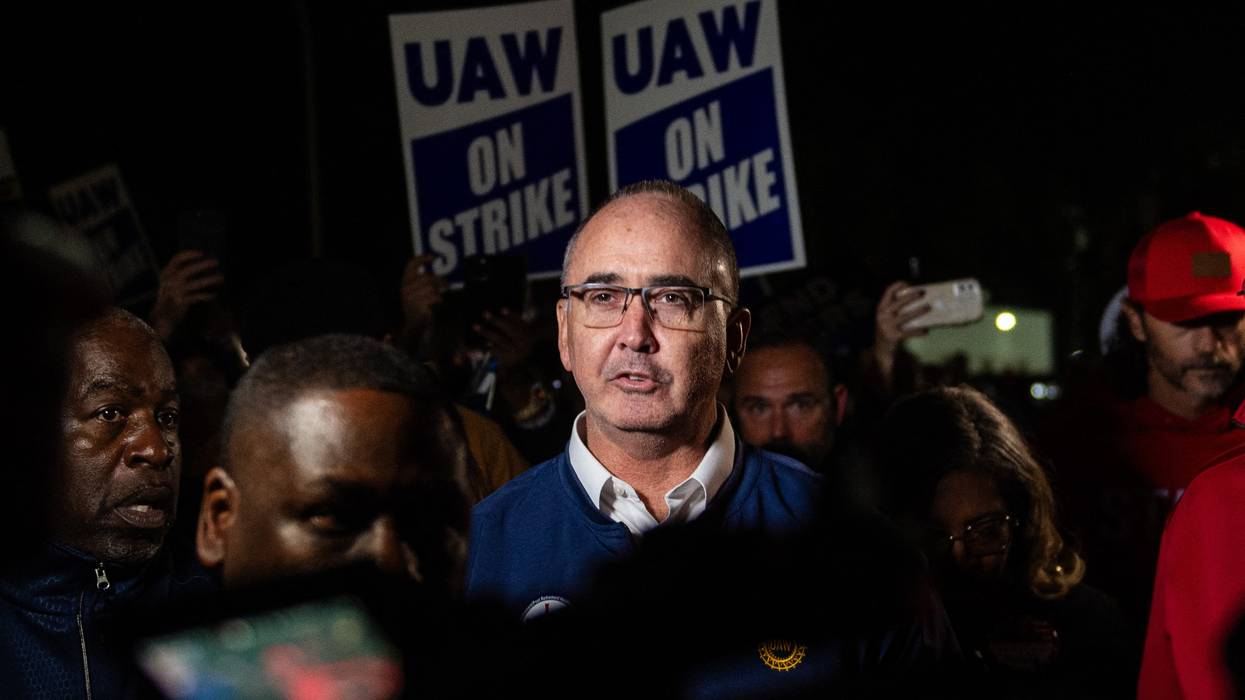
"This is what happens when you go against corporate America and their allies," said the United Auto Workers president.
United Auto Workers president Shawn Fain issued a fiery statement on Sunday vowing to "fight back hard" as President Donald Trump's Justice Department launched a probe into allegations that the union leader abused his authority to seek benefits for his fiancée and her sister.
Fain rejected the claims as "false" and accused UAW vice president Rich Boyer, who is vying for the union presidency, of "trying to weaponize these bogus allegations to steal the upcoming UAW election." Fain also hit out at court-appointed federal monitor Neil Barofsky, whom the union president accused of harboring "a political grudge against me because the UAW took an anti-war stance about what was happening in Gaza."
"Rich Boyer has fed the monitor false allegations about me," said Fain. "We're going to fight back hard."
In 2023, Fain emerged as one of the most prominent union leaders in the nation during the UAW's weeks-long "Stand Up Strike" against the Big Three automakers, which yielded historic contracts for UAW members. On Sunday, Fain suggested that the union's successes under his leadership are fueling his opponents' attacks.
"This is what happens when you go against corporate America and their allies," said Fain, "and I'm not going to be intimidated or harassed out of serving our membership."
Bloomberg reported Sunday that the US Justice Department has launched a grand jury probe into allegations that Fain "sought a financial bonus for his fiancée and pushed for a worker’s compensation claim for her sister."
"He allegedly retaliated against Boyer for refusing to approve the benefits by stripping the official of his duties as chief negotiator with Stellantis NV, the maker of Jeep and Ram vehicles," Bloomberg noted. "The allegations became public last month in a report by the court-appointed monitor."
Fain on Sunday denied retaliating against Boyer. "The truth when it comes to Boyer," Fain said, "is that I didn't want him running the Stellantis Department because he wasn't doing a good job for our members."
The UAW president went on to accuse Boyer of trying to "hire family members into UAW positions" and failing to enforce the union's contract with Stellantis.
"Boyer is bad for our union and I'm not going to let him use the monitor's bogus investigation so he can try to fail upwards into a bigger title," said Fain. "Our election is in six weeks. Neil Barofsky will not run our union, no matter how hard he tries. And no company sellout like Boyer is going to dictate our elections."
Barofsky was appointed as UAW monitor in 2021—around two years before Fain was sworn in as union president—as part of a consent decree with the Justice Department in the wake of a corruption investigation.
Relations between Fain and Barofsky have reportedly been strained since late 2023, when the UAW became the largest union in the US to call for a ceasefire in Gaza as the Palestinian enclave faced a massive Israeli assault.
Shortly after the UAW's demand, according to The Detroit News, Barofsky "called Fain for a personal conversation related to the ceasefire statement and other issues around the war—a call Fain would later indicate made him uncomfortable, and that a union lawyer told Barofsky was out of line."
In February 2024, weeks after the UAW's ceasefire call, Fain and Barofsky had an "expletive-laden discussion" that Fain says "led to the monitor launching an investigation into him," The Detroit News reported last week. Fain reportedly said at one point during the February phone meeting that Barofsky accused the union leader of being antisemitic, which Fain furiously denied.
"For anybody to ever f------ say I'm antisemitic, brother, I'll fight your ass in front of this building in a heartbeat," Fain said, according to The Detroit News. "I do not f------ like that, and I don't appreciate it."