

SUBSCRIBE TO OUR FREE NEWSLETTER
Daily news & progressive opinion—funded by the people, not the corporations—delivered straight to your inbox.
5
#000000
#FFFFFF
To donate by check, phone, or other method, see our More Ways to Give page.
Daily news & progressive opinion—funded by the people, not the corporations—delivered straight to your inbox.
Campaign for America's Future:
Toby Chaudhuri or Rachel Perrone at 202-955-5665
Major progressive, labor and consumer rights leaders joined forces today to demand important corrections to the Bush administration's financial rescue proposal despite warnings from the administration's top economists who got us into this mess.
The groups, representing more than 20 million Americans, sent a letter to members of Congress today urging them to require basic conditions before agreeing to any financial bailout request. The groups also announced that hundreds of events will be held across the country on Thursday to demand conditions on the bailout.
With a groundswell of opposition forming around the Bush administration's $700 billion bailout request, Campaign for America's Future co-director Robert Borosage said Congress must not write President Bush a blank check for $700 billion without conditions.
"The financial crisis won't go away on its own and doing nothing is not an option. Neither is writing a blank check for $700 billion to the same folks who got us into this mess, especially without a clear system of oversight and accountability." said Borosage. "This is common sense. If American taxpayers are asked to bail out the financial industry, at the very least, we deserve to know how our hard-earned money will be spent."
Representatives from top progressive and labor groups-- including the Campaign for America's Future, AFL-CIO, SEIU, AFSCME, AFT, NEA, ACORN, Alliance for Justice, Center for American Progress and Center for Community Change -- met at an emergency closed-door meeting yesterday to develop a statement of principles for bailing the American economy out of its financial woes.
The statement urges Congress to insist on public oversight and transparency, taxpayer protections and equity, regulations to ensure this doesn't happen again, major public investments to support the economy, increased accountability for executives and directors and aid for homeowners who were misled by predatory lenders.
More than 35 leaders signed the statement, including Borosage, AFL-CIO president John Sweeney, SEIU president Andy Stern, AFSCME president Gerald McEntee, United Steelworkers president Leo Gerard, ACORN president Maude Hurd, Center for American Progress president John Podesta, Center for Community Change president Deepak Bhargava and USAction president William McNary.
TEXT OF LETTER
DEMANDING BAILOUT CONDITIONSA Call for Common Sense
Every man, woman, and child in America is now being told to ante up $2,000 - an estimated $700 billion in all - to bail out Wall Street's recklessness, or the very people who created this crisis are telling us that they will bring down our entire economy.
The Treasury Department's proposal that the Secretary be given essentially unlimited authority to spend $700 billion to bail out any financial institution across the world is irresponsible and unacceptable.
We urge the Congress to insist on some basic conditions for any bailout.
- Public Oversight. This kind of power can never be centralized in a single individual - much less one who did not even stand for election. Any funds must be controlled by an independent entity, with consumers and workers given seats on its board. Congress should be empowered to name independent monitors and to approve all board members.
- Protect the Taxpayer. The Treasury bill would have taxpayers buying paper that nobody else wants at prices far above its current value. If a firm wants to auction off its toxic paper to the US Government, taxpayers should get equity in that firm equal to any amount paid in excess of the paper's value. This will deter profitable firms from using the government as a dumpster for their toxic paper. And it will insure that if the bailout works and the firms become profitable, taxpayers, not simply bankers, benefit from the upside.
- Curb the casino. This crisis was caused because sensible regulations of the banking system that worked for dozens of years were dismantled or went unenforced. No bailout can go forward without requiring the necessary regulation to insure this does not happen again. Any institution, which receives assistance, should agree to come under a microscope going forward in terms of disclosure requirements, and it should have stringent capital requirement imposed upon it.
- Invest in the real economy. Ending the bankers strike is not sufficient enough to avoid the recession into which we have been driven. Major public investment in new energy and conservation, rebuilding schools and infrastructure, extending unemployment and food stamps, helping states avoid crippling cuts in police and health services - is vital to get the real economy moving and put people back to work. No bailout should proceed without being linked to support for a major public investment plan to get the economy going.
- Hold CEOs and Boards of Directors Accountable. Wall Street CEOs shouldn't be pocketing millions while taxpayers are forced to bail them out. Any firm that applies for relief must agree to cancel all stock option programs and CEOs should have stringent limits placed on their compensation until the Company has repaid all taxpayer assistance.
- Aid the victims, not just the predators. Both bankers and home owners made foolish bets that home prices would keep rising. Many homeowners, however, were misled by predatory lenders into taking mortgages that they didn't understand and couldn't afford. It would be simply obscene to help the predators and not those that they preyed upon. No bail out of the banks should take place without measures to help people in trouble stay in their homes. Explicit provisions should ensure use of the full array of financial and legal tools available to the government to stop foreclosures and restructure home mortgage loans for ordinary Americans, including amending the bankruptcy code to allow judges to modify mortgages. Where workouts are not feasible, people should be allowed to stay in their homes as renters.
--Robert Borosage, co-director, Campaign for America's Future
--John Sweeney, president, AFL-CIO
--Andy Stern, president, Service Employees International Union (SEIU)
--Gerald McEntee, president, Am. Fed. of State, County and Municipal Employees (AFSCME)--Randi Weingarten, president, American Federation of Teachers (AFT)
--Larry Cohen, president, Communications Workers of America (CWA)
--Dennis Van Roekel, president, National Education Association (NEA)
--Leo Gerard, president, United Steelworkers (USW)
--Maude Hurd, national president, ACORN--Nan Aron, president, Alliance for Justice
--Amy Issacs, national director, Americans for Democratic Action
--Kevin Zeese, executive director, Campaign for Fresh Air & Clean Politics
--John Podesta, president, Center for American Progress Action Fund--Deepak Bhargava, president, Center for Community Change
--Deborah Weinstein, executive director, Coalition for Human Needs
--Donald Mathis, president, Community Action Partnership
--Jane Hamsher, firedoglake.com
--James D. Weill, president, Food Research & Action Center (FRAC)--Brent Blackwelder, president, Friends of the Earth
--John Cavanagh, director, Institute for Policy Studies
--Sarita Gupta, executive director, Jobs with Justice
--Wade Henderson, president, Leadership Conference on Civil Rights
--Carissa Picard, esq., president, Military Spouses for Change--Sally Greenberg, executive director, National Consumers League
--Christine L. Owens, executive director, National Employment Law Project
--Gary Bass, executive director, OMB Watch
--Adam Lioz, program director, Progressive Future
--Joanne Carter, executive director, RESULTS--William McNary, president, USAction
--Paula Brantner, executive director, Workplace Fairness
--Dan Cantor, executive director, Working Families Party
--Mark Lotwis, executive director, 21st Century Democrats

"Trump has turned Venezuela into an effective US colony," said one critic.
Some critics of the Trump administration are reacting with horror to revelations that US Secretary of State Marco Rubio has been serving as the de facto ruler of Venezuela.
According to a Saturday report in The New York Times, Rubio for the last several months has been acting informally as the "viceroy" of Venezuela ever since its recognized president, Nicolás Maduro, was abducted by the American military in January and brought to the US to face charges related to "narco-terrorism."
The Times' sources revealed that Rubio "effectively controls Venezuela’s finances, the distribution of its natural resources, and its government" and "is deeply involved in the country’s day-to-day operations," while maintaining regular contact with acting Venezuelan President Delcy Rodríguez.
Under current arrangements, the US Treasury Department takes in revenue from Venezuela's exports, including its petroleum, and then disperses the money back to the country through its private banks with strict conditions set by Rubio over what it can be spent on.
In explaining the system, the Times likened it to "parents handing out allowances to children," adding that it gives Rubio "immense leverage over... Rodríguez, who depends on the money to pay workers and prop up the national currency."
Elizabeth Saunders, professor of political science at Columbia University, described Rubio's power over Venezuela as "insane," as well as "derelict, unconscionable, and impeachable."
"The secretary of state's time is scarce, valuable, and not outsourcable," Saunders emphasized.
Orlando J. Pérez, professor of Political Science at the University of North Texas at Dallas, said the Times report made a mockery of Rubio's professed claims to want to bring democracy back to Venezuela.
"It appears Rubio has transformed from democracy promotion warrior," Pérez commented, "to transactional realpolitik operative!"
Kenneth Roth, former executive director at Human Rights Watch, wrote that US control over Venezuela appeared similar to the kind of imperial power wielded by European nations in the 19th Century.
"Trump has turned Venezuela into an effective US colony," said Roth, "with Marco Rubio as the viceroy and Washington controlling the country’s oil revenue and dictating major foreign and domestic policies. Democracy has been relegated to the distant future."
Bradley Simpson, historian at the University of Connecticut, also saw the current US arrangement with Venezuela as a return to overt imperialism.
"We are literally back in the Dollar Diplomacy days of the 1910s," Simpson wrote, "when the United States invaded countries and took over their financial systems and ran them as effective colonies. Flagrantly illegal, enormously corrupt. Where is the organization of American states or UN in denouncing this?"
"These hoodlums come in with machine guns—M4, an American-made machine gun—and they detain us. They block off the road."
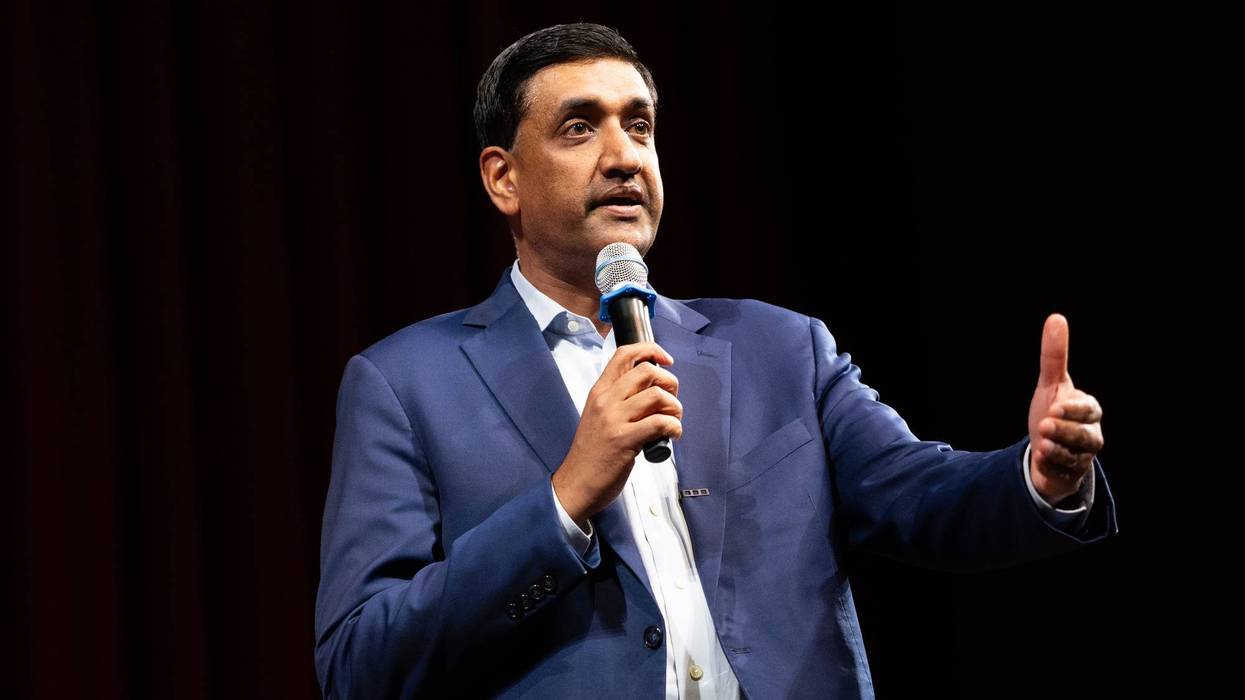
Rep. Ro Khanna this week was detained by a group of Israeli settlers whom he described as "hoodlums... with machine guns" while making a visit to a Palestinian village in the occupied West Bank.
In an interview with Reuters published on Saturday, Khanna (D-Calif.) said he and his tour group were surrounded by armed settlers as they were traveling through the West Bank on Wednesday.
"We were at a village that Israeli settlers had destroyed, they had destroyed the school, they had destroyed that village, and we were just looking at it," said Khanna. "And these hoodlums come in with machine guns—M4, an American-made machine gun—and they detain us. They block off the road."
The California Democrat said that the settlers called in members of the Israel Defense Forces (IDF) to help them deal with him and his group.
"The IDF is on their side," Khanna remarked, "not on the side of the Americans."
Cameron Kasky, an aide to Khanna, told Reuters that the group was held for over an hour before officials whom he believed to be police intervened and secured their release.
The IDF told Reuters that both military troops and police officers dispersed the settlers who had set up a roadblock near the small Palestinian village of Khirbet Zanuta.
Khanna wasn't the only American to have a run-in with Israeli settlers this week, as CNN reported that four settlers attacked groups of journalists, including CNN reporters and crew, who were traveling through an area north of the Palestinian city of Ramallah on Saturday.
As the journalists were driving, four settlers blocked off the road with their cars and began attacking the reporters' vehicles with wooden clubs and metal rods.
"The settlers then began to jump on the vehicle behind CNN's—carrying another group of journalists—and smashed the windshield of that vehicle," the network reported. "Another group of settlers tried to block a separate exit route before chasing the journalists towards the town of Sinjil."
Israeli police arrived on the scene and arrested four settlers who were allegedly responsible for the attacks, CNN reported.
"The Israel Police and the IDF view any manifestation of violence or causing damage to property very seriously," the Israeli officers said after the arrests, "especially when it concerns media personnel performing their work."
Israeli settlers for years have carried out violent attacks on Palestinians living in the West Bank, and witnesses have regularly described IDF soldiers at the scene either standing by as the attacks occur or even actively helping the attackers.
In an interview with CNN on Tuesday, Israeli Prime Minister Benjamin Netanyahu said that claims about settler violence have been "blown up beyond belief," describing attacks as being carried out by a small number of "juvenile delinquents."
"This brazen act should be seen as nothing more than an attempt to prevent the public from knowing what is happening in their country by intimidating journalists from doing their jobs."
The Trump administration on Friday escalated its war with the press by subpoenaing several reporters at The New York Times days after the paper published a story on Wednesday that detailed security concerns about the luxury jet the Qatari government gave to President Donald Trump.
According to the Times, the subpoenas are attempting to force reporters to testify before a federal grand jury in Manhattan on Wednesday next week, a move that the paper describes as an "extraordinary escalation in President Trump’s efforts to threaten and intimidate independent news organizations."
The issued subpoenas do not specifically name the Times' reporting on the Qatari jet as the reason for the grand jury probe, although they were given to all four journalists—Tyler Pager, Julian Barnes, Eric Schmitt, and Eric Lipton—who reported the story.
Additionally, the Times noted, a senior official at the FBI had asked the paper to hold off publishing its story on the jet before it came out on Wednesday, citing unspecified national security concerns about its content.
David McCraw, the top attorney representing the Times' newsroom, denounced the subpoenas as an attack on the freedom of the press.
"The appearance of federal law enforcement agents on the doorstep of news reporters should shock the conscience of any American who believes in the Constitution and the press freedom it protects," said McGraw. “This brazen act should be seen as nothing more than an attempt to prevent the public from knowing what is happening in their country by intimidating journalists from doing their jobs."
It is highly uncommon for government investigators to subpoena journalists when they are probing national security leaks, as such actions are generally seen as having a chilling effect on reporters’ ability to gather information.
Rick Stengel, former under secretary of state for President Barack Obama, said that the Times' reporting on the Qatari jet, whose security upgrades are being financed with US tax dollars, is completely within the scope of constitutional protections for press freedom.
"The reporting that the Times journalists have been subpoenaed for is exactly the kind of journalism the First Amendment is designed to protect: matters involving national security and taxpayer dollars," wrote Stengel in a Saturday social media post. "Reporting that embarrasses a president is protected speech."
Fox News chief national security correspondent Jennifer Griffin also denounced the Trump administration for trying to drag reporters into a grand jury investigation.
"This action by the US government to subpoena reporters for reporting legitimate news on security concerns about Air Force One should alarm every American," Griffin wrote.
Seth Stern, chief of advocacy for the Freedom of the Press Foundation, accused the Trump administration of abusing government power not to defend national security, but to protect the president from personal humiliation.
"We've long said that when the government claims it needs to investigate journalists to protect national security, it really means its own reputational security," said Stern. "This is as clear an example as you can get. The administration's embarrassment that it reportedly charged taxpayers hundreds of millions of dollars to retrofit a flying bribe that still isn't secure enough for hostile times does not supersede the need for a free and independent press."
This is the second time in recent weeks that the Trump administration has tried to subpoena reporters to compel their testimony in grand jury investigations.
In June, the US Department of Justice issued subpoenas for national security reporters at The Washington Post and The Wall Street Journal related to national security leaks.
Subpoenas against both news organizations were withdrawn after they issued legal challenges in sealed filings.