SUBSCRIBE TO OUR FREE NEWSLETTER
Daily news & progressive opinion—funded by the people, not the corporations—delivered straight to your inbox.
5
#000000
#FFFFFF
To donate by check, phone, or other method, see our More Ways to Give page.
Daily news & progressive opinion—funded by the people, not the corporations—delivered straight to your inbox.
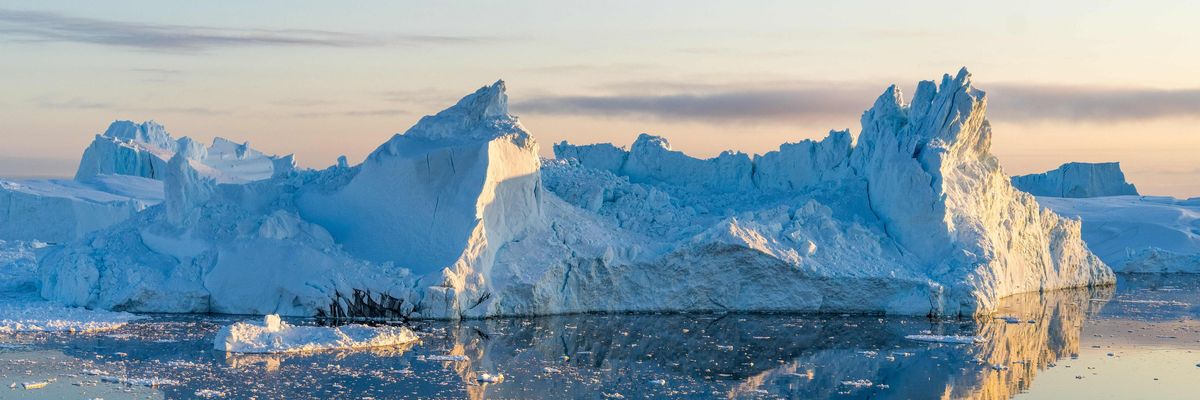
Icebergs are seen near Ilulissat, Greenland on May 16, 2021. (Photo: Ulrik Pedersen/NurPhoto via Getty Images)
A new report released at the 2022 United Nations Conference of the Parties on Monday revealed that some level of total Arctic sea ice loss in summer months is now unavoidable, regardless of whether policymakers are able to drastically reduce planet-heating fossil fuel emissions.
Even an ambitious emissions-cutting agenda--one that slashes emissions by at least 50% by 2030, which experts say would put the planet on the path to a peak global temperature rise of 1.6degC to 1.8degC--"will not prevent at least one ice-free summer before 2050," reads the annual State of the Cryosphere report.
"This is a stark wake-up call on the irreversible damage our climate and natural environment is suffering due to a lack of action on emissions," said Dr. Helen Findlay of Plymouth Marine Laboratory, who reviewed the findings. "We are now past the point of no return on the loss of summer sea ice in the Arctic. Urgent steps must now be taken to ensure further catastrophe is avoided, for example, crossing chemical thresholds related to ocean acidification."
The Laboratory said the report denotes a "terminal diagnosis for Arctic Sea ice."
Dramatically slashing fossil fuel pollution would ultimately allow summer sea ice levels to stabilize and the number of ice-free summers in the Arctic to decline, while currently implemented reduction policies would make ice-free conditions "during much of spring and fall, as well as summer" likely in the Arctic by 2040.
If emissions are permitted to keep growing by two to three parts per million per year, according to the International Cryosphere Climate Initiative (ICCI), which released the report at COP27, the Arctic could lose all of its sea ice for much of the year by 2030.
"Urgent steps must now be taken to ensure further catastrophe is avoided."
"There's nothing we can do about that now," Julie Brigham-Gette, a co-author of the report and scientist at the University of Massachusetts Amherst, told The Guardian of at least some amount of ice-free summers in the Arctic. "That milestone has now past so the next thing we need to avoid is ice shelf collapses in Antarctica and the further breakdown of the ice systems in Greenland. We can't stuff the genie back into the bottle once they are gone."
As the report notes, "Summer Arctic sea ice extent has often been considered a bellwether of climate change, with great attention paid to the September minimum each year."
The loss of sea ice in the Arctic for parts of the year would cause the open ocean to absorb more heat, worsening global heating. As Common Dreams reported in August, the Arctic is growing hotter nearly four times as fast as the Earth as a whole. In turn, Arctic waters are absorbing more carbon dioxide from the atmosphere, leading to faster ocean acidification in the region and greater harms to marine life.
Even in a low-emissions scenario, the loss of sea ice is expected to cause more than one and a half feet of sea level rise in the next century, while currently implemented emissions reduction plans would cause sea level rise to "continue at a relatively rapid pace for many centuries and be essentially permanent on human timescales, ending at 15-20 meters [49-65 feet] or more above today," the report reads.
Under an "optimistic" emissions reduction plan, putting the planet on a path to 2.1degC of temperature rise by 2100, "sea levels would reach around 0.75 meters (2.4 feet) above today early in the next century."
"The two lowest emissions pathways or scenarios are the only ones with any possibility of preventing these catastrophic events that cannot be reversed in anything less than centuries, to tens of thousands of years," said Brigham-Grette in a statement. "A decision to exceed these limits is a de facto decision to make this happen."
The report was released less than two weeks after the U.N. Environment Program (UNEP) warned that there is currently no "credible pathway" in place to a planet in which temperatures rise by only 1.5degC above preindustrial levels, the goal outlined in the 2015 Paris climate agreement, and called for a "rapid transformation of societies."
Dear Common Dreams reader, It’s been nearly 30 years since I co-founded Common Dreams with my late wife, Lina Newhouser. We had the radical notion that journalism should serve the public good, not corporate profits. It was clear to us from the outset what it would take to build such a project. No paid advertisements. No corporate sponsors. No millionaire publisher telling us what to think or do. Many people said we wouldn't last a year, but we proved those doubters wrong. Together with a tremendous team of journalists and dedicated staff, we built an independent media outlet free from the constraints of profits and corporate control. Our mission has always been simple: To inform. To inspire. To ignite change for the common good. Building Common Dreams was not easy. Our survival was never guaranteed. When you take on the most powerful forces—Wall Street greed, fossil fuel industry destruction, Big Tech lobbyists, and uber-rich oligarchs who have spent billions upon billions rigging the economy and democracy in their favor—the only bulwark you have is supporters who believe in your work. But here’s the urgent message from me today. It's never been this bad out there. And it's never been this hard to keep us going. At the very moment Common Dreams is most needed, the threats we face are intensifying. We need your support now more than ever. We don't accept corporate advertising and never will. We don't have a paywall because we don't think people should be blocked from critical news based on their ability to pay. Everything we do is funded by the donations of readers like you. When everyone does the little they can afford, we are strong. But if that support retreats or dries up, so do we. Will you donate now to make sure Common Dreams not only survives but thrives? —Craig Brown, Co-founder |
A new report released at the 2022 United Nations Conference of the Parties on Monday revealed that some level of total Arctic sea ice loss in summer months is now unavoidable, regardless of whether policymakers are able to drastically reduce planet-heating fossil fuel emissions.
Even an ambitious emissions-cutting agenda--one that slashes emissions by at least 50% by 2030, which experts say would put the planet on the path to a peak global temperature rise of 1.6degC to 1.8degC--"will not prevent at least one ice-free summer before 2050," reads the annual State of the Cryosphere report.
"This is a stark wake-up call on the irreversible damage our climate and natural environment is suffering due to a lack of action on emissions," said Dr. Helen Findlay of Plymouth Marine Laboratory, who reviewed the findings. "We are now past the point of no return on the loss of summer sea ice in the Arctic. Urgent steps must now be taken to ensure further catastrophe is avoided, for example, crossing chemical thresholds related to ocean acidification."
The Laboratory said the report denotes a "terminal diagnosis for Arctic Sea ice."
Dramatically slashing fossil fuel pollution would ultimately allow summer sea ice levels to stabilize and the number of ice-free summers in the Arctic to decline, while currently implemented reduction policies would make ice-free conditions "during much of spring and fall, as well as summer" likely in the Arctic by 2040.
If emissions are permitted to keep growing by two to three parts per million per year, according to the International Cryosphere Climate Initiative (ICCI), which released the report at COP27, the Arctic could lose all of its sea ice for much of the year by 2030.
"Urgent steps must now be taken to ensure further catastrophe is avoided."
"There's nothing we can do about that now," Julie Brigham-Gette, a co-author of the report and scientist at the University of Massachusetts Amherst, told The Guardian of at least some amount of ice-free summers in the Arctic. "That milestone has now past so the next thing we need to avoid is ice shelf collapses in Antarctica and the further breakdown of the ice systems in Greenland. We can't stuff the genie back into the bottle once they are gone."
As the report notes, "Summer Arctic sea ice extent has often been considered a bellwether of climate change, with great attention paid to the September minimum each year."
The loss of sea ice in the Arctic for parts of the year would cause the open ocean to absorb more heat, worsening global heating. As Common Dreams reported in August, the Arctic is growing hotter nearly four times as fast as the Earth as a whole. In turn, Arctic waters are absorbing more carbon dioxide from the atmosphere, leading to faster ocean acidification in the region and greater harms to marine life.
Even in a low-emissions scenario, the loss of sea ice is expected to cause more than one and a half feet of sea level rise in the next century, while currently implemented emissions reduction plans would cause sea level rise to "continue at a relatively rapid pace for many centuries and be essentially permanent on human timescales, ending at 15-20 meters [49-65 feet] or more above today," the report reads.
Under an "optimistic" emissions reduction plan, putting the planet on a path to 2.1degC of temperature rise by 2100, "sea levels would reach around 0.75 meters (2.4 feet) above today early in the next century."
"The two lowest emissions pathways or scenarios are the only ones with any possibility of preventing these catastrophic events that cannot be reversed in anything less than centuries, to tens of thousands of years," said Brigham-Grette in a statement. "A decision to exceed these limits is a de facto decision to make this happen."
The report was released less than two weeks after the U.N. Environment Program (UNEP) warned that there is currently no "credible pathway" in place to a planet in which temperatures rise by only 1.5degC above preindustrial levels, the goal outlined in the 2015 Paris climate agreement, and called for a "rapid transformation of societies."
A new report released at the 2022 United Nations Conference of the Parties on Monday revealed that some level of total Arctic sea ice loss in summer months is now unavoidable, regardless of whether policymakers are able to drastically reduce planet-heating fossil fuel emissions.
Even an ambitious emissions-cutting agenda--one that slashes emissions by at least 50% by 2030, which experts say would put the planet on the path to a peak global temperature rise of 1.6degC to 1.8degC--"will not prevent at least one ice-free summer before 2050," reads the annual State of the Cryosphere report.
"This is a stark wake-up call on the irreversible damage our climate and natural environment is suffering due to a lack of action on emissions," said Dr. Helen Findlay of Plymouth Marine Laboratory, who reviewed the findings. "We are now past the point of no return on the loss of summer sea ice in the Arctic. Urgent steps must now be taken to ensure further catastrophe is avoided, for example, crossing chemical thresholds related to ocean acidification."
The Laboratory said the report denotes a "terminal diagnosis for Arctic Sea ice."
Dramatically slashing fossil fuel pollution would ultimately allow summer sea ice levels to stabilize and the number of ice-free summers in the Arctic to decline, while currently implemented reduction policies would make ice-free conditions "during much of spring and fall, as well as summer" likely in the Arctic by 2040.
If emissions are permitted to keep growing by two to three parts per million per year, according to the International Cryosphere Climate Initiative (ICCI), which released the report at COP27, the Arctic could lose all of its sea ice for much of the year by 2030.
"Urgent steps must now be taken to ensure further catastrophe is avoided."
"There's nothing we can do about that now," Julie Brigham-Gette, a co-author of the report and scientist at the University of Massachusetts Amherst, told The Guardian of at least some amount of ice-free summers in the Arctic. "That milestone has now past so the next thing we need to avoid is ice shelf collapses in Antarctica and the further breakdown of the ice systems in Greenland. We can't stuff the genie back into the bottle once they are gone."
As the report notes, "Summer Arctic sea ice extent has often been considered a bellwether of climate change, with great attention paid to the September minimum each year."
The loss of sea ice in the Arctic for parts of the year would cause the open ocean to absorb more heat, worsening global heating. As Common Dreams reported in August, the Arctic is growing hotter nearly four times as fast as the Earth as a whole. In turn, Arctic waters are absorbing more carbon dioxide from the atmosphere, leading to faster ocean acidification in the region and greater harms to marine life.
Even in a low-emissions scenario, the loss of sea ice is expected to cause more than one and a half feet of sea level rise in the next century, while currently implemented emissions reduction plans would cause sea level rise to "continue at a relatively rapid pace for many centuries and be essentially permanent on human timescales, ending at 15-20 meters [49-65 feet] or more above today," the report reads.
Under an "optimistic" emissions reduction plan, putting the planet on a path to 2.1degC of temperature rise by 2100, "sea levels would reach around 0.75 meters (2.4 feet) above today early in the next century."
"The two lowest emissions pathways or scenarios are the only ones with any possibility of preventing these catastrophic events that cannot be reversed in anything less than centuries, to tens of thousands of years," said Brigham-Grette in a statement. "A decision to exceed these limits is a de facto decision to make this happen."
The report was released less than two weeks after the U.N. Environment Program (UNEP) warned that there is currently no "credible pathway" in place to a planet in which temperatures rise by only 1.5degC above preindustrial levels, the goal outlined in the 2015 Paris climate agreement, and called for a "rapid transformation of societies."