SUBSCRIBE TO OUR FREE NEWSLETTER
Daily news & progressive opinion—funded by the people, not the corporations—delivered straight to your inbox.
5
#000000
#FFFFFF
To donate by check, phone, or other method, see our More Ways to Give page.
Daily news & progressive opinion—funded by the people, not the corporations—delivered straight to your inbox.
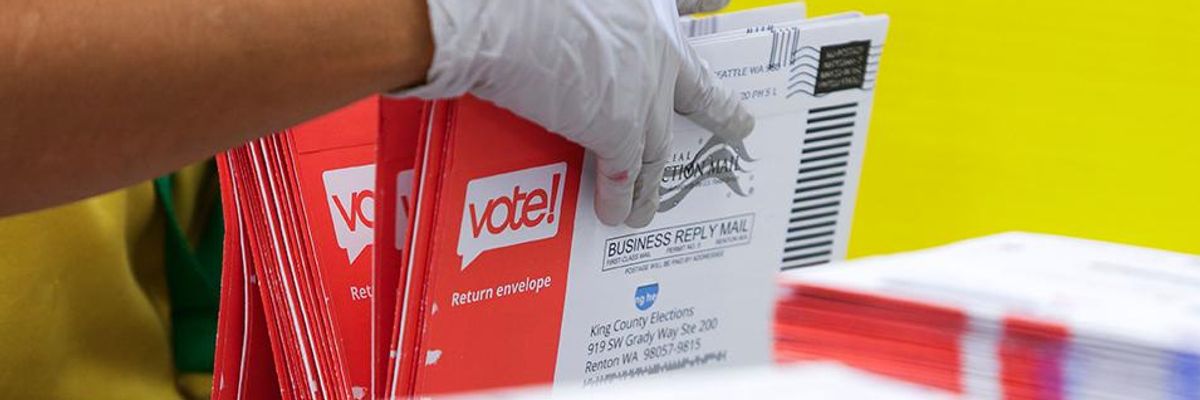
An election worker opens envelopes containing vote-by-mail ballots for the August 4 Washington state primary at King County Elections in Renton, Washington on August 3, 2020. (Photo: Jason Redmond/AFP via Getty Images)
In a win for voting rights advocates, a federal judge Wednesday temporarily blocked a Tennessee law that bars first-time voters from casting their ballots by mail unless they show identification at an election office beforehand.
"This is an important victory for Tennessee voters wishing to participate in the 2020 election that don't want to have to choose between their health and exercising their right to vote," Danielle Lang, co-director of voting rights and redistricting at Campaign Legal Center, said in a press release. "Especially during an election held during a pandemic, it is important that anybody be able to vote by absentee and mail ballot to encourage participation."
According to reporting by the Associated Press, U.S. District Judge Eli Richardson in Nashville ordered the preliminary injunction in the midst of the Covid-19 pandemic, assuring that he did so without concern "about how his decisions could aid one side or the other on the political front." The change must be in place for the November 3 general election, he said.
The Judge Richardson wrote that the state argued for its law, which plaintiffs say affected an estimated 128,000 newly registered voters last election cycle, through "a non-existent" congressional requirement and congressional intent. Tennessee has about 4.1 million registered voters.
Kristen Clarke, president and executive director of the Lawyers' Committee for Civil Rights Under Law, tweeted in celebration of the ruling Wednesday night.
Richardson, appointed to the court by President Donald Trump, had previously ruled against two other requests from plaintiffs in the lawsuit, one that dealt with distribution of absentee voting forms and another relating to the state's signature matching requirement.
"The court concludes that the requested injunction would favorably impact the public interest because as discussed above, it would serve to prevent what, based on the current record, likely would be a violation of the First Amendment right to vote enjoyed by the American citizenry," Richardson wrote.
Richardson's ruling is not the first affecting voting laws in the Volunteer State amidst the Covid-19 pandemic. According to reporting from The Tennessean:
A state court judge in June ordered that all eligible voters should have an absentee voting option during the health crisis, and that ruling was carried out during the Aug. 6 primary. However, the state kept enforcing the first-time voter requirement, which the state judge said the plaintiffs failed to bring up before her ruling.
Then the state Supreme Court overturned the absentee expansion last month, restoring the excuse-based absentee voting system and citing the state's promise--made for the first time in front of the high court--that people can vote by mail if they believe they or someone in their care face a higher risk of Covid-19 due to underlying health conditions.
"The court recognized that forcing voters to choose between voting and their health violates the Constitution," Ezra Rosenberg, co-director of the voting rights project at the Lawyers' Committee for Civil Rights Under Law, said in a statement. "This decision means that first-time voters in Tennessee who registered by mail or online--and there are tens of thousands of them, many of whom are young--can vote in November by mail, without risking their health."
Dear Common Dreams reader, It’s been nearly 30 years since I co-founded Common Dreams with my late wife, Lina Newhouser. We had the radical notion that journalism should serve the public good, not corporate profits. It was clear to us from the outset what it would take to build such a project. No paid advertisements. No corporate sponsors. No millionaire publisher telling us what to think or do. Many people said we wouldn't last a year, but we proved those doubters wrong. Together with a tremendous team of journalists and dedicated staff, we built an independent media outlet free from the constraints of profits and corporate control. Our mission has always been simple: To inform. To inspire. To ignite change for the common good. Building Common Dreams was not easy. Our survival was never guaranteed. When you take on the most powerful forces—Wall Street greed, fossil fuel industry destruction, Big Tech lobbyists, and uber-rich oligarchs who have spent billions upon billions rigging the economy and democracy in their favor—the only bulwark you have is supporters who believe in your work. But here’s the urgent message from me today. It's never been this bad out there. And it's never been this hard to keep us going. At the very moment Common Dreams is most needed, the threats we face are intensifying. We need your support now more than ever. We don't accept corporate advertising and never will. We don't have a paywall because we don't think people should be blocked from critical news based on their ability to pay. Everything we do is funded by the donations of readers like you. When everyone does the little they can afford, we are strong. But if that support retreats or dries up, so do we. Will you donate now to make sure Common Dreams not only survives but thrives? —Craig Brown, Co-founder |
In a win for voting rights advocates, a federal judge Wednesday temporarily blocked a Tennessee law that bars first-time voters from casting their ballots by mail unless they show identification at an election office beforehand.
"This is an important victory for Tennessee voters wishing to participate in the 2020 election that don't want to have to choose between their health and exercising their right to vote," Danielle Lang, co-director of voting rights and redistricting at Campaign Legal Center, said in a press release. "Especially during an election held during a pandemic, it is important that anybody be able to vote by absentee and mail ballot to encourage participation."
According to reporting by the Associated Press, U.S. District Judge Eli Richardson in Nashville ordered the preliminary injunction in the midst of the Covid-19 pandemic, assuring that he did so without concern "about how his decisions could aid one side or the other on the political front." The change must be in place for the November 3 general election, he said.
The Judge Richardson wrote that the state argued for its law, which plaintiffs say affected an estimated 128,000 newly registered voters last election cycle, through "a non-existent" congressional requirement and congressional intent. Tennessee has about 4.1 million registered voters.
Kristen Clarke, president and executive director of the Lawyers' Committee for Civil Rights Under Law, tweeted in celebration of the ruling Wednesday night.
Richardson, appointed to the court by President Donald Trump, had previously ruled against two other requests from plaintiffs in the lawsuit, one that dealt with distribution of absentee voting forms and another relating to the state's signature matching requirement.
"The court concludes that the requested injunction would favorably impact the public interest because as discussed above, it would serve to prevent what, based on the current record, likely would be a violation of the First Amendment right to vote enjoyed by the American citizenry," Richardson wrote.
Richardson's ruling is not the first affecting voting laws in the Volunteer State amidst the Covid-19 pandemic. According to reporting from The Tennessean:
A state court judge in June ordered that all eligible voters should have an absentee voting option during the health crisis, and that ruling was carried out during the Aug. 6 primary. However, the state kept enforcing the first-time voter requirement, which the state judge said the plaintiffs failed to bring up before her ruling.
Then the state Supreme Court overturned the absentee expansion last month, restoring the excuse-based absentee voting system and citing the state's promise--made for the first time in front of the high court--that people can vote by mail if they believe they or someone in their care face a higher risk of Covid-19 due to underlying health conditions.
"The court recognized that forcing voters to choose between voting and their health violates the Constitution," Ezra Rosenberg, co-director of the voting rights project at the Lawyers' Committee for Civil Rights Under Law, said in a statement. "This decision means that first-time voters in Tennessee who registered by mail or online--and there are tens of thousands of them, many of whom are young--can vote in November by mail, without risking their health."
In a win for voting rights advocates, a federal judge Wednesday temporarily blocked a Tennessee law that bars first-time voters from casting their ballots by mail unless they show identification at an election office beforehand.
"This is an important victory for Tennessee voters wishing to participate in the 2020 election that don't want to have to choose between their health and exercising their right to vote," Danielle Lang, co-director of voting rights and redistricting at Campaign Legal Center, said in a press release. "Especially during an election held during a pandemic, it is important that anybody be able to vote by absentee and mail ballot to encourage participation."
According to reporting by the Associated Press, U.S. District Judge Eli Richardson in Nashville ordered the preliminary injunction in the midst of the Covid-19 pandemic, assuring that he did so without concern "about how his decisions could aid one side or the other on the political front." The change must be in place for the November 3 general election, he said.
The Judge Richardson wrote that the state argued for its law, which plaintiffs say affected an estimated 128,000 newly registered voters last election cycle, through "a non-existent" congressional requirement and congressional intent. Tennessee has about 4.1 million registered voters.
Kristen Clarke, president and executive director of the Lawyers' Committee for Civil Rights Under Law, tweeted in celebration of the ruling Wednesday night.
Richardson, appointed to the court by President Donald Trump, had previously ruled against two other requests from plaintiffs in the lawsuit, one that dealt with distribution of absentee voting forms and another relating to the state's signature matching requirement.
"The court concludes that the requested injunction would favorably impact the public interest because as discussed above, it would serve to prevent what, based on the current record, likely would be a violation of the First Amendment right to vote enjoyed by the American citizenry," Richardson wrote.
Richardson's ruling is not the first affecting voting laws in the Volunteer State amidst the Covid-19 pandemic. According to reporting from The Tennessean:
A state court judge in June ordered that all eligible voters should have an absentee voting option during the health crisis, and that ruling was carried out during the Aug. 6 primary. However, the state kept enforcing the first-time voter requirement, which the state judge said the plaintiffs failed to bring up before her ruling.
Then the state Supreme Court overturned the absentee expansion last month, restoring the excuse-based absentee voting system and citing the state's promise--made for the first time in front of the high court--that people can vote by mail if they believe they or someone in their care face a higher risk of Covid-19 due to underlying health conditions.
"The court recognized that forcing voters to choose between voting and their health violates the Constitution," Ezra Rosenberg, co-director of the voting rights project at the Lawyers' Committee for Civil Rights Under Law, said in a statement. "This decision means that first-time voters in Tennessee who registered by mail or online--and there are tens of thousands of them, many of whom are young--can vote in November by mail, without risking their health."