SUBSCRIBE TO OUR FREE NEWSLETTER
Daily news & progressive opinion—funded by the people, not the corporations—delivered straight to your inbox.
5
#000000
#FFFFFF
To donate by check, phone, or other method, see our More Ways to Give page.
Daily news & progressive opinion—funded by the people, not the corporations—delivered straight to your inbox.
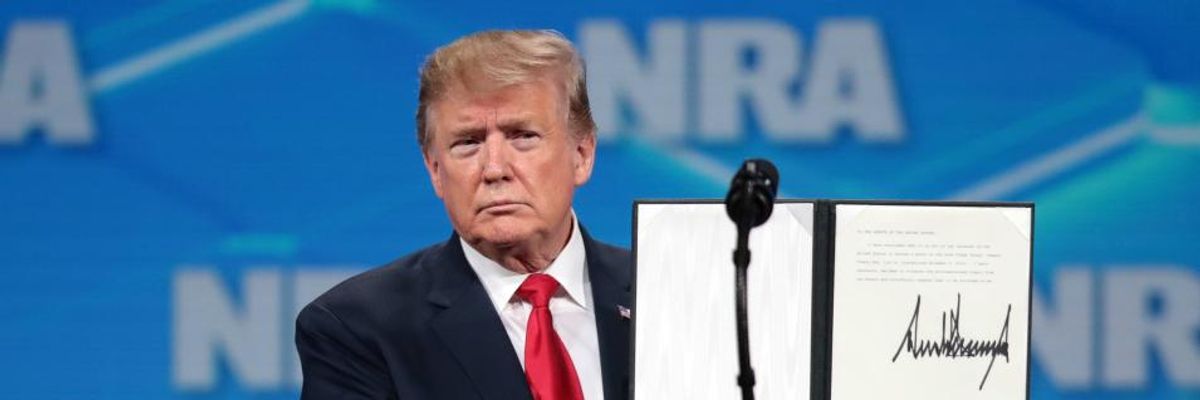
President Donald Trump shows the crowd a signed document rejecting the U.N. Arms Trade Treaty at the NRA-ILA Leadership Forum at the 148th NRA Annual Meetings & Exhibits on April 26, 2019 in Indianapolis, Indiana. (Photo: Scott Olson/Getty Images)
President Donald Trump announced during a speech to the National Rifle Association Friday that he is withdrawing the U.S. from a global arms treaty that aims to restrict the flow of weapons to human rights abusers.
"As the biggest arms exporter, the U.S. signature to the ATT was an important step towards ensuring that dangerous weapons stay out of the wrong hands."
--Adotei Akwei, Amnesty International USA
"I hope you're happy," Trump told the crowd gathered at the NRA's annual convention in Indianapolis as he signed a letter asking the Senate to stop the treaty ratification process.
The Arms Trade Treaty (ATT) was negotiated at the United Nations and signed by former President Barack Obama in 2013, but Congress never ratified the agreement.
Adotei Akwei, deputy director for advocacy and government relations for Amnesty International USA, warned in a statement that the president's move could open the "floodgates for arms sales with weakened human rights criteria, which could potentially fuel brutal conflicts and make everyone less safe."
"This announcement is a misguided blow to efforts to promote international peace and security," said Akwei. "As the biggest arms exporter, the U.S. signature to the ATT was an important step towards ensuring that dangerous weapons stay out of the wrong hands."
Louis Charbonneau, U.N. director for Human Rights Watch, tweeted that the NRA has been working to undermine the treaty and mislead people about its aims from the very beginning.
The NRA has characterized the arms treaty as an attack on the Second Amendment, but Amnesty's Akwei said the ATT "in no way interferes" with the U.S. Constitution.
According to the Washington Post, the ATT "seeks to prevent illicit arms transfers that fuel destructive conflicts, making it harder to conduct weapon sales in violation of arms embargoes. About 100 countries, including U.S. allies in Europe, have ratified the treaty while more than 30 others have signed but not ratified. Countries that have shunned the treaty entirely include Russia, North Korea, and Syria."
Rachel Stohl, managing director of the nonpartisan Stimson Center and former consultant to the ATT negotiations, said Trump's decision to withdraw U.S. support for the treaty is "misguided" and potentially dangerous.
"The ATT was intended prevent the irresponsible and illegal transfer of conventional arms to commit violations of human rights and international humanitarian law," Stohl said in a statement.
"[T]he United States is instead choosing to be in the company of governments that routinely flout responsible transfer controls," Stohl added.
Dear Common Dreams reader, It’s been nearly 30 years since I co-founded Common Dreams with my late wife, Lina Newhouser. We had the radical notion that journalism should serve the public good, not corporate profits. It was clear to us from the outset what it would take to build such a project. No paid advertisements. No corporate sponsors. No millionaire publisher telling us what to think or do. Many people said we wouldn't last a year, but we proved those doubters wrong. Together with a tremendous team of journalists and dedicated staff, we built an independent media outlet free from the constraints of profits and corporate control. Our mission has always been simple: To inform. To inspire. To ignite change for the common good. Building Common Dreams was not easy. Our survival was never guaranteed. When you take on the most powerful forces—Wall Street greed, fossil fuel industry destruction, Big Tech lobbyists, and uber-rich oligarchs who have spent billions upon billions rigging the economy and democracy in their favor—the only bulwark you have is supporters who believe in your work. But here’s the urgent message from me today. It's never been this bad out there. And it's never been this hard to keep us going. At the very moment Common Dreams is most needed, the threats we face are intensifying. We need your support now more than ever. We don't accept corporate advertising and never will. We don't have a paywall because we don't think people should be blocked from critical news based on their ability to pay. Everything we do is funded by the donations of readers like you. When everyone does the little they can afford, we are strong. But if that support retreats or dries up, so do we. Will you donate now to make sure Common Dreams not only survives but thrives? —Craig Brown, Co-founder |
President Donald Trump announced during a speech to the National Rifle Association Friday that he is withdrawing the U.S. from a global arms treaty that aims to restrict the flow of weapons to human rights abusers.
"As the biggest arms exporter, the U.S. signature to the ATT was an important step towards ensuring that dangerous weapons stay out of the wrong hands."
--Adotei Akwei, Amnesty International USA
"I hope you're happy," Trump told the crowd gathered at the NRA's annual convention in Indianapolis as he signed a letter asking the Senate to stop the treaty ratification process.
The Arms Trade Treaty (ATT) was negotiated at the United Nations and signed by former President Barack Obama in 2013, but Congress never ratified the agreement.
Adotei Akwei, deputy director for advocacy and government relations for Amnesty International USA, warned in a statement that the president's move could open the "floodgates for arms sales with weakened human rights criteria, which could potentially fuel brutal conflicts and make everyone less safe."
"This announcement is a misguided blow to efforts to promote international peace and security," said Akwei. "As the biggest arms exporter, the U.S. signature to the ATT was an important step towards ensuring that dangerous weapons stay out of the wrong hands."
Louis Charbonneau, U.N. director for Human Rights Watch, tweeted that the NRA has been working to undermine the treaty and mislead people about its aims from the very beginning.
The NRA has characterized the arms treaty as an attack on the Second Amendment, but Amnesty's Akwei said the ATT "in no way interferes" with the U.S. Constitution.
According to the Washington Post, the ATT "seeks to prevent illicit arms transfers that fuel destructive conflicts, making it harder to conduct weapon sales in violation of arms embargoes. About 100 countries, including U.S. allies in Europe, have ratified the treaty while more than 30 others have signed but not ratified. Countries that have shunned the treaty entirely include Russia, North Korea, and Syria."
Rachel Stohl, managing director of the nonpartisan Stimson Center and former consultant to the ATT negotiations, said Trump's decision to withdraw U.S. support for the treaty is "misguided" and potentially dangerous.
"The ATT was intended prevent the irresponsible and illegal transfer of conventional arms to commit violations of human rights and international humanitarian law," Stohl said in a statement.
"[T]he United States is instead choosing to be in the company of governments that routinely flout responsible transfer controls," Stohl added.
President Donald Trump announced during a speech to the National Rifle Association Friday that he is withdrawing the U.S. from a global arms treaty that aims to restrict the flow of weapons to human rights abusers.
"As the biggest arms exporter, the U.S. signature to the ATT was an important step towards ensuring that dangerous weapons stay out of the wrong hands."
--Adotei Akwei, Amnesty International USA
"I hope you're happy," Trump told the crowd gathered at the NRA's annual convention in Indianapolis as he signed a letter asking the Senate to stop the treaty ratification process.
The Arms Trade Treaty (ATT) was negotiated at the United Nations and signed by former President Barack Obama in 2013, but Congress never ratified the agreement.
Adotei Akwei, deputy director for advocacy and government relations for Amnesty International USA, warned in a statement that the president's move could open the "floodgates for arms sales with weakened human rights criteria, which could potentially fuel brutal conflicts and make everyone less safe."
"This announcement is a misguided blow to efforts to promote international peace and security," said Akwei. "As the biggest arms exporter, the U.S. signature to the ATT was an important step towards ensuring that dangerous weapons stay out of the wrong hands."
Louis Charbonneau, U.N. director for Human Rights Watch, tweeted that the NRA has been working to undermine the treaty and mislead people about its aims from the very beginning.
The NRA has characterized the arms treaty as an attack on the Second Amendment, but Amnesty's Akwei said the ATT "in no way interferes" with the U.S. Constitution.
According to the Washington Post, the ATT "seeks to prevent illicit arms transfers that fuel destructive conflicts, making it harder to conduct weapon sales in violation of arms embargoes. About 100 countries, including U.S. allies in Europe, have ratified the treaty while more than 30 others have signed but not ratified. Countries that have shunned the treaty entirely include Russia, North Korea, and Syria."
Rachel Stohl, managing director of the nonpartisan Stimson Center and former consultant to the ATT negotiations, said Trump's decision to withdraw U.S. support for the treaty is "misguided" and potentially dangerous.
"The ATT was intended prevent the irresponsible and illegal transfer of conventional arms to commit violations of human rights and international humanitarian law," Stohl said in a statement.
"[T]he United States is instead choosing to be in the company of governments that routinely flout responsible transfer controls," Stohl added.