SUBSCRIBE TO OUR FREE NEWSLETTER
Daily news & progressive opinion—funded by the people, not the corporations—delivered straight to your inbox.
5
#000000
#FFFFFF
To donate by check, phone, or other method, see our More Ways to Give page.
Daily news & progressive opinion—funded by the people, not the corporations—delivered straight to your inbox.
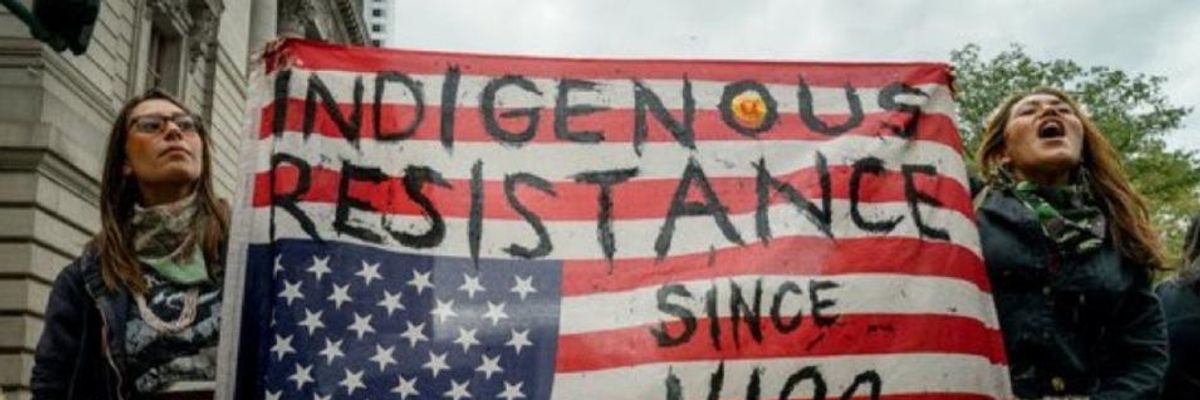
Cities across the U.S. celebrated Indigenous People's Day on Monday, opting not to observe Columbus Day. (Photo: @MoBetter_B/Twitter)
As cities across the United States aim to honor the millions of people who lived on the North American continent for centuries before they faced the persecution of European explorers who arrived to claim the land as their own, many local governments marked Indigenous People's Day on Monday.
Indigenous activists applauded the move as they urged Americans to also acknowledge the battles First Nations groups are fighting in the present day.
"Formerly known as Columbus Day, today is Indigenous Peoples Day in more than 80 (and counting) cities, counties, and states," wrote Jade Begay and Dallas Goldtooth in Sierra magazine. "Christopher Columbus was not a hero, he was a murderer. The land we all exist on is stolen. The history we've been taught is not accurate or complete. And perhaps most important among those truths, Indigenous lands are still being colonized, and our people are still suffering the trauma and impacts of colonization."
San Francisco and Cincinnati, Ohio were among the cities that celebrated Indigenous Peoples Day for the first time this year.
"San Francisco has a responsibility to oppose the systematic racism towards indigenous peoples in the United States, which perpetuates high rates of poverty and income inequality, exacerbating health, education, and social crises among Native Americans," read a measure that passed earlier this year, calling for San Francisco to replace Columbus Day.
Begay and Goldtooth and urged those marking the day to support indigenous groups fighting fossil fuel industries, high rates of violence, and other rights violations as they work to protect the land they've inhabited for centuries:
Across the country we continue to see the violation of our right and treaties as extractive projects are proposed and constructed. Across the nation, we continue to grieve our missing and murdered Indigenous women, victims of violence brought to their communities by extractive oil and mining projects. We continue bear the brunt of climate change as our food sovereignty is threatened by dying ecosystems and as our animal relatives are becoming extinct due to land loss, warmer seasons, and/or contamination. And now, we are fighting for the very right to resist as anti-protest laws emerge across the country, which aim to criminalize our people for protecting what is most sacred to us.
The authors called on supporters to embrace "three frameworks that move our fight for indigenous rights forward"--intersectionality, indigenous feminism, and efforts to "change the story" about indigenous people.
"We have all been affected by capitalism, colonization and white supremacy. As such, it's going to take all of us--native and non-native alike--to dismantle these systems of oppression," wrote Begay and Goldtooth. "However, white allies in particular must be held accountable for their role in the dismantling of white supremacy and extractive economies."
President Donald Trump's comments on the holiday contrasted with the attitudes of a growing segment of the American population, as he tweeted about Columbus's "spirit of determination and adventure," with no mention in his presidential proclamation of the indigenous people who were enslaved and subjected to genocide by Europeans. His comments were met by condemnation on social media.
Dear Common Dreams reader, It’s been nearly 30 years since I co-founded Common Dreams with my late wife, Lina Newhouser. We had the radical notion that journalism should serve the public good, not corporate profits. It was clear to us from the outset what it would take to build such a project. No paid advertisements. No corporate sponsors. No millionaire publisher telling us what to think or do. Many people said we wouldn't last a year, but we proved those doubters wrong. Together with a tremendous team of journalists and dedicated staff, we built an independent media outlet free from the constraints of profits and corporate control. Our mission has always been simple: To inform. To inspire. To ignite change for the common good. Building Common Dreams was not easy. Our survival was never guaranteed. When you take on the most powerful forces—Wall Street greed, fossil fuel industry destruction, Big Tech lobbyists, and uber-rich oligarchs who have spent billions upon billions rigging the economy and democracy in their favor—the only bulwark you have is supporters who believe in your work. But here’s the urgent message from me today. It's never been this bad out there. And it's never been this hard to keep us going. At the very moment Common Dreams is most needed, the threats we face are intensifying. We need your support now more than ever. We don't accept corporate advertising and never will. We don't have a paywall because we don't think people should be blocked from critical news based on their ability to pay. Everything we do is funded by the donations of readers like you. When everyone does the little they can afford, we are strong. But if that support retreats or dries up, so do we. Will you donate now to make sure Common Dreams not only survives but thrives? —Craig Brown, Co-founder |
As cities across the United States aim to honor the millions of people who lived on the North American continent for centuries before they faced the persecution of European explorers who arrived to claim the land as their own, many local governments marked Indigenous People's Day on Monday.
Indigenous activists applauded the move as they urged Americans to also acknowledge the battles First Nations groups are fighting in the present day.
"Formerly known as Columbus Day, today is Indigenous Peoples Day in more than 80 (and counting) cities, counties, and states," wrote Jade Begay and Dallas Goldtooth in Sierra magazine. "Christopher Columbus was not a hero, he was a murderer. The land we all exist on is stolen. The history we've been taught is not accurate or complete. And perhaps most important among those truths, Indigenous lands are still being colonized, and our people are still suffering the trauma and impacts of colonization."
San Francisco and Cincinnati, Ohio were among the cities that celebrated Indigenous Peoples Day for the first time this year.
"San Francisco has a responsibility to oppose the systematic racism towards indigenous peoples in the United States, which perpetuates high rates of poverty and income inequality, exacerbating health, education, and social crises among Native Americans," read a measure that passed earlier this year, calling for San Francisco to replace Columbus Day.
Begay and Goldtooth and urged those marking the day to support indigenous groups fighting fossil fuel industries, high rates of violence, and other rights violations as they work to protect the land they've inhabited for centuries:
Across the country we continue to see the violation of our right and treaties as extractive projects are proposed and constructed. Across the nation, we continue to grieve our missing and murdered Indigenous women, victims of violence brought to their communities by extractive oil and mining projects. We continue bear the brunt of climate change as our food sovereignty is threatened by dying ecosystems and as our animal relatives are becoming extinct due to land loss, warmer seasons, and/or contamination. And now, we are fighting for the very right to resist as anti-protest laws emerge across the country, which aim to criminalize our people for protecting what is most sacred to us.
The authors called on supporters to embrace "three frameworks that move our fight for indigenous rights forward"--intersectionality, indigenous feminism, and efforts to "change the story" about indigenous people.
"We have all been affected by capitalism, colonization and white supremacy. As such, it's going to take all of us--native and non-native alike--to dismantle these systems of oppression," wrote Begay and Goldtooth. "However, white allies in particular must be held accountable for their role in the dismantling of white supremacy and extractive economies."
President Donald Trump's comments on the holiday contrasted with the attitudes of a growing segment of the American population, as he tweeted about Columbus's "spirit of determination and adventure," with no mention in his presidential proclamation of the indigenous people who were enslaved and subjected to genocide by Europeans. His comments were met by condemnation on social media.
As cities across the United States aim to honor the millions of people who lived on the North American continent for centuries before they faced the persecution of European explorers who arrived to claim the land as their own, many local governments marked Indigenous People's Day on Monday.
Indigenous activists applauded the move as they urged Americans to also acknowledge the battles First Nations groups are fighting in the present day.
"Formerly known as Columbus Day, today is Indigenous Peoples Day in more than 80 (and counting) cities, counties, and states," wrote Jade Begay and Dallas Goldtooth in Sierra magazine. "Christopher Columbus was not a hero, he was a murderer. The land we all exist on is stolen. The history we've been taught is not accurate or complete. And perhaps most important among those truths, Indigenous lands are still being colonized, and our people are still suffering the trauma and impacts of colonization."
San Francisco and Cincinnati, Ohio were among the cities that celebrated Indigenous Peoples Day for the first time this year.
"San Francisco has a responsibility to oppose the systematic racism towards indigenous peoples in the United States, which perpetuates high rates of poverty and income inequality, exacerbating health, education, and social crises among Native Americans," read a measure that passed earlier this year, calling for San Francisco to replace Columbus Day.
Begay and Goldtooth and urged those marking the day to support indigenous groups fighting fossil fuel industries, high rates of violence, and other rights violations as they work to protect the land they've inhabited for centuries:
Across the country we continue to see the violation of our right and treaties as extractive projects are proposed and constructed. Across the nation, we continue to grieve our missing and murdered Indigenous women, victims of violence brought to their communities by extractive oil and mining projects. We continue bear the brunt of climate change as our food sovereignty is threatened by dying ecosystems and as our animal relatives are becoming extinct due to land loss, warmer seasons, and/or contamination. And now, we are fighting for the very right to resist as anti-protest laws emerge across the country, which aim to criminalize our people for protecting what is most sacred to us.
The authors called on supporters to embrace "three frameworks that move our fight for indigenous rights forward"--intersectionality, indigenous feminism, and efforts to "change the story" about indigenous people.
"We have all been affected by capitalism, colonization and white supremacy. As such, it's going to take all of us--native and non-native alike--to dismantle these systems of oppression," wrote Begay and Goldtooth. "However, white allies in particular must be held accountable for their role in the dismantling of white supremacy and extractive economies."
President Donald Trump's comments on the holiday contrasted with the attitudes of a growing segment of the American population, as he tweeted about Columbus's "spirit of determination and adventure," with no mention in his presidential proclamation of the indigenous people who were enslaved and subjected to genocide by Europeans. His comments were met by condemnation on social media.