SUBSCRIBE TO OUR FREE NEWSLETTER
Daily news & progressive opinion—funded by the people, not the corporations—delivered straight to your inbox.
5
#000000
#FFFFFF
To donate by check, phone, or other method, see our More Ways to Give page.
Daily news & progressive opinion—funded by the people, not the corporations—delivered straight to your inbox.
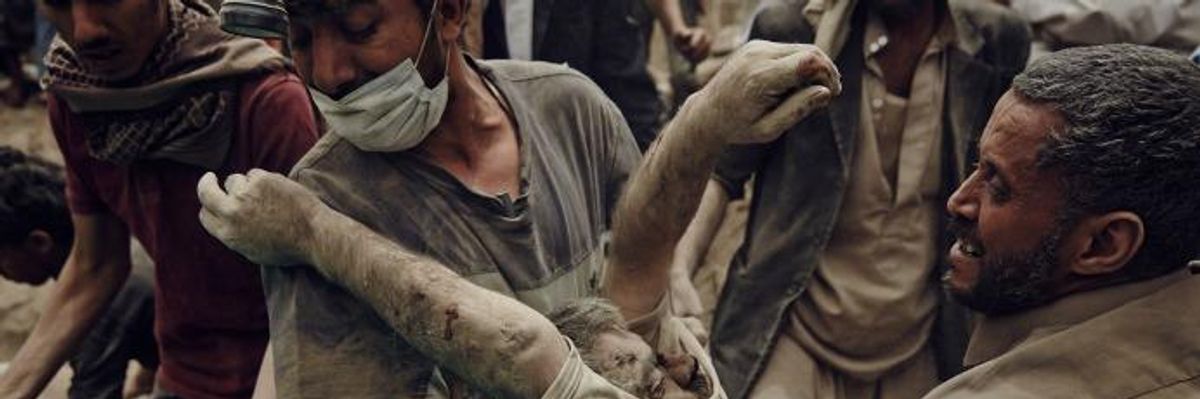
On June 12, 2017, people carry the dead body of a man that was killed when four houses were destroyed in the historical old city of Sana'a by what witnesses described as a missile or bomb from a Saudi Arabian warplane overheard. On Wednesday, dozens of civilians are reported dead after the Saudis bombed a hotel in the city. (Photo by Sebastiano Tomada/Getty Images Reportage Reportage)
An airstrike by the U.S.-backed Saudi-led coalition on a hotel near the Yemeni capital Sanaa killed dozens of people on Wednesday, multiple news agencies have reported, as a "man made" humanitarian crisis extends its grip on the impoverished nation.
"Each day that passes brings more suffering to the unbearable lives of the Yemeni people."
--Shane Stevenson, Oxfam InternationalA local medic estimated the number of those killed at 35, Reuters reports. The Associated Press reports that the number may be as high as 60, citing officials and witnesses.
Since March 2015, Saudi-led forces backing the current Yemeni government have waged a military campaign against Houthi forces, with the U.K. and U.S. fueling the war with millions in arms sales as well as logistical support to ally Saudi Arabia. The United Nations estimates the conflict has killed over 10,000 civilians.
Whether the latest additions to the death toll are civilians remains unclear. A doctor helping with the rescue efforts told AP that all those killed were farmers. A spokesperson for the Saudi coalition said it was a legitimate military target, Reuters reports.
The New York Times adds:
Saudi officials have insisted their aircraft avoid civilian targets, but hospitals, schools and other civilian facilities have been struck by Saudi warplanes. Last October, the coalition confirmed that one of its jets had accidentally bombed a wedding party in Sana, killing 100 people.
Any survivors of the airstrike face dim prospects, as the country suffers the largest cholera epidemic in the world--there have been over half a million cases--and faces decimated health infrastructure.
The war, now in its third year, and the cholera epidemic, combined with looming famine have created a trifecta of horrors for Yemenis--all of which have been made more deadly due to an ongoing embargo by the Saudis
From BBC News:
[The] blockade imposed onYemen since 2015 by the Saudi-led coalition has reduced the amount of food, aid and fuel allowed into the country to a trickle.
The little that does make it in by sea often spends weeks waiting to be offloaded because the cranes at Hudaydah [also written Hodeidah}--once Yemen's busiest port--have been bombed beyond use or repair.
When new cranes were donated by the U.S. government to the U.N.'s World Food Programme (WFP) last December, they were stopped at sea by the coalition and refused entry.
In the story that aired on BBC Tuesday night, the main working hospital in Hudaydah offered a bleak look at just how bad things have become in the war-torn country. In the final scene, the family whose son has just died from malnutrition asks the camera crew to keep cameras rolling so that the world will see just how much suffering is being endured:
United Nations aid chief Stephen O'Brien urged this month for "all ports--land, sea, and air--[to be ] open to civilian--including commercial--traffic," and called for "desperately needed mobile cranes to Hudaydah port, which handles some 70 percent of imports into Yemen and is the closest port of entry to the majority of people who need humanitarian assistance."
"Each day that passes brings more suffering to the unbearable lives of the Yemeni people," said Shane Stevenson, Oxfam's Country Director in Yemen. "The world is shamefully failing them. A new disaster after another is leading to a man-made catastrophe in Yemen and thousands of people face stark live or die choices every day. What more needs to happen in Yemen for the international community to properly respond?"
Dear Common Dreams reader, It’s been nearly 30 years since I co-founded Common Dreams with my late wife, Lina Newhouser. We had the radical notion that journalism should serve the public good, not corporate profits. It was clear to us from the outset what it would take to build such a project. No paid advertisements. No corporate sponsors. No millionaire publisher telling us what to think or do. Many people said we wouldn't last a year, but we proved those doubters wrong. Together with a tremendous team of journalists and dedicated staff, we built an independent media outlet free from the constraints of profits and corporate control. Our mission has always been simple: To inform. To inspire. To ignite change for the common good. Building Common Dreams was not easy. Our survival was never guaranteed. When you take on the most powerful forces—Wall Street greed, fossil fuel industry destruction, Big Tech lobbyists, and uber-rich oligarchs who have spent billions upon billions rigging the economy and democracy in their favor—the only bulwark you have is supporters who believe in your work. But here’s the urgent message from me today. It's never been this bad out there. And it's never been this hard to keep us going. At the very moment Common Dreams is most needed, the threats we face are intensifying. We need your support now more than ever. We don't accept corporate advertising and never will. We don't have a paywall because we don't think people should be blocked from critical news based on their ability to pay. Everything we do is funded by the donations of readers like you. When everyone does the little they can afford, we are strong. But if that support retreats or dries up, so do we. Will you donate now to make sure Common Dreams not only survives but thrives? —Craig Brown, Co-founder |
An airstrike by the U.S.-backed Saudi-led coalition on a hotel near the Yemeni capital Sanaa killed dozens of people on Wednesday, multiple news agencies have reported, as a "man made" humanitarian crisis extends its grip on the impoverished nation.
"Each day that passes brings more suffering to the unbearable lives of the Yemeni people."
--Shane Stevenson, Oxfam InternationalA local medic estimated the number of those killed at 35, Reuters reports. The Associated Press reports that the number may be as high as 60, citing officials and witnesses.
Since March 2015, Saudi-led forces backing the current Yemeni government have waged a military campaign against Houthi forces, with the U.K. and U.S. fueling the war with millions in arms sales as well as logistical support to ally Saudi Arabia. The United Nations estimates the conflict has killed over 10,000 civilians.
Whether the latest additions to the death toll are civilians remains unclear. A doctor helping with the rescue efforts told AP that all those killed were farmers. A spokesperson for the Saudi coalition said it was a legitimate military target, Reuters reports.
The New York Times adds:
Saudi officials have insisted their aircraft avoid civilian targets, but hospitals, schools and other civilian facilities have been struck by Saudi warplanes. Last October, the coalition confirmed that one of its jets had accidentally bombed a wedding party in Sana, killing 100 people.
Any survivors of the airstrike face dim prospects, as the country suffers the largest cholera epidemic in the world--there have been over half a million cases--and faces decimated health infrastructure.
The war, now in its third year, and the cholera epidemic, combined with looming famine have created a trifecta of horrors for Yemenis--all of which have been made more deadly due to an ongoing embargo by the Saudis
From BBC News:
[The] blockade imposed onYemen since 2015 by the Saudi-led coalition has reduced the amount of food, aid and fuel allowed into the country to a trickle.
The little that does make it in by sea often spends weeks waiting to be offloaded because the cranes at Hudaydah [also written Hodeidah}--once Yemen's busiest port--have been bombed beyond use or repair.
When new cranes were donated by the U.S. government to the U.N.'s World Food Programme (WFP) last December, they were stopped at sea by the coalition and refused entry.
In the story that aired on BBC Tuesday night, the main working hospital in Hudaydah offered a bleak look at just how bad things have become in the war-torn country. In the final scene, the family whose son has just died from malnutrition asks the camera crew to keep cameras rolling so that the world will see just how much suffering is being endured:
United Nations aid chief Stephen O'Brien urged this month for "all ports--land, sea, and air--[to be ] open to civilian--including commercial--traffic," and called for "desperately needed mobile cranes to Hudaydah port, which handles some 70 percent of imports into Yemen and is the closest port of entry to the majority of people who need humanitarian assistance."
"Each day that passes brings more suffering to the unbearable lives of the Yemeni people," said Shane Stevenson, Oxfam's Country Director in Yemen. "The world is shamefully failing them. A new disaster after another is leading to a man-made catastrophe in Yemen and thousands of people face stark live or die choices every day. What more needs to happen in Yemen for the international community to properly respond?"
An airstrike by the U.S.-backed Saudi-led coalition on a hotel near the Yemeni capital Sanaa killed dozens of people on Wednesday, multiple news agencies have reported, as a "man made" humanitarian crisis extends its grip on the impoverished nation.
"Each day that passes brings more suffering to the unbearable lives of the Yemeni people."
--Shane Stevenson, Oxfam InternationalA local medic estimated the number of those killed at 35, Reuters reports. The Associated Press reports that the number may be as high as 60, citing officials and witnesses.
Since March 2015, Saudi-led forces backing the current Yemeni government have waged a military campaign against Houthi forces, with the U.K. and U.S. fueling the war with millions in arms sales as well as logistical support to ally Saudi Arabia. The United Nations estimates the conflict has killed over 10,000 civilians.
Whether the latest additions to the death toll are civilians remains unclear. A doctor helping with the rescue efforts told AP that all those killed were farmers. A spokesperson for the Saudi coalition said it was a legitimate military target, Reuters reports.
The New York Times adds:
Saudi officials have insisted their aircraft avoid civilian targets, but hospitals, schools and other civilian facilities have been struck by Saudi warplanes. Last October, the coalition confirmed that one of its jets had accidentally bombed a wedding party in Sana, killing 100 people.
Any survivors of the airstrike face dim prospects, as the country suffers the largest cholera epidemic in the world--there have been over half a million cases--and faces decimated health infrastructure.
The war, now in its third year, and the cholera epidemic, combined with looming famine have created a trifecta of horrors for Yemenis--all of which have been made more deadly due to an ongoing embargo by the Saudis
From BBC News:
[The] blockade imposed onYemen since 2015 by the Saudi-led coalition has reduced the amount of food, aid and fuel allowed into the country to a trickle.
The little that does make it in by sea often spends weeks waiting to be offloaded because the cranes at Hudaydah [also written Hodeidah}--once Yemen's busiest port--have been bombed beyond use or repair.
When new cranes were donated by the U.S. government to the U.N.'s World Food Programme (WFP) last December, they were stopped at sea by the coalition and refused entry.
In the story that aired on BBC Tuesday night, the main working hospital in Hudaydah offered a bleak look at just how bad things have become in the war-torn country. In the final scene, the family whose son has just died from malnutrition asks the camera crew to keep cameras rolling so that the world will see just how much suffering is being endured:
United Nations aid chief Stephen O'Brien urged this month for "all ports--land, sea, and air--[to be ] open to civilian--including commercial--traffic," and called for "desperately needed mobile cranes to Hudaydah port, which handles some 70 percent of imports into Yemen and is the closest port of entry to the majority of people who need humanitarian assistance."
"Each day that passes brings more suffering to the unbearable lives of the Yemeni people," said Shane Stevenson, Oxfam's Country Director in Yemen. "The world is shamefully failing them. A new disaster after another is leading to a man-made catastrophe in Yemen and thousands of people face stark live or die choices every day. What more needs to happen in Yemen for the international community to properly respond?"