SUBSCRIBE TO OUR FREE NEWSLETTER
Daily news & progressive opinion—funded by the people, not the corporations—delivered straight to your inbox.
5
#000000
#FFFFFF
To donate by check, phone, or other method, see our More Ways to Give page.
Daily news & progressive opinion—funded by the people, not the corporations—delivered straight to your inbox.
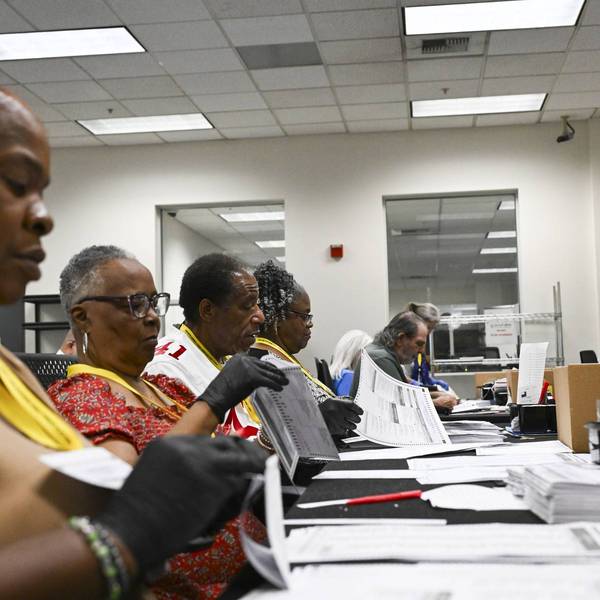
Voting rights advocates are crying foul after a Reuters investigation revealed that the U.S. Department of Justice (DOJ) is scaling back its deployment of election observers during this year's presidential election.
According to Reuters, which saw a DOJ fact sheet outlining the plan, the changes represent more fallout from the U.S. Supreme Court's 2013 decision in Shelby County, Alabama v. Holder, which struck down parts of the 1965 Voting Rights Act (VRA).
Reuters explains:
The Supreme Court ruling undercut a key section of the Act that requires such states to obtain U.S. approval before changing election laws. The court struck down the formula used to determine which states were affected.
By doing so, it ended the Justice Department's ability to select voting areas it deemed at risk of racial discrimination and deploy observers there, the fact sheet said.
Eleven mostly Southern states had been certified as needing federal observers by the department.
Federal observers can still be sent to monitor elections but only when authorized by federal court rulings. Currently, courts have done so in five states: Alabama, Alaska, California, Louisiana, and New York, according to the Justice Department.
Meanwhile, as Common Dreams has reported, state and local threats to voting rights have exploded in the three years since the Shelby ruling. According to the Brennan Center for Justice, 17 states will have restrictive voting laws in effect for the first time in a presidential election in 2016.
In turn, voting rights advocates say federal election observers--who are authorized to report from inside polling places, gathering evidence of unlawful activity, such as intimidation or failure to provide people with voting materials in their language, that can be used as evidence in court--are more important than ever.
"Election monitors play a critical role in protecting voting rights, especially for voters of color and others who have historically been vulnerable to rampant voting discrimination," said Wade Henderson, president and CEO of the Leadership Conference on Civil and Human Rights, which is among several groups urging Congress to restore the VRA.
"This news creates an open invitation for more voting discrimination and voter suppression to go unchecked in the November election, particularly in those states and local jurisdictions with a history of voting discrimination that, before the Shelby County decision, would have federal election monitors there to document discriminatory voting behavior," he said.
Indeed, said Kristen Clarke, president and executive director of the Lawyers' Committee for Civil Rights Under Law: "The Justice Department's decision to terminate the core component of its federal observer program has a significant impact on the 2016 election landscape."
"Federal observers helped to block and deter discriminatory conduct that might otherwise go undetected," Clarke said. "Without federal observers, greater vigilance will be required to fight voter suppression and discrimination at the polls."
The Lawyers' Committee said that in response to the DOJ's decision, it will expand its nonpartisan election monitoring program, which works to expand voter access through monitors stationed outside polling sites and through its 866-OUR-VOTE hotline.
Dear Common Dreams reader, It’s been nearly 30 years since I co-founded Common Dreams with my late wife, Lina Newhouser. We had the radical notion that journalism should serve the public good, not corporate profits. It was clear to us from the outset what it would take to build such a project. No paid advertisements. No corporate sponsors. No millionaire publisher telling us what to think or do. Many people said we wouldn't last a year, but we proved those doubters wrong. Together with a tremendous team of journalists and dedicated staff, we built an independent media outlet free from the constraints of profits and corporate control. Our mission has always been simple: To inform. To inspire. To ignite change for the common good. Building Common Dreams was not easy. Our survival was never guaranteed. When you take on the most powerful forces—Wall Street greed, fossil fuel industry destruction, Big Tech lobbyists, and uber-rich oligarchs who have spent billions upon billions rigging the economy and democracy in their favor—the only bulwark you have is supporters who believe in your work. But here’s the urgent message from me today. It's never been this bad out there. And it's never been this hard to keep us going. At the very moment Common Dreams is most needed, the threats we face are intensifying. We need your support now more than ever. We don't accept corporate advertising and never will. We don't have a paywall because we don't think people should be blocked from critical news based on their ability to pay. Everything we do is funded by the donations of readers like you. When everyone does the little they can afford, we are strong. But if that support retreats or dries up, so do we. Will you donate now to make sure Common Dreams not only survives but thrives? —Craig Brown, Co-founder |
Voting rights advocates are crying foul after a Reuters investigation revealed that the U.S. Department of Justice (DOJ) is scaling back its deployment of election observers during this year's presidential election.
According to Reuters, which saw a DOJ fact sheet outlining the plan, the changes represent more fallout from the U.S. Supreme Court's 2013 decision in Shelby County, Alabama v. Holder, which struck down parts of the 1965 Voting Rights Act (VRA).
Reuters explains:
The Supreme Court ruling undercut a key section of the Act that requires such states to obtain U.S. approval before changing election laws. The court struck down the formula used to determine which states were affected.
By doing so, it ended the Justice Department's ability to select voting areas it deemed at risk of racial discrimination and deploy observers there, the fact sheet said.
Eleven mostly Southern states had been certified as needing federal observers by the department.
Federal observers can still be sent to monitor elections but only when authorized by federal court rulings. Currently, courts have done so in five states: Alabama, Alaska, California, Louisiana, and New York, according to the Justice Department.
Meanwhile, as Common Dreams has reported, state and local threats to voting rights have exploded in the three years since the Shelby ruling. According to the Brennan Center for Justice, 17 states will have restrictive voting laws in effect for the first time in a presidential election in 2016.
In turn, voting rights advocates say federal election observers--who are authorized to report from inside polling places, gathering evidence of unlawful activity, such as intimidation or failure to provide people with voting materials in their language, that can be used as evidence in court--are more important than ever.
"Election monitors play a critical role in protecting voting rights, especially for voters of color and others who have historically been vulnerable to rampant voting discrimination," said Wade Henderson, president and CEO of the Leadership Conference on Civil and Human Rights, which is among several groups urging Congress to restore the VRA.
"This news creates an open invitation for more voting discrimination and voter suppression to go unchecked in the November election, particularly in those states and local jurisdictions with a history of voting discrimination that, before the Shelby County decision, would have federal election monitors there to document discriminatory voting behavior," he said.
Indeed, said Kristen Clarke, president and executive director of the Lawyers' Committee for Civil Rights Under Law: "The Justice Department's decision to terminate the core component of its federal observer program has a significant impact on the 2016 election landscape."
"Federal observers helped to block and deter discriminatory conduct that might otherwise go undetected," Clarke said. "Without federal observers, greater vigilance will be required to fight voter suppression and discrimination at the polls."
The Lawyers' Committee said that in response to the DOJ's decision, it will expand its nonpartisan election monitoring program, which works to expand voter access through monitors stationed outside polling sites and through its 866-OUR-VOTE hotline.
Voting rights advocates are crying foul after a Reuters investigation revealed that the U.S. Department of Justice (DOJ) is scaling back its deployment of election observers during this year's presidential election.
According to Reuters, which saw a DOJ fact sheet outlining the plan, the changes represent more fallout from the U.S. Supreme Court's 2013 decision in Shelby County, Alabama v. Holder, which struck down parts of the 1965 Voting Rights Act (VRA).
Reuters explains:
The Supreme Court ruling undercut a key section of the Act that requires such states to obtain U.S. approval before changing election laws. The court struck down the formula used to determine which states were affected.
By doing so, it ended the Justice Department's ability to select voting areas it deemed at risk of racial discrimination and deploy observers there, the fact sheet said.
Eleven mostly Southern states had been certified as needing federal observers by the department.
Federal observers can still be sent to monitor elections but only when authorized by federal court rulings. Currently, courts have done so in five states: Alabama, Alaska, California, Louisiana, and New York, according to the Justice Department.
Meanwhile, as Common Dreams has reported, state and local threats to voting rights have exploded in the three years since the Shelby ruling. According to the Brennan Center for Justice, 17 states will have restrictive voting laws in effect for the first time in a presidential election in 2016.
In turn, voting rights advocates say federal election observers--who are authorized to report from inside polling places, gathering evidence of unlawful activity, such as intimidation or failure to provide people with voting materials in their language, that can be used as evidence in court--are more important than ever.
"Election monitors play a critical role in protecting voting rights, especially for voters of color and others who have historically been vulnerable to rampant voting discrimination," said Wade Henderson, president and CEO of the Leadership Conference on Civil and Human Rights, which is among several groups urging Congress to restore the VRA.
"This news creates an open invitation for more voting discrimination and voter suppression to go unchecked in the November election, particularly in those states and local jurisdictions with a history of voting discrimination that, before the Shelby County decision, would have federal election monitors there to document discriminatory voting behavior," he said.
Indeed, said Kristen Clarke, president and executive director of the Lawyers' Committee for Civil Rights Under Law: "The Justice Department's decision to terminate the core component of its federal observer program has a significant impact on the 2016 election landscape."
"Federal observers helped to block and deter discriminatory conduct that might otherwise go undetected," Clarke said. "Without federal observers, greater vigilance will be required to fight voter suppression and discrimination at the polls."
The Lawyers' Committee said that in response to the DOJ's decision, it will expand its nonpartisan election monitoring program, which works to expand voter access through monitors stationed outside polling sites and through its 866-OUR-VOTE hotline.