SUBSCRIBE TO OUR FREE NEWSLETTER
Daily news & progressive opinion—funded by the people, not the corporations—delivered straight to your inbox.
5
#000000
#FFFFFF
To donate by check, phone, or other method, see our More Ways to Give page.
In an interview during Nancy Reagan's funeral on Friday, Hillary Clinton credited the former first lady and President Ronald Reagan with starting a "national conversation" on HIV and AIDS at a time when "no one wanted to talk about it."
"And, you know, that too is something that I really appreciate was her very effective but low-key advocacy," Clinton said, "but it penetrated the public conscience, and people began to say 'hey we have to do something about this too'."
Watch:
Her remarks resounded across the internet, as journalists, activists, and social media users pointed out that Reagan's legacy on AIDS was, in fact, disastrous.
Journalist Glenn Greenwald tweeted, "this is offensive, revisionist bullshit."
Dan Savage, a prominent LGBTQI activist and advice columnist, wrote in a post for The Stranger:
That is a fucking lie. You could only say the Reagans started "a national conversation" about AIDS if terrified, desperate, and dying people screaming "WHY AREN'T YOU SAYING OR DOING ANYTHING ABOUT AIDS!" at the Reagans counts. It does not count.
[...] We watched our friends and lovers die by the tens of thousands while Nancy and Ronnie sat silently in theWhite House.
At the New Republic, reporter Gwyneth Kelly added:
Just how "low-key" was Nancy's advocacy? So low-key that most people would characterize it as not advocacy at all. After the disease's first cases were identified in 1981, President Reagan waited until 1987, almost at the end of his second term, to speak publicly about the disease. His communications director, Pat Buchanan, described AIDS as "nature's revenge on gay men."
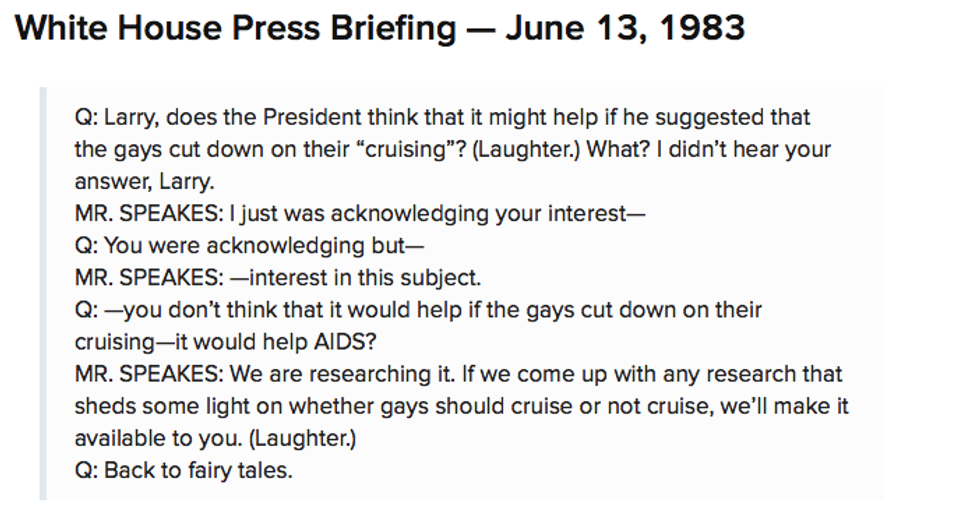
Buzzfeed also published transcripts of numerous White House press conferences during the early 1980s--at the height of the epidemic--in which Reagan's press secretary, Larry Speakes, laughed off questions on whether the president would address the AIDS crisis.
Reagan would wait seven years to do so. In the meantime, Nancy in 1985 rejected a request to help move actor Rock Hudson, then dying of AIDS, to a French military hospital where he would be able to receive treatment. Hudson, a friend of the Reagans, had asked for their assistance because he was not a French citizen.
A 1992 Vanity Fair profile of Elizabeth Taylor described how the Reagans responded to Hudson:
One of Taylor's first letters went to Nancy Reagan, suggesting she might want to get involved with AIDS. The First Lady's response was frosty. President Reagan had yet to publicly utter the word 'AIDS'--"not even when he spoke to Rock Hudson on the telephone,' says Krim. 'Before Hudson admitted he had AIDS, he'd said he had hepatitis, so when Reagan called Hudson before he died, Reagan referred to his hepatitis.'
Many on Friday were also insulted by Clinton's use of the term "national conversation."
Richard Socarides, a former White House adviser on LGBTQI issues to President Bill Clinton, told the Associated Press earlier this week, "[W]hen the country needed leadership, President Reagan was not there, and his wife--who was able to do more--was not willing to step up. It reflects rather harshly on both of them."
Kevin Catchart, executive director of the rights group Lambda Legal, added, "Shameful is not even strong enough a word for the record of the Reagan administration on this."
Update:
Following the public reaction and widespread outrage, Clinton attempted to walk back the comments and issued the following statement later on Friday:
In an interview during Nancy Reagan's funeral on Friday, Hillary Clinton credited the former first lady and President Ronald Reagan with starting a "national conversation" on HIV and AIDS at a time when "no one wanted to talk about it."
"And, you know, that too is something that I really appreciate was her very effective but low-key advocacy," Clinton said, "but it penetrated the public conscience, and people began to say 'hey we have to do something about this too'."
Watch:
Her remarks resounded across the internet, as journalists, activists, and social media users pointed out that Reagan's legacy on AIDS was, in fact, disastrous.
Journalist Glenn Greenwald tweeted, "this is offensive, revisionist bullshit."
Dan Savage, a prominent LGBTQI activist and advice columnist, wrote in a post for The Stranger:
That is a fucking lie. You could only say the Reagans started "a national conversation" about AIDS if terrified, desperate, and dying people screaming "WHY AREN'T YOU SAYING OR DOING ANYTHING ABOUT AIDS!" at the Reagans counts. It does not count.
[...] We watched our friends and lovers die by the tens of thousands while Nancy and Ronnie sat silently in theWhite House.
At the New Republic, reporter Gwyneth Kelly added:
Just how "low-key" was Nancy's advocacy? So low-key that most people would characterize it as not advocacy at all. After the disease's first cases were identified in 1981, President Reagan waited until 1987, almost at the end of his second term, to speak publicly about the disease. His communications director, Pat Buchanan, described AIDS as "nature's revenge on gay men."
Buzzfeed also published transcripts of numerous White House press conferences during the early 1980s--at the height of the epidemic--in which Reagan's press secretary, Larry Speakes, laughed off questions on whether the president would address the AIDS crisis.
Reagan would wait seven years to do so. In the meantime, Nancy in 1985 rejected a request to help move actor Rock Hudson, then dying of AIDS, to a French military hospital where he would be able to receive treatment. Hudson, a friend of the Reagans, had asked for their assistance because he was not a French citizen.
A 1992 Vanity Fair profile of Elizabeth Taylor described how the Reagans responded to Hudson:
One of Taylor's first letters went to Nancy Reagan, suggesting she might want to get involved with AIDS. The First Lady's response was frosty. President Reagan had yet to publicly utter the word 'AIDS'--"not even when he spoke to Rock Hudson on the telephone,' says Krim. 'Before Hudson admitted he had AIDS, he'd said he had hepatitis, so when Reagan called Hudson before he died, Reagan referred to his hepatitis.'
Many on Friday were also insulted by Clinton's use of the term "national conversation."
Richard Socarides, a former White House adviser on LGBTQI issues to President Bill Clinton, told the Associated Press earlier this week, "[W]hen the country needed leadership, President Reagan was not there, and his wife--who was able to do more--was not willing to step up. It reflects rather harshly on both of them."
Kevin Catchart, executive director of the rights group Lambda Legal, added, "Shameful is not even strong enough a word for the record of the Reagan administration on this."
Update:
Following the public reaction and widespread outrage, Clinton attempted to walk back the comments and issued the following statement later on Friday:
In an interview during Nancy Reagan's funeral on Friday, Hillary Clinton credited the former first lady and President Ronald Reagan with starting a "national conversation" on HIV and AIDS at a time when "no one wanted to talk about it."
"And, you know, that too is something that I really appreciate was her very effective but low-key advocacy," Clinton said, "but it penetrated the public conscience, and people began to say 'hey we have to do something about this too'."
Watch:
Her remarks resounded across the internet, as journalists, activists, and social media users pointed out that Reagan's legacy on AIDS was, in fact, disastrous.
Journalist Glenn Greenwald tweeted, "this is offensive, revisionist bullshit."
Dan Savage, a prominent LGBTQI activist and advice columnist, wrote in a post for The Stranger:
That is a fucking lie. You could only say the Reagans started "a national conversation" about AIDS if terrified, desperate, and dying people screaming "WHY AREN'T YOU SAYING OR DOING ANYTHING ABOUT AIDS!" at the Reagans counts. It does not count.
[...] We watched our friends and lovers die by the tens of thousands while Nancy and Ronnie sat silently in theWhite House.
At the New Republic, reporter Gwyneth Kelly added:
Just how "low-key" was Nancy's advocacy? So low-key that most people would characterize it as not advocacy at all. After the disease's first cases were identified in 1981, President Reagan waited until 1987, almost at the end of his second term, to speak publicly about the disease. His communications director, Pat Buchanan, described AIDS as "nature's revenge on gay men."
Buzzfeed also published transcripts of numerous White House press conferences during the early 1980s--at the height of the epidemic--in which Reagan's press secretary, Larry Speakes, laughed off questions on whether the president would address the AIDS crisis.
Reagan would wait seven years to do so. In the meantime, Nancy in 1985 rejected a request to help move actor Rock Hudson, then dying of AIDS, to a French military hospital where he would be able to receive treatment. Hudson, a friend of the Reagans, had asked for their assistance because he was not a French citizen.
A 1992 Vanity Fair profile of Elizabeth Taylor described how the Reagans responded to Hudson:
One of Taylor's first letters went to Nancy Reagan, suggesting she might want to get involved with AIDS. The First Lady's response was frosty. President Reagan had yet to publicly utter the word 'AIDS'--"not even when he spoke to Rock Hudson on the telephone,' says Krim. 'Before Hudson admitted he had AIDS, he'd said he had hepatitis, so when Reagan called Hudson before he died, Reagan referred to his hepatitis.'
Many on Friday were also insulted by Clinton's use of the term "national conversation."
Richard Socarides, a former White House adviser on LGBTQI issues to President Bill Clinton, told the Associated Press earlier this week, "[W]hen the country needed leadership, President Reagan was not there, and his wife--who was able to do more--was not willing to step up. It reflects rather harshly on both of them."
Kevin Catchart, executive director of the rights group Lambda Legal, added, "Shameful is not even strong enough a word for the record of the Reagan administration on this."
Update:
Following the public reaction and widespread outrage, Clinton attempted to walk back the comments and issued the following statement later on Friday: