SUBSCRIBE TO OUR FREE NEWSLETTER
Daily news & progressive opinion—funded by the people, not the corporations—delivered straight to your inbox.
5
#000000
#FFFFFF
To donate by check, phone, or other method, see our More Ways to Give page.
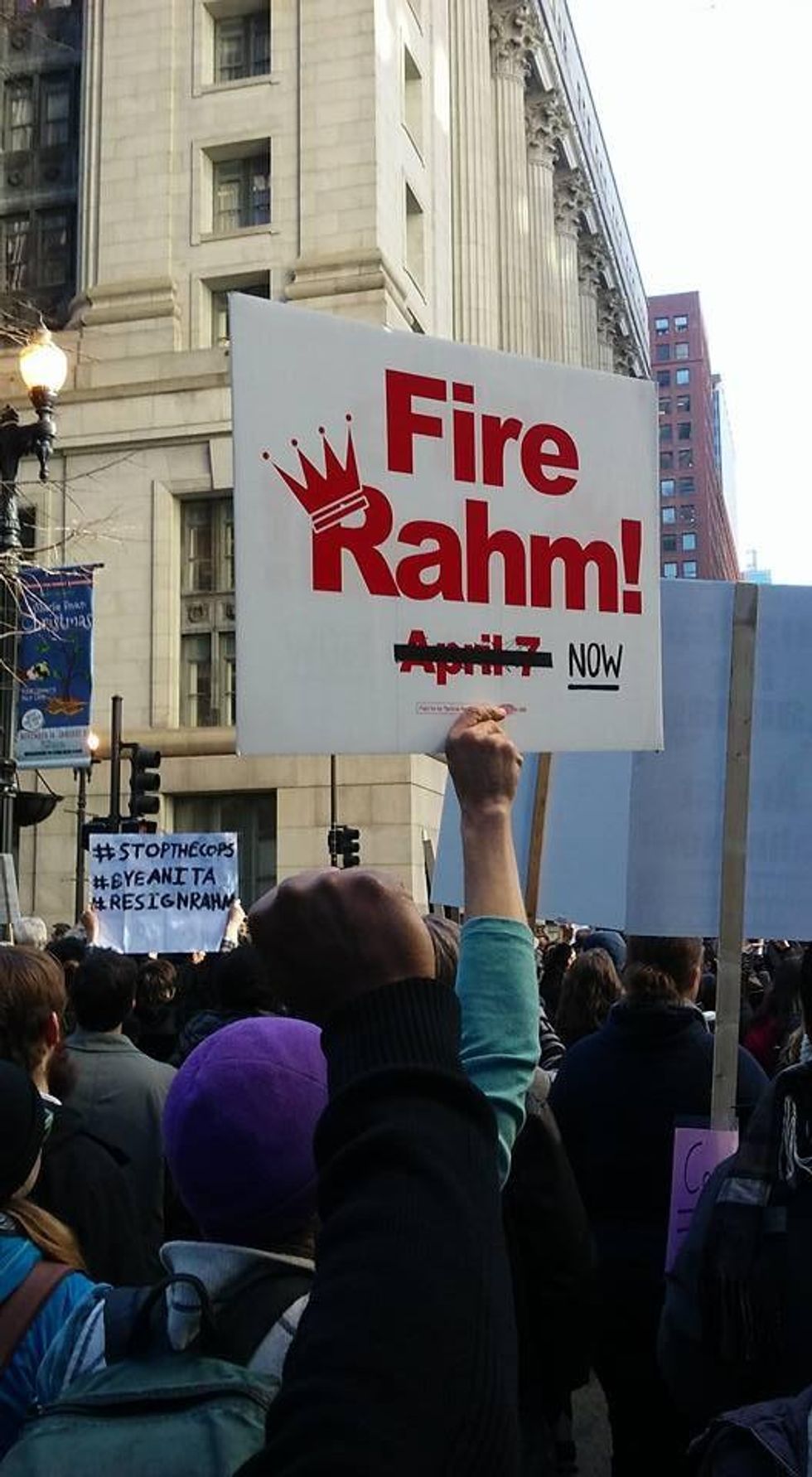
Hundreds of protesters marched through the streets of downtown Chicago on Wednesday afternoon demanding the resignation of Mayor Rahm Emanuel.
The protesters, who gathered in the Loop and continued to march down the busy Magnificent Mile, shouted out chants including "Who's got to go? Rahm's got to go," "No more killer cops," and, "How many shots? 16 shots." Some held signs reading "Resign, Rahm."
Local WGN News has a live feed here; ABC 7 has a live feed here.
The march, part of a citywide walkout, comes hours after speech by Emanuel in which he said he was "sorry" for the shooting last year of 17-year-old African American Laquan McDonald by a white Chicago Police Officer. That officer, Jason Van Dyke, has been charged with first-degree murder. "What happened on October 20, 2014, should never have happened," Emanuel said.
Emanuel has faced continued calls to resign in the wake of the scandal. As Common Dreams previously reported,
Emanuel was among those who fought for more than a year to keep dash-cam video of the October, 2014 shooting of black teenager Laquan McDonald by white officer Jason Van Dyke out of the public eye. A court ordered the footage to be released at the end of November. In addition to showing McDonald lying on the ground as Van Dyke unloads 16 rounds into his twitching body, the video contradicts the account given by officials in the immediate wake of the shooting.
And as Common Dreams reported last week, the
scandal is deepening after city officials were forced to release additional surveillance footage of the deadly shooting of 17-year-old African American Laquan McDonald by a white officer--and it showed an unexplained 80-minute gap covering the time the teenager was killed.
The missing footage aligns with the account of Jay Darshane, the manager of the Burger King that is located roughly 50 yards from the killing, who told a grand jury in November that police tampered with the restaurant's surveillance system, erasing roughly 86 minutes of footage. In addition, the manager told the Chicago Tribune that the FBI confiscated the restaurant's surveillance images.
While Emanuel said in his speech earlier in the day, "Supervision and leadership in the police department and the oversight agencies that were in place failed," others stress that the shooting of McDonald, and the events that followed it, are emblematic of a far deeper problem.
Curtis Black wrote at The Chicago Reporter Tuesday:
Mayor Rahm Emanuel faces what may well be the central crisis of his administration in the continuing outrage over the police killing of Laquan McDonald.
It's an outrage decades in the making, with McDonald's killing emblematic of hundreds of black men killed by Chicago police officers, until now with apparent impunity. Beneath it lies the growing recognition that the system to hold police accountable for misconduct and excessive force is "designed to fail," to protect bad cops from the consequences of their misdeeds.
"If he aspires to lead us forward from this recent tragedy, Emanuel needs to acknowledge this tragic (and ongoing) history. He needs to acknowledge the history and continuing existence of racial injustice in the way we police communities in Chicago," Black wrote.
Willie J.R. Fleming, with the Anti-Eviction Campaign echoed those points, telling NBC 5 Chicago, "It's bigger than the shooting of Laquan MCDonald, the murder of Percy Coleman's son, it's bigger than Ronnie man, Ronald Johnson." What it should be called, he added, "is a cultural corruption. It's the daily practice and procedures of the Chicago Police Department, the City Council of Chicago and the mayor's office."
Hundreds of protesters marched through the streets of downtown Chicago on Wednesday afternoon demanding the resignation of Mayor Rahm Emanuel.
The protesters, who gathered in the Loop and continued to march down the busy Magnificent Mile, shouted out chants including "Who's got to go? Rahm's got to go," "No more killer cops," and, "How many shots? 16 shots." Some held signs reading "Resign, Rahm."
Local WGN News has a live feed here; ABC 7 has a live feed here.
The march, part of a citywide walkout, comes hours after speech by Emanuel in which he said he was "sorry" for the shooting last year of 17-year-old African American Laquan McDonald by a white Chicago Police Officer. That officer, Jason Van Dyke, has been charged with first-degree murder. "What happened on October 20, 2014, should never have happened," Emanuel said.
Emanuel has faced continued calls to resign in the wake of the scandal. As Common Dreams previously reported,
Emanuel was among those who fought for more than a year to keep dash-cam video of the October, 2014 shooting of black teenager Laquan McDonald by white officer Jason Van Dyke out of the public eye. A court ordered the footage to be released at the end of November. In addition to showing McDonald lying on the ground as Van Dyke unloads 16 rounds into his twitching body, the video contradicts the account given by officials in the immediate wake of the shooting.
And as Common Dreams reported last week, the
scandal is deepening after city officials were forced to release additional surveillance footage of the deadly shooting of 17-year-old African American Laquan McDonald by a white officer--and it showed an unexplained 80-minute gap covering the time the teenager was killed.
The missing footage aligns with the account of Jay Darshane, the manager of the Burger King that is located roughly 50 yards from the killing, who told a grand jury in November that police tampered with the restaurant's surveillance system, erasing roughly 86 minutes of footage. In addition, the manager told the Chicago Tribune that the FBI confiscated the restaurant's surveillance images.
While Emanuel said in his speech earlier in the day, "Supervision and leadership in the police department and the oversight agencies that were in place failed," others stress that the shooting of McDonald, and the events that followed it, are emblematic of a far deeper problem.
Curtis Black wrote at The Chicago Reporter Tuesday:
Mayor Rahm Emanuel faces what may well be the central crisis of his administration in the continuing outrage over the police killing of Laquan McDonald.
It's an outrage decades in the making, with McDonald's killing emblematic of hundreds of black men killed by Chicago police officers, until now with apparent impunity. Beneath it lies the growing recognition that the system to hold police accountable for misconduct and excessive force is "designed to fail," to protect bad cops from the consequences of their misdeeds.
"If he aspires to lead us forward from this recent tragedy, Emanuel needs to acknowledge this tragic (and ongoing) history. He needs to acknowledge the history and continuing existence of racial injustice in the way we police communities in Chicago," Black wrote.
Willie J.R. Fleming, with the Anti-Eviction Campaign echoed those points, telling NBC 5 Chicago, "It's bigger than the shooting of Laquan MCDonald, the murder of Percy Coleman's son, it's bigger than Ronnie man, Ronald Johnson." What it should be called, he added, "is a cultural corruption. It's the daily practice and procedures of the Chicago Police Department, the City Council of Chicago and the mayor's office."
Hundreds of protesters marched through the streets of downtown Chicago on Wednesday afternoon demanding the resignation of Mayor Rahm Emanuel.
The protesters, who gathered in the Loop and continued to march down the busy Magnificent Mile, shouted out chants including "Who's got to go? Rahm's got to go," "No more killer cops," and, "How many shots? 16 shots." Some held signs reading "Resign, Rahm."
Local WGN News has a live feed here; ABC 7 has a live feed here.
The march, part of a citywide walkout, comes hours after speech by Emanuel in which he said he was "sorry" for the shooting last year of 17-year-old African American Laquan McDonald by a white Chicago Police Officer. That officer, Jason Van Dyke, has been charged with first-degree murder. "What happened on October 20, 2014, should never have happened," Emanuel said.
Emanuel has faced continued calls to resign in the wake of the scandal. As Common Dreams previously reported,
Emanuel was among those who fought for more than a year to keep dash-cam video of the October, 2014 shooting of black teenager Laquan McDonald by white officer Jason Van Dyke out of the public eye. A court ordered the footage to be released at the end of November. In addition to showing McDonald lying on the ground as Van Dyke unloads 16 rounds into his twitching body, the video contradicts the account given by officials in the immediate wake of the shooting.
And as Common Dreams reported last week, the
scandal is deepening after city officials were forced to release additional surveillance footage of the deadly shooting of 17-year-old African American Laquan McDonald by a white officer--and it showed an unexplained 80-minute gap covering the time the teenager was killed.
The missing footage aligns with the account of Jay Darshane, the manager of the Burger King that is located roughly 50 yards from the killing, who told a grand jury in November that police tampered with the restaurant's surveillance system, erasing roughly 86 minutes of footage. In addition, the manager told the Chicago Tribune that the FBI confiscated the restaurant's surveillance images.
While Emanuel said in his speech earlier in the day, "Supervision and leadership in the police department and the oversight agencies that were in place failed," others stress that the shooting of McDonald, and the events that followed it, are emblematic of a far deeper problem.
Curtis Black wrote at The Chicago Reporter Tuesday:
Mayor Rahm Emanuel faces what may well be the central crisis of his administration in the continuing outrage over the police killing of Laquan McDonald.
It's an outrage decades in the making, with McDonald's killing emblematic of hundreds of black men killed by Chicago police officers, until now with apparent impunity. Beneath it lies the growing recognition that the system to hold police accountable for misconduct and excessive force is "designed to fail," to protect bad cops from the consequences of their misdeeds.
"If he aspires to lead us forward from this recent tragedy, Emanuel needs to acknowledge this tragic (and ongoing) history. He needs to acknowledge the history and continuing existence of racial injustice in the way we police communities in Chicago," Black wrote.
Willie J.R. Fleming, with the Anti-Eviction Campaign echoed those points, telling NBC 5 Chicago, "It's bigger than the shooting of Laquan MCDonald, the murder of Percy Coleman's son, it's bigger than Ronnie man, Ronald Johnson." What it should be called, he added, "is a cultural corruption. It's the daily practice and procedures of the Chicago Police Department, the City Council of Chicago and the mayor's office."