SUBSCRIBE TO OUR FREE NEWSLETTER
Daily news & progressive opinion—funded by the people, not the corporations—delivered straight to your inbox.
5
#000000
#FFFFFF
To donate by check, phone, or other method, see our More Ways to Give page.
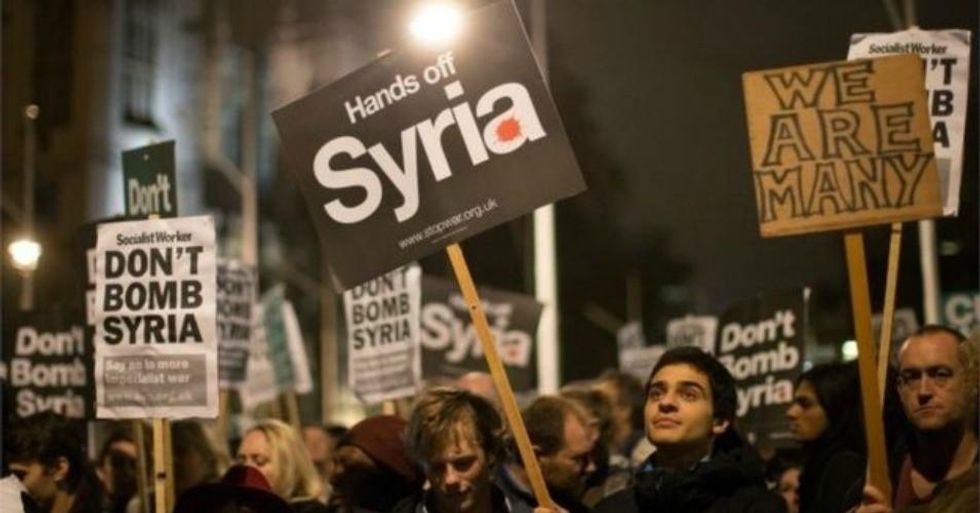
Amid warnings that "new war will not increase the prospects of peace," the UK carried out its first airstrikes in Syria on Thursday, just hours after members of Parliament voted to expand the use of military force in the fight against the Islamic State (ISIS).
Four Royal Air Force (RAF) fighter jets were seen taking off from a base in Cyprus and returning without their weapons early Thursday morning. The Ministry of Defense confirmed that the planes had taken part in the UK's "first offensive operation in Syria and conducted strikes."
"A new war will not increase the prospects of peace in Syria, nor will the British people be safer from terrorism." --Stop the War Coalition
On Wednesday night, Parliament debated for more than 11 hours on whether to authorize bombings in Syria, eventually voting to approve them 397-223, despite widespread outcry against military action from the public and anti-war MPs like Labour Party leader Jeremy Corbyn.
"British service men and women will now be in harm's way and the loss of innocent lives is sadly almost inevitable," Corbyn said following the vote.
Thursday's strikes were reportedly focused on six targets in an oilfield in eastern Syria, which Defense Secretary Michael Fallon called "one of the largest and most important to Daesh's financial operations."
At least two Syrian diaspora groups, Raqqa Is Slowly Dying and the Manchester-based Rethink Rebuild Society, immediately rebuffed those comments, warning instead that targeting oilfields would have no positive impact for the coalition or for Syrian citizens--and could in fact send ISIS an influx of new recruits.
As Raqqa Is Slowly Dying's Sarmad Al Jilane wrote in a blog post published Monday, the U.S.-led coalition already conducting airstrikes in Syria has made no progress against ISIS. "[T]he oil extraction operations were not affected significantly because the extraction methods are primitive, and the bombing of these wells will not detriment to the financial cycle associated to the oil sector," Al Jilane wrote.
Middle East experts have also cautioned that targeting oilfields cuts off Syrian civilians from the infrastructure that they depend on for daily life and stirs opposition to the West's cause.
As Tim Eaton, project manager for Chatham House's Syria and Its Neighbours Policy Initiative, told the Guardian on Thursday:
What happens a lot of the time is that we are presented with this premise that bombing terrorists is a good thing to do and that we oppose Isis and that there may be some civilian casualties which are unfortunate collateral in those strikes.
Taking out oil at the well-head means that while Isis is unable to generate profit from the sale of that oil, civilians that rely on it to heat their homes and run their vehicles will no longer have it.
What we often do not consider is that even soft targets such as oil infrastructure and the infrastructure targets that the defence secretary was talking about today in IS-controlled areas are also the infrastructure that the civilians in those areas rely upon.
Much has been made of Shadow Foreign Secretary and Labour MP Hilary Benn's impassioned speech during the debate in the House of Commons, which some said was instrumental in galvanizing a 'Yes' vote by calling for the UK to "confront the evil" of ISIS. But out of the frenzy of lavishing responses, some critical voices emerged to castigate Benn for his "familiar invocation of the just war doctrine," as British journalist Sam Kriss put it in a piece for VICE.
"For those who stand in solidarity with the Syrian people, you cannot say that the decision to send more bombs by the U.K. airplanes will do anything to help them." --Asad Rehman
Benn's speech "was not the masterstroke of a consummate statesman; it was disingenuous nonsense," Kriss wrote. "Benn has form here: he voted for the 2003 war in Iraq (making him far more responsible for the rise of Isis than some of the people who will die in the airstrikes he's so passionately promoting) and the disastrous 2011 air war in Libya.... As if our sincere good wishes mean anything when we're lobbing bombs at a city from 30,000 feet."
The UK-based Stop the War Coalition also expressed its opposition to the authorization, stating Thursday, "There is no good case for British airstrikes in a war which is already seeing the two major military powers, the U.S. and Russia, bombing Syria."
"A new war will not increase the prospects of peace in Syria, nor will the British people be safer from terrorism," the group said.
As the coalition's former national organizer Asad Rehman told Democracy Now! on Thursday, "We know that the Syrian people have endured a tragic, violent war. Millions of people have been forced to be refugees. And hundreds of thousands of people continue to be killed each year. And they're being killed by the bombs of all sides. And for those who stand in solidarity with the Syrian people, you cannot say that the decision to send more bombs by the U.K. airplanes will do anything to help them."
Amid warnings that "new war will not increase the prospects of peace," the UK carried out its first airstrikes in Syria on Thursday, just hours after members of Parliament voted to expand the use of military force in the fight against the Islamic State (ISIS).
Four Royal Air Force (RAF) fighter jets were seen taking off from a base in Cyprus and returning without their weapons early Thursday morning. The Ministry of Defense confirmed that the planes had taken part in the UK's "first offensive operation in Syria and conducted strikes."
"A new war will not increase the prospects of peace in Syria, nor will the British people be safer from terrorism." --Stop the War Coalition
On Wednesday night, Parliament debated for more than 11 hours on whether to authorize bombings in Syria, eventually voting to approve them 397-223, despite widespread outcry against military action from the public and anti-war MPs like Labour Party leader Jeremy Corbyn.
"British service men and women will now be in harm's way and the loss of innocent lives is sadly almost inevitable," Corbyn said following the vote.
Thursday's strikes were reportedly focused on six targets in an oilfield in eastern Syria, which Defense Secretary Michael Fallon called "one of the largest and most important to Daesh's financial operations."
At least two Syrian diaspora groups, Raqqa Is Slowly Dying and the Manchester-based Rethink Rebuild Society, immediately rebuffed those comments, warning instead that targeting oilfields would have no positive impact for the coalition or for Syrian citizens--and could in fact send ISIS an influx of new recruits.
As Raqqa Is Slowly Dying's Sarmad Al Jilane wrote in a blog post published Monday, the U.S.-led coalition already conducting airstrikes in Syria has made no progress against ISIS. "[T]he oil extraction operations were not affected significantly because the extraction methods are primitive, and the bombing of these wells will not detriment to the financial cycle associated to the oil sector," Al Jilane wrote.
Middle East experts have also cautioned that targeting oilfields cuts off Syrian civilians from the infrastructure that they depend on for daily life and stirs opposition to the West's cause.
As Tim Eaton, project manager for Chatham House's Syria and Its Neighbours Policy Initiative, told the Guardian on Thursday:
What happens a lot of the time is that we are presented with this premise that bombing terrorists is a good thing to do and that we oppose Isis and that there may be some civilian casualties which are unfortunate collateral in those strikes.
Taking out oil at the well-head means that while Isis is unable to generate profit from the sale of that oil, civilians that rely on it to heat their homes and run their vehicles will no longer have it.
What we often do not consider is that even soft targets such as oil infrastructure and the infrastructure targets that the defence secretary was talking about today in IS-controlled areas are also the infrastructure that the civilians in those areas rely upon.
Much has been made of Shadow Foreign Secretary and Labour MP Hilary Benn's impassioned speech during the debate in the House of Commons, which some said was instrumental in galvanizing a 'Yes' vote by calling for the UK to "confront the evil" of ISIS. But out of the frenzy of lavishing responses, some critical voices emerged to castigate Benn for his "familiar invocation of the just war doctrine," as British journalist Sam Kriss put it in a piece for VICE.
"For those who stand in solidarity with the Syrian people, you cannot say that the decision to send more bombs by the U.K. airplanes will do anything to help them." --Asad Rehman
Benn's speech "was not the masterstroke of a consummate statesman; it was disingenuous nonsense," Kriss wrote. "Benn has form here: he voted for the 2003 war in Iraq (making him far more responsible for the rise of Isis than some of the people who will die in the airstrikes he's so passionately promoting) and the disastrous 2011 air war in Libya.... As if our sincere good wishes mean anything when we're lobbing bombs at a city from 30,000 feet."
The UK-based Stop the War Coalition also expressed its opposition to the authorization, stating Thursday, "There is no good case for British airstrikes in a war which is already seeing the two major military powers, the U.S. and Russia, bombing Syria."
"A new war will not increase the prospects of peace in Syria, nor will the British people be safer from terrorism," the group said.
As the coalition's former national organizer Asad Rehman told Democracy Now! on Thursday, "We know that the Syrian people have endured a tragic, violent war. Millions of people have been forced to be refugees. And hundreds of thousands of people continue to be killed each year. And they're being killed by the bombs of all sides. And for those who stand in solidarity with the Syrian people, you cannot say that the decision to send more bombs by the U.K. airplanes will do anything to help them."
Amid warnings that "new war will not increase the prospects of peace," the UK carried out its first airstrikes in Syria on Thursday, just hours after members of Parliament voted to expand the use of military force in the fight against the Islamic State (ISIS).
Four Royal Air Force (RAF) fighter jets were seen taking off from a base in Cyprus and returning without their weapons early Thursday morning. The Ministry of Defense confirmed that the planes had taken part in the UK's "first offensive operation in Syria and conducted strikes."
"A new war will not increase the prospects of peace in Syria, nor will the British people be safer from terrorism." --Stop the War Coalition
On Wednesday night, Parliament debated for more than 11 hours on whether to authorize bombings in Syria, eventually voting to approve them 397-223, despite widespread outcry against military action from the public and anti-war MPs like Labour Party leader Jeremy Corbyn.
"British service men and women will now be in harm's way and the loss of innocent lives is sadly almost inevitable," Corbyn said following the vote.
Thursday's strikes were reportedly focused on six targets in an oilfield in eastern Syria, which Defense Secretary Michael Fallon called "one of the largest and most important to Daesh's financial operations."
At least two Syrian diaspora groups, Raqqa Is Slowly Dying and the Manchester-based Rethink Rebuild Society, immediately rebuffed those comments, warning instead that targeting oilfields would have no positive impact for the coalition or for Syrian citizens--and could in fact send ISIS an influx of new recruits.
As Raqqa Is Slowly Dying's Sarmad Al Jilane wrote in a blog post published Monday, the U.S.-led coalition already conducting airstrikes in Syria has made no progress against ISIS. "[T]he oil extraction operations were not affected significantly because the extraction methods are primitive, and the bombing of these wells will not detriment to the financial cycle associated to the oil sector," Al Jilane wrote.
Middle East experts have also cautioned that targeting oilfields cuts off Syrian civilians from the infrastructure that they depend on for daily life and stirs opposition to the West's cause.
As Tim Eaton, project manager for Chatham House's Syria and Its Neighbours Policy Initiative, told the Guardian on Thursday:
What happens a lot of the time is that we are presented with this premise that bombing terrorists is a good thing to do and that we oppose Isis and that there may be some civilian casualties which are unfortunate collateral in those strikes.
Taking out oil at the well-head means that while Isis is unable to generate profit from the sale of that oil, civilians that rely on it to heat their homes and run their vehicles will no longer have it.
What we often do not consider is that even soft targets such as oil infrastructure and the infrastructure targets that the defence secretary was talking about today in IS-controlled areas are also the infrastructure that the civilians in those areas rely upon.
Much has been made of Shadow Foreign Secretary and Labour MP Hilary Benn's impassioned speech during the debate in the House of Commons, which some said was instrumental in galvanizing a 'Yes' vote by calling for the UK to "confront the evil" of ISIS. But out of the frenzy of lavishing responses, some critical voices emerged to castigate Benn for his "familiar invocation of the just war doctrine," as British journalist Sam Kriss put it in a piece for VICE.
"For those who stand in solidarity with the Syrian people, you cannot say that the decision to send more bombs by the U.K. airplanes will do anything to help them." --Asad Rehman
Benn's speech "was not the masterstroke of a consummate statesman; it was disingenuous nonsense," Kriss wrote. "Benn has form here: he voted for the 2003 war in Iraq (making him far more responsible for the rise of Isis than some of the people who will die in the airstrikes he's so passionately promoting) and the disastrous 2011 air war in Libya.... As if our sincere good wishes mean anything when we're lobbing bombs at a city from 30,000 feet."
The UK-based Stop the War Coalition also expressed its opposition to the authorization, stating Thursday, "There is no good case for British airstrikes in a war which is already seeing the two major military powers, the U.S. and Russia, bombing Syria."
"A new war will not increase the prospects of peace in Syria, nor will the British people be safer from terrorism," the group said.
As the coalition's former national organizer Asad Rehman told Democracy Now! on Thursday, "We know that the Syrian people have endured a tragic, violent war. Millions of people have been forced to be refugees. And hundreds of thousands of people continue to be killed each year. And they're being killed by the bombs of all sides. And for those who stand in solidarity with the Syrian people, you cannot say that the decision to send more bombs by the U.K. airplanes will do anything to help them."