SUBSCRIBE TO OUR FREE NEWSLETTER
Daily news & progressive opinion—funded by the people, not the corporations—delivered straight to your inbox.
5
#000000
#FFFFFF
To donate by check, phone, or other method, see our More Ways to Give page.
Peace activist, environmentalist, songwriter, and folk legend Pete Seeger died on Monday. He was 94.
Confirmed by family members, Seeger is reported to have died of natural causes at a hospital not far from his longtime home in the town of Beacon, New York along the Hudson River.
According to the Associated Press:
Seeger's grandson, Kitama Cahill-Jackson, said his grandfather died peacefully in his sleep around 9:30 p.m. at New York Presbyterian Hospital, where he had been for six days. Family members were with him.
"He was chopping wood 10 days ago," Cahill-Jackson recalled.
A banjo and guitar player who once traveled the country with Woody Guthrie, Seeger was a giant of the folk music revival of the Twentieth Century, playing for audiences and children all over the world. As well known for his political activism and consistent voice against war, destruction, and oppression, Seeger was often shunned by the powerful but never wavered in his commitment to justice, beauty, and the power of music to bring people together.
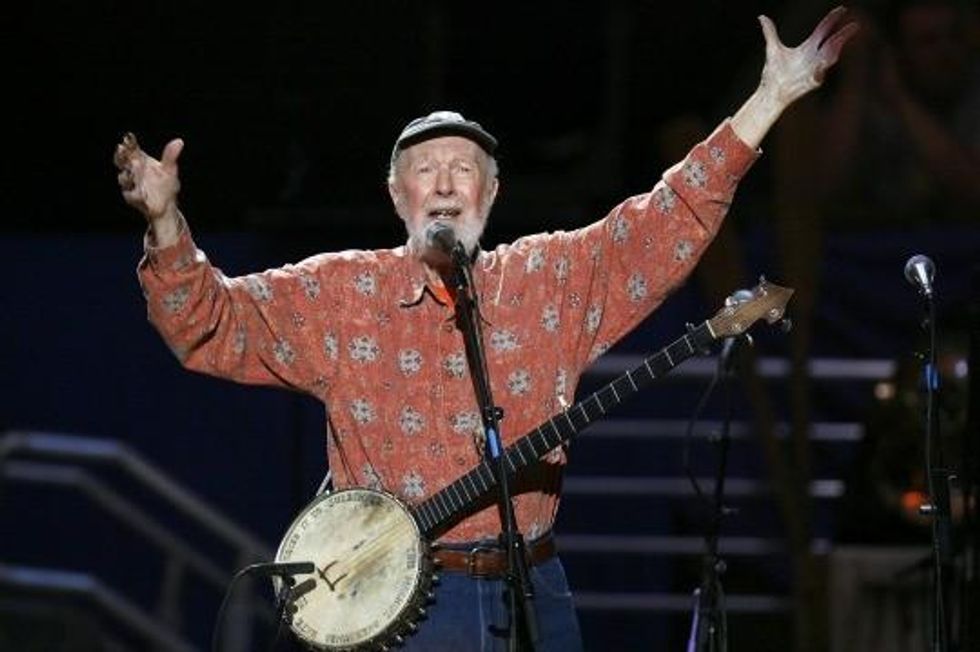
Throughout his career, that spanned nearly eighty years of playing music for people, Seeger used his banjo playing and singing to support labor struggles, the civil rights movement, anti-war campaigns, and environmental causes.
"My job," he said in 2009, "is to show folks there's a lot of good music in this world, and if used right it may help to save the planet."
From Rolling Stone:
A tall, strapping figure known for his crisp-as-a-mountain-stream singing and banjo playing, Seeger was [...] a walking, talking, strumming embodiment of the connection between folk song and leftist politics. Throughout his career, he participated in pro-union and civil rights events and protested wars and nuclear power. For his trouble -- and his membership in the American Communist Party -- Seeger was blacklisted by the House Un-American Activities Committee in the Fifties; to make ends meet, he had to play sometimes four concerts a day, for $25 each. "I still believe the only chance for the human raced to survive is to give up such pleasures as war, racism and private profit," Seeger told RS in 1979, beliefs he held until his death.
News of his death was being met with both sorrow and celebration as those who knew him and his music reflected on the undoubted positive impact he left on them, the music world, and humankind.
Peace activist, environmentalist, songwriter, and folk legend Pete Seeger died on Monday. He was 94.
Confirmed by family members, Seeger is reported to have died of natural causes at a hospital not far from his longtime home in the town of Beacon, New York along the Hudson River.
According to the Associated Press:
Seeger's grandson, Kitama Cahill-Jackson, said his grandfather died peacefully in his sleep around 9:30 p.m. at New York Presbyterian Hospital, where he had been for six days. Family members were with him.
"He was chopping wood 10 days ago," Cahill-Jackson recalled.
A banjo and guitar player who once traveled the country with Woody Guthrie, Seeger was a giant of the folk music revival of the Twentieth Century, playing for audiences and children all over the world. As well known for his political activism and consistent voice against war, destruction, and oppression, Seeger was often shunned by the powerful but never wavered in his commitment to justice, beauty, and the power of music to bring people together.
Throughout his career, that spanned nearly eighty years of playing music for people, Seeger used his banjo playing and singing to support labor struggles, the civil rights movement, anti-war campaigns, and environmental causes.
"My job," he said in 2009, "is to show folks there's a lot of good music in this world, and if used right it may help to save the planet."
From Rolling Stone:
A tall, strapping figure known for his crisp-as-a-mountain-stream singing and banjo playing, Seeger was [...] a walking, talking, strumming embodiment of the connection between folk song and leftist politics. Throughout his career, he participated in pro-union and civil rights events and protested wars and nuclear power. For his trouble -- and his membership in the American Communist Party -- Seeger was blacklisted by the House Un-American Activities Committee in the Fifties; to make ends meet, he had to play sometimes four concerts a day, for $25 each. "I still believe the only chance for the human raced to survive is to give up such pleasures as war, racism and private profit," Seeger told RS in 1979, beliefs he held until his death.
News of his death was being met with both sorrow and celebration as those who knew him and his music reflected on the undoubted positive impact he left on them, the music world, and humankind.
Peace activist, environmentalist, songwriter, and folk legend Pete Seeger died on Monday. He was 94.
Confirmed by family members, Seeger is reported to have died of natural causes at a hospital not far from his longtime home in the town of Beacon, New York along the Hudson River.
According to the Associated Press:
Seeger's grandson, Kitama Cahill-Jackson, said his grandfather died peacefully in his sleep around 9:30 p.m. at New York Presbyterian Hospital, where he had been for six days. Family members were with him.
"He was chopping wood 10 days ago," Cahill-Jackson recalled.
A banjo and guitar player who once traveled the country with Woody Guthrie, Seeger was a giant of the folk music revival of the Twentieth Century, playing for audiences and children all over the world. As well known for his political activism and consistent voice against war, destruction, and oppression, Seeger was often shunned by the powerful but never wavered in his commitment to justice, beauty, and the power of music to bring people together.
Throughout his career, that spanned nearly eighty years of playing music for people, Seeger used his banjo playing and singing to support labor struggles, the civil rights movement, anti-war campaigns, and environmental causes.
"My job," he said in 2009, "is to show folks there's a lot of good music in this world, and if used right it may help to save the planet."
From Rolling Stone:
A tall, strapping figure known for his crisp-as-a-mountain-stream singing and banjo playing, Seeger was [...] a walking, talking, strumming embodiment of the connection between folk song and leftist politics. Throughout his career, he participated in pro-union and civil rights events and protested wars and nuclear power. For his trouble -- and his membership in the American Communist Party -- Seeger was blacklisted by the House Un-American Activities Committee in the Fifties; to make ends meet, he had to play sometimes four concerts a day, for $25 each. "I still believe the only chance for the human raced to survive is to give up such pleasures as war, racism and private profit," Seeger told RS in 1979, beliefs he held until his death.
News of his death was being met with both sorrow and celebration as those who knew him and his music reflected on the undoubted positive impact he left on them, the music world, and humankind.