SUBSCRIBE TO OUR FREE NEWSLETTER
Daily news & progressive opinion—funded by the people, not the corporations—delivered straight to your inbox.
5
#000000
#FFFFFF
To donate by check, phone, or other method, see our More Ways to Give page.
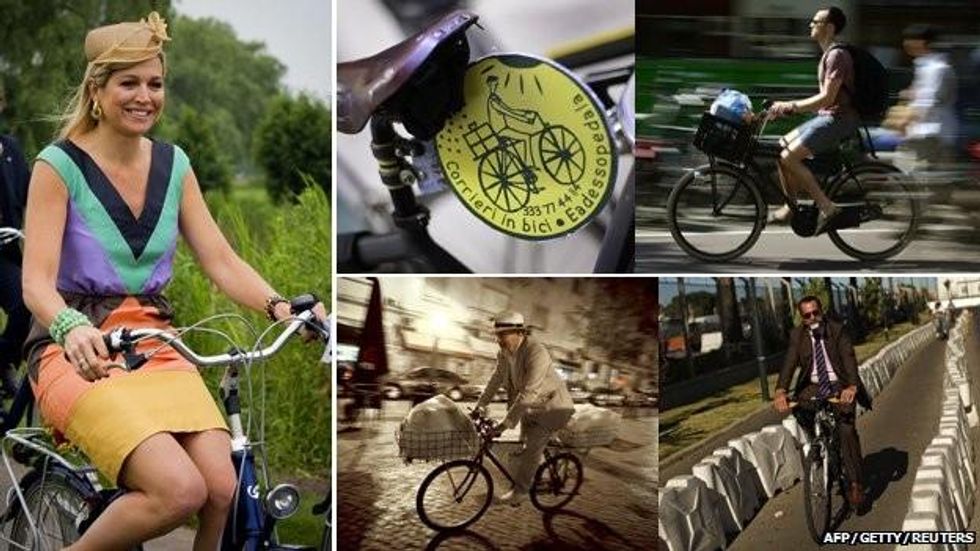
According to new data from the bicycle industry body Coliped and the auto industry association ACEA--and reviewed by Agence France-Presse--all across Europe bicycle sales are soaring past car sales as commuters and recreational cyclists exercise the full potential of fossil-fuel free transport.
Notably, people in southern Europe, who have traditionally relied on automobiles more heavily than northerners, have joined the swell of cyclists. According to AFP, "More bicycles were sold than cars last year in 26 of the European Union's 28 members, the exceptions being Belgium and Luxembourg."
As AFP reports:
Milan has been one of the latest European cities to roll out a bike-sharing scheme, dubbed "Bikemi", on the model of the Parisian "Velib", as well as extending its network of cycle lanes.
For the Bucharest in-crowd, cycling is now the way to roll, with fashionable bars featuring bicycles as design objects and collective bike rides staged on a weekly basis.
In Spain, 780,000 bikes were sold last year against 700,000 cars, in spite of complaints from bike users who say the country's cities remain dangerous on two wheels.
Madrid is rolling out a new bike rental scheme next year, and has unveiled plans for a "green ring" of cycle paths looping 10 kilometers around the city center.
According to Spain's road traffic agency, while the number of cyclists is steady, they are using their bikes more and more often. Cycle use for everyday journeys has jumped from 17 to 30 percent.
In austerity-hit Portugal cyclist numbers are on the rise in cities like Lisbon and Porto, although not so much in the country's mountainous regions.
The economic crisis has had a major a hand in the shift, with car sales plummeting since 2008, while bikes "have proved pretty much crisis-proof with 19.7 million sold Europe-wide in 2012 according to Coliped," reports AFP.
"The economic crisis has had an impact on all areas of people's lives, including on transport," said Giulietta Pagliaccio, head of the Italian cycling federation Fiab. "But there has also been a small revolution in terms of lifestyle."
_______________________
According to new data from the bicycle industry body Coliped and the auto industry association ACEA--and reviewed by Agence France-Presse--all across Europe bicycle sales are soaring past car sales as commuters and recreational cyclists exercise the full potential of fossil-fuel free transport.
Notably, people in southern Europe, who have traditionally relied on automobiles more heavily than northerners, have joined the swell of cyclists. According to AFP, "More bicycles were sold than cars last year in 26 of the European Union's 28 members, the exceptions being Belgium and Luxembourg."
As AFP reports:
Milan has been one of the latest European cities to roll out a bike-sharing scheme, dubbed "Bikemi", on the model of the Parisian "Velib", as well as extending its network of cycle lanes.
For the Bucharest in-crowd, cycling is now the way to roll, with fashionable bars featuring bicycles as design objects and collective bike rides staged on a weekly basis.
In Spain, 780,000 bikes were sold last year against 700,000 cars, in spite of complaints from bike users who say the country's cities remain dangerous on two wheels.
Madrid is rolling out a new bike rental scheme next year, and has unveiled plans for a "green ring" of cycle paths looping 10 kilometers around the city center.
According to Spain's road traffic agency, while the number of cyclists is steady, they are using their bikes more and more often. Cycle use for everyday journeys has jumped from 17 to 30 percent.
In austerity-hit Portugal cyclist numbers are on the rise in cities like Lisbon and Porto, although not so much in the country's mountainous regions.
The economic crisis has had a major a hand in the shift, with car sales plummeting since 2008, while bikes "have proved pretty much crisis-proof with 19.7 million sold Europe-wide in 2012 according to Coliped," reports AFP.
"The economic crisis has had an impact on all areas of people's lives, including on transport," said Giulietta Pagliaccio, head of the Italian cycling federation Fiab. "But there has also been a small revolution in terms of lifestyle."
_______________________
According to new data from the bicycle industry body Coliped and the auto industry association ACEA--and reviewed by Agence France-Presse--all across Europe bicycle sales are soaring past car sales as commuters and recreational cyclists exercise the full potential of fossil-fuel free transport.
Notably, people in southern Europe, who have traditionally relied on automobiles more heavily than northerners, have joined the swell of cyclists. According to AFP, "More bicycles were sold than cars last year in 26 of the European Union's 28 members, the exceptions being Belgium and Luxembourg."
As AFP reports:
Milan has been one of the latest European cities to roll out a bike-sharing scheme, dubbed "Bikemi", on the model of the Parisian "Velib", as well as extending its network of cycle lanes.
For the Bucharest in-crowd, cycling is now the way to roll, with fashionable bars featuring bicycles as design objects and collective bike rides staged on a weekly basis.
In Spain, 780,000 bikes were sold last year against 700,000 cars, in spite of complaints from bike users who say the country's cities remain dangerous on two wheels.
Madrid is rolling out a new bike rental scheme next year, and has unveiled plans for a "green ring" of cycle paths looping 10 kilometers around the city center.
According to Spain's road traffic agency, while the number of cyclists is steady, they are using their bikes more and more often. Cycle use for everyday journeys has jumped from 17 to 30 percent.
In austerity-hit Portugal cyclist numbers are on the rise in cities like Lisbon and Porto, although not so much in the country's mountainous regions.
The economic crisis has had a major a hand in the shift, with car sales plummeting since 2008, while bikes "have proved pretty much crisis-proof with 19.7 million sold Europe-wide in 2012 according to Coliped," reports AFP.
"The economic crisis has had an impact on all areas of people's lives, including on transport," said Giulietta Pagliaccio, head of the Italian cycling federation Fiab. "But there has also been a small revolution in terms of lifestyle."
_______________________