SUBSCRIBE TO OUR FREE NEWSLETTER
Daily news & progressive opinion—funded by the people, not the corporations—delivered straight to your inbox.
5
#000000
#FFFFFF
To donate by check, phone, or other method, see our More Ways to Give page.


Daily news & progressive opinion—funded by the people, not the corporations—delivered straight to your inbox.

"We were surprised by the magnitude of radioactivity" downstream from the plant, said co-author Avner Vengosh, geochemistry professor at Duke's Nicholas School of the Environment. "It's unusual to find this level," he told USA Today, adding that other sites should be investigated.
The Guardian reports:
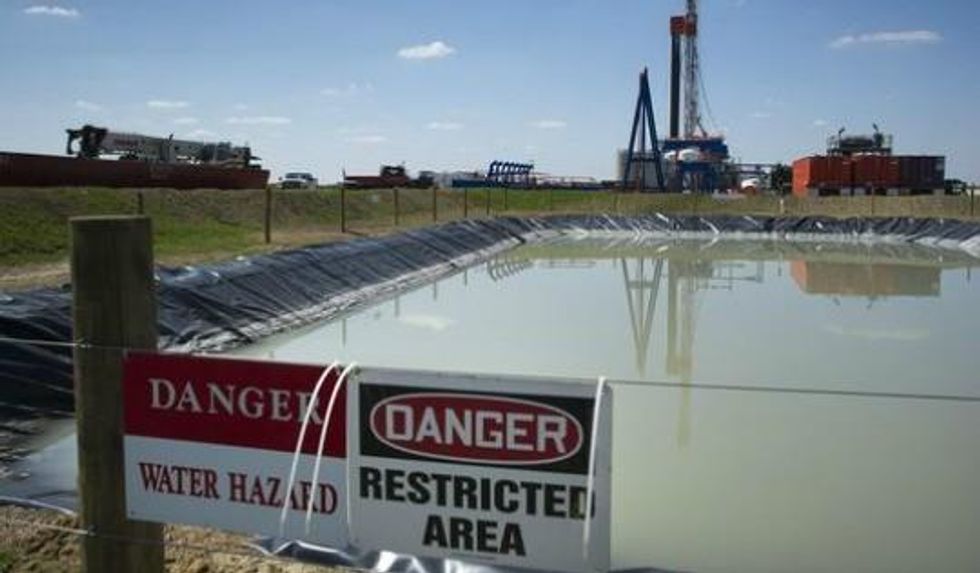
The Duke University study, published on Wednesday, examined the water discharged from Josephine Brine Treatment Facility into Blacklick Creek, which feeds into a water source for western Pennsylvania cities, including Pittsburgh. Scientists took samples upstream and downstream from the treatment facility over a two-year period, with the last sample taken in June this year.
Elevated levels of chloride and bromide, combined with strontium, radium, oxygen, and hydrogen isotopic compositions, are present in the Marcellus shale waste waters, the study found.
The report, published in the journal Environmental Science & Technology by a group of Duke University researchers, states that fracking waste water disposal methods pose a great threat to human and environmental health, particularly gas companies that send waste to treatment sites that are currently allowed to release treated water into local streams.
Shale gas production, i.e. fracking, is currently exempt from certain rules within laws such as the Clean Water Act and the Safe Water Drinking Act due to the "Halliburton loophole" pushed through by former Vice-President/former Halliburton CEO Dick Cheney. Frackers are allowed to monitor their own waste production and largely avoid any regulated restrictions.
According to the researchers, radium levels in the Pennsylvania stream sediments where waste-water was discharged were about "200 times greater than upstream and background sediments and above radioactive waste disposal threshold regulations, posing potential environmental risks of radium bio-accumulation in localized areas of shale gas waste-water disposal."
"Each day, oil and gas producers generate 2 billion gallons of waste-water," said co-author Robert B. Jackson, Duke professor of environmental science, Tuesday. "They produce more waste-water than hydrocarbons. That's the broader implication of this study. We have to do something with this waste-water."
"The use of fossil fuels has a direct climate connection," he said. "Hundreds of billions of gallons of waste-water is a consequence of our reliance -- our addiction -- to fossil fuels. That's another price we pay for needing so much oil and gas."
_______________________

Dear Common Dreams reader, It’s been nearly 30 years since I co-founded Common Dreams with my late wife, Lina Newhouser. We had the radical notion that journalism should serve the public good, not corporate profits. It was clear to us from the outset what it would take to build such a project. No paid advertisements. No corporate sponsors. No millionaire publisher telling us what to think or do. Many people said we wouldn't last a year, but we proved those doubters wrong. Together with a tremendous team of journalists and dedicated staff, we built an independent media outlet free from the constraints of profits and corporate control. Our mission has always been simple: To inform. To inspire. To ignite change for the common good. Building Common Dreams was not easy. Our survival was never guaranteed. When you take on the most powerful forces—Wall Street greed, fossil fuel industry destruction, Big Tech lobbyists, and uber-rich oligarchs who have spent billions upon billions rigging the economy and democracy in their favor—the only bulwark you have is supporters who believe in your work. But here’s the urgent message from me today. It's never been this bad out there. And it's never been this hard to keep us going. At the very moment Common Dreams is most needed, the threats we face are intensifying. We need your support now more than ever. We don't accept corporate advertising and never will. We don't have a paywall because we don't think people should be blocked from critical news based on their ability to pay. Everything we do is funded by the donations of readers like you. When everyone does the little they can afford, we are strong. But if that support retreats or dries up, so do we. Will you donate now to make sure Common Dreams not only survives but thrives? —Craig Brown, Co-founder |
Jacob Chamberlain is a former staff writer for Common Dreams. He is the author of Migrant Justice in the Age of Removal. His website is www.jacobpchamberlain.com.

"We were surprised by the magnitude of radioactivity" downstream from the plant, said co-author Avner Vengosh, geochemistry professor at Duke's Nicholas School of the Environment. "It's unusual to find this level," he told USA Today, adding that other sites should be investigated.
The Guardian reports:
The Duke University study, published on Wednesday, examined the water discharged from Josephine Brine Treatment Facility into Blacklick Creek, which feeds into a water source for western Pennsylvania cities, including Pittsburgh. Scientists took samples upstream and downstream from the treatment facility over a two-year period, with the last sample taken in June this year.
Elevated levels of chloride and bromide, combined with strontium, radium, oxygen, and hydrogen isotopic compositions, are present in the Marcellus shale waste waters, the study found.
The report, published in the journal Environmental Science & Technology by a group of Duke University researchers, states that fracking waste water disposal methods pose a great threat to human and environmental health, particularly gas companies that send waste to treatment sites that are currently allowed to release treated water into local streams.
Shale gas production, i.e. fracking, is currently exempt from certain rules within laws such as the Clean Water Act and the Safe Water Drinking Act due to the "Halliburton loophole" pushed through by former Vice-President/former Halliburton CEO Dick Cheney. Frackers are allowed to monitor their own waste production and largely avoid any regulated restrictions.
According to the researchers, radium levels in the Pennsylvania stream sediments where waste-water was discharged were about "200 times greater than upstream and background sediments and above radioactive waste disposal threshold regulations, posing potential environmental risks of radium bio-accumulation in localized areas of shale gas waste-water disposal."
"Each day, oil and gas producers generate 2 billion gallons of waste-water," said co-author Robert B. Jackson, Duke professor of environmental science, Tuesday. "They produce more waste-water than hydrocarbons. That's the broader implication of this study. We have to do something with this waste-water."
"The use of fossil fuels has a direct climate connection," he said. "Hundreds of billions of gallons of waste-water is a consequence of our reliance -- our addiction -- to fossil fuels. That's another price we pay for needing so much oil and gas."
_______________________

Jacob Chamberlain is a former staff writer for Common Dreams. He is the author of Migrant Justice in the Age of Removal. His website is www.jacobpchamberlain.com.

"We were surprised by the magnitude of radioactivity" downstream from the plant, said co-author Avner Vengosh, geochemistry professor at Duke's Nicholas School of the Environment. "It's unusual to find this level," he told USA Today, adding that other sites should be investigated.
The Guardian reports:
The Duke University study, published on Wednesday, examined the water discharged from Josephine Brine Treatment Facility into Blacklick Creek, which feeds into a water source for western Pennsylvania cities, including Pittsburgh. Scientists took samples upstream and downstream from the treatment facility over a two-year period, with the last sample taken in June this year.
Elevated levels of chloride and bromide, combined with strontium, radium, oxygen, and hydrogen isotopic compositions, are present in the Marcellus shale waste waters, the study found.
The report, published in the journal Environmental Science & Technology by a group of Duke University researchers, states that fracking waste water disposal methods pose a great threat to human and environmental health, particularly gas companies that send waste to treatment sites that are currently allowed to release treated water into local streams.
Shale gas production, i.e. fracking, is currently exempt from certain rules within laws such as the Clean Water Act and the Safe Water Drinking Act due to the "Halliburton loophole" pushed through by former Vice-President/former Halliburton CEO Dick Cheney. Frackers are allowed to monitor their own waste production and largely avoid any regulated restrictions.
According to the researchers, radium levels in the Pennsylvania stream sediments where waste-water was discharged were about "200 times greater than upstream and background sediments and above radioactive waste disposal threshold regulations, posing potential environmental risks of radium bio-accumulation in localized areas of shale gas waste-water disposal."
"Each day, oil and gas producers generate 2 billion gallons of waste-water," said co-author Robert B. Jackson, Duke professor of environmental science, Tuesday. "They produce more waste-water than hydrocarbons. That's the broader implication of this study. We have to do something with this waste-water."
"The use of fossil fuels has a direct climate connection," he said. "Hundreds of billions of gallons of waste-water is a consequence of our reliance -- our addiction -- to fossil fuels. That's another price we pay for needing so much oil and gas."
_______________________