SUBSCRIBE TO OUR FREE NEWSLETTER
Daily news & progressive opinion—funded by the people, not the corporations—delivered straight to your inbox.
5
#000000
#FFFFFF
To donate by check, phone, or other method, see our More Ways to Give page.
From Reuters:
A Finance Ministry decree limited cash withdrawals to no more than 300 euros per day and banned the cashing of checks.
The island's central bank will review all commercial transactions over 5,000 euros and scrutinize transactions over 200,000 euros on an individual basis. People leaving Cyprus can take only 1,000 euros with them.
These unprecedented measures on individuals has all been done to secure a ten billion euro bailout package from the European Troika that has unleashed turmoil in Cyprus since it was first announced two weekends ago.
Though the restrictions are said to be short-term only, there is no guarantee that they'll be lifted anytime soon. As some Cypriots adjust to the "new normal" others spent the last week in public protest and loud calls have come from many quarters for the small island country to simply leave the Eurozone and reinstitute its own currency.
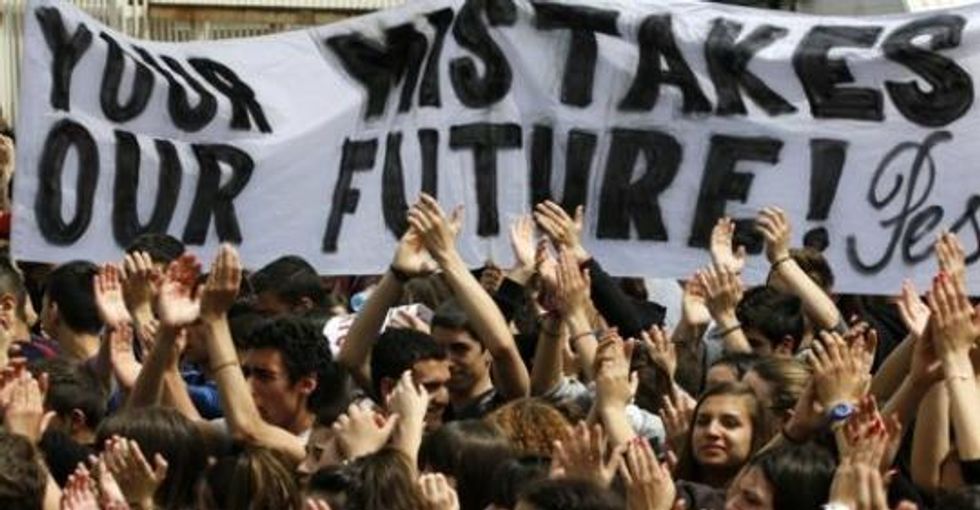
"Out with the troika", "Fuck the troika", "Go home Troika", said the placards. "No to the policies of austerity." "No to privatisations." "No to the memorandum of catastrophe."
As The Guardian's Helena Smith reports, what's happening in Cyprus is nothing less than "one of the biggest experiments in global financial history" and Cypriots--not the wealthy Russian's who use the island as an offshore bank--are set to be the victims in the ploy:
Waiting for poverty to strike is no game. It makes ordinary men and women helpless, desperate and scared. "If you look at it mathematically, there is no way out: we will just never be able to repay our bills to the EU and IMF," said Haris Christou, one young Cypriot speaking for his compatriots. "Am I afraid? Of course I am afraid. Everybody knows everything in Cyprus is going to get bad, really bad. And nobody knows where exactly we are headed."
On Wednesday night men and women, some young, some old, gave voice to that fear. They gathered outside the offices of the European commission, and then lined the road that leads up to Cyprus's colonial-era presidential palace, to protest against a rescue programme that, wittingly or not, will destroy their country's banking sector and bring its economy to its knees.
"Out with the troika", "Fuck the troika", "Go home Troika", said the placards. "No to the policies of austerity." "No to privatisations." "No to the memorandum of catastrophe."
And cross Europe, other countries living under threat from the Troika's austerity policies worry that the unprecedented levy on private deposits could soon be a tool foisted upon them.
As The Guardian reports:
With ink on the Cypriot bailout barely dry, the focus was turning to which countries might face the same fate, following Greece, Ireland, Portugal and Spain.
James Howat, European economist at Capital Economics, said: "Cyprus has shown that even the smallest members of the eurozone can rock the single currency area.
"Slovenia is probably the next country most likely to be forced into a bailout programme, but Malta and Luxembourg are also vulnerable given the size of their banking sectors relative to their economies.
"There is already evidence of market stress in Slovenia, with government bond yields rising from 4.5% to 6.5% over the last two weeks."
What it all proves in the end, writes analyst Richard Eskow at the Campaign for America's Future, is that the champions of austerity and the financial elite continue to call the shots on both sides of the Atlantic. The result, Eskow argues, is that the bankers invite the pain and the people pay the price.
Once again our austerity-minded financial leaders have placed the interests of the banking sector over those of the general population. The banks of Cyprus were managed recklessly. But, although one bank's being restructured into "toxic assets," policymakers have focused on bank customers - and on the people of Cyprus - rather than on the bankers who behaved badly.
In fact, they seem to have forgotten about the bankers - and about the international community's role in the crisis. The EU admitted Cyprus, banks and all. Billionaires and multinational corporations from around the world benefited from their Cyprus bank accounts. Bank malfeasance in the United States precipitated the global crisis which brought down Cyprus' economy.
But the burden's not being placed on bankers in the US, Western Europe, or even within Cyprus. There, as in the US, the motto seems to be "Rescue them and then pretend they don't exist."
______________________________________
From Reuters:
A Finance Ministry decree limited cash withdrawals to no more than 300 euros per day and banned the cashing of checks.
The island's central bank will review all commercial transactions over 5,000 euros and scrutinize transactions over 200,000 euros on an individual basis. People leaving Cyprus can take only 1,000 euros with them.
These unprecedented measures on individuals has all been done to secure a ten billion euro bailout package from the European Troika that has unleashed turmoil in Cyprus since it was first announced two weekends ago.
Though the restrictions are said to be short-term only, there is no guarantee that they'll be lifted anytime soon. As some Cypriots adjust to the "new normal" others spent the last week in public protest and loud calls have come from many quarters for the small island country to simply leave the Eurozone and reinstitute its own currency.
"Out with the troika", "Fuck the troika", "Go home Troika", said the placards. "No to the policies of austerity." "No to privatisations." "No to the memorandum of catastrophe."
As The Guardian's Helena Smith reports, what's happening in Cyprus is nothing less than "one of the biggest experiments in global financial history" and Cypriots--not the wealthy Russian's who use the island as an offshore bank--are set to be the victims in the ploy:
Waiting for poverty to strike is no game. It makes ordinary men and women helpless, desperate and scared. "If you look at it mathematically, there is no way out: we will just never be able to repay our bills to the EU and IMF," said Haris Christou, one young Cypriot speaking for his compatriots. "Am I afraid? Of course I am afraid. Everybody knows everything in Cyprus is going to get bad, really bad. And nobody knows where exactly we are headed."
On Wednesday night men and women, some young, some old, gave voice to that fear. They gathered outside the offices of the European commission, and then lined the road that leads up to Cyprus's colonial-era presidential palace, to protest against a rescue programme that, wittingly or not, will destroy their country's banking sector and bring its economy to its knees.
"Out with the troika", "Fuck the troika", "Go home Troika", said the placards. "No to the policies of austerity." "No to privatisations." "No to the memorandum of catastrophe."
And cross Europe, other countries living under threat from the Troika's austerity policies worry that the unprecedented levy on private deposits could soon be a tool foisted upon them.
As The Guardian reports:
With ink on the Cypriot bailout barely dry, the focus was turning to which countries might face the same fate, following Greece, Ireland, Portugal and Spain.
James Howat, European economist at Capital Economics, said: "Cyprus has shown that even the smallest members of the eurozone can rock the single currency area.
"Slovenia is probably the next country most likely to be forced into a bailout programme, but Malta and Luxembourg are also vulnerable given the size of their banking sectors relative to their economies.
"There is already evidence of market stress in Slovenia, with government bond yields rising from 4.5% to 6.5% over the last two weeks."
What it all proves in the end, writes analyst Richard Eskow at the Campaign for America's Future, is that the champions of austerity and the financial elite continue to call the shots on both sides of the Atlantic. The result, Eskow argues, is that the bankers invite the pain and the people pay the price.
Once again our austerity-minded financial leaders have placed the interests of the banking sector over those of the general population. The banks of Cyprus were managed recklessly. But, although one bank's being restructured into "toxic assets," policymakers have focused on bank customers - and on the people of Cyprus - rather than on the bankers who behaved badly.
In fact, they seem to have forgotten about the bankers - and about the international community's role in the crisis. The EU admitted Cyprus, banks and all. Billionaires and multinational corporations from around the world benefited from their Cyprus bank accounts. Bank malfeasance in the United States precipitated the global crisis which brought down Cyprus' economy.
But the burden's not being placed on bankers in the US, Western Europe, or even within Cyprus. There, as in the US, the motto seems to be "Rescue them and then pretend they don't exist."
______________________________________
From Reuters:
A Finance Ministry decree limited cash withdrawals to no more than 300 euros per day and banned the cashing of checks.
The island's central bank will review all commercial transactions over 5,000 euros and scrutinize transactions over 200,000 euros on an individual basis. People leaving Cyprus can take only 1,000 euros with them.
These unprecedented measures on individuals has all been done to secure a ten billion euro bailout package from the European Troika that has unleashed turmoil in Cyprus since it was first announced two weekends ago.
Though the restrictions are said to be short-term only, there is no guarantee that they'll be lifted anytime soon. As some Cypriots adjust to the "new normal" others spent the last week in public protest and loud calls have come from many quarters for the small island country to simply leave the Eurozone and reinstitute its own currency.
"Out with the troika", "Fuck the troika", "Go home Troika", said the placards. "No to the policies of austerity." "No to privatisations." "No to the memorandum of catastrophe."
As The Guardian's Helena Smith reports, what's happening in Cyprus is nothing less than "one of the biggest experiments in global financial history" and Cypriots--not the wealthy Russian's who use the island as an offshore bank--are set to be the victims in the ploy:
Waiting for poverty to strike is no game. It makes ordinary men and women helpless, desperate and scared. "If you look at it mathematically, there is no way out: we will just never be able to repay our bills to the EU and IMF," said Haris Christou, one young Cypriot speaking for his compatriots. "Am I afraid? Of course I am afraid. Everybody knows everything in Cyprus is going to get bad, really bad. And nobody knows where exactly we are headed."
On Wednesday night men and women, some young, some old, gave voice to that fear. They gathered outside the offices of the European commission, and then lined the road that leads up to Cyprus's colonial-era presidential palace, to protest against a rescue programme that, wittingly or not, will destroy their country's banking sector and bring its economy to its knees.
"Out with the troika", "Fuck the troika", "Go home Troika", said the placards. "No to the policies of austerity." "No to privatisations." "No to the memorandum of catastrophe."
And cross Europe, other countries living under threat from the Troika's austerity policies worry that the unprecedented levy on private deposits could soon be a tool foisted upon them.
As The Guardian reports:
With ink on the Cypriot bailout barely dry, the focus was turning to which countries might face the same fate, following Greece, Ireland, Portugal and Spain.
James Howat, European economist at Capital Economics, said: "Cyprus has shown that even the smallest members of the eurozone can rock the single currency area.
"Slovenia is probably the next country most likely to be forced into a bailout programme, but Malta and Luxembourg are also vulnerable given the size of their banking sectors relative to their economies.
"There is already evidence of market stress in Slovenia, with government bond yields rising from 4.5% to 6.5% over the last two weeks."
What it all proves in the end, writes analyst Richard Eskow at the Campaign for America's Future, is that the champions of austerity and the financial elite continue to call the shots on both sides of the Atlantic. The result, Eskow argues, is that the bankers invite the pain and the people pay the price.
Once again our austerity-minded financial leaders have placed the interests of the banking sector over those of the general population. The banks of Cyprus were managed recklessly. But, although one bank's being restructured into "toxic assets," policymakers have focused on bank customers - and on the people of Cyprus - rather than on the bankers who behaved badly.
In fact, they seem to have forgotten about the bankers - and about the international community's role in the crisis. The EU admitted Cyprus, banks and all. Billionaires and multinational corporations from around the world benefited from their Cyprus bank accounts. Bank malfeasance in the United States precipitated the global crisis which brought down Cyprus' economy.
But the burden's not being placed on bankers in the US, Western Europe, or even within Cyprus. There, as in the US, the motto seems to be "Rescue them and then pretend they don't exist."
______________________________________