
"We ask President (Barack) Obama to push for more guarantees for Colombian workers," Miguel Conde, with Sintrainagro, a union representing workers on palm-oil plantations, said at at press event held at AFL-CIO headquarters in Washington. "In Colombia, it is easier to form an armed group than a trade union... because we still have no guarantees from the government."
The U.S.-Colombia Free Trade Agreement (Colombia FTA) was originally negotiated by the George W. Bush administration. Colombia--a country that for decades has been the most dangerous place in the world for trade union organizers-- promsied to curtail the culture of murder and abuse, but human rights groups both inside and outside of Colombia warned against the deal. After several years, the US Congress ultimately approved the pact in October 2011, but only after the inclusion of a 37-point Labour Action Plan (LAP), designed to improving the conditions for Colombian workers and organizers.
The problem, according to activists interviewed by Al-Jazeera and a report recently released by the AFL-CIO, is that the protections are either not being implemented at all, or are insufficient to address the ongoing abuses.
"Though the LAP included some important measures that Colombian unions and the AFL-CIO have been demanding for years," reads the AFL-CIO's report (pdf), "its scope was too limited--it fully resolved neither the grave violations of union freedoms nor the continuing violence and threats against unionists and human rights defenders."
"What happened since [implementation] is a surge in reprisals against almost all of the trade unions and labour activists that really believed in the Labour Action Plan," Gimena Sanchez-Garzoli, a rights advocate at the Washington Office on Latin America (WOLA), a watchdog group, said at the report's launch.
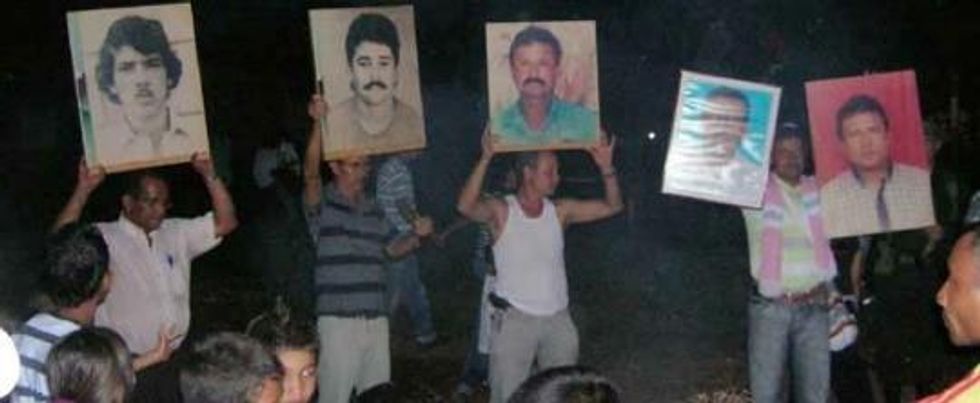
This included the April 27 killing of Daniel Aguirre, a labour leader who had helped to organise Colombia's sugarcane workers. According to Sanchez-Garzoli, 34 Colombian trade unionists have been killed since the LAP was implemented, including 11 this year alone.
"There is no reason to believe that top officials are not making sincere efforts to make a change," Celeste Drake, a trade policy expert with AFL-CIO, told Al-Jazeera.
"The problem is these changes cannot simply be made by people with good intentions at the top. It's a culture within the government and throughout Colombia that for years has tolerated, condoned, promoted intolerance to the exercise of worker rights."
# # #